December, 2026
Home › Budgeting for Wealth Growth › Spending Control & Expense Management › The 7-Day Spending Reset: A Day-by-Day Protocol
The 7-Day Spending Reset: A Day-by-Day Protocol
TL;DR
— The 7-day spending reset is a structured protocol that addresses the most common causes of spending drift in a single focused week — no deprivation required, just specific targeted actions each day.
— Each day has one primary task: the tasks are ordered so that structural changes happen before behavioral ones, and one-time actions happen before habit changes.
— The total active time is approximately four to six hours spread across seven days — most days require 20 to 45 minutes of focused work.
— The reset produces measurable results within the first 30 days: reduced monthly spending, restored savings contributions, and the structural habits that prevent the same drift from recurring.
— Day 1 is the hardest because it requires facing the numbers honestly — every subsequent day gets easier as actions produce visible progress.
— The reset works best when completed consecutively — spreading the actions over several weeks allows momentum to dissipate and reduces completion probability significantly.
Spending drift does not require a dramatic event to take hold. A few months of reduced attention, a busy period that broke the review habit, some accumulated subscriptions that slipped in during a trial period, and spending that gradually expanded across several categories — the result is a situation where financial outcomes have quietly deteriorated without any single obvious mistake. The numbers look different than they did six months ago, and the path back is not obvious.
The 7-day spending reset is designed to address the most common causes of moderate spending drift in a single structured week. It is not a period of restriction or deprivation — it is a week of specific structural actions that produce lasting financial improvement because they address root causes rather than symptoms. By the end of the seven days, leaks have been cancelled, transfers have been recalibrated, the environment has been adjusted to reduce spending triggers, and the maintenance habits are in place to prevent the same drift from recurring.
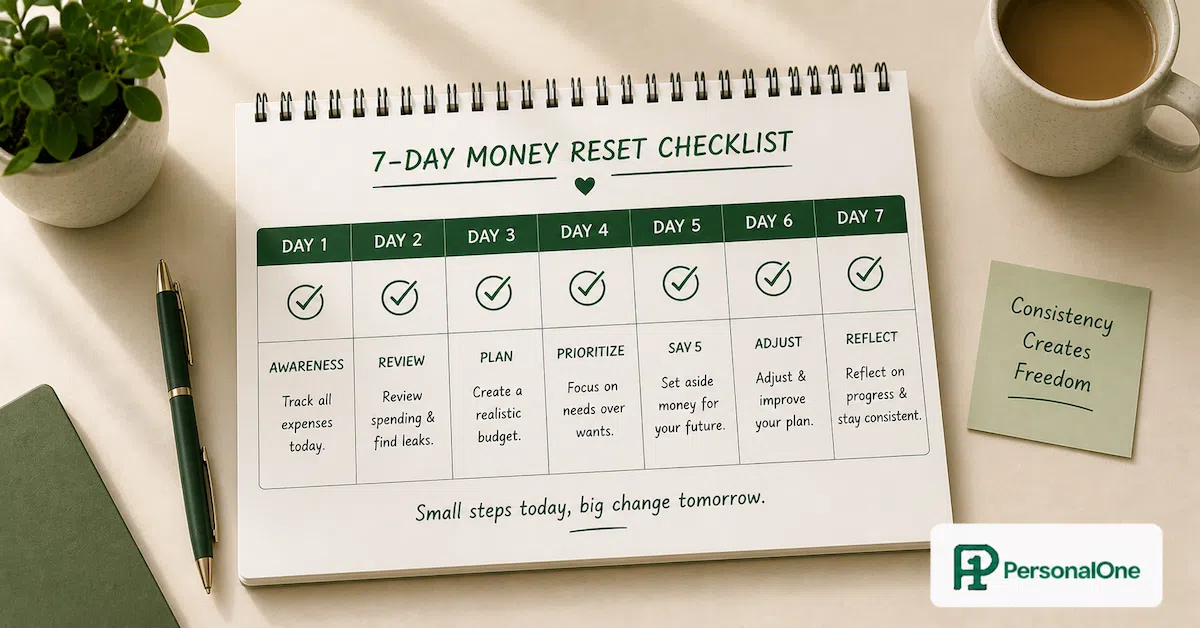
The protocol is specific and sequential. Complete each day's task before moving to the next. The ordering is deliberate: structural changes precede behavioral ones, one-time actions precede habit formation, and the diagnostic work that informs later decisions happens at the start. To fully stop overspending and take control of your spending at a structural level, the week's work needs to be completed fully, not partially.
Before You Start: What This Reset Is and Is Not
This reset is: A structured week of specific, concrete actions that address the structural causes of spending drift. It includes a spending assessment, a leak audit and cancellation session, account recalibration, environmental adjustments, and maintenance habit setup. Each day has a defined task with a defined outcome.
This reset is not: A restriction period where you spend nothing or drastically reduce spending across all categories for seven days. It is not a budget-building exercise that requires detailed category tracking indefinitely afterward. It is not a motivational program that depends on enthusiasm being sustained. It is a structural fix that produces outcomes independent of motivation.
Who it works best for: People whose spending has drifted moderately from a previously working system — where subscriptions have accumulated, savings contributions have slowed, and spending is running higher than intended without obvious large-purchase explanations. For more severe financial situations that include significant debt, income instability, or substantial life changes, the longer reset process in the full spending reset guide provides a more comprehensive framework. For the complete multi-week version, see how to reset your spending when things have gone significantly off track.
Day 1: The Honest Assessment (45 minutes)
What you are doing: Building an accurate picture of where your money has actually been going over the past three months, so every subsequent action is based on reality rather than assumption.
How to do it: Download or access the last three months of statements from every account you use: primary checking, secondary accounts, and every credit card. Go through each statement and total spending by broad category: housing and utilities, food (groceries + restaurants + delivery), transportation, subscriptions and memberships, shopping, and other. Create a simple table with one column per month and one row per category.
What to look for: Categories where spending increased month over month without an obvious explanation. Categories where monthly totals are significantly higher than your intuitive estimate. Recurring charges that appear in all three months that you had not mentally included as regular expenses. One-time charges in one month that may recur annually — these need to be identified for the irregular expense allocation calculation.
What to produce: A simple three-month spending summary that tells you specifically where the drift has occurred and by approximately how much. This document informs every subsequent day's work. If you have not done this before and do not know exactly where your money has been going, Day 1 may take longer than 45 minutes and is worth the additional time. Every other day's decisions depend on the accuracy of this foundation.
Day 1 Completion Criteria
You have a three-month spending summary by broad category. You have identified at least three specific areas where spending has increased beyond what you consider appropriate for your financial situation. You have a list of every recurring charge across all accounts and cards. You are done for today.
Day 2: The Leak Audit and Cancellation Session (60 minutes)
What you are doing: Going through every recurring charge identified yesterday and cancelling everything that is not actively providing proportionate value.
How to do it: For each recurring charge on your list, apply three tests: Do you actively use it at least monthly? Does it provide value proportionate to its monthly cost? Would you sign up for this today at this price if you were not already paying for it? Any charge that fails two or more of these tests gets cancelled today, not deferred.
The cancellation rule: Cancel the same day. Do not say "I'll cancel at the end of the month" or "I'll give it one more week." Cancel now. Most services continue through the end of the paid period regardless of when you cancel, so you lose nothing. The inertia that allowed the subscription to accumulate will allow the deferral to result in no cancellation. Same-day cancellation is the only rule that reliably works.
For services that make cancellation difficult: Budget the time. A 20-minute phone call to cancel a $30 per month service saves $360 per year — an effective hourly rate that makes the call worth making regardless of how inconvenient the process is designed to be. Work through the difficult cancellations first while your energy is highest.
Day 2 Completion Criteria
Every recurring charge that failed the three-test evaluation has been cancelled, with a confirmation email or cancellation number recorded. You know the exact monthly amount freed up by today's cancellations. You are done for today.
Day 3: Account Recalibration (30 minutes)
What you are doing: Updating your automated transfers to reflect your actual current financial situation — incorporating the subscriptions cancelled yesterday, any changes in fixed obligations since the last calibration, and the savings rate you want to restore or establish.
How to do it: Total your current genuine monthly fixed obligations: rent or mortgage, insurance, utilities base rates, loan minimums, and the subscriptions that survived yesterday's audit. Add a 10 percent buffer. This is the bills account transfer amount.
Decide your target monthly savings contribution. If you were saving consistently before the drift period, restore to that level. If you were not saving consistently, choose a starting amount that is achievable given your current income and fixed obligations — undershooting and sustaining is better than overshooting and abandoning. This is the savings transfer amount.
The spending account transfer is what remains: monthly take-home income minus bills account transfer minus savings transfer. This number is your sustainable monthly discretionary spending allocation. If it feels insufficient, that is important information — either fixed obligations need to be reduced (structural work over the coming months) or income needs to increase. The number tells you the truth; acting on false numbers produces the drift you are resetting from.
Log into your primary bank and update all three automated transfers. Apply them starting with the next payday. Do not wait for a "natural" restart date — the next payday is the right date.
Day 3 Completion Criteria
All three automated transfers — bills, savings, spending — have been updated in your banking system to take effect on the next payday. You know the exact spending account balance you will start each pay period with going forward. You are done for today.
Day 4: Environmental Adjustments (45 minutes)
What you are doing: Reducing the frequency of purchase triggers in your daily environment — one-time changes that produce ongoing reductions in impulse spending without requiring any ongoing willpower to maintain.
Email unsubscribe session (20 minutes): Search your inbox for "unsubscribe," "opt out," and "promotional." Unsubscribe from every retail, restaurant, and service promotional email list. These emails are purchase stimuli that initiate shopping sessions you did not choose to have. Removing them removes a significant share of impulse purchase opportunities at the source. Set an email filter to catch any that slip through during the unsubscribe process.
Phone environment cleanup (15 minutes): Delete shopping apps you use for impulse browsing rather than intentional purchasing. For apps you want to keep, move them from the home screen to a secondary folder. Remove saved payment information from all browsers and shopping accounts. Each of these changes adds a specific friction step between impulse and purchase — individually minor, collectively significant.
Low-balance alert setup (10 minutes): Set a push notification on your spending account to fire when the balance drops below 35 percent of your per-period transfer amount. This single alert replaces daily active monitoring: the alert fires when you need to know, and silence means you are on track. Enable push notifications for all transactions on your spending account so every charge registers as it posts.
Day 4 Completion Criteria
You have unsubscribed from all retail promotional emails. Shopping apps have been relocated or deleted. Saved payment information has been removed from all browsers. Low-balance and transaction alerts are active on the spending account. You are done for today.
Day 5: Food System Reset (60 minutes)
What you are doing: Rebuilding the meal planning habit that eliminates the "nothing to eat" situations that drive the expensive delivery and restaurant spending that is often the largest variable category in spending drift.
How to do it: Plan meals for the next seven days. Five dinners, five work lunches, and breakfast options. For each meal, list the specific ingredients needed. Cross-reference against what is already in the house. Create a shopping list for only what is missing.
Do the grocery shop today. Buy the list, nothing else beyond genuine incidentals. The total grocery spend for a single adult on a thoughtful weekly plan is typically $60 to $120 depending on location and dietary choices — significantly less than the accumulated cost of several delivery orders and restaurant meals that an unplanned week produces.
The meal planning habit itself is more valuable than any specific week's plan. The habit eliminates the decision "what will I eat tonight?" from occurring at 7pm when you are hungry, tired, and most likely to choose delivery. A decision made at the grocery store on a full stomach is a different decision than one made when hungry at the end of a long day.
Day 5 Completion Criteria
You have a seven-day meal plan and a stocked refrigerator and pantry. The grocery trip is complete. You have set a recurring calendar reminder for Sunday meal planning each week going forward. You are done for today.
Day 6: Maintenance Habit Setup (20 minutes)
What you are doing: Installing the two maintenance habits that prevent drift from re-accumulating after the reset — the daily balance check and the weekly 10-minute review.
Daily balance check habit: Identify an existing daily routine to attach this habit to. Morning coffee preparation, opening the phone after waking, commute start — any reliable daily anchor works. The habit is: after the anchor activity, open the spending account and note the balance. Thirty seconds. No logging. Just awareness. Set this up today by opening the spending account app immediately after the anchor activity for the first time, establishing the sequence that will become automatic over the next 30 days.
Weekly review habit: Schedule a recurring 10-minute appointment in your calendar for the same day and time each week. Label it "Spending Review." The review covers: spending account balance check, transaction scan for unusual or unrecognized charges, and forward projection of whether the remaining balance covers anticipated expenses for the rest of the pay period. If the projection shows a potential shortfall, identify one specific adjustment. If the projection is fine, close the app. Done.
Annual review reminder: Set a calendar reminder twelve months from today for a full subscription audit and account transfer recalibration. This is the maintenance action that prevents the same drift from accumulating undetected over the following year.
Day 6 Completion Criteria
The daily balance check habit has been attached to a specific existing routine. The weekly review is in the calendar as a recurring appointment. The annual review reminder is set. You are done for today.
Day 7: The Forward Plan and Reset Completion (30 minutes)
What you are doing: Confirming the reset is complete, documenting the changes made, and establishing the specific financial goals the reset is now enabling.
Document the reset outcomes: Record what was cancelled and the monthly savings produced. Record the new transfer amounts and how they compare to previous ones. Record the specific categories where spending drift occurred and the structural changes made to address them. This documentation serves two purposes: it confirms that the reset actions are in place, and it provides a baseline that makes drift visible if it recurs.
Set one specific financial goal for the next 90 days: The freed-up money from cancelled subscriptions and recalibrated transfers needs a destination. Without a specific destination, it will be absorbed into general spending within 60 days. Identify one specific goal: build the emergency fund to a target level, eliminate one specific debt, reach a savings milestone. The goal gives the reset outcomes a purpose beyond the immediate financial improvement.
Schedule the 30-day check-in: Set a calendar reminder 30 days from today to review whether the reset changes are holding. Check the savings transfer, confirm the weekly review habit is running, verify no new subscriptions have accumulated. The 30-day check-in is not a repeat of the full reset — it is a 15-minute confirmation that the structure is operating as intended.
Day 7 Completion Criteria — Reset Complete
✓ Spending assessment completed with three-month category breakdown
✓ All failing subscriptions cancelled with confirmations recorded
✓ All three account transfers recalibrated to current reality
✓ Environmental adjustments made (email, apps, saved cards, alerts)
✓ Meal plan complete and groceries purchased
✓ Daily balance check habit installed, weekly review in calendar
✓ Reset outcomes documented, 90-day goal set, 30-day check-in scheduled
What to Expect in the 30 Days After the Reset
The first week after the reset typically feels noticeably different because the spending account transfer has been recalibrated and the daily balance check is providing real-time awareness that was absent before. The balance visible at the start of each day changes behavior in subtle ways — not through restriction, but through the awareness that makes deliberate choices possible where previously spending happened automatically.
By week two, the meal planning habit begins to produce its behavioral impact: fewer unplanned meals, reduced delivery order frequency, and a stocked kitchen that makes cooking the path of least resistance rather than the inconvenient alternative to delivery. The food spending decline is typically visible by mid-month in the spending account balance.
By week three, the environmental changes begin to register. Fewer promotional emails means fewer impulse shopping sessions. Shopping apps off the home screen means fewer idle browsing-to-purchasing conversions. The absence of saved payment information means each purchase requires slightly more deliberate action. Collectively these produce a reduction in the frequency and ease of unplanned purchases that compounds throughout the month.
By month end, most people who complete the reset in full find that their spending account has more remaining balance than it did before the reset, their savings transfer has executed, and they have not experienced the spending as meaningfully restricted. The savings came from waste elimination, not from reduced quality of life. Understanding why structure produces outcomes that willpower cannot makes this result less surprising: the reset changed the system that produces spending decisions, not the level of self-control applied to an unchanged system.
Frequently Asked Questions
What if I cannot complete all seven days consecutively?
Complete as many consecutive days as possible and then finish the remaining days without a gap longer than two days. The consecutive format is recommended because it maintains momentum through the portion of the reset (Days 1 and 2) that requires confronting uncomfortable numbers — momentum that carries through the subsequent structural changes. Gaps between days allow the discomfort to produce avoidance. If you must pause, pause after Day 3 (structural changes complete) rather than before.
My spending drift is severe, not moderate. Is this the right approach?
The 7-day protocol addresses moderate drift. If your spending has significantly outpaced income for multiple months, if debt has been accumulating, or if the situation involves financial hardship rather than drift, the more comprehensive spending reset process is the right starting point. The 7-day protocol is a recalibration tool for a working system that has lost its calibration, not a crisis intervention for a system that never worked.
How much will I actually save from the reset?
It varies significantly based on how much has accumulated and what the assessment reveals. The most consistent finding is $75 to $200 per month in reduced spending from the subscription cancellations and food spending changes alone, with additional savings from reduced impulse purchasing as the environmental changes take effect over the following 30 to 60 days. The more recent your last systematic review, the less accumulated waste there is to find — which is an argument for the annual review habit rather than waiting until drift requires a full reset.
Seven days. One complete structural reset. Lasting results.
The Budgeting for Wealth Growth hub covers the complete spending control framework — the structural systems, automation, and habits that keep your finances on track without requiring the kind of sustained effort that a spending reset should not have to be repeated.
Explore the Budgeting Hub →Resources
CFPB — Spending Tracker and Budget Tools
FDIC — Money Smart Financial Education
CFPB — Setting and Tracking Financial Goals
This article is part of the Budgeting for Wealth Growth hub on PersonalOne — a complete framework for building spending awareness and structural control that makes financial progress automatic.
Disclaimer: This content is for educational purposes only and does not constitute financial advice. The spending reset protocol described here is a general framework — results vary based on individual financial situations, spending patterns, and how thoroughly each step is completed. Adjust the process to reflect your specific circumstances.