October, 2026
Home › Budgeting for Wealth Growth › Spending Control & Expense Management › Where Your Money Is Really Going Each Month
Where Your Money Is Really Going Each Month
TL;DR
— Most people are off by 30 to 40 percent when they estimate their own monthly spending — the gap between what you think you spend and what you actually spend is where budget plans collapse.
— The biggest surprises are almost never in the obvious categories — they are in subscriptions, small recurring charges, and irregular expenses that do not feel like spending in the moment.
— A one-time 30-minute statement audit reveals more about your spending patterns than months of daily tracking.
— Understanding where your money goes is the prerequisite for every other spending decision — you cannot control what you cannot see.
— The goal is not to feel guilty about past spending — it is to get accurate data so future decisions are made on reality, not assumption.
Ask most people where their money goes each month and they will give you an answer. Rent, car payment, groceries, utilities. Maybe a streaming service or two. The number they arrive at is usually several hundred dollars short of what actually left their account last month.
This is not dishonesty. It is the natural result of how money moves through a modern life — dozens of small transactions, automatic charges, annual renewals, and one-off purchases that feel too minor to remember but add up to a number that would surprise you. The version of your spending that lives in your head is a rough sketch. The version in your bank statements is the complete picture.
You cannot fix a spending problem you cannot see, and you cannot understand your spending patterns without looking at the actual data. This article covers how to find where your money is really going — without spending weeks logging transactions — and what to do with that information once you have it. The foundation of spending control and expense management is not discipline. It is visibility. You need to see the full picture before any system can help you change it.
Why Your Mental Model of Spending Is Wrong
Human memory is optimized for significance, not frequency. You remember the big purchase — the new laptop, the vacation deposit, the car repair. You do not remember the seventeen small purchases that happened between them. A $6 coffee three times a week is $936 per year, but it never appears in your mental summary of monthly spending because no single transaction felt meaningful enough to store.
Recurring charges make this worse. A subscription you signed up for two years ago is fully automated — the money leaves before you ever think about whether you still want the service. It does not feel like a decision because you are not making one each month. But the charge is real, it recurs indefinitely, and it has no natural stopping point unless you actively cancel it. These are precisely the hidden expenses that drain budgets without ever registering as conscious spending decisions.
Annual and irregular charges are the hardest category to track mentally. Car registration, insurance renewals, quarterly subscriptions, professional memberships — these arrive once, feel like one-time events, and never make it into your monthly mental accounting. But when you divide them by 12, they represent a real and predictable monthly obligation that your spending estimate has completely ignored.
The Three Categories Your Mental Model Misses
Small recurring purchases: Coffee, lunches, convenience store stops. Individual amounts too small to remember, collective impact significant.
Automated subscriptions: Streaming, software, membership services. Invisible because the decision was made once, not monthly.
Irregular but predictable expenses: Annual fees, quarterly charges, seasonal spending. Absent from monthly estimates but real when averaged across the year.
The 30-Minute Statement Audit
You do not need a budget app, a spreadsheet, or weeks of transaction logging to understand where your money goes. You need three months of bank and credit card statements and 30 minutes. That is enough to identify every recurring charge, every spending category, and every surprise that does not match your mental model.
The Audit Process
Step 1 — Download three months of statements. Pull the last three months from every account you actively use — primary checking, secondary accounts, and every credit card. Three months captures irregular expenses better than one and smooths out unusually high or low months.
Step 2 — Highlight every recurring charge. Go through each statement and mark any charge that appeared more than once across the three months. These are your subscriptions, membership fees, and automatic payments. List each one with the monthly amount.
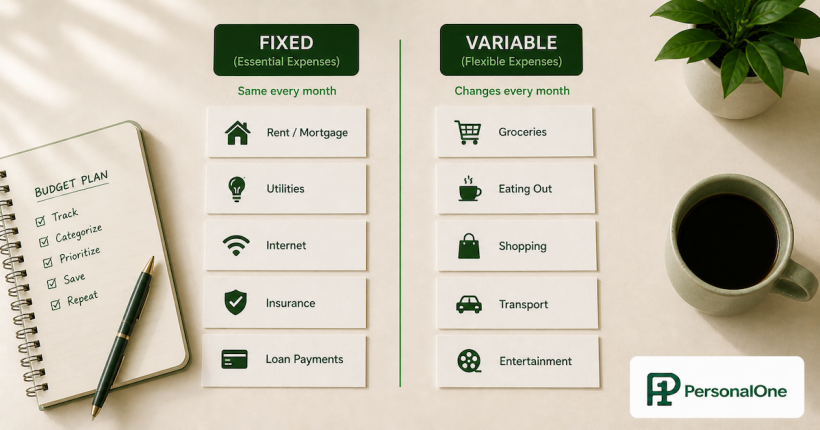
Step 3 — Total spending by broad category. Do not log every transaction. Add up totals for: fixed bills (rent, utilities, insurance, car payment), groceries, restaurants and takeout, entertainment, shopping, and everything else. Rough totals are sufficient — you are looking for patterns, not precision.
Step 4 — Calculate monthly averages. Divide three-month totals by three. This is your actual average monthly spending in each category, including the irregular expenses that would not appear in a single-month snapshot.
Step 5 — Compare to your estimate. Write down what you thought you were spending before you started. Compare. The difference between your estimate and the actual figure is the visibility gap that every spending system has to close before it can work.
What You Will Find
The audit almost always surfaces the same categories of surprise. Knowing what to look for makes the process faster and the findings easier to interpret.
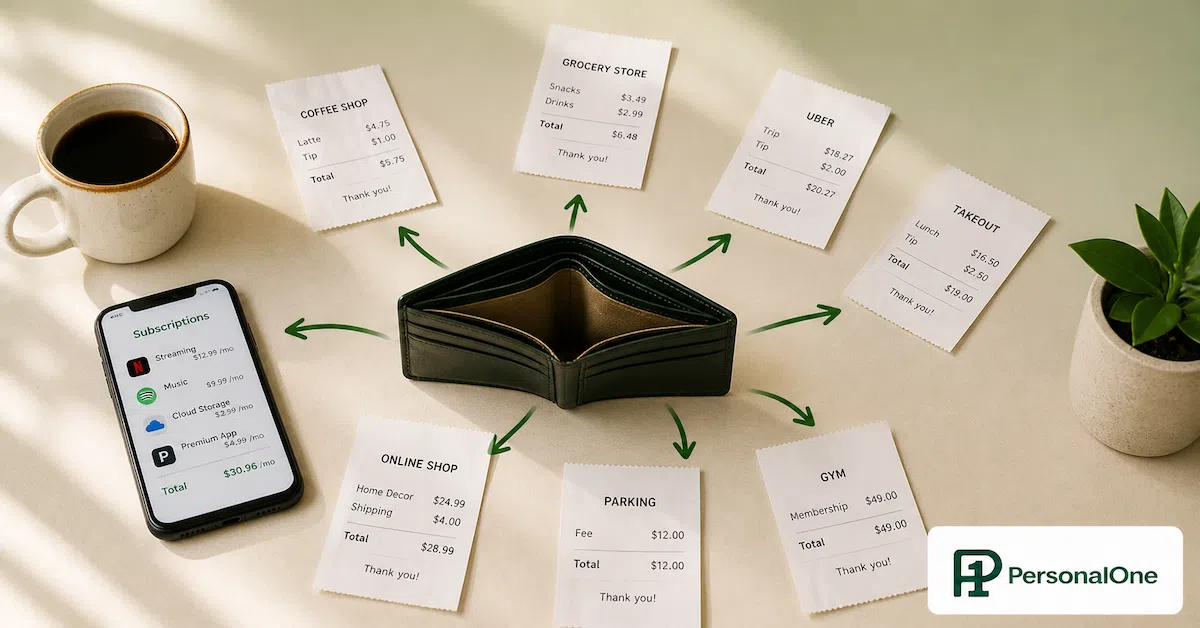
Subscriptions you forgot you had. The average person has 3 to 5 subscriptions they no longer actively use. A fitness app from a New Year's resolution. A streaming service that duplicates one you actually use. A software subscription that stopped being useful six months ago. Each one is small. Together they represent $20 to $80 per month in autopilot spending.
Food spending significantly higher than expected. Most people underestimate food spending by 30 to 50 percent. Groceries feel like a necessity and get properly estimated. Restaurants, takeout, delivery apps, and coffee purchases are treated as individual events and never totaled mentally. When you add them all up, the combined food spending number is usually the biggest surprise in the audit.
Convenience spending that accumulates invisibly. Gas station purchases, pharmacy runs for non-essential items, Amazon impulse buys, convenience fees on event tickets. None of these feel like a category. All of them add up to a meaningful monthly number when you see them aggregated.
Annual expenses that distort specific months. If one of your three audit months included a car insurance renewal, a professional association fee, or holiday spending, that month will look dramatically higher than the others. Identifying these irregular charges and dividing them by 12 gives you their true monthly cost and prevents you from treating them as one-time surprises when they recur next year.
Understanding Your Spending Patterns
The audit gives you data. Understanding your spending patterns requires interpreting that data in context. The same monthly total means different things depending on what is driving it.
Fixed vs. variable spending ratio. If more than 60 percent of your spending is fixed — locked-in bills and recurring charges you cannot easily change — your flexibility to adjust spending is limited. The lever is either income or negotiating fixed costs down. If most spending is variable, you have more immediate control but also more exposure to drift. Knowing which situation you are in directs where to focus first.
Discretionary vs. necessary spending. Within each category, some spending is necessary (groceries for actual meals) and some is discretionary (restaurants, delivery fees, premium brand choices at the grocery store). The audit does not automatically separate these — that requires a second look at the category totals with the question: what portion of this was a choice vs. a requirement?
Trend direction matters more than current level. A single month's data tells you where you are. Three months of data tells you which direction you are heading. If restaurant spending went from $280 to $340 to $420 over three months, the absolute number matters less than the trajectory. Identifying a category that is trending up lets you address the pattern before it compounds further. This is how you track where your money goes in a way that is actually useful — not as a punishment, but as a navigation tool.
What to Do With What You Find
The audit is the diagnosis. What follows is triage — deciding which findings require immediate action, which to monitor, and which are simply accurate reflections of intentional choices.
Act immediately on forgotten subscriptions. Any recurring charge for a service you do not actively use should be cancelled within 24 hours of finding it. Not reviewed for later cancellation — cancelled. The friction of leaving it creates inertia, and inertia means the charge continues. A cancelled subscription that you later regret can be restarted; the money spent while you thought about it is gone.
Flag but do not immediately cut categories that surprised you. If your restaurant spending is significantly higher than you thought, that is useful information. It does not automatically mean the number is wrong for your life. Evaluate whether the spending reflects actual value you received — meals you enjoyed, time saved, social connection — or whether it is primarily driven by convenience and habit. The answer determines the right response.
Build irregular expenses into your monthly planning. Every irregular expense you identified in the audit — annual fees, quarterly renewals, seasonal spending — now has a monthly average. That average belongs in your spending plan as a fixed monthly number, not treated as a surprise when it arrives. This alone closes one of the most common gaps between budget plans and reality.
Once you have an accurate picture of where your money goes, the next step is building the structural system that makes the right behavior automatic. Understanding your spending patterns is the starting point. The reason most budgets fail is not that people spend too much — it is that they try to change behavior without changing the structure that produces it.
Frequently Asked Questions
Do I really need three months of statements, or will one month work?
One month gives you a snapshot. Three months gives you a pattern. A single month may be unusually high (a month with a car repair, a big purchase, or holiday spending) or unusually low (a month where you happened to stay in and cook more). Three months smooths these variations and captures the irregular expenses that appear quarterly or annually. It takes the same amount of time to do and produces significantly more reliable data.
What if I use cash frequently? How do I account for that?
Look at ATM withdrawals on your statements and treat those as cash spending. If you withdraw $200 at an ATM, that $200 went somewhere — log it in the miscellaneous or discretionary category unless you specifically remember what it was for. People who use cash frequently tend to underestimate their total spending even more than card users because cash feels less real at the point of spending.
Should I include my partner's spending in the audit?
If you manage finances jointly, yes. Pull statements from all shared accounts and any individual accounts that draw from shared income. The goal is to understand total household cash flow, not just your individual spending. If finances are separate, audit your own accounts first and share the process with your partner so they can do their own.
I found a lot of surprising numbers. Where do I start making changes?
Start with the easiest wins: cancel unused subscriptions and recurring charges that provide no current value. These require no lifestyle change and produce immediate results. Then identify the one or two categories where your actual spending most significantly exceeds both your estimate and what you would consider reasonable. Address one category at a time rather than trying to overhaul everything simultaneously.
Seeing where your money goes is the first step. Controlling it is the system.
The complete Budgeting for Wealth Growth framework covers how to build spending control that runs automatically — so the right financial behavior becomes the default, not the exception.
Explore the Budgeting Hub →Resources
CFPB — Spending Tracker and Budget Tools
FDIC — Money Smart Financial Education
This article is part of the Budgeting for Wealth Growth hub on PersonalOne — a complete framework for building the spending awareness and structural control that makes financial progress automatic.
Disclaimer: This content is for educational purposes only and does not constitute financial advice. Individual spending patterns vary based on income, location, household size, and personal circumstances. The audit process described here is a general framework — adjust it to reflect your specific financial situation.