October, 2026
Home › Budgeting for Wealth Growth › Spending Control & Expense Management › Fixed vs Variable Expenses (And Why It Matters)
Fixed vs Variable Expenses (And Why It Matters)
TL;DR
— Fixed expenses are locked in by contract or commitment — they do not change based on daily behavior and can only be reduced through structural decisions like renegotiating, refinancing, or cancelling.
— Variable expenses change based on daily choices — they respond immediately to behavior change and give you real-time control over your spending.
— Most people apply the wrong strategy to each type: trying to control fixed expenses with daily discipline (impossible) and negotiating variable expenses when they should just choose differently (unnecessary complexity).
— The category something belongs to determines what lever to pull — structural decisions for fixed, behavioral choices for variable.
— A high fixed-to-variable expense ratio limits your flexibility — if most of your income is locked into fixed obligations, behavioral change cannot meaningfully improve your financial situation.
— Most people underestimate their fixed costs because they forget irregular charges: annual insurance renewals, quarterly subscriptions, semi-annual fees that do not appear in a single month's review.
Understanding the difference between fixed and variable expenses is not a budgeting technicality. It is the prerequisite for knowing which financial problems you can solve today with behavior change and which require structural decisions that take longer to implement. Applying the wrong approach — trying to manage a fixed expense with daily discipline, or treating a variable expense like a locked-in obligation — produces frustration without improvement because the lever being pulled does not connect to the problem being addressed.
The category an expense belongs to tells you everything about what kind of action will actually move the number. To manage your expenses effectively, you need to know not just what you are spending, but which category each expense lives in — because the category determines the strategy, and the strategy determines whether your effort produces results or just produces effort.
Fixed Expenses: What They Are and How They Work
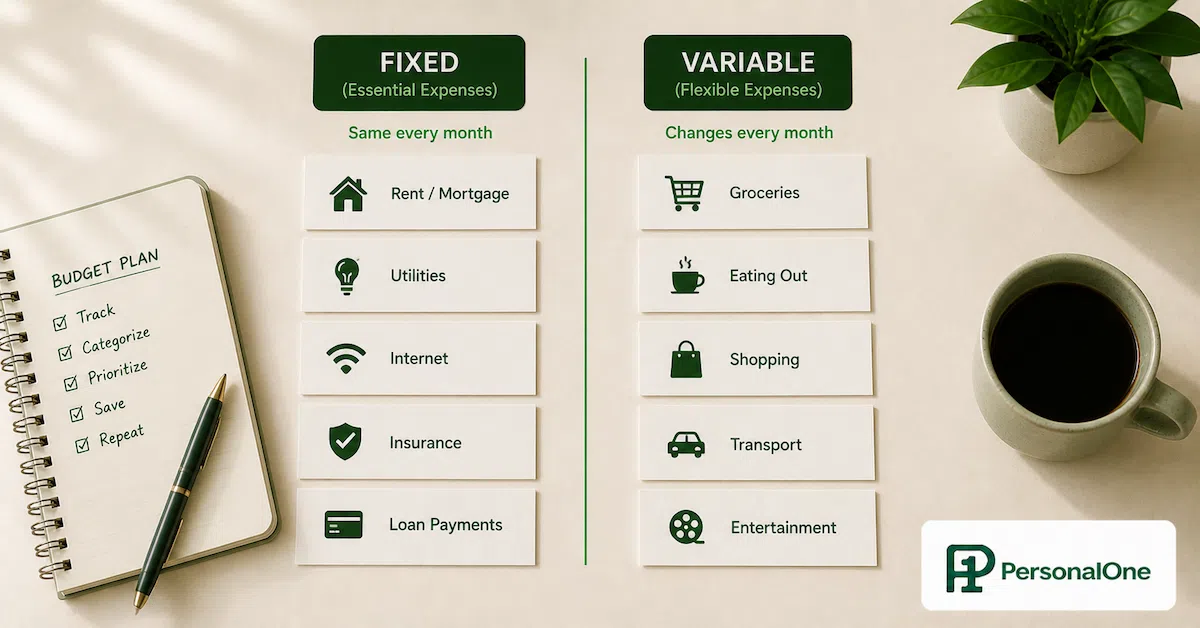
A fixed expense is a cost that recurs at a consistent amount on a predictable schedule, independent of your behavior during the period. The key characteristic is that daily choices do not change the amount. Whether you ate at home every night this month or went out every single day, your rent is the same. Whether you drove 200 miles or parked the car for two weeks, your car insurance premium is unchanged. Fixed expenses are locked in by contract, commitment, or ongoing service agreement.
Common fixed expenses include rent or mortgage payment, car payment, insurance premiums (auto, health, renters, homeowners, life), student loan minimum payments, fixed subscription services, internet service, phone plan, and any debt minimum payment with a fixed monthly amount. These expenses arrive reliably, for the same amount, regardless of anything you do between billing cycles.
Because fixed expenses are locked in by contract or commitment, the only way to reduce them is through structural decisions: renegotiating a contract, refinancing a loan at a lower rate, moving to a less expensive location, downgrading a service plan, cancelling a subscription, or eliminating the underlying commitment entirely. These changes require deliberate effort, often involve friction or inconvenience, and may take time to implement. But the savings they produce are permanent — a $150 reduction in a monthly car insurance premium saves $1,800 per year automatically, every year, with no ongoing behavior required to maintain the savings.
Common Fixed Expenses by Category
Housing: Rent, mortgage payment, HOA fees, renter's insurance or homeowner's insurance premium
Transportation: Car payment, auto insurance, parking permits, public transit pass
Debt service: Student loan minimums, personal loan payments, credit card minimums
Utilities (base rates): Internet, phone plan base cost, streaming and software subscriptions at fixed monthly tiers
Insurance: Health insurance premiums, life insurance premiums, disability insurance
Variable Expenses: What They Are and How They Work
A variable expense changes based on the choices you make each period. The amount you spend on groceries, gas, dining out, clothing, entertainment, personal care, and household supplies varies month to month based on decisions you make daily — what you buy, where you shop, how frequently you use a service, how much you consume. Variable expenses respond directly and immediately to behavior change, which is both their vulnerability (they drift upward easily) and their flexibility (they can be reduced quickly).
The distinction sounds clear in theory but blurs in practice. Some expenses that feel variable are actually semi-fixed: your electricity bill varies but within a predictable range, and large swings are unusual. Your grocery spending varies but certain baseline items recur reliably. True impulse purchases are fully variable. The base cost of feeding yourself each month is semi-fixed. Both require different thinking about management.
Because variable expenses are directly controlled by behavior, the lever for changing them is different from fixed expenses. You do not negotiate a contract or refinance a loan. You make different choices: buying a store brand instead of a name brand, cooking at home instead of ordering delivery, choosing a less expensive entertainment option. The changes happen immediately and cost you nothing in terms of friction or transition — but they also require ongoing behavioral consistency rather than a single structural decision that then runs automatically.
Common Variable Expenses by Category
Food: Groceries, restaurants, coffee shops, delivery apps, work lunches
Transportation: Gas (usage-dependent), rideshare, parking (non-permit)
Entertainment and leisure: Movies, concerts, hobbies, recreational activities
Shopping: Clothing, home goods, personal care items, electronics
Health and wellness: Prescriptions (variable co-pays), gym classes, wellness products
The Irregular Expense Category Most People Ignore
There is a third category that does not fit cleanly into either fixed or variable: irregular but predictable expenses. These are costs that occur on a cycle longer than monthly — annually, semi-annually, or quarterly — and that you know are coming but fail to plan for because they do not appear in a typical monthly review.
Car registration. Annual insurance renewal (separate from the monthly premium). Professional association memberships. Quarterly subscriptions. Holiday spending. Back-to-school shopping. Home maintenance costs that recur seasonally. These expenses arrive on a predictable schedule and for a somewhat predictable amount, but because they do not appear every month, they feel like surprises when they arrive. A budget that does not account for irregular expenses is a budget that will be violated by expenses that were entirely foreseeable.
The correct treatment is to convert irregular expenses into a monthly number by dividing their annual total by twelve. A $360 annual car registration is $30 per month. A $600 holiday spending budget is $50 per month. A $240 professional membership renewal is $20 per month. Adding all irregular expenses and dividing by twelve gives you a monthly allocation that, when set aside automatically, means the cash exists when the irregular expense arrives rather than requiring you to scramble.
How to Calculate Your Irregular Expense Allocation
Step 1: List every expense you paid in the last 12 months that did not appear as a regular monthly charge. Include all annual renewals, quarterly fees, and seasonal spending.
Step 2: Total them. This is your annual irregular expense burden.
Step 3: Divide by 12. This is your monthly irregular expense allocation — the amount that needs to be set aside each month to have the cash available when these expenses arrive.
Step 4: Automate a monthly transfer of this amount into a dedicated sinking fund account. When the expense arrives, the money is waiting rather than requiring you to find it from elsewhere.
Why the Category Determines the Strategy
The most common expense management mistake is applying the wrong tool to the wrong expense type. When you try to manage a fixed expense through behavioral discipline — "I need to spend less on rent this month" — you are pulling a lever that is not connected to anything. Rent does not change based on your daily discipline. The only way rent changes is if you renegotiate your lease, find a roommate, or move. Recognizing it as a fixed expense tells you immediately that the only productive action is structural.
The reverse error is equally common: treating variable expenses as if they are as locked-in as fixed ones. "I have to spend this much on groceries" converts a flexible expense into a psychological fixed one. Most variable spending has meaningful flexibility if you are willing to examine the choices producing it — brand preferences, frequency of dining out, convenience premiums, shopping habits. Recognizing variable expenses as controllable through daily choices tells you that behavioral change is a viable and direct lever.
The table below shows which action to take based on which category the expense falls into:
| Expense Type | Responds To | How to Reduce | Timeline |
|---|---|---|---|
| Fixed | Structural decisions | Negotiate, refinance, cancel, downgrade, relocate | Days to months to implement; permanent once done |
| Variable | Behavioral choices | Choose differently, reduce frequency, shop differently | Immediate effect; requires ongoing consistency |
| Irregular | Planning and automation | Convert to monthly allocation, automate sinking fund | Eliminates surprise; does not reduce the total cost |
Why Your Fixed-to-Variable Ratio Matters
The ratio of fixed to variable expenses in your monthly spending determines how much flexibility you have to respond to income changes, financial goals, or unexpected events. If 75 percent of your take-home income goes to fixed obligations before you spend a dollar on variable expenses, your options are severely limited. A period of reduced income becomes an immediate crisis because your fixed costs do not reduce when your income does. Cutting variable expenses — eating out less, buying fewer clothes — cannot produce meaningful cash flow relief when variable expenses are only 25 percent of income to begin with.
This is why high fixed cost loads are a structural problem, not a spending discipline problem. The common advice to "spend less on restaurants" or "cut the coffee habit" cannot meaningfully improve a financial situation where 70 to 80 percent of income is locked into contracts and commitments before discretionary spending begins. In that situation, the high-leverage action is reducing the fixed cost load — even one or two significant structural changes can free up more money than years of variable expense discipline.
Conversely, if your fixed expenses are low relative to income — say, 40 to 50 percent — you have significant flexibility. The same income reduction that would be a crisis at 75 percent fixed is stressful but manageable at 45 percent, because you have meaningful variable expenses that can be reduced quickly through behavioral choices without threatening your core obligations.
Auditing Your Expenses by Category
Before you can make smart decisions about which expenses to target, you need an accurate picture of what where your money is actually going and which category each expense belongs to. Most people have a rough sense of their fixed expenses but significantly underestimate them because they forget irregular charges and omit expenses that feel variable but actually recur reliably.
Pull three months of bank and credit card statements. For every line item, ask: does this amount recur at the same rate regardless of my behavior? If yes, it is fixed or semi-fixed. If the amount varies based on my choices, it is variable. If it appears only occasionally but is predictable over a longer time horizon, it is irregular. Work through every charge and assign it a category. The resulting map is your actual expense structure — not the one you think you have, but the one your statements confirm.
Common surprises in this exercise: streaming and software subscriptions that have accumulated into a significant fixed cost total; food spending that is significantly higher than estimated because restaurant and delivery app spending is counted separately from grocery spending; insurance premiums that have crept upward without a corresponding review of whether better rates are available; and phone plan costs that include upgraded tiers or device payments that could be reduced.
Strategies for Each Category
For fixed expenses — the structural review. Once per year, review every fixed expense and ask: is this the best available rate for this service, and is this service still providing value proportionate to its cost? For insurance, get competing quotes. For phone plans, call and ask about lower-tier options. For subscriptions, evaluate whether the service is still actively used. For debt, investigate whether refinancing at a lower rate makes mathematical sense given current interest rates and remaining term. Each fixed expense that gets reduced saves money automatically, permanently, with no ongoing effort.
For variable expenses — the category audit. Identify the two or three variable categories where spending most frequently exceeds what you would consider reasonable. These are the categories where behavioral change produces the most immediate impact. Set a specific ceiling for each through your account structure — the spending account balance is the limit, and it enforces itself without requiring you to track individual categories if the transfer amount is calibrated correctly. To cut unnecessary expenses, start with variable categories where spending is habitual rather than intentional — these yield the most reduction with the least actual sacrifice.
For irregular expenses — the sinking fund. Calculate the monthly allocation required to cover all irregular expenses across the year. Set up an automatic monthly transfer to a dedicated account — a savings account labeled "irregular expenses" or an account used exclusively for planned one-time costs. When a car registration arrives, the money is already there. When holiday spending season arrives, it is funded. The discipline required to maintain this system is front-loaded — setting it up once — and then it runs automatically.
Subscriptions: A Special Case Worth Examining
Subscriptions deserve specific attention because they occupy an unusual position in the expense category framework. Monthly subscriptions are technically fixed expenses — they recur at the same amount regardless of how much you use the service. But because they can be cancelled with relatively low friction, they respond to structural review more like variable expenses than like rent or insurance.
The behavioral dynamic around subscriptions makes them particularly prone to accumulation. Signing up takes one click. Cancellation requires navigating to settings, often after finding the service, and completing a process that most platforms deliberately design to be inconvenient. The monthly charge is small enough to escape notice. The result is that most people carry three to six subscriptions they no longer actively use, paying a combined $30 to $80 per month for services that provide no current value.
Treating subscriptions as a fixed expense review target — auditing the complete list annually and cancelling anything unused — is one of the highest-return expense management actions available. It is structural (one review, lasting result) rather than behavioral (requires ongoing discipline), and it frees up money permanently without requiring any lifestyle adjustment. These are precisely the kinds of hidden expenses that drain budgets without registering as significant because each individual charge is small.
Applying This Framework to Your Budget
Once you have categorized your expenses and calculated your fixed-to-variable ratio, you can build a budget that reflects how expenses actually work rather than treating all costs as equally manageable. The bills account in a multi-account structure holds your fixed expenses — everything that is automated and predictable. The spending account holds your variable expense allocation — the amount available for daily choices. The irregular expense sinking fund holds the monthly conversion of annual and quarterly costs.
Each account enforces its own constraints without requiring active management. Bills pay from the bills account automatically. The spending account balance is the real-time variable expense limit. The sinking fund accumulates until each irregular expense arrives. The structure reflects the reality that different expense types require different treatment — and provides different mechanisms for each rather than trying to manage all expenses through a single behavioral strategy applied to a single account.
This framework does not require perfection or complete categorization of every transaction. It requires understanding which major expenses are fixed (and therefore require structural action when you want to reduce them) and which are variable (and therefore respond to daily choices). That understanding changes where you invest your effort and dramatically increases the probability that the effort produces results.
Frequently Asked Questions
Are utilities fixed or variable expenses?
Most utilities are semi-variable: they have a fixed base component (connection fee, base rate) and a variable usage component that responds to behavior. Electricity, water, and gas all vary somewhat based on how much you use, but within a relatively predictable range for a given location and household size. For practical budget purposes, treating them as semi-fixed with a budgeted monthly average works better than treating them as fully flexible variable expenses.
Are subscriptions fixed or variable expenses?
Monthly subscriptions are technically fixed because they recur at the same amount regardless of usage. But they can be cancelled with relatively low friction, which means they respond to structural review similarly to other fixed expenses. The key distinction is that subscriptions are fixed only as long as you keep them. The appropriate action is a periodic structural review that cancels any subscription no longer providing proportionate value, rather than daily behavior change aimed at using the service more to justify the cost.
My fixed expenses already consume 70 percent of my income. What can I realistically do?
At 70 percent fixed, variable expense reduction cannot meaningfully move your financial situation. The leverage is in the fixed cost load. Prioritize structural review: insurance quotes, phone plan options, subscription audits, refinancing debt if rates support it, and evaluating whether any major fixed commitment (a vehicle, a living arrangement) can be restructured at lower cost. Even reducing the fixed load by five to ten percentage points creates significantly more room than any behavioral change in variable categories could produce.
How do I handle an expense that shifts between fixed and variable?
Some expenses transition. A gym membership that was actively used (and therefore felt valuable as a fixed expense) becomes a wasted fixed expense if you stop going. A phone plan that was appropriate at one life stage may be more than necessary at another. The category itself is not the issue — the appropriateness of the current commitment to your current situation is. Annual reviews of all fixed expenses should include this evaluation: is this commitment still appropriate, or has my usage pattern changed enough that a structural adjustment makes sense?
Knowing your expense types is the map. Structure is the vehicle.
The Budgeting for Wealth Growth hub covers how to build the account structures, automation, and sinking funds that manage fixed, variable, and irregular expenses so the right behavior becomes the default rather than the constant effort.
Explore the Budgeting Hub →Resources
CFPB — Spending Tracker and Budget Tools
FDIC — Money Smart Financial Education
CFPB — How to Set and Track Financial Goals
This article is part of the Budgeting for Wealth Growth hub on PersonalOne — a complete framework for building spending awareness and structural control that makes financial progress automatic.
Disclaimer: This content is for educational purposes only and does not constitute financial advice. Expense categories and the appropriate strategies for managing them vary based on individual income, financial situation, and goals. Adjust the frameworks described here to reflect your specific circumstances.