Updated: May 20, 2026
Home › Debt Relief & Credit Repair › DIY Credit Recovery › 30-Day Debt Repair Challenge
Part of DIY Credit Recovery — a guide to repairing your credit and breaking the debt cycle on your own terms, without paying for services you don't need.
What You Need to Know
— This is a 30-day behavioral reset — not debt settlement and not credit repair mechanics. The goal is to stop the habits that keep debt growing before you can start making real progress.
— Week 1: Face your numbers — full debt inventory, spending audit, net worth calculation, budget blind spots.
— Week 2: Cancel the cash leaks — subscriptions, bill negotiation, redirecting freed cash to debt immediately.
— Week 3: Stack wins with snowball or avalanche — pick a payoff method and create visible momentum.
— Week 4: Build automation — autopay, pause rules, and accountability systems that prevent relapse.
— Not about perfection — small, consistent moves compound into freedom.
Debt doesn't usually happen because of one catastrophic decision. It builds gradually — one subscription not cancelled, one restaurant meal instead of cooking, one balance carried month-to-month that never quite gets paid off. Breaking the debt cycle means breaking the behavior patterns that keep feeding it. That's what this debt repair challenge is designed to do: stabilize your spending, reset your habits, and give you a foundation that DIY credit recovery can build on long-term.
This isn't about shame or extreme deprivation. It's about making small, intentional moves that compound into real results — four weeks, four phases, a financial foundation that stays stable after the challenge ends.
Why a Behavioral Reset Comes Before Anything Else
Most debt elimination advice skips past the part where you're still adding to the pile. You can't snowball your way out of debt if you're still swiping for things you don't need. You can't automate your way to stability if the spending behavior is still creating new chaos every month. The reset comes first. The strategy comes second.
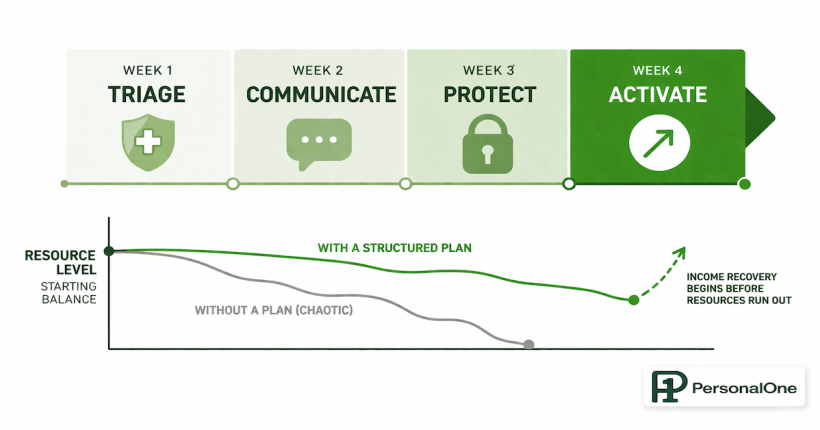
A 30-day behavioral challenge works because it's short enough to commit to, long enough to form real habits, and structured enough that you always know what to do next. The four-week sequence is deliberate: awareness in Week 1, elimination in Week 2, momentum in Week 3, automation in Week 4. Each week depends on the previous one.
Who this is for: people carrying credit card debt, student loans, or personal loans who can still make minimum payments but feel stuck. People in the "minimum payment trap" with no clear acceleration path. Anyone who knows they're overspending but hasn't faced the full picture yet.
Who should combine this with professional help: if you're facing collections, active lawsuits, or debt that significantly exceeds your annual income, a behavioral reset alone won't resolve the structural problem. This challenge works best alongside — not instead of — the broader debt relief and credit repair options when the situation requires it.
Week 1: Face the Numbers Without Flinching
You can't fix what you won't face. Week 1 is about radical financial honesty — no judgment, no minimizing, just data. Most people avoid this step for months or years. That avoidance is exactly what keeps the debt growing.
Week 1 Actions
- List every debt with its current balance, interest rate, minimum payment, and due date
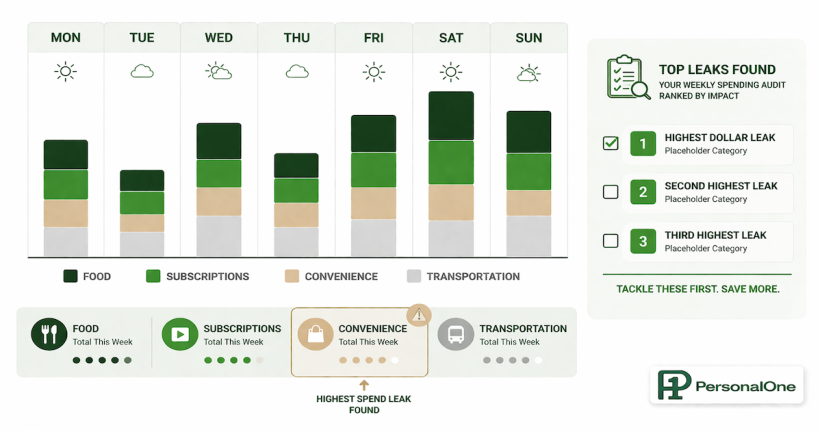
- Track every dollar spent for 7 days — every coffee, every app charge, every impulse buy
- Calculate your net worth (total assets minus total liabilities) — even if the number is negative, write it down
- Identify your "budget blind spots": subscriptions you forgot about, recurring charges you don't use, late fees that show up quarterly
- Write down your financial why — what does life look like when you're debt-free? What becomes possible?
Challenge Tip: Confronting Your Debt Is Power
Facing your full financial picture is uncomfortable — but it's the foundation for every win that follows. Most people avoid this step for years and wonder why nothing ever changes. The discomfort lasts one day. The clarity lasts indefinitely.
The goal of Week 1 isn't to solve anything. It's to see everything clearly for the first time. The list you build this week becomes the map you follow for the next 30 days and beyond.
Week 2: Cancel the Cash Leaks
If Week 1 shows you the problem, Week 2 starts solving it. This is where your spending detox gets real. Cash leaks are the recurring, automatic, and habitual expenses that drain money without you actively deciding to spend it. Most people don't know exactly what they're paying for every month until they look.
Week 2 Actions
- Audit every subscription and recurring charge identified in Week 1 — cancel anything you haven't actively used in the past 30 days
- Call your internet, phone, and insurance providers and ask for a lower rate — loyalty discounts, competitor-match rates, and promotional offers are often available without switching
- Replace two takeout or restaurant meals this week with home-prepped alternatives and redirect the saved cash immediately
- Set up real-time spending alerts on every debit and credit card so you're notified the moment money moves
- Make one extra debt payment this week — even $25 — using money freed from cancelled leaks
Challenge Tip: Plugging Leaks Boosts Progress Fast
Most people find $100–$300 per month in forgotten subscriptions and unnecessary recurring charges. That's $1,200–$3,600 per year that currently disappears — and could be going straight to debt payoff instead.
By the end of Week 2, your spending detox is in motion. You're not depriving yourself — you're redirecting waste toward freedom. The difference matters psychologically: this is intentional, not punishing.
What I've Seen
One thing I've consistently seen during subscription audits is that people almost never realize how much money is leaking through small automatic charges until they see everything listed in one place. It's rarely one giant expense — it's eight or nine smaller ones happening quietly in the background: unused streaming services, forgotten apps, trial memberships that converted months ago, food delivery subscriptions, gaming renewals, cloud storage upgrades. I've watched people find $180–$350 per month in under an hour, and the emotional shift is immediate. The moment they realize the debt isn't only coming from "big mistakes," the situation starts feeling solvable again instead of permanent.
Week 3: Stack Your Wins, Not Your Bills
Week 3 is where momentum begins. You have two weeks of financial clarity and freed cash flow behind you. Now you direct that energy toward visible, measurable debt reduction. Identifying the leaks is only half the equation — this week you take the freed resources and put them to work against the debt list you built in Week 1.
Week 3 Actions
- Choose your payoff method: Snowball (smallest balance first — quick psychological wins) or Avalanche (highest interest first — mathematically optimal). Either works. Pick the one that will keep you moving.
- Make one extra debt payment this week above your regular minimums — even $25 builds the habit and proves to yourself the system works
- If you have any side hustle or irregular income this month, commit 100% of it to debt payoff
- Acknowledge your wins — reviewing a balance that dropped because of your actions creates the motivation feedback loop that sustains the challenge
- Measure: how much total debt have you paid down across three weeks?
Challenge Tip: Small Wins Create Big Momentum
The first account you close — even a small store card — gives you psychological fuel that no spreadsheet can replicate. Don't underestimate what it does to your confidence when you see a balance hit zero for the first time.
Snowball or Avalanche: both are valid. Snowball keeps motivation high by delivering fast wins. Avalanche saves the most money mathematically. People who quit their debt payoff plans usually do so because they lose momentum, not because the math fails them — which is a strong argument for Snowball if you're prone to discouragement. Once you have your method, the debt repair hacks guide covers the specific tactics — timing payments to statement closing dates, requesting limit increases, and redirecting side income — that make either method move faster.
Week 4: Build Automation and Lock In the Habits
Finishing strong means keeping the results. Week 4 is about converting everything you've built into systems that run without requiring daily decisions. Willpower is not a reliable financial strategy. Infrastructure is.
Week 4 Actions
- Automate minimum payments on every debt account — no exceptions. If cash flow allows, automate extra payments on your priority debt too.
- Implement a 24-hour pause rule before any non-essential purchase over $50 — one day of delay eliminates the majority of impulse spending
- Set up monthly net worth tracking on the first of each month — a single number that tells you whether you're moving in the right direction
- Create a small fun fund separate from debt payments — $20–$50 per month of guilt-free spending prevents the deprivation spiral that leads to binge spending
- Schedule your 30-day review: what worked, what didn't, what continues in Month 2
Challenge Tip: Automation Removes Willpower From the Equation
Your debt detox challenge ends at Day 30, but the systems you've built don't. Automated payments, spending alerts, and a monthly net worth review are habits that compound for years after the challenge ends.
What Happens After Day 30
The 30-day challenge establishes the behavioral foundation. What follows is the sustained execution that eliminates the debt entirely.
Months 2–6: Debt Payoff Acceleration. Continue your chosen payoff method with the freed cash flow you identified in Week 2. As accounts close, immediately redirect those minimum payments to the next target — this is the rollover mechanic that makes debt payoff accelerate over time. Track progress visually. Adjust your budget quarterly as your financial situation shifts.
Months 7–12: Credit Recovery. As debt balances drop, credit utilization falls and your payment history accumulates. Focus on keeping utilization below 30% (ideally under 10%) on any remaining revolving accounts. Dispute any errors that appeared on your credit report during the debt-heavy period — collection accounts, incorrect balances, or misreported payment statuses. Every on-time payment in this phase is building the positive history that eventually outweighs the old negative marks. The full credit recovery sequence — disputes, utilization reduction, rent reporting, and how long each step takes — is in the guide to rebuilding damaged credit.
Year 2+: Building Forward. Once debt is eliminated, redirect those monthly payments into a 3–6 month emergency fund, then into investments. The habit infrastructure you built during the detox — automated payments, spending awareness, monthly reviews — transfers directly to wealth building. The system doesn't change; only the destination of the money changes.
Common Challenges and How to Handle Them
"I feel overwhelmed by the numbers." Start smaller than you think you need to. Week 1 doesn't require you to solve anything — just list the debts and track spending for 7 days. That's the entire assignment. Momentum builds from the first completed step, not from a perfect plan.
"I can't find any money to cut." Most people who say this haven't tracked every dollar for a full week yet. Track for 7 days and the leaks appear. The $8 app charge you forgot about, the streaming service you haven't used in two months, the recurring donation that autopays from an account you don't check — these add up reliably to $100–$300 per month for most households.
"I slipped up and made an impulse purchase." Normal. Expected. Don't quit the challenge. Acknowledge what triggered the purchase, learn the pattern, and continue. Progress over perfection is how 30-day challenges succeed. The only true failure is stopping.
"My income is too irregular for this to work." Irregular income makes the behavioral structure more important, not less. Focus on consistency of action, not consistency of amounts. In high-income weeks, redirect aggressively. In low-income weeks, redirect whatever is available — even $10. The habit of intentional redirection is the core skill, not the specific dollar amount.
See Every Account. Track Every Dollar.
Monarch Money connects all your accounts in one dashboard — so you can see exactly where the leaks are, track your debt payoff progress, and know when the system is working.
Try Monarch Money FreeGovernment & Official Sources
CFPB: Managing Debt — official government resource on debt collection rights, repayment options, and consumer protections.
CFPB: 5 Steps to Controlling Your Debt — structured debt reduction framework from the Consumer Financial Protection Bureau.
FTC: Dealing with Debt — consumer guidance on debt collection, credit reporting, and your legal rights when dealing with creditors.
More From PersonalOne
Return to the Debt Relief & Credit Repair hub for a complete overview of every recovery path — from behavioral resets to credit repair to long-term financial stability.
Frequently Asked Questions
Do I need to cut out all fun spending during this challenge? No. Week 4 specifically builds a small fun fund for guilt-free spending. Challenges that feel like punishment fail because deprivation triggers binge spending. The goal is sustainable habits, not misery. You're cutting waste, not cutting quality of life.
What if I can't make extra debt payments each week? Any extra amount counts. Even $10 redirected to debt is a win. The purpose of the challenge is to build the habit of intentional debt payoff, not to hit a specific dollar target. Consistency of behavior matters far more than the size of any individual payment.
Will this eliminate all my debt in 30 days? No — and it's not designed to. It creates the habits, systems, and behavioral infrastructure that eliminate debt over the months and years that follow. Most people see their first small account closed within 60–90 days of starting the challenge. The 30 days establish the foundation; the debt elimination happens in the months after.
Should I use Snowball or Avalanche? Snowball (smallest balance first) delivers quick wins that sustain motivation. Avalanche (highest interest first) minimizes total interest paid. Both work. The best method is the one you'll stick with. If you've tried to pay off debt before and lost momentum, choose Snowball. If you're analytically motivated and the math matters to you, choose Avalanche.
What if I have more serious debt — collections, lawsuits, or debt exceeding my income? A behavioral reset doesn't resolve structural debt problems. If you're being contacted by collectors, facing legal action, or carrying debt that's structurally unmanageable on your current income, the 30-day challenge should be paired with professional debt relief guidance. The CFPB's debt resources (linked above) explain your legal rights and available options. A nonprofit credit counselor can help you evaluate settlement, management plans, and bankruptcy based on your specific situation.
Can I do this challenge with a partner or friend? Accountability partners significantly increase success rates for behavioral challenges. Share your Week 1 numbers with someone you trust, check in weekly on your progress, and celebrate completed weeks together. The social commitment adds a layer of accountability that makes the challenge much harder to quietly abandon when it gets uncomfortable.
Disclaimer: This article is for educational purposes only and does not constitute financial, legal, or credit repair advice. Individual results vary based on income, debt levels, and personal circumstances. The strategies described represent general behavioral approaches and are not personalized financial recommendations. Consult a qualified financial professional before making financial decisions. PersonalOne is not responsible for decisions made based on this content.