2026
Home › Financial Stability › Buffer Account Systems › Paycheck Timing Strategy
TL;DR — Most bill timing problems are fixable without changing your income — just by rescheduling due dates or restructuring which bills hit which pay period
— Aligning bills with your paycheck dates is the fastest zero-cost fix for paycheck timing gaps — most billers will change your due date if you call and ask
— The longer-term fix is the buffer account system, which makes paycheck timing irrelevant because bills are always paid from the previous month’s income
— Biweekly pay creates a natural two-paycheck structure that, with intentional bill alignment, can eliminate timing gaps permanently
— Understanding your personal cash flow calendar — exactly when income arrives and when each bill is due — is the prerequisite to fixing inconsistent cash flow
A paycheck timing strategy is the deliberate alignment of bill due dates with income arrival dates — and it is one of the fastest ways to reduce monthly cash flow stress before a full buffer account is built. Most people treat their bill due dates as fixed facts of life: rent is due on the 1st, the credit card is due on the 15th, the car payment is due on the 22nd, and the paycheck arrives on the 20th. The result is that some bills always hit before money is available. But most of those dates are not actually fixed — they are defaults that can be changed with a phone call. The complete system for eliminating timing problems permanently is the income timing buffer system.
The goal of a paycheck timing strategy is to make income and obligations land in the same windows rather than in misaligned sequences. You are not earning more or spending less — you are restructuring when money flows so that the same income and expenses stop creating gaps. When bills are aligned with paychecks and you understand your cash flow calendar precisely, the sensation of money always being short before payday often significantly reduces or disappears without any change in income.
The guide on building financial stability covers the complete framework for building stable cash flow infrastructure — of which paycheck timing alignment is one practical layer.
Step 1: Build Your Personal Cash Flow Calendar
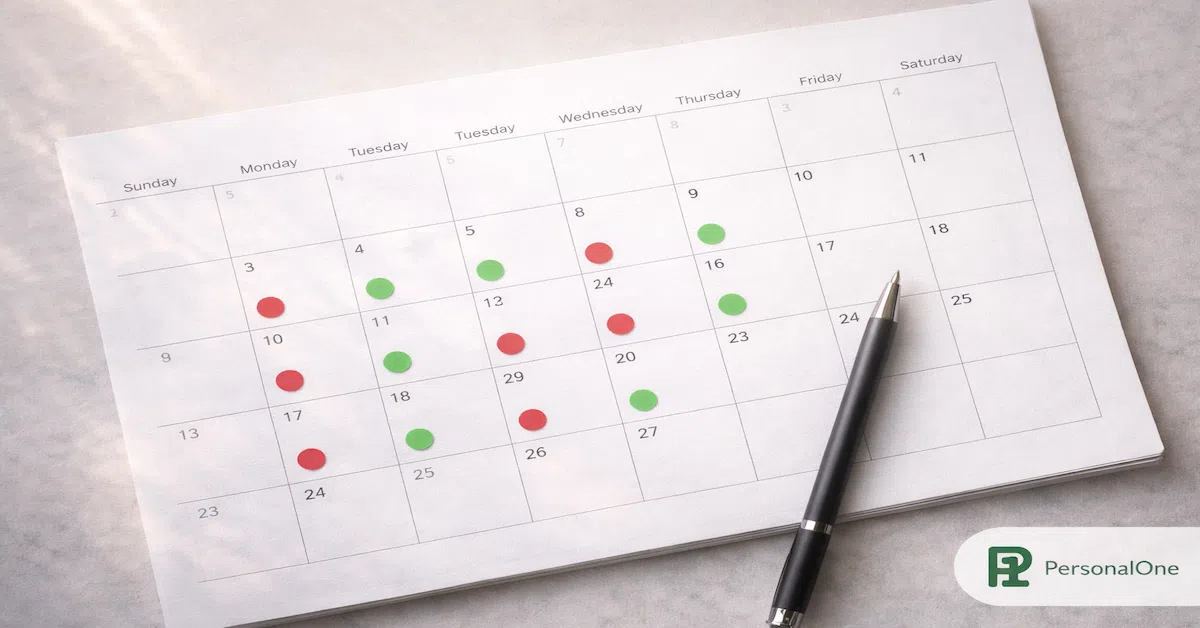
The first step is visibility. List every income arrival date and every bill due date for one complete month. Use actual dates from your last three months of bank and credit card statements — not what you think the dates are, but what they actually are. Most people discover that their mental model of their cash flow is less accurate than the actual data. Common surprises: annual subscriptions that auto-renew on dates you forgot, insurance premiums that pull quarterly rather than monthly, and credit card due dates that have drifted from where you originally set them.
Once every date is mapped, you can see exactly where the gaps are. Bills that fall 3–7 days before a paycheck are the primary target. Bills that fall immediately after a paycheck are already aligned. Bills that fall at the end of the month after a mid-month pay period are a secondary target. The calendar tells you exactly which dates to reschedule and which to leave alone.
What This Looks Like When You Map It for Real
Across more than 120 people I've worked with, the same pattern shows up almost every time we build a cash flow calendar: their mental model of when money arrives and when bills hit is wrong in at least two or three places.
The most common surprise is not the big bills — it's the smaller ones that quietly stack. Annual subscriptions that renew on random dates, quarterly insurance premiums that don't align with pay periods, and credit card due dates that have drifted over time without notice. In several cases, people believed they had one or two tight weeks per month, but once we mapped everything, it turned out they had four or five separate mini-gaps caused by overlapping smaller payments.
Biweekly pay adds another layer. Many people assume two paychecks cleanly cover all bills, but when mapped, we often find one paycheck doing double duty — covering both current expenses and leftover obligations from the previous pay period. That creates the exact feeling people describe: "I'm fine one week, then suddenly everything hits at once."
Once the calendar is laid out with real dates — not estimates — the problem becomes obvious. It's not that income is too low in that moment. It's that the sequence is misaligned. And once that sequence is corrected, either through bill alignment or a buffer system, the same income starts behaving very differently.
The guide on what happens when bills hit before your paycheck covers the specific consequences of timing gaps — overdraft risk, cascading late fees, and the stress patterns that compound when income and obligations are misaligned — and gives you the immediate short-term tactics for managing those gaps while you work on the longer-term calendar fix.
Step 2: Align Bills With Your Paycheck Dates
Reschedule credit card due dates. Every major credit card issuer allows you to change your payment due date. Call the number on the back of your card and request a date 3–5 days after your regular payday. If you are paid on the 1st and 15th, request due dates on the 5th and 20th. If you are paid weekly, cluster all credit card due dates in the first week of each month. This is free, takes 5 minutes, and takes effect within one billing cycle.
Move utility due dates. Most utility companies (electric, gas, water, internet, phone) allow due date changes with a 30-day advance notice. Call and request a date 2–4 days after your payday. Not all utilities have this flexibility, but most of the major ones do. Even moving one large utility bill from before payday to after payday can significantly reduce the timing gap.
Negotiate rent due date at lease renewal. Rent due dates are harder to change mid-lease but are negotiable at renewal, especially for tenants with strong payment history. A request to move the due date from the 1st to the 5th — framed as setting up a reliable autopay on payday — is often acceptable to landlords who prefer automated, reliable payments over potentially late ones.
When timing fixes alone are not enough to close the gap — when the math simply does not work even with aligned dates — the guide on how to reduce expenses when timing fixes are not enough covers the specific expense reduction tactics that create breathing room without requiring a permanent lifestyle change.
Step 3: Structure Biweekly Pay for Consistent Bill Coverage
Biweekly pay (26 paychecks per year) creates a natural structure for bill timing when used intentionally. Assign each paycheck a specific set of obligations: Paycheck 1 (arrives around the 1st) covers rent, phone, internet, and subscriptions. Paycheck 2 (arrives around the 15th) covers credit cards, car payment, and utility bills. Every bill has a specific funding source. No paycheck is doing double duty. No bill is in a gap between pay periods.
The two extra paychecks that biweekly pay produces each year (months where three paychecks arrive) are the best opportunity to jump-start the buffer build. If all monthly obligations are covered by two paychecks, the third paycheck in a three-paycheck month goes entirely to the buffer account, compressing the build timeline significantly.
For people with irregular income — freelance, contract, or gig work — biweekly pay structure does not apply, and the timing problem requires a fundamentally different approach. The guide on how irregular income requires more than timing fixes covers how variable income earners need to approach both the buffer build and bill management differently from those on a fixed pay schedule.
The Permanent Fix: Make Timing Irrelevant With the Buffer
Paycheck timing alignment is a valuable short-term fix. But it still requires ongoing management — you are still operating within the current-month income and current-month expenses framework. The permanent fix is the buffer account system, which makes the timing question irrelevant: when one month of expenses is always pre-funded, it does not matter when bills hit within the month because the money is already there.
Timing alignment gets you from chaotic cash flow to organized cash flow. The buffer gets you from organized cash flow to consistently funded cash flow with no timing management required. The step-by-step guide on how to build a buffer that removes timing problems permanently covers the full accumulation sequence — from calculating your target to activation.
The guide on how to stop living paycheck to paycheck using structure not timing tricks addresses the full picture — why timing alignment alone is not enough and what the complete structural shift looks like when both alignment and buffer are in place.
Align the bills. Build the buffer. Eliminate timing anxiety permanently.
The complete buffer account framework takes you from timing management to timing independence.
Explore Buffer Account Systems →Official Sources
CFPB — Overdraft Protection — CFPB guidance on overdraft fees, opt-out rights, and how to manage accounts during paycheck timing gaps without incurring overdraft charges.
CFPB — Savings Tools and Resources — Guidance on short-term savings reserves and building the cash flow buffer that makes paycheck timing permanently irrelevant.
Continue Learning About Financial Stability
Paycheck timing alignment is one layer of a larger cash flow system. The complete framework for building lasting financial stability is in the Financial Stability guide.
Frequently Asked Questions
Will changing my bill due dates affect my credit score?
No. Changing a credit card due date does not affect your credit score. The account history, credit limit, and payment record remain unchanged. The only potential issue is the transition month: depending on when you change the date, you may have a shorter or longer payment window before the first payment on the new date. Confirm with the issuer when the new due date takes effect and make sure you do not inadvertently miss the first payment under the new schedule.
What if my employer pays me on the last business day of the month and my rent is due on the 1st?
This is one of the most common and most solvable timing gaps. If rent is due on the 1st and your paycheck arrives on the 28th–31st, request that your bank make the rent transfer automatically on the 1st rather than waiting until the paycheck has been sitting for days. Alternatively, ask your landlord about a 3–5 day grace period (most leases include one) and schedule the payment for the 3rd — confirmed funds after the month-end paycheck has processed. The longer-term fix is a buffer so last month’s paycheck is already funding this month’s rent.
How do I handle inconsistent income and paycheck timing?
Freelancers, contractors, and gig workers with irregular income cannot rely on payday-aligned bill scheduling because payday itself is unpredictable. For irregular income, the buffer account system is even more critical — a two-month buffer rather than one month is the appropriate target, providing a larger cushion against income timing variability. Bill due dates should be clustered in the middle of the month rather than at month-end, to give the maximum time for irregular payments to clear before bills hit.
How long does it take for bill due date changes to take effect?
Credit card due date changes typically take effect within one billing cycle — usually 30 days. Utility companies generally require 30 days advance notice. The transition month can be slightly awkward: you may have two payments close together if the new date is before the current cycle closes. Plan for this by keeping a small buffer in checking during the transition month, and confirm the new due date in writing before assuming the change is active.
Is paycheck timing alignment a substitute for a budget?
No — it is a complement to a budget, not a replacement. Timing alignment solves when money flows. A budget solves how much flows to each category. Both are needed. Timing alignment without a budget means you have eliminated gaps but may still be overspending in categories that eat into next month’s obligations. A budget without timing alignment means you know your numbers but still experience the stress of bills arriving before income. The combination of both — with a buffer on top — is what produces genuinely stable cash flow.
Disclaimer: This article is for educational purposes only and does not constitute financial advice. PersonalOne is not a licensed financial advisor, broker, or investment professional. Individual financial situations vary — consult a qualified financial professional for personalized guidance.