2026
Home › Financial Stability › Buffer Account Systems › How to Stop Living Paycheck to Paycheck
TL;DR — Living paycheck to paycheck is almost always a systems problem, not a discipline problem — willpower cannot fix what a missing structure creates
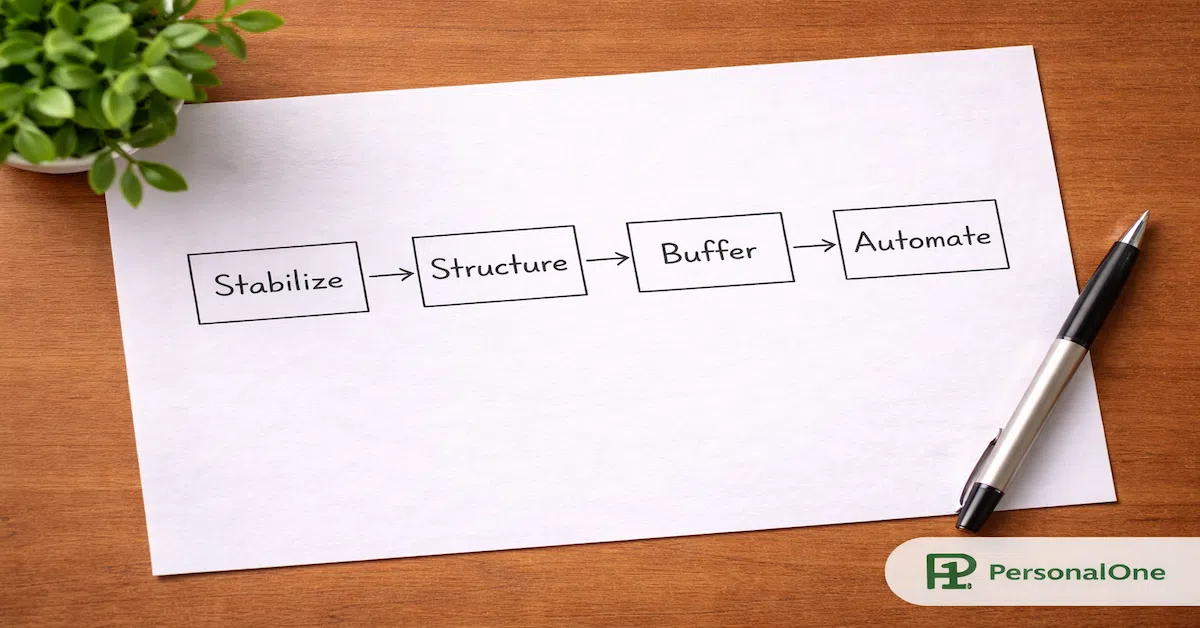
— The escape requires four sequential steps: Stabilize (know your real numbers), Structure (set up your banking correctly), Buffer (get one month ahead), Automate (remove ongoing decisions)
— Most people fail because they try to solve a systems problem with budgeting tips — tips address behavior, systems address architecture
— You do not need a higher income to stop living paycheck to paycheck — most people can escape on their current income with the right structural shifts
— The four-step system in this guide connects to a complete set of PersonalOne resources that walk each step in full detail
If you are looking for help to stop living paycheck to paycheck, the first thing to understand is that you are not failing at money — you are operating without a system. These are not the same problem, and they do not have the same solution. Failing at money implies you need more discipline, better habits, more willpower. Operating without a system means the infrastructure that should be routing, protecting, and growing your money does not exist yet. The fix is not trying harder. The fix is building the system. That is what this guide covers. The complete framework is in the financial stability foundation.
The paycheck-to-paycheck cycle is one of the most common financial situations in the United States across all income levels. Federal Reserve survey data consistently shows that people earning $75,000 per year report living paycheck to paycheck at nearly the same rate as people earning $35,000. The income variable matters less than most people assume. What matters is the structural relationship between how money arrives, how it gets routed, whether a buffer exists between income and obligations, and whether the system runs automatically or requires constant manual management. That buffer — and the complete system for building it — is the one-month ahead money system.
This guide gives you the help that actually works: a four-step system that addresses the architecture problem rather than the behavior problem. Each step builds on the previous one. None of them require income increases to implement. All of them have been the turning point for people who felt permanently stuck in the cycle — including people who had tried budgeting apps, spending trackers, and strict no-spend months without lasting results.
Why Most Advice Does Not Work (And What Does)
Before the four-step system, it is worth understanding why most paycheck-to-paycheck advice fails — because if you have tried and struggled before, that failure was likely the advice's fault, not yours.
Tips address behavior. Systems address architecture. The most common advice for breaking the paycheck cycle — cut your coffee, track your spending, follow the 50/30/20 rule — treats the problem as a behavior problem. It assumes you are spending too much in the wrong places and that awareness plus willpower will fix it. For most people who are stuck in the paycheck cycle, the problem is not that they are unaware of what they are spending. The problem is that there is no structural gap between their income and their obligations, no buffer to absorb timing mismatches, no automated routing that moves money to savings before it can be spent, and no banking architecture that separates different money functions into different accounts with different purposes.
Budgeting is a reporting tool, not a financial system. A budget tells you where your money went. It does not change where your money goes unless the underlying infrastructure changes. Tracking that you spent $400 on dining out last month does not automatically result in spending $200 this month. The only thing that reliably changes spending is removing the decision — automating money away before it is available to spend, creating a separate account for savings that requires deliberate action to access, and building a buffer that absorbs the small crises that usually trigger unplanned spending.
Willpower is finite. Systems are permanent. Every financial decision you make manually requires willpower. Every bill you pay by logging in and manually transferring funds, every savings deposit you initiate based on what is left over at month-end, every spending choice that involves consciously overriding an impulse — these all draw from a finite resource that depletes under stress, tiredness, and the accumulated friction of daily life. A financial system that routes money automatically requires no willpower after the initial setup.
The core insight that changes everything:
You do not have a spending problem. You have a systems problem. The four steps below build the system. Once the system is running, the paycheck-to-paycheck cycle stops — not because you are more disciplined, but because the structure that perpetuated it no longer exists.
The Four-Step System to Break the Paycheck Cycle
The system that reliably breaks the paycheck-to-paycheck cycle has four sequential steps. Each step is a prerequisite for the next. Skipping steps is the most common reason people partially implement this system and do not get the full result. Work through them in order.
Step 1: Stabilize — Know Your Real Numbers
Time required: One weekend. Ongoing effort: Zero once complete.
You cannot build a financial system on estimated numbers. The first step is getting precise visibility into exactly what money comes in, exactly what money goes out, and exactly when both happen. This is not a budget — it is an audit. You are not making decisions yet. You are collecting data.
What to calculate in the stabilize phase:
✓ True monthly income: After-tax take-home, not gross. If you have irregular income, calculate the average of the last six months — not the best month.
✓ True fixed expenses: Every recurring obligation with a fixed or predictable amount — rent, car payment, insurance, phone, internet, subscriptions. List every single one with its exact due date.
✓ True variable expenses: Groceries, fuel, dining, entertainment, personal care — average of the last three months from actual bank and credit card statements, not estimates.
✓ Annual and irregular expenses: Car registration, insurance renewals, holiday spending, annual subscriptions — divide each by 12 to get the true monthly cost. Most people dramatically underestimate their spending because they forget these.
✓ The gap: Income minus all of the above. This number — which may be positive or negative — is your current margin. Everything in the next three steps is built on this number.
Most people discover in the stabilize phase that their expenses are higher than their mental model suggested — specifically because irregular and annual expenses get forgotten. A household that thinks it has $400/month of discretionary margin often has $150 once forgotten expenses are accounted for. The stabilize phase makes that real number visible so you are building the rest of the system on accurate data. If the gap is tighter than expected, the guide on how expense compression creates immediate financial breathing room covers specific tactics for creating margin before the buffer build begins.
One immediate action in the stabilize phase: Call every biller with a due date that falls before your payday and reschedule it to 2–3 days after payday. Credit cards, utilities, and phone companies almost always allow this. This alone eliminates most recurring timing gaps before the buffer is built.
Step 2: Structure — Set Up Your Banking Correctly
Time required: One afternoon. Ongoing effort: Zero once automated.
A single checking account that receives your income and pays all your bills gives money no structure and no protection. Everything is available, everything is one decision away from being spent, and there is no separation between spending money and saving money. The structure phase creates the banking architecture that routes money automatically to where it belongs before you can spend it on something else.
The correct banking structure for breaking the paycheck cycle:
Account 1 — Primary Checking (Bills and Fixed Expenses): Your paycheck lands here. Only fixed, recurring, essential bills are paid from this account. This account has a known, predictable outflow each month. You know exactly what will leave it and when. It is not a spending account.
Account 2 — Spending Account (Variable Daily Expenses): A fixed amount transfers automatically from the primary checking to this account on payday. This is your grocery money, fuel money, dining budget, and discretionary spending. When it is gone, it is gone. The fixed transfer amount forces a spending ceiling without requiring ongoing tracking.
Account 3 — High-Yield Savings (Emergency Fund): At a separate bank from your primary checking, with a 1–3 day transfer delay that creates behavioral friction. Your emergency fund lives here — untouched except for genuine emergencies. Earns 4–5%+ APY in the current rate environment.
Account 4 — Buffer Savings (Next Month’s Bills): At the same bank as your primary checking for immediate access. This is the account you are building toward in Step 3. Once funded, every paycheck deposits here first, and this account funds next month’s bills.
The banking structure removes money from the spending account before you see it. When your paycheck arrives and automatically sends $300 to savings, $500 to spending, and $200 to the buffer, the money is already allocated before you check your balance. The complete guide to building this banking infrastructure is in the Banking Systems guide.
Step 3: Buffer — Get One Month Ahead
Time required: 3–6 months to build. Ongoing effort: Zero once activated.
This is the step that actually breaks the paycheck-to-paycheck cycle. The buffer account system creates a permanent one-month gap between your income timing and your bill timing. Instead of this month’s paycheck paying this month’s bills, last month’s paycheck always pays this month’s bills. Your arriving paycheck funds next month. You are always one month ahead. The guide on how to build a one-month buffer for financial stability covers the full step-by-step accumulation process.
When you are one month ahead, the paycheck-to-paycheck dynamic is permanently broken — not temporarily reduced, not improved, but structurally eliminated. There is no countdown to payday because the bills are already funded. There is no overdraft risk because the money was deposited 30 days ago. There is no timing anxiety because timing no longer matters.
How to build the buffer: Save one month of essential expenses (rent, utilities, groceries, minimum debt payments, transportation) as a lump sum in a dedicated account labeled "Buffer — Next Month." The three most effective funding sources are an automatic transfer of 10–20% of each paycheck, a tax refund directed entirely to the buffer account, and a temporary suspension of one discretionary spending category for 3–6 months. Once the buffer reaches its target, activate it: pay this month’s bills from the buffer, deposit the arriving paycheck into the buffer for next month, and maintain this one-month-ahead cycle permanently.
The buffer activation moment is the most significant financial shift most people make. The month the system activates, the paycheck arrives and it is not needed to pay anything due right now. Every bill is already covered. The paycheck goes into the buffer. That feeling — of money that is not already spent — is what living paycheck to paycheck prevents you from ever experiencing. Building to that moment is worth the 3–6 month sprint.
Step 4: Automate — Remove Friction and Ongoing Decisions
Time required: One afternoon to set up. Ongoing effort: Near zero.
Once the banking structure and buffer are in place, automation locks the system in and removes the ongoing decisions that willpower-based approaches require. Automation is what converts a system you manage into a system that runs. The complete guide to financial automation is in the Financial Automation guide.
What to automate after the buffer is built:
✓ All fixed bill payments on autopay: Every recurring fixed bill set to autopay from the primary checking account 2–3 days after the standard payday. No manual payments, no login-and-pay rituals, no late fees from forgotten due dates.
✓ Automatic spending account transfer on payday: A fixed dollar amount transfers from primary checking to the spending account on payday, every payday. The spending ceiling is set automatically.
✓ Automatic savings transfer on payday: A fixed amount transfers to the emergency fund HYSA on payday, every payday. Savings happen before spending rather than from whatever is left over at month-end.
✓ Automatic retirement contribution: 401(k) contributions set to capture the full employer match, processed through payroll before take-home pay is calculated.
✓ Automatic investing contribution: A fixed monthly contribution to a Roth IRA or taxable robo-advisor account, set to execute on the same day as all other automatic transfers.
After automation is complete, the only ongoing financial decision is whether the spending account amount is appropriately calibrated to variable monthly needs. Everything else runs without any input from you. The complete framework for budgeting habits that support this structure is in the Budgeting and Savings guide.
Where Most People Fail in the System Build
Understanding where the implementation breaks down is as important as understanding the steps themselves. The four most common failure points:
Failure 1: Skipping Step 1 and building on estimated numbers. The banking structure and buffer target are both calculated from your actual expense numbers. If those numbers are wrong — because you estimated rather than measured from three months of real data — every downstream calculation is off. The buffer will be underfunded. The spending account transfer will be incorrectly sized. The system will feel broken when it is actually just miscalibrated. Do the audit. Use real numbers.
Failure 2: Building the buffer in the same account as the emergency fund. Commingling the buffer and emergency fund in a single savings account is the most common structural error. When an emergency draws from the combined account, the buffer is depleted and the timing system fails that month. Keep every account clearly separated with a specific, labeled purpose.
Failure 3: Reducing the automatic transfer when the build feels tight. The buffer-building sprint creates temporary cash flow compression. Most people reduce or pause the automatic transfer when this compression becomes uncomfortable — and then never reinstate it at the previous level. The result is a partial buffer that never activates. Set the transfer at a level that is uncomfortable but not cash-flow-threatening and hold it there for the full sprint period.
Failure 4: Treating automation as optional after setup. The system only runs automatically after the automation is configured. Telling yourself you will manually transfer savings each month or pay bills whenever they arrive reintroduces the willpower dependency that automation eliminates. The setup is the one-time investment. The automation is what returns that investment forever.
What Changes After the System Is Running
Checking your bank account becomes neutral. When you are living paycheck to paycheck, checking your bank account carries anxiety — you are always calculating whether the balance is safe relative to upcoming obligations. After the system is running, checking the account is informational rather than anxiety-producing. Bills are funded. Savings are moving. The balance is what it should be.
Small unexpected expenses stop being crises. A $200 car repair that previously required a credit card or emergency fund withdrawal now comes from the spending account or a sinking fund without disrupting anything else. The system absorbs small shocks automatically. The emergency fund is preserved for genuine emergencies rather than the routine surprises that a budget with no margin cannot absorb.
Financial decisions become less emotionally loaded. When money is not always scarce, individual spending decisions carry less psychological weight. You are not calculating every transaction against a mental countdown to payday. You know what the spending account holds. When it is gone, spending slows. When it refills on payday, normal spending resumes.
The system starts compounding. With the buffer handling timing, the emergency fund growing, and investing running automatically, the structural advantages start compounding. Each month the system runs, the financial position is slightly stronger. The guide on how to break the paycheck-to-paycheck cycle permanently covers exactly what that compounding looks like in the months after activation — and what to protect to keep the cycle broken long-term.
Your Next Move: Where to Start in the PersonalOne System
Each of the four steps in this guide has a complete dedicated resource in the PersonalOne system. Start with Step 1 immediately — the stabilize phase requires only time, no money, and gives you the real numbers everything else is built on. From there, work through each step in sequence. Do not jump to automation before the buffer is built. Do not build the buffer before the banking structure is in place.
The guide on how paycheck timing strategy fits into a full system is worth reading before or alongside Step 1 — it covers how to align bill due dates with payday as a zero-cost fix that eliminates timing gaps while the buffer build is underway.
Step 1 → Stabilize
Know your real numbers. Audit three months of actual expenses. Build your cash flow calendar.
Financial Stability Guide →Step 2 → Structure
Set up your multi-account banking infrastructure. Primary checking, spending account, emergency fund, and buffer account.
Banking Systems Guide →Step 3 → Buffer
Build one month of expenses in a dedicated account and get permanently one paycheck ahead of your bills.
Buffer Account System →Step 4 → Automate
Set every transfer, bill payment, savings contribution, and investment on automatic. Remove ongoing decisions entirely.
Financial Automation Guide →You don’t need to earn more. You need a system.
The four-step system in this guide connects to a complete set of PersonalOne resources built specifically to walk you from paycheck to paycheck to financially stable — step by step, on any income.
Start with the financial stability guide. Everything else follows from there.
Start With the Financial Stability Guide →Official Sources
CFPB — Savings Tools and Resources — Consumer Financial Protection Bureau guidance on building emergency savings, cash flow management, and savings account structures for people building financial stability from scratch.
Federal Reserve — Report on the Economic Well-Being of U.S. Households — Annual Federal Reserve survey data on household financial resilience, emergency savings capacity, and paycheck-to-paycheck prevalence across income levels.
FDIC — Consumer Resource Center — FDIC guidance on insured savings products, account types, and how to verify deposit insurance before opening any savings or checking account as part of your banking structure.
Continue Learning About Financial Stability
Stopping the paycheck-to-paycheck cycle is the entry point to lasting financial stability. The complete framework is in the Financial Stability guide.
Frequently Asked Questions
Is it really possible to stop living paycheck to paycheck without a higher income?
For most people, yes — because the paycheck-to-paycheck cycle is primarily a structural problem rather than an income problem. Federal Reserve survey data consistently shows that people at all income levels report living paycheck to paycheck. What the data also shows is that people who escape the cycle at any income level almost always have a structural shift in common: a buffer account, automated savings, and money routed away from spending before it can be spent. There are genuine cases where income is so low that no structural optimization can create margin — but those cases are less common than most people assume when they are in the cycle.
How long does it take to fully implement this system?
The audit (Step 1) takes one weekend. The banking structure (Step 2) takes one afternoon. The buffer build (Step 3) takes 3–6 months of consistent automatic transfers, or less if a tax refund or windfall is available during the build period. Automation (Step 4) takes one afternoon after the buffer is funded. Total calendar time: 3–6 months from start to fully operational system. Total active effort: roughly 8–12 hours spread across those months. The rest is waiting for the automatic transfers to accumulate.
What if I have a lot of debt? Can I still build this system?
Yes — and you should. High-interest debt creates ongoing cash flow drain that makes the system harder to build but does not make it impossible or unwise. The priority sequence with debt: build the $1,000 starter emergency fund first, make all minimum payments on all debts to protect credit and avoid fees, then build the buffer and attack high-interest debt simultaneously at whatever ratio your margin allows. Paying off all debt before building any buffer is the approach most likely to leave you financially vulnerable during the payoff period.
I've tried budgeting before and it never lasted. Why is this different?
Budgeting as behavior change requires ongoing willpower. This system replaces willpower with structure. After the four steps are complete, you are not making daily financial decisions — the structure makes them for you. The spending account limits your variable spending without requiring you to track it manually. Savings happen automatically before you see the balance. Bills pay themselves. The difference between budgeting that does not last and a system that does is the presence or absence of automation and structure.
What is the first thing I should do today?
Open your last three months of bank and credit card statements and calculate your true essential expense number. This takes 30–60 minutes and costs nothing. It gives you the real number your buffer target and banking structure are built on. Everything else in the system depends on getting this number right. Do it today, before the motivation this article may have generated dissipates. The first action is the most important one.
Disclaimer: This article is for educational purposes only and does not constitute financial advice. PersonalOne is not a licensed financial advisor, broker, or investment professional. Individual financial situations vary — consult a qualified financial professional for personalized guidance.