2026
Home › Financial Stability › Buffer Account Systems › How to Break the Paycheck-to-Paycheck Cycle With a Buffer
TL;DR — The paycheck-to-paycheck cycle is primarily a timing and structural problem, not an income problem — most people can break it without earning more
— The solution is the one-month buffer: this month’s income funds next month’s expenses, permanently eliminating the income-obligation timing gap
— Breaking the cycle requires a one-time capital accumulation effort (saving one month of expenses) that can take 3–6 months, but then the system runs permanently
— The psychological shift from breaking the cycle is as significant as the financial shift — most people describe it as the first time they felt financially in control
— Cash flow consistency after breaking the cycle means every month looks the same: income arrives, goes into the buffer, bills are already funded, and no calculation is needed
The most effective way to break paycheck to paycheck cycle behavior is not to earn more — it is to change the structural timing relationship between income and expenses. The cycle exists because each paycheck pays the bills of the current period. The buffer breaks that link by shifting the timing: this month’s income funds next month’s expenses, creating a permanent one-month gap between earning and spending that eliminates the countdown to payday. The complete framework for building this system is inside the monthly cash flow buffer system.
The statement that the paycheck-to-paycheck cycle is not an income problem is not wishful thinking — it is a structural observation. Federal Reserve survey data consistently shows that people at all income levels report living paycheck to paycheck. High earners with high expenses live paycheck to paycheck just as low earners with lower expenses do. The variable that determines whether someone escapes the cycle is not their income level — it is whether they have built the one-month timing shift.
The PersonalOne financial stability guide covers the full framework for building the structural cash flow improvements that make this shift stick long-term.
Why Most Paycheck-to-Paycheck Solutions Fail
The most common advice for breaking the paycheck cycle — budget more carefully, spend less, earn more — addresses spending behavior without addressing the structural timing problem. A person who budgets very carefully but has no buffer is still one timing gap away from an overdraft. A person who earns more but spends proportionally more is still at the same structural position relative to their obligations. Budgeting apps, spending trackers, and income increases do not change the fundamental timing relationship between income arrival and bill due dates. Only the buffer does that.
The other common failure is treating symptom fixes as solutions. Rescheduling bill due dates, using paycheck advance apps, or negotiating payment deferrals are all damage control tactics that manage the timing gap without eliminating it. They require ongoing management every month and stop working the moment you stop actively managing them. Cash flow consistency — the state where no monthly cash flow management is required because income always exceeds current obligations by one full month — only comes from the buffer.
For people whose income is variable or unpredictable, the cycle is even harder to break because the timing gap shifts with each income fluctuation. The guide on how income volatility keeps people stuck without a system covers why irregular earners need a larger buffer and a different approach to breaking the cycle than those on a fixed pay schedule.
The Three-Phase Escape Plan
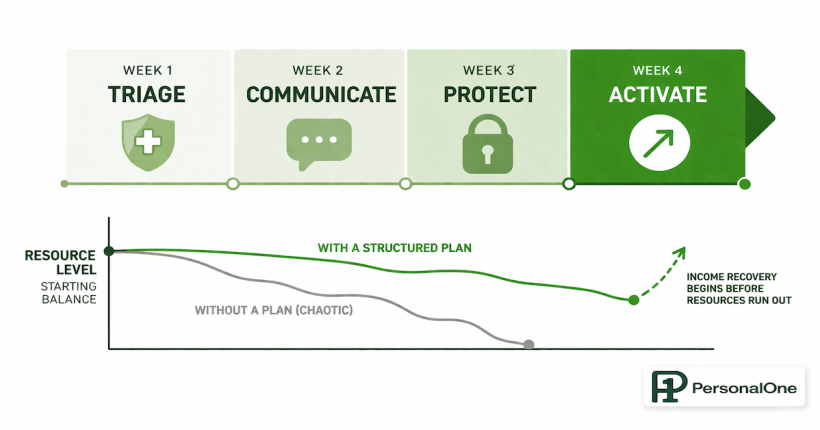
Phase 1 — Stabilize (Month 1–2). Before building anything, stop the bleeding. Reschedule bill due dates to align with payday. Build a $1,000 starter emergency fund to absorb small shocks during the buffer-building period. Identify and eliminate any recurring charges that are not essential. Map your cash flow calendar exactly. This phase is not about accumulation — it is about stopping the outflows that undermine accumulation.
Phase 2 — Build the buffer (Month 2–6). Set an automatic transfer of 10–20% of each paycheck to a dedicated buffer savings account. Redirect any windfalls (tax refund, bonus) directly to the buffer. Suspend one discretionary spending category and redirect it to the buffer. Continue until the account holds exactly one month of essential expenses. Do not touch it during this phase for any purpose — it is under construction. The full step-by-step process for this phase is in the guide on how to build your buffer account step by step.
Phase 3 — Activate and maintain (Ongoing). The month the buffer reaches target, activate it: pay this month’s bills from the buffer and deposit the arriving paycheck into the buffer for next month. From this point, the cycle is broken. Every month, last month’s income funds this month’s bills. The paycheck is not a lifeline — it is a deposit. The countdown to payday does not exist anymore because the bills are already funded when they arrive.
Understanding how the one-month buffer rule eliminates paycheck dependence explains the mechanics behind why Phase 3 works permanently — not just the actions to take, but why the timing shift itself is what breaks the cycle at its root.
What Cash Flow Consistency Actually Feels Like
After breaking the paycheck-to-paycheck cycle with a buffer, cash flow consistency means that every month has the same financial structure. Income arrives. It goes into the buffer. Bills pull from the buffer as they are due. The buffer refills automatically on the next payday. There is no calculation required. There is no countdown. There is no anxiety about whether Thursday’s balance can clear Friday’s charge. The relationship between money and time changes completely — money is no longer something that is always about to run out, and financial decisions stop being made from scarcity.
What That "First Time in Control" Actually Looks Like
One moment that comes up again and again happens right after the buffer is activated — not months later, but within the first one or two billing cycles.
I worked with a client who had just finished building their one-month buffer after about four months of steady contributions. The first month they activated it, something small but meaningful happened: their rent auto-drafted on the 1st, their utilities hit on the 3rd, and their credit card payment cleared on the 5th — and they didn't check their bank balance once.
That had never happened before.
Before the buffer, they were checking their account almost daily during that same week — mentally subtracting bills, timing purchases, and making sure nothing hit too early. That week used to feel like a countdown. After the buffer, it felt like nothing at all.
They told me later the shift wasn't dramatic — it was quiet. There was no big financial win, no sudden increase in income. The difference was that nothing needed attention. The bills were already funded. The paycheck that came in mid-month didn't go out immediately — it just sat in the account.
That's the part most people don't expect. Financial control doesn't feel like intensity or constant awareness. It feels like the absence of urgency. The moment you stop tracking every transaction in your head and start trusting the system — that's when the worry-cycle is actually broken.
Most people who reach this state describe it as the first time they felt financially in control — not because their income is higher, but because the structural relationship between income and obligation has fundamentally changed. The buffer is the mechanism. The cash flow consistency is the outcome. And that outcome is accessible on any income level that generates any surplus above essential expenses.
One critical protection that prevents falling back into the cycle once you have broken it: a fully funded emergency fund. The guide on how emergency funds prevent you from falling back into the cycle covers why the buffer alone is not enough and how the emergency fund serves as the second structural layer that keeps the buffer intact when real disruptions hit.
For the complete picture of what breaking the cycle looks like across all layers — not just the buffer, but the full structural shift — the guide on how to stop living paycheck to paycheck using a full system covers the complete sequence from stabilization through long-term cash flow independence.
Break the cycle. Build the buffer. Own the month.
The complete buffer account framework is in the Buffer Account Systems cluster.
Explore Buffer Account Systems →Official Sources
CFPB — Savings Tools and Resources — CFPB resources on building short-term cash reserves, managing cash flow gaps, and savings strategies for breaking the paycheck-to-paycheck cycle.
Federal Reserve — Report on the Economic Well-Being of U.S. Households — Annual Federal Reserve survey data on household financial resilience, emergency savings capacity, and paycheck-to-paycheck prevalence across income levels.
Continue Learning About Financial Stability
Breaking the paycheck-to-paycheck cycle is the foundation of financial stability. The complete framework is in the Financial Stability guide.
Frequently Asked Questions
I have tried to save before and always end up spending it. How is the buffer different?
The buffer works because it has a specific, non-negotiable purpose rather than being general savings. Money labeled "buffer — next month's bills" in a dedicated account resists spending because it has a clear functional claim. General savings accounts feel more available to spend. Additionally, the buffer becomes the mechanism that pays your bills — touching it for non-bill purposes is not spending savings, it is undermining the system that prevents overdrafts. The stakes are higher and the purpose is clearer than general savings.
What if I have debt that is draining my cash flow?
High-interest debt creates ongoing cash flow drain that makes building a buffer harder but does not make it impossible. The priority order: $1,000 emergency fund, then minimum payment compliance on all debts (to protect credit and avoid fees), then buffer building and debt payoff in parallel at whatever ratio your cash flow allows. Eliminating high-interest debt and building the buffer are both financial stability goals — neither should be completely paused for the other at the expense of leaving you structurally vulnerable.
How long does it realistically take to break the cycle?
For most people with some discretionary margin in their budget: 3–6 months of consistent automatic transfers. For people who receive a tax refund during the build period: potentially 1–2 months. For people with very tight margins: 6–12 months with a smaller automatic transfer. The timeline is variable, but the structure is constant. Every step toward the buffer is a step away from the paycheck cycle, even if the full activation takes longer than expected.
Does breaking the paycheck-to-paycheck cycle mean I no longer need a budget?
No — the buffer eliminates timing anxiety, not the need to manage spending. Once the cycle is broken, a budget becomes less stressful to maintain because you are no longer operating from scarcity. But without spending awareness, the buffer can be gradually eroded by lifestyle expansion. The buffer is a structural fix. A budget is a behavioral tool. Both serve different functions and work best together.
What happens if I have a major expense right after activating the buffer?
If a major expense hits shortly after activation and draws the buffer below its target, treat the shortfall as a debt to the buffer and replenish it with the next one or two paychecks before resuming normal operations. This is exactly what the $1,000 starter emergency fund built in Phase 1 is for — to absorb the kind of shock that would otherwise derail the buffer build or deplete the buffer immediately after activation. The two-layer system (buffer plus emergency fund) provides the redundancy needed to survive a disruption without resetting to zero.
Disclaimer: This article is for educational purposes only and does not constitute financial advice. PersonalOne is not a licensed financial advisor, broker, or investment professional. Individual financial situations vary — consult a qualified financial professional for personalized guidance.