May 13, 2026
Home › Financial Stability › Financial Shock Absorption › How to Negotiate With Creditors
What You Need to Know
— Creditors negotiate regularly — hardship programs, deferred payments, reduced interest rates, and settlement offers are all standard tools available when you ask
— The single most important rule: call before you miss a payment — proactive contact produces dramatically better outcomes than reactive contact after missing
— You have more leverage than you think — creditors prefer reduced payment agreements over defaults, charge-offs, and collection costs
— Get every agreement in writing before relying on it — verbal agreements with creditors are not enforceable
— Know what you are asking for before you call — a specific request produces better results than a general hardship statement
Knowing how to negotiate with creditors during financial hardship is one of the most underused financial skills available to people in acute financial stress — because most people do not know that creditors negotiate, or they assume negotiation is only for people who are already significantly behind. Creditor hardship programs exist precisely for this situation and are available to people who call before missing payments, not just those who have already defaulted. The financial shock absorption strategy that includes creditor negotiation as a standard component is in the Financial Shock Absorption guide.
Creditors have significant financial incentive to negotiate with you. The alternative — default, charge-off, and collections — costs them more in lost interest, collection agency fees, and administrative overhead than a reduced payment arrangement. This is your leverage. You are not asking for a favor when you negotiate lower payments during hardship — you are offering a structured resolution that serves both parties. The complete financial stability system that includes preventing this situation from recurring is in the financial stability guide.
Before You Call: Know What You Are Asking For
The most common negotiation failure is calling a creditor without a specific ask. “I am struggling to pay” is an opening statement. “I am requesting a 90-day payment deferral due to job loss” is a specific ask. Creditors have specific programs for specific scenarios, and naming the scenario and the request you want allows the representative to route you to the correct department and the correct program.
Before each call, decide which of the following you are requesting: a payment deferral (delaying payments without penalty), a temporary rate reduction (lower interest during hardship), a hardship payment plan (reduced minimum payment for a defined period), a settlement offer (lump-sum payment for less than the full balance on a delinquent account), or a waiver of late fees or penalties already assessed. Each of these is a different conversation with a different outcome.
How to Negotiate Lower Payments: The Call Script
Open the call: “I am calling because I am experiencing a financial hardship due to [job loss/medical expense/income reduction] and I want to discuss hardship options before I miss a payment. Who should I speak with about hardship programs?” Asking to be transferred to the hardship department specifically bypasses the general customer service representative and gets you to the person with authority to make accommodations.
State your situation clearly and briefly: the nature of the hardship, when it began, and your expected timeline for resolution if known. Do not over-explain or apologize extensively — creditor representatives handle these calls daily and respond better to clear, factual statements than to emotional appeals.
Make your specific request: “I am requesting a 90-day payment deferral while I resolve [job loss situation].” If the representative says that program is not available, ask: “What hardship options do you have available?” Most creditors have multiple options and the first response is not always the full picture of what is available.
Creditor-Specific Negotiation Strategies
Credit card companies. Request a hardship program that reduces your interest rate to 0–9% and sets a fixed monthly payment. Most major issuers have these programs for 12–24 months. Your account may be closed during the program period (the card is no longer usable for new charges), but the existing balance is paid off at a significantly lower cost. This is separate from minimum payment deferrals, which are typically shorter-term.
Medical providers and hospitals. Medical billing departments have more flexibility than almost any other creditor. Request a zero-interest payment plan at the minimum amount you can consistently pay. Additionally, ask specifically whether the hospital has a financial assistance or charity care program — these programs can reduce or eliminate bills for patients who meet income criteria and are available regardless of insurance status. Ask for the financial counselor, not the billing representative.
Utility providers. Most utility companies have state-mandated hardship programs and federal LIHEAP assistance programs. They also offer budget billing (paying a fixed monthly average rather than variable amounts) and extended payment arrangements that allow you to pay current usage plus a fixed monthly amount toward past-due balances. Shutoff can typically be stopped while a payment arrangement is in effect.
Collection agencies. Collection agencies purchase debts for 10–30 cents on the dollar and have significant room to settle for less than the full balance. An offer of 40–60% of the balance as a lump-sum settlement is often accepted. Always get a settlement agreement in writing before sending any payment, and request written confirmation that the account will be reported as “settled” or “paid” to credit bureaus as part of the agreement.
After the Call: Documentation Is Non-Negotiable
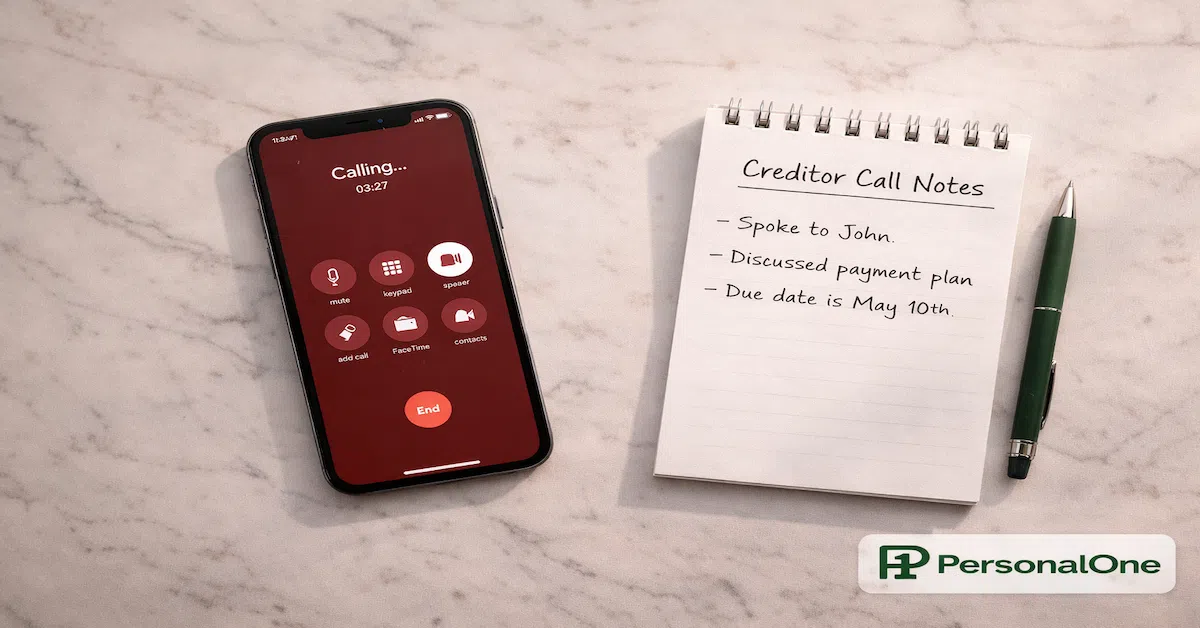
Record every call: date, time, representative’s name and ID number if provided, what was requested, and what was agreed. Request written confirmation of any agreement via email or mail before changing payment behavior. Do not rely on verbal agreements — creditor representatives change, systems do not always reflect phone agreements, and you need documentation if the agreement is not honored. If the creditor will not provide written confirmation, follow up with a letter to the creditor summarizing the agreement and requesting written acknowledgment.
Call before you miss. Ask for the hardship department. Get it in writing.
The complete framework for navigating financial crisis — including prioritizing bills, building an emergency budget, and recovering from arrears — is in the Financial Shock Absorption guide.
Explore Financial Shock Absorption →Resources
Official Sources
CFPB — Debt Collection — Consumer Financial Protection Bureau comprehensive guidance on your rights during debt collection, how to communicate with creditors, how to dispute debts, and what protections apply under federal law.
FTC — Dealing With Debt — Federal Trade Commission guidance on the Fair Debt Collection Practices Act, negotiating with creditors, understanding debt settlement risks, and finding legitimate credit counseling services.
CFPB — When a Debt Collector Contacts You — Step-by-step CFPB guidance on how to respond to creditor and collector contact, request debt validation, and negotiate payment arrangements.
Return to the financial stability guide for the complete system this cluster is part of.
Frequently Asked Questions
Will negotiating a hardship plan hurt my credit score?
A hardship plan that allows you to make reduced but consistent payments typically does less credit score damage than missing payments outright. Some creditors report hardship plans to credit bureaus and some do not — ask specifically before agreeing. A settlement for less than the full balance is reported as “settled” rather than “paid in full,” which affects your score but less severely than a charge-off or default judgment. The credit impact of proactive negotiation is almost always better than the impact of complete non-payment.
Can I negotiate my rent with my landlord?
Landlords are often more flexible than institutional creditors, particularly for tenants with strong payment history, because finding a new tenant is expensive and time-consuming. Contact your landlord directly, explain your situation, and propose a specific arrangement: a temporary rent reduction for 60–90 days, a deferred payment plan that adds a fixed amount to future months, or a one-time payment delay. Put any agreement in writing and have both parties sign it before missing a scheduled payment.
What is the difference between a hardship program and debt settlement?
A hardship program is an arrangement with a current or recently delinquent creditor to modify payment terms — reduced interest, deferred payments, or lower minimums — while you maintain the account. Debt settlement involves offering a lump-sum payment for less than the full balance on an already-delinquent account. Hardship programs are proactive and preserve credit relationships. Debt settlement is reactive, requires the account to already be in significant default for most creditors to accept it, and has more significant credit score impact. Both are legitimate tools in different stages of financial difficulty.
Disclaimer: This article is for informational and educational purposes only. Creditor programs, settlement terms, and credit reporting practices vary by institution and account type. Verify terms directly with each creditor. For complex debt situations, consider consulting a non-profit credit counselor certified through the NFCC.