Updated: May 6, 2026
Home › Budgeting & Savings › Savings Strategy & Wealth Growth › 9 Year-End Savings Challenges to Jumpstart Your Finances
TL;DR
-- Year-end motivation is real -- use December to build savings habits with short, manageable challenges before January expectations hit.
-- Start small and specific: no-spend weekends, $5 automated transfers, or 30-envelope challenges work better than overwhelming commitments.
-- Cancel the waste: subscription detox alone can free up $30–$75 monthly you are not using.
-- Automate everything possible: round-up savings, recurring transfers, and sinking funds work passively throughout the year.
-- Quick wins before January 1 create momentum that compounds -- the habit matters more than the dollar amount.
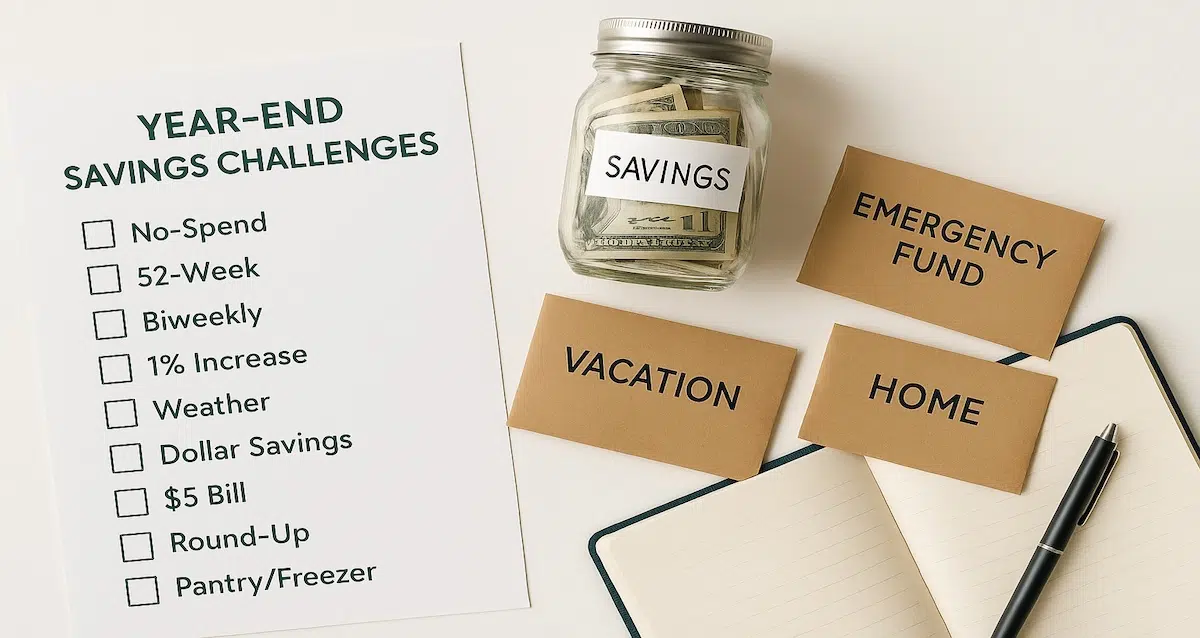
The end of the year brings a rare level of motivation. As the holidays pass and January creeps closer, there is a small window when people feel ready to reset, rebuild, or restart their financial habits. That is where year-end savings challenges come in.
You do not need a strict budget or a complicated spreadsheet. You need something simple, proven, and aligned with how real people actually spend money. These challenges are flexible, beginner-friendly, and designed to give you quick wins before the new year hits.
Why Year-End Savings Challenges Actually Work
Unlike New Year’s resolutions that often fail by February, year-end challenges leverage a unique psychological advantage: you are building momentum before the pressure of January expectations hits. These mini-challenges create immediate wins that boost confidence and establish habits you will carry into the new year.
The key is choosing challenges that match your lifestyle, income level, and current financial situation. You are not committing to perfection -- you are committing to progress. These challenges work best when they are connected to a larger savings strategy and wealth growth framework that runs year-round. And if you do not yet have a working budget underneath, learning how to build a budget that actually works before layering in savings tactics is what separates people who sustain momentum from people who run out of steam by March.
December is also a natural trigger for reviewing your finances before the new year -- pulling three months of actual spending data, identifying where the overruns happened, and resetting the budget before January rather than scrambling to fix it after. The challenges below work best when they sit on top of that audit rather than replacing it.
Challenge 1: The No-Spend Year-End Weekend
Duration: One weekend in December • Difficulty: Beginner-friendly
Instead of committing to a full no-spend month, start with one weekend. Two days of restraint resets your spending baseline without overwhelming you.
No spending on: food delivery, takeout, shopping, entertainment, or impulse purchases of any kind.
You can spend on: true essentials, emergencies, and bills already on autopay.
The impact: Most people save $100–$300 in a single no-spend weekend. More importantly, it creates a short psychological reset that recalibrates spending instincts going into the new year.
Challenge 2: The Micro-Automation Savings Challenge
Duration: Set up once, runs all year • Difficulty: Easy (10 minutes)
Set up tiny automated transfers that run passively without requiring ongoing decisions or willpower. The goal is one decision in December that pays dividends all year.
Examples: $5 every Monday = $260 saved annually. $10 every payday bi-weekly = $260 saved annually. $20 every 15th of the month = $240 saved annually. $1 daily = $365 saved annually.
How to implement: Most banks allow recurring transfers in online banking or their mobile app. Set the transfer to move money from checking to a separate savings account automatically. These small amounts compound fast when automated, and you will barely notice the transfers happening.
Challenge 3: The 30-Envelope Challenge (Minimalist Edition)
Duration: December only (4 weeks) • Difficulty: Moderate
The original 100-Envelope Challenge requires saving $5,050 total -- unrealistic during expensive holiday months. The 30-envelope version gives you structure without the burnout.
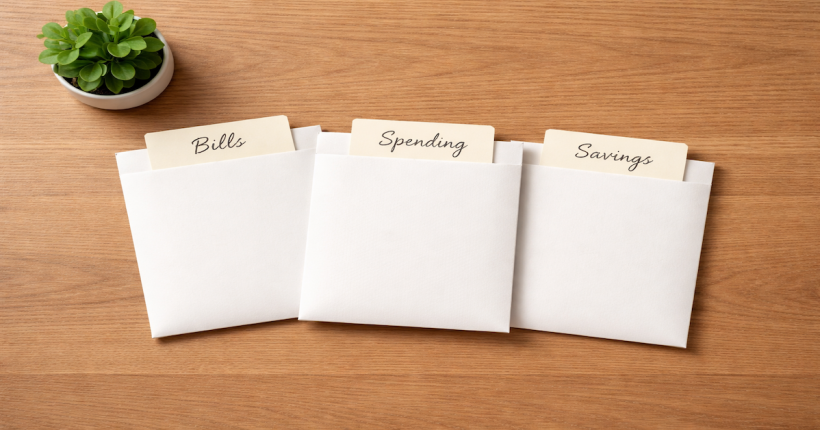
Label 30 envelopes (or digital equivalents) $1 to $30. Draw two envelopes per week in December. Save whatever dollar amount you draw, immediately. Track your progress visually.
Average savings: $250–$350 for most participants. Maximum: $465 if you draw the highest combinations.
Digital alternative: Use a notes app instead of physical envelopes and transfer the amounts immediately after drawing.
Challenge 4: The Subscription Detox Challenge
Duration: One afternoon audit + ongoing savings • Difficulty: Easy but eye-opening
The Federal Trade Commission reports that unused subscriptions cost consumers billions annually. Most people underestimate their monthly subscription spending by 30–50%.
The plan: List every subscription by reviewing three months of bank and credit card statements. Cancel anything unused. Pause anything you can resume later. Rotate between streaming platforms quarterly instead of maintaining all simultaneously.
Common subscriptions to audit: streaming services, music platforms, fitness apps, meal kits, cloud storage, software, news subscriptions, and subscription boxes.
Then automate the savings: If you cancel $40 in subscriptions, immediately set up a $40 monthly automatic transfer to your emergency fund or sinking fund. Average savings: $30–$75 monthly.
Challenge 5: The $50 Holiday Reset Challenge
Duration: One week • Difficulty: Moderate to challenging
Holiday spending blows up budgets. December credit card statements often shock people in January. This challenge repairs the damage before the new year by resetting your spending baseline fast.
Take $50 and assign it to groceries for the week, meal prep ingredients, and essential household items only. No top-ups, no dining out, no delivery. Use what is already in your pantry and freezer.
Scale it up: If $50 is too tight for your household, try $75 or $100 -- the principle remains the same. The goal is constraint, not deprivation.
Challenge 6: The Round-Up Savings Challenge
Duration: Set up in December, runs all year • Difficulty: Very easy
Many banks round transactions to the nearest dollar and save the difference automatically. A $7.63 purchase rounds to $8.00 and $0.37 moves to savings without any decision on your part.
Manual alternative: If your bank does not offer this, simulate it once per week -- calculate round-up amounts from your transactions and transfer the total to savings.
Average annual savings: $250–$500 depending on transaction frequency. Set it once and let it run passively throughout the year.
Challenge 7: The Cash-Only Week Challenge
Duration: One week • Difficulty: Moderate (requires planning)
One week. One envelope. A fixed amount of cash. Leave your debit and credit cards at home.
Withdraw your weekly discretionary budget in cash (typically $100–$200). Use only cash for all variable, non-essential spending. When the cash is gone, you are done spending for the week.
The psychology: Research shows people spend 12–18% less when using physical cash because handing over bills creates real spending awareness that card swipes do not.
Exclude from the challenge: bills on autopay, gas, and online necessities. Focus the cash constraint on dining out, entertainment, and shopping only.
Savings challenges create momentum. A complete system makes it last.
Short challenges are the starting point. Strategic savings allocation, automated surplus management, and long-term wealth building are what happen after the challenge ends. See the full framework.
Explore the Budgeting & Savings SystemChallenge 8: The 1% Income Challenge
Duration: Commit before December 31, continue monthly • Difficulty: Easy to moderate
Save just 1% of your annual income before the year ends, then maintain that habit monthly going forward.
By income level: $40,000 = $400 yearly ($33/month). $50,000 = $500 yearly ($42/month). $70,000 = $700 yearly ($58/month). $100,000 = $1,000 yearly ($83/month).
Progressive approach: Once 1% feels comfortable, increase to 2%, then 3%. The habit matters more than the percentage right now. Small consistent savings rates applied systematically over time are the foundation of real wealth accumulation.
Challenge 9: The Sinking Fund Jumpstart
Duration: Start now, fund throughout the year • Difficulty: Easy with high impact
Pick one upcoming goal and build a small starter fund for it before the year ends. Even $50–$100 creates psychological momentum and makes the goal feel real rather than abstract.
Sinking fund ideas: travel fund, car repairs, moving costs, debt payoff, next year’s holiday fund, emergency fund starter, home improvement, education or certifications.
How to start: Choose your goal. Open a separate savings account or sub-account. Contribute $50–$100 now to make it real. Set up automatic monthly transfers going forward. Calculate backward: goal amount divided by months remaining equals your monthly contribution.
The CFPB confirms that sinking funds reduce financial stress and prevent credit card dependency. When you save incrementally for known future expenses, they stop feeling like emergencies. If your first sinking fund goal is financial protection rather than a specific purchase, the most high-impact starting point is using those savings to build an emergency fund -- the buffer that prevents every future unexpected expense from becoming a debt event.
Choosing Your Challenges: A Strategic Approach
Financial progress compounds when challenges work together rather than compete. Rather than attempting all nine simultaneously, combine two or three that are complementary and match your current situation.
Beginner combination: No-Spend Weekend + Subscription Detox + Round-Up Savings. Automation-focused combination: Micro-Automation + 1% Income + Round-Up Savings. Intensive reset combination: Cash-Only Week + $50 Holiday Reset + Subscription Detox. Long-term builder combination: Sinking Fund + Micro-Automation + 1% Income.
Making Your Challenges Stick
The real value of year-end savings challenges is not just the money saved in December -- it is the momentum and habits that carry into the new year.
Track progress visually. Use a simple tracker -- digital or physical -- to mark completed challenge days or milestones. Visual progress creates motivation and accountability that abstract goals do not provide.
Automate everything possible. Challenges that require ongoing daily decisions fail more often than automated challenges. Set up recurring transfers, round-up programs, and automatic bill payments once -- then let the system do the work. One setup session in December can run the entire year. The approach to building a repeatable savings system is what converts a one-time challenge into a year-round default -- automation is the mechanism that makes the habit permanent without requiring ongoing willpower.
Adjust without abandoning. If a challenge feels too restrictive, modify it rather than quitting. A 1% savings rate beats 0%, even if you originally aimed for 3%. Progress over perfection, always.
Connect challenges to bigger goals. Specific, concrete goals drive more consistent behavior than abstract saving. Knowing exactly what you are building toward is what turns a December challenge into a year-round habit. If restriction-based challenges feel unsustainable, the approach to saving money without cutting the things you enjoy covers how to find savings margin through structural changes rather than deprivation.
Your Year-End Financial Reset
These challenges are not meant to overhaul your life -- they are meant to give you manageable wins before the new year. By cutting spending strategically, automating small transfers, detoxing unused subscriptions, and restarting your savings rhythm, you position yourself for stronger financial habits going into January and beyond.
You do not need a perfect plan. You need a simple jumpstart. Choose one, two, or three challenges that fit your situation. Commit to them. Track your progress. Carry the momentum forward. The simple money-saving habits that actually work are not dramatic -- they are small, consistent actions applied repeatedly across the year. That is what year-end challenges are designed to start.
These challenges sit inside a broader budgeting and savings system built for long-term wealth growth -- one where December momentum does not fade in January because it has been converted into automation, structure, and habits that run without ongoing effort.
Official Resources
CFPB -- Save for Your Goals & Financial Wellness -- Government tools and guidance for building savings goals, sinking funds, and emergency fund targets.
Federal Trade Commission -- What to Know About Subscription Services -- Official guidance on identifying, managing, and canceling recurring subscription charges.
Federal Reserve -- Economic Well-Being of U.S. Households Report -- Annual data on household savings rates, financial resilience, and emergency fund coverage across income levels.
Continue Learning About Budgeting & Savings
Year-end savings challenges are the entry point. The complete framework for turning short-term momentum into long-term financial stability is in the Budgeting & Savings guide.
Frequently Asked Questions
What is the easiest savings challenge to start with?
The No-Spend Weekend or Subscription Detox are the most beginner-friendly. Both require minimal planning and deliver immediate results. The No-Spend Weekend is just two days of restraint; the Subscription Detox takes one afternoon but creates ongoing monthly savings that continue automatically.
Should I do multiple challenges at once?
Start with one or two maximum. It is better to succeed at two challenges than feel overwhelmed attempting five simultaneously. Once you have completed your first challenges, add more gradually. Combinations that complement each other -- like automation plus a spending reset -- work better than stacking multiple restriction-based challenges at the same time.
How long should a savings challenge last?
For year-end challenges, one week to one month is ideal. The goal is creating momentum, not committing to unsustainable long-term restrictions. Some challenges -- like automation and round-up savings -- you set up once and they run indefinitely with no ongoing effort required.
What if I fail a challenge partway through?
Restart immediately or modify the challenge to be more realistic. If the Cash-Only Week felt too restrictive, try a Cash-Only Weekend instead. Every attempt teaches you something about your spending patterns. A 1% savings rate beats 0%, even if you originally aimed for 3%. Progress over perfection, always.
Can these challenges actually make a meaningful difference?
Yes. Combining just three challenges -- Subscription Detox ($40/month), Micro-Automation ($20/month), and Round-Up Savings ($25/month) -- creates $1,020 in annual savings. That is enough for a vacation fund, an emergency fund starter, or a significant debt payment. The key is using year-end motivation to establish habits that continue throughout the year rather than stopping on January 1.
This content is for educational purposes only and does not constitute financial advice. PersonalOne is not a licensed financial advisor, broker, or investment professional. Individual financial situations vary -- consult a qualified financial professional for personalized guidance.