Home › Debt Relief & Credit Repair › Debt Settlement Options › Debt Settlement Explained: When It Helps, When It Hurts, and What It Really Costs
About the Author
Don Briscoe is a financial systems coach with 12+ years helping Millennials and Gen Z escape paycheck-to-paycheck cycles. He founded PersonalOne to deliver the financial education he wished existed — structured, honest, and framework-first.
TL;DR — Quick Summary
- Debt settlement means negotiating to pay less than you owe — typically 40–60% of the balance, but it severely damages your credit and carries tax consequences.
- It helps when you're facing bankruptcy or default — if you can't make minimum payments and have lump sum funds available, settlement can prevent collections lawsuits.
- It hurts your credit significantly — expect 100+ point score drops, 7 years of negative marks, and difficulty getting approved for new credit.
- Real costs include fees, taxes, and credit damage — settlement companies charge 15–25% of enrolled debt, forgiven debt is taxable income, and credit impact lasts years.
- Most people have better alternatives — credit counseling, debt management plans, or strategic bankruptcy often produce better long-term outcomes.
Debt settlement sounds like relief. Commercials promise you can "pay pennies on the dollar" and "get out of debt fast." The marketing makes it seem simple — hire a company, they negotiate, you save thousands.
The reality is more complicated. Debt settlement can provide genuine relief in specific situations, but it's also one of the most damaging options for your credit and comes with hidden costs that extend far beyond the settlement fees.
This isn't a decision to make based on a late-night TV ad or a sponsored post. Understanding when debt settlement actually helps versus when it destroys your financial future requires looking at the complete picture — the mechanics, the costs, the alternatives, and the long-term consequences.
Debt settlement sits within a broader ecosystem of relief strategies. For a full map of how settlement compares to your other options, see the Debt Settlement Explained cluster hub.
What Debt Settlement Actually Means
Debt settlement is the process of negotiating with creditors to accept less than the full balance you owe as payment in full. Instead of paying 100% of what you owe, you might settle for 40–60% of the balance.
Here's how the basic mechanics work:
You stop making payments. Either on your own or under guidance from a settlement company, you stop paying your creditors. This is intentional — creditors won't negotiate seriously until they believe you genuinely can't pay.
Money accumulates in a dedicated account. Instead of paying creditors, you deposit money into a separate account. This builds the lump sum you'll eventually use to settle debts.
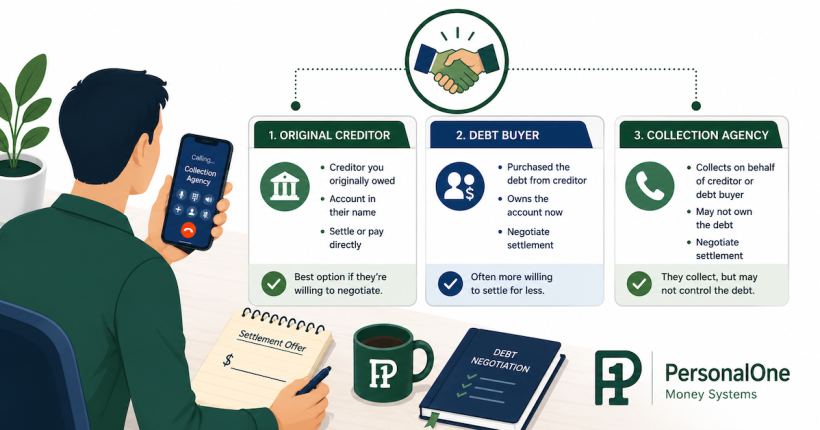
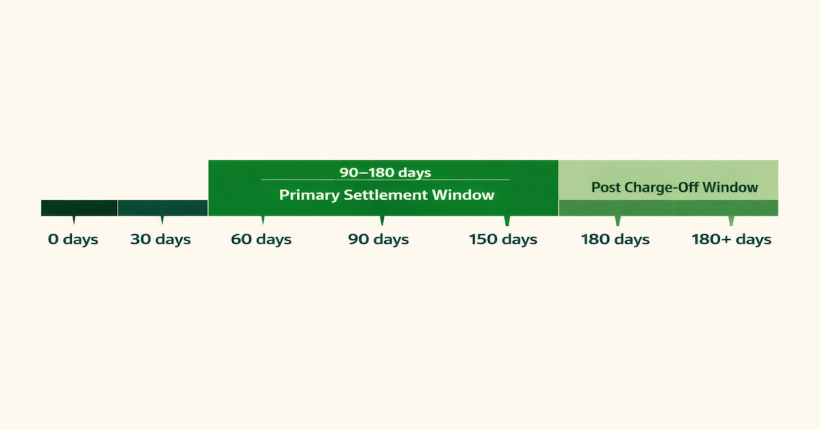
Your accounts go delinquent and eventually charge off. As months pass without payment, your accounts become 30, 60, 90+ days late. Eventually, creditors charge off the debts — typically after 180 days — and may sell them to collection agencies.
Settlement negotiations begin. Once creditors believe you can't or won't pay the full amount, they become willing to negotiate. Your settlement company — or you, if doing this yourself — offers a lump sum for less than the balance.
You pay the settled amount. If the creditor accepts, you pay the agreed amount from your accumulated savings. The creditor reports the debt as "settled" or "paid settled" on your credit report.
This process typically takes 2–4 years to complete all enrolled debts. During that time, your credit is severely damaged, you're vulnerable to lawsuits, and interest and late fees continue accumulating on unpaid balances.
Continue Learning About Debt Settlement
When Debt Settlement Actually Helps
Despite its downsides, debt settlement can be the right choice in specific circumstances. It's not for people who are just struggling — it's for people facing financial catastrophe.
Scenario 1: You're Facing Imminent Bankruptcy
If bankruptcy is your only other option, debt settlement might provide a slightly less damaging alternative. While both destroy your credit, a settled debt falls off your credit report in 7 years, whereas a bankruptcy can affect you for 7–10 years and creates additional barriers — housing applications, professional licenses, security clearances.
Settlement makes sense here if you have income but not enough to manage minimum payments, you have access to lump sum funds (tax refund, inheritance, liquidated assets), your total unsecured debt is under $50,000, and you want to avoid the public record and legal complications of bankruptcy.
Scenario 2: Your Debts Are Already in Collections
Once debts have charged off and gone to collections, your credit is already severely damaged. At this point, settlement doesn't make things much worse — the damage is done. Settling might actually help by resolving debts before they turn into lawsuits.
This works when multiple accounts are already 120+ days past due or charged off, you're receiving collection calls daily, you have realistic means to accumulate settlement funds within 6–12 months, and creditors are threatening legal action.
Scenario 3: You Have a Lump Sum Available
Debt settlement works best when you can negotiate and pay quickly. If you suddenly have access to a significant lump sum — inheritance, insurance settlement, liquidated retirement account, bonus — you can potentially settle debts rapidly and minimize the damage period.
This scenario is effective when you have 40–60% of your total debt available immediately, you can negotiate and close settlements within 3–6 months, and you're willing to accept the credit damage in exchange for debt elimination.
Real Example: Sarah had $35,000 in credit card debt across five accounts. After a job loss, she couldn't make minimum payments — her only other option was bankruptcy. She negotiated settlements herself, paying $14,000 total (40% of balances) using money from liquidating her 401(k). Her credit score dropped from 680 to 520, but she avoided bankruptcy and was debt-free in 8 months. Three years later, her score had recovered to 640.
These three scenarios represent the narrow set of situations where settlement is a legitimate tool. For a full breakdown of how settlement fits alongside bankruptcy, credit counseling, and other relief paths, see the Debt Settlement Explained cluster hub.
When Debt Settlement Destroys Your Financial Future
For every situation where settlement makes sense, there are ten where it's the wrong choice. The marketing hides these scenarios, but they represent the majority of cases.
When You Can Still Make Minimum Payments
If you're currently managing minimum payments — even if it's tight — settlement is almost certainly a mistake. Intentionally destroying your credit when you have functioning accounts makes no financial sense. Better options exist: credit counseling and debt management plans, balance transfer cards if your credit is still good, debt consolidation loans, negotiating lower interest rates directly with creditors. These options preserve your credit while reducing your debt burden.
When You Don't Have Settlement Funds
Many people enroll in debt settlement programs without realistic means to accumulate settlement funds. They're told to deposit $200–300 monthly into their settlement account, but this amount is insufficient to settle debts quickly. Meanwhile, late fees and interest accumulate on unpaid debts, your balances increase despite not paying, settlement companies take their fees first (15–25% of enrolled debt), it takes 3–4 years to settle all debts with your credit destroyed the entire time, and creditors may sue before you accumulate enough to settle.
Critical Reality Check: If you can't afford minimum payments of $800/month but can afford settlement deposits of $300/month, you're better off applying that $300 toward actual debt through a debt management plan. Your credit stays intact and creditors work with you instead of against you.
When You Have Secured Debt or Student Loans
Debt settlement only works on unsecured debt — primarily credit cards and medical bills. It doesn't work on mortgages (foreclosure happens instead), auto loans (repossession happens instead), student loans (federal loans have better hardship options, private loans rarely settle), or tax debt (the IRS has its own negotiation programs). If most of your debt is secured or non-dischargeable, settlement won't solve your problem.
When You're Young and Building Credit
If you're in your 20s or early 30s, settlement can derail major life milestones for years: difficulty getting approved for mortgages, higher interest rates on auto loans, problems renting apartments, issues with employment background checks, and inability to qualify for rewards credit cards. Younger people almost always have better long-term outcomes by choosing slower repayment options that preserve credit.
The Real Costs of Debt Settlement
Settlement companies emphasize savings — "We saved you $15,000!" — but they don't clearly explain the actual total cost.
Direct Financial Costs
Settlement company fees: Legitimate companies charge 15–25% of enrolled debt. On $30,000 in enrolled debt, you're paying $4,500–7,500 in fees alone.
Late fees and interest: While you're not paying creditors, your balances grow. A $5,000 balance can balloon to $7,000+ over 18 months of non-payment.
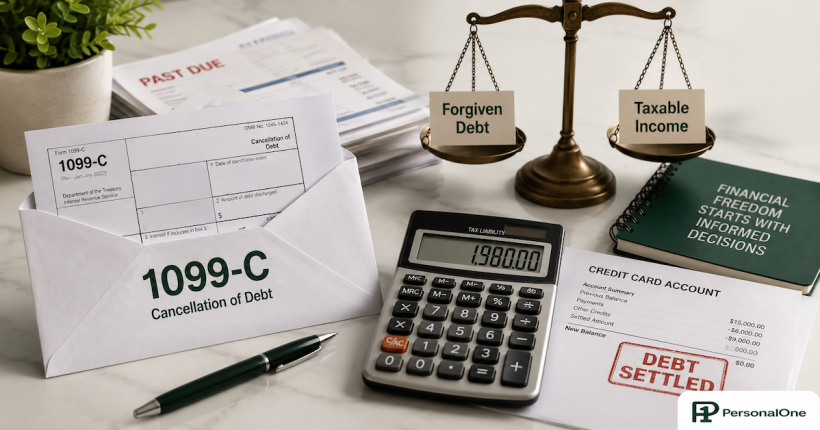
Tax consequences: Any forgiven debt over $600 is reported to the IRS as taxable income. If you settle $20,000 in debt for $10,000, you receive a 1099-C for $10,000. At a 22% bracket, that's a $2,200 tax bill you weren't expecting.
Real Cost Example: $30,000 Debt Settlement
Marketed Savings: "Settle $30,000 for only $12,000 — save $18,000!"
Actual Costs:
- Settlement payments: $12,000
- Company fees (20%): $6,000
- Accumulated interest/fees: $3,000
- Tax on forgiven amount (22%): $3,960
- Total Cost: $24,960
Actual Savings: $5,040 — not $18,000. Plus a 100+ point credit score drop lasting 7 years.
Credit Score Impact
Immediate damage: Missing payments drops your score 60–100+ points within the first few months.
Charge-offs: When accounts charge off at 180 days late, your score drops another 40–60 points per account.
Settled accounts: "Paid settled" notations remain for 7 years from the date of first delinquency — not from the settlement date.
Total drop: Most people see scores fall 100–200+ points. A 720 score can drop to 520. A 650 score can drop below 500.
Opportunity Costs
The hidden costs are often larger than the financial ones: difficulty getting approved for rentals or mortgages for 3–5 years minimum, significantly higher interest rates when you do get approved, higher auto and home insurance premiums tied to credit scores, employment barriers for financial or security-clearance positions, and loss of access to rewards credit products.
How Long Debt Settlement Actually Takes
Settlement companies often suggest timelines of "24–48 months," but the reality varies dramatically based on your situation.
Best case (rare): 6–12 months if you have lump sum funds and can settle quickly.
Typical case: 24–36 months for most debts, longer for holdout creditors who refuse to settle.
Worst case (common): 48+ months if you can only deposit small amounts monthly, or indefinite if creditors sue before you accumulate enough to settle.
During this entire period your credit remains severely damaged, collection calls and letters continue, you're vulnerable to lawsuits, and balances keep growing with fees and interest.
Red Flags: When Settlement Companies Are Scamming You
The debt settlement industry has significant regulation problems. While some legitimate companies follow federal regulations, predatory operators are common. Watch for these warning signs:
Upfront fees before settling any debt: It's illegal for companies to charge fees before successfully settling debts. Upfront payment requests are a scam.
Guarantees of specific savings: No company can guarantee creditors will accept specific settlement amounts. "We guarantee 50% savings!" is false.
Pressure to enroll immediately: Legitimate companies give you time to consider. "This offer expires today!" signals problems.
Claims that settlement doesn't hurt credit: Any company saying settlement won't damage your credit is lying. It always damages credit significantly.
Tells you to stop communicating with creditors entirely: This can expose you to lawsuits before you've accumulated settlement funds.
Promises to stop all collection calls immediately: They can't stop calls until debts are settled. Claims otherwise are false.
FTC Rule: The Federal Trade Commission's Telemarketing Sales Rule prohibits debt settlement companies from charging fees before settling debts. If a company asks for upfront payment, report them to the FTC and your state attorney general.
Alternatives That Usually Work Better
Before choosing settlement, consider these alternatives that often produce better long-term outcomes:
Credit Counseling and Debt Management Plans
Nonprofit credit counseling agencies create debt management plans where you make one monthly payment distributed to creditors. Creditors often reduce interest rates to 0–8%, no credit damage from missed payments, accounts remain in good standing, and typical completion runs 3–5 years. Best for people who can afford reduced payments but struggle with current minimums.
Direct Creditor Negotiation
Contact creditors yourself to request reduced interest rates, hardship programs with lower payments, suspended late fees, or extended repayment periods. Many creditors have legitimate hardship programs that preserve your credit while reducing payments — at no cost to you.
Balance Transfer Cards
If your credit is still good (650+), balance transfer cards offering 0% APR for 12–21 months let you pay down principal without interest accumulation. Best for people with functioning credit who need breathing room to pay down balances aggressively.
Debt Consolidation Loans
Personal loans that consolidate multiple debts into one payment at a lower interest rate — typically 7–15% vs. credit card rates. One payment, fixed repayment timeline, no credit damage if you maintain payments. Best for people with decent credit (620+) who can qualify for reasonable rates.
Strategic Bankruptcy
If you're truly insolvent and settlement isn't working, bankruptcy can stop all collection activity immediately, discharge debt completely with no tax consequences, and often allows credit recovery to begin faster than settlement. Chapter 7 stays on your credit for 10 years, but many people see scores recover to 650+ within 2–3 years if they rebuild deliberately.
DIY Debt Settlement: Worth the Risk?
You can negotiate settlements yourself without hiring a company — saving the 15–25% company fees, but requiring significant time, knowledge, and stress tolerance.
Advantages: Save thousands in fees, direct control over negotiations, faster settlements if you have lump sum funds, and no dependence on settlement companies.
Disadvantages: Dealing with aggressive collection calls daily, negotiating without experience or leverage, risk of accepting bad settlement terms, no protection if creditors sue, and the full emotional and time burden on you.
If you attempt DIY settlement: get all agreements in writing before paying anything, never give creditors access to your bank account, pay with cashier's checks or money orders and keep records, verify accounts are reported as "paid settled" on your credit report, and be prepared for 1099-C tax forms for every forgiven amount.
What to Know About Taxes and Forgiven Debt
This is the surprise that catches most people unprepared. Forgiven debt is considered taxable income by the IRS.
How it works: If you settle a $10,000 debt for $4,000, the $6,000 difference is "cancellation of debt income." The creditor sends you Form 1099-C, and you must report it on your tax return. At a 22% bracket, that's $1,320 in additional taxes.
Exceptions apply if you're insolvent at the time of settlement (liabilities exceed assets), the debt is discharged in bankruptcy, or the debt is qualified farm or real property business debt. The insolvency exception is most common for settlement — you'll need IRS Form 982 and documentation that liabilities exceeded assets when the debt was forgiven.
Critical: Set aside 25–30% of every forgiven amount for taxes. If you settle $20,000 for $8,000 (saving $12,000), put $3,000–3,600 aside for tax season. Not doing this leaves you with an unexpected tax bill that can spiral into new debt — the exact problem you were trying to solve.
Before You Decide on Debt Settlement
Debt settlement is one option within a larger spectrum of relief strategies. The right choice depends on your debt type, income stability, and long-term financial goals — and getting it wrong costs years of recovery time.
The debt relief and credit repair system maps every available option and routes you to the path that matches your actual situation.
View the Full Debt Relief System →Continue Learning About Debt Settlement
Resources
Official Sources
- Federal Trade Commission — Debt Relief Services
- CFPB — Negotiating With Debt Collectors
- IRS — Cancellation of Debt (Tax Topic 431)
This article is part of the Debt Relief & Credit Repair authority hub — the complete system for understanding your options, resolving debt, and rebuilding on solid ground.
Frequently Asked Questions
Will debt settlement stop creditors from suing me?
No. Debt settlement doesn't provide legal protection from lawsuits. Creditors can sue at any time while you're not paying. Some creditors — Capital One and Discover among them — are known for suing relatively quickly. Once you're sued, you lose negotiating leverage because the creditor has a judgment and can garnish wages or bank accounts.
Can I keep some credit cards out of settlement and maintain good credit on those?
Technically yes, but it rarely works in practice. If you're not paying some creditors, others often close your accounts anyway when they see delinquencies. More importantly, if you can afford to keep some accounts current, you can probably afford credit counseling instead — which would protect all your accounts.
How much will creditors typically accept in settlement?
It varies widely. Credit card companies often settle for 40–60% if accounts are severely delinquent (120+ days). Collection agencies that bought your debt for pennies on the dollar might accept 20–40%. Medical debt often settles for less. But there are no guarantees — some creditors refuse to settle, especially if you have assets they can pursue through legal action.
Can I do debt settlement while still employed?
Yes, but employment makes you more vulnerable to lawsuits. Creditors are more likely to sue if they know you have wages to garnish. Settlement tends to work better — or less badly — for people with limited income and no attachable assets, because creditors know they can't collect much through legal action.
What happens if I enroll in debt settlement but can't follow through?
You're left worse off than when you started. Your credit is destroyed from months of non-payment, your balances are higher from accumulated fees and interest, you may have paid settlement company fees with nothing to show for it, and you still face the original debt plus potential lawsuits. This is why having realistic settlement funds in place is critical before starting the process.
How long does debt settlement stay on my credit report?
Settled accounts remain on your credit report for 7 years from the date of first delinquency — not from the settlement date. So if you went delinquent in January 2024 and settled in June 2025, the negative marks stay until January 2031. The impact on your score diminishes over time, but the record remains for the full 7 years.