Updated: May 12, 2026
Home › Credit Building & Protection › Credit Utilization & Payment Strategy › How Credit Card Payments Actually Affect Your Credit Score
Part of the Credit Utilization & Payment Strategy cluster.
About the Author
Don Briscoe is a financial systems strategist with 12+ years of experience helping Millennials and Gen Z build income and financial stability. He founded PersonalOne to provide the financial education he wished existed — structured, honest, and free.
What You Need to Know
— Credit card companies report your balance to the bureaus on your statement closing date, not your payment due date.
— Paying in full after the statement closes still means the bureaus saw a high balance. Pay before the closing date to control what gets reported.
— Utilization resets every month — there is no historical penalty. A score suppressed by high utilization can recover in a single billing cycle.
— This guide covers how utilization is calculated, specific strategies for managing reported balances, and how to time payments before a major loan application.
Paying on time is not the whole story. How credit card payments affect your credit score depends just as much on when your balance gets reported to the bureaus as it does on whether you pay at all — and those two things happen on completely different dates. Getting this wrong costs points every single month without any obvious signal that it is happening.
This guide breaks down exactly how the reporting and payment cycle works, why paying in full is not enough on its own, and the specific strategies for controlling what the credit bureaus actually see on your file. It also covers how to time everything tactically before a mortgage or auto loan application, where a few score points can translate directly into a better rate.
The Reporting Date vs. Due Date Confusion
There is a widespread assumption about how this works: you receive a statement, pay the balance by the due date, and the bureaus see a zero balance. That is not what happens. What they do not understand is that when you pay, and what balance gets reported, can have a larger impact on your credit score than the payment itself.
Your credit card company reports your balance to the bureaus on your statement closing date, not your payment due date. The two dates are typically 21 to 25 days apart. Most people assume the sequence works like this: they receive a statement, pay the balance by the due date, and the bureaus see a zero balance. That is not what happens.
Here is the actual sequence: the statement closes on the closing date and the balance at that moment gets reported to the bureaus. You receive the statement a few days later. The payment is due 21 to 25 days after closing. You pay in full on the due date. But the bureaus already received a report showing the high balance from three weeks earlier. Your utilization for that month reflects that high balance — regardless of the fact that you paid in full.
Key point: The balance that affects your credit score is the balance on your statement closing date — not the balance when you make your payment. If you charge $5,000 and pay it off two days after the statement closes, the bureaus see $5,000, not $0.
How Credit Utilization Is Actually Calculated
Credit utilization — the percentage of available credit you are using — accounts for approximately 30% of your FICO score. It is the second most important factor after payment history. The calculation is straightforward: balance reported divided by credit limit equals utilization percentage. A $3,000 balance on a $10,000 limit is 30% utilization. Understanding this is foundational to any credit utilization payment strategy that actually moves the needle.
FICO applies increasingly significant score penalties as utilization climbs. The 0 to 10% range is optimal and generates the maximum points available for this factor. The 10 to 30% range is considered good with a minor reduction. Between 30 and 50%, the impact becomes noticeable. Between 50 and 70%, utilization begins causing significant score damage. Above 70%, the damage is severe and can reduce scores by 50 to 100 points or more depending on the rest of the profile.
FICO calculates utilization in two ways simultaneously — both per individual card and across all cards combined. You can have excellent overall utilization while a single maxed-out card creates a separate penalty. Keeping each individual card below 30% matters, not just the aggregate number.
Same Spending, Different Scores: A Real Example
Person A has a $5,000 limit, spends $4,000 monthly, and pays the full balance on the due date. Statement closes with $4,000 balance. Reported utilization: 80%. Score impact: negative 50 to 80 points.
Person B has the same $5,000 limit, spends the same $4,000 monthly, but pays $3,500 before the statement closes. Statement closes with $500 balance. Pays remaining $500 on due date. Reported utilization: 10%. Score impact: neutral to positive.
Both people spend $4,000 and pay $4,000. Person B's score is 50 to 80 points higher because of payment timing alone.
What I've Seen
One of the most common patterns I've seen is people doing everything right — paying their credit cards in full every month — and still watching their credit score stall or drop.
In one case, someone was putting $3,000 to $4,000 a month on a single card with a $5,000 limit. They never carried a balance. They paid in full every single month. On paper, that sounds perfect.
But their score kept coming back 40 to 60 points lower than expected. The issue wasn't debt — it was timing. Their statement was closing with a high balance every cycle, so the credit bureaus consistently saw 70% to 80% utilization, even though the balance was paid off weeks later.
The fix was simple but completely non-obvious: make one payment before the statement closed. Within a single billing cycle, their reported utilization dropped under 10%, and their score rebounded almost immediately.
The takeaway: the biggest mistake isn't missing payments — it's assuming that paying in full automatically optimizes your score. Without controlling what gets reported, you can do everything right and still lose points every month.
Strategy 1: Pay Before the Statement Closes
The most direct way to control your reported utilization is to pay down your balance before your statement closing date. The goal is to let the statement close with a low balance — ideally below 10% of your credit limit — regardless of how much you spent during the billing cycle. Anyone working to increase their credit score quickly using timing strategies will find this single habit is the highest-leverage change available.
To implement this, find your statement closing date. It appears on any previous statement or you can call the issuer. Three to five days before that date, make a payment that brings your balance down to your target level. Let the statement close with the low balance, then pay the remaining small amount by the due date.
The three-to-five day buffer matters because payments take one to three business days to post and clear. A payment made the day before closing may not post in time. Build that buffer in as a standing rule rather than cutting it close, and the strategy runs reliably without requiring active judgment each month.
Strategy 2: Multiple Payments Per Month
Instead of one large payment at the end of the billing cycle, make smaller payments throughout the month as spending occurs. This keeps the running balance low at all times, which means the balance is already low when the statement closes — without requiring a large lump sum payment a few days before closing.
A simple version: if you spend $1,000 in week one, pay $1,000 at the end of week one. Repeat for weeks two and three. By the time the statement closes, only your final week of spending appears as the outstanding balance. On a $5,000 limit with $4,000 in monthly spending, the statement closes at $1,000 — 20% utilization — rather than $4,000, which would be 80%.
This approach requires no change to spending habits. It only changes when money moves. How well this works in practice often depends on your cash flow timing — specifically whether you have enough buffer in your checking account to make payments before payday. A buffer account system is the infrastructure that makes early payments consistently possible rather than sporadic. For anyone with a checking account and credit card at the same bank, the transfers can typically be completed in seconds through a single app.
Strategy 3: The $0 Balance Nuance
Counterintuitively, having every card report a $0 balance is not the optimal FICO outcome. The scoring model prefers to see active, responsible credit use — which means some utilization is better than none. People with the highest FICO scores typically have one card reporting a small balance in the 1 to 5% range while all other cards show $0.
The practical setup: designate one card as your reporting card for a given month. Let it close with a small balance — $50 to $150 on a $3,000 limit, for example. Pay it in full after the statement closes. All other cards get paid to zero before their statements close. This signals active engagement with credit while keeping utilization negligible. The score difference between all-zero and one-card-at-1-to-5% is modest — typically 5 to 15 points — but it can matter when you are close to a score tier threshold.
When Payment Timing Does Not Matter
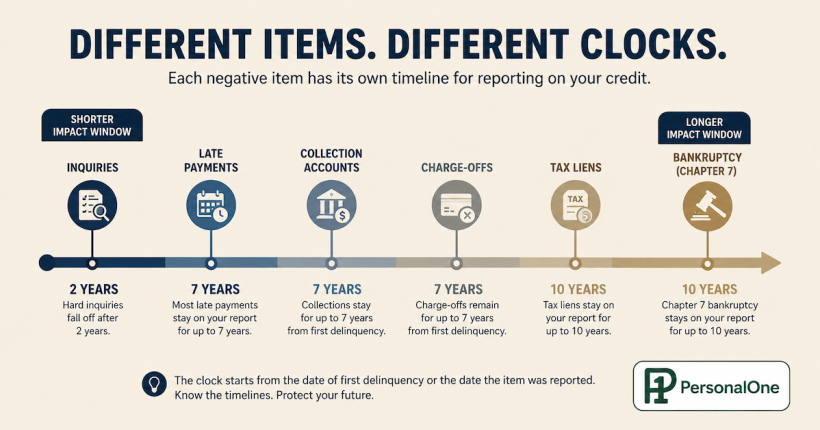
Understanding where timing is irrelevant helps you focus effort where it produces results. For avoiding late payment reporting, whether you pay on day one or day 29 of your grace period makes no difference to your payment history — as long as you pay before the due date. One day late is treated the same as 29 days late for bureau reporting purposes.
For interest charges, paying your full statement balance by the due date avoids interest entirely, regardless of when during the grace period you pay. Pre-statement payments do not accelerate your interest savings relative to a full balance payment on the due date.
For cards you rarely use, payment timing is largely irrelevant. If a card closes with a $40 balance on a $5,000 limit, the utilization is below 1% regardless of when during the cycle you pay. Reserve the pre-statement payment effort for cards where you carry significant monthly spending relative to the credit limit.
Payment Timing Before a Major Loan Application
If you are planning to apply for a mortgage, auto loan, or any product where rate is tied to your score, payment timing becomes tactical. Utilization resets every month — there is no history attached to it, only the current reported balance. What matters is what the bureaus show when the lender pulls your file. For a full picture of all five FICO factors and how they interact, understanding how credit scores work and what gets reported to the bureaus is essential context before going into application mode.
60 to 90 Days Before Applying
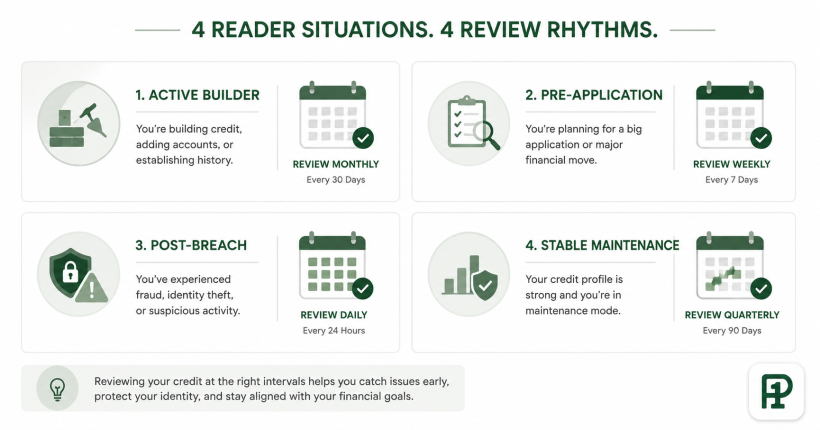
Begin consistent utilization management. Pay all card balances to below 10% before each statement closes. Avoid new credit applications. Monitor your reported balances monthly through AnnualCreditReport.com to confirm the lower utilization is actually being reflected in your file — there can be a one-cycle lag between your payment and the bureau update.
30 Days Before Applying
Pay all cards to $0 except one card carrying 1 to 5% utilization. Time the payments so low balances will have reported to the bureaus one to two weeks before the application date — this means working backward from each card's closing date, not the application date. Verify all payments have cleared and pull your own credit report to confirm the reported balances reflect your payments.
Application Week
Do not make large purchases on any credit card. Do not close accounts. Do not apply for other credit. Keep balances stable until the application is approved and funded. Any significant shift in your credit profile between application and closing can affect approval or the rate you receive.
Autopay Settings and Utilization
Autopay protects your payment history. It does not manage utilization. These are two separate jobs requiring two separate approaches.
Statement balance autopay pays your full balance on the due date and eliminates interest. But it does not reduce reported utilization because the statement has already closed and reported a high balance before the payment is made. Minimum payment autopay prevents late payment reporting but leaves the full balance accumulating and reporting monthly. Both are incomplete solutions for utilization management.
The optimal setup uses both: set minimum payment autopay as a permanent safety net, then layer manual pre-statement payments on top. The autopay minimum prevents the worst outcome — a missed payment destroying your score in a busy or disorganized month. The manual payment controls what gets reported. Each addresses a different risk, and together they cover the full system.
The Impact of Holiday Spending on Reported Balances
High-spend periods like the holiday season create a predictable utilization spike that catches many people off guard. Spending that looks normal relative to income can push a card well above 30% utilization during November and December, and that higher balance gets reported before most people realize the damage is done. Understanding how holiday spending impacts your reported balances and building pre-statement payments into that season specifically can prevent a months-long score recovery.
The fix is the same as any other month — pay down the balance before the statement closes — but it requires proactive awareness during a period when most people are focused on spending, not credit management. Setting a calendar reminder to make a pre-statement payment in the second week of December, regardless of spend level, is the kind of infrastructure-based habit that removes the decision from the moment entirely.
Managing Multiple Cards
For two to three cards, identify all statement closing dates and schedule pre-statement payments three to five days before each. Designate one card as the reporting card and let it close with a small balance. Pay all others to zero or near-zero before their closing dates.
For four or more cards, a consolidation approach reduces the tracking overhead. Concentrate most spending on one primary card, keep other cards at minimal balances, and manage utilization on the primary card only. Rotate the primary card every few months to keep all accounts showing activity — extended inactivity can lead issuers to close cards, which reduces available credit and can raise overall utilization. The long-term effect of paying off credit cards and how it reduces utilization over time is compounded when you are also managing the reported balance each cycle.
One practical shortcut: call each issuer and request a statement closing date change. Most allow this once per year. Aligning all closing dates to the same date converts a multi-tracking problem into a single monthly event and dramatically reduces the management friction.
Business Cards and Personal Credit
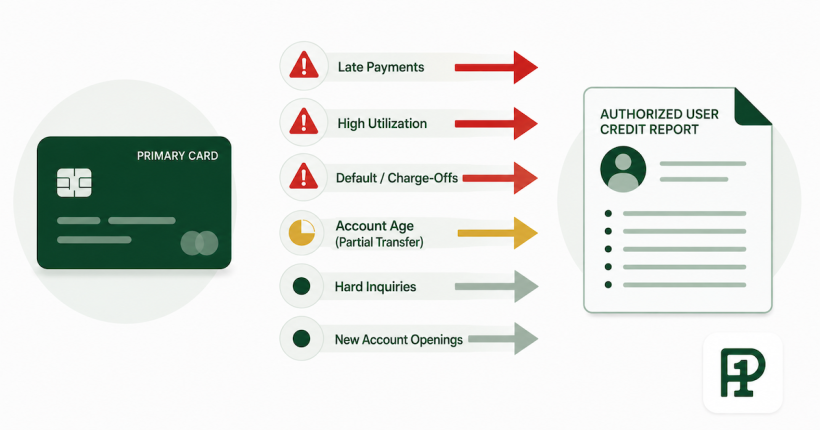
Business credit cards issued in your name typically do not report balances to personal credit bureaus as long as payments are on time. This creates a useful opportunity: high-volume spending that would push personal card utilization above target thresholds can be routed through a business card instead, leaving personal utilization clean without restricting spending.
The important caveat is asymmetric: responsible balance levels on business cards are invisible to personal bureaus, but late payments generally are not. Maintain on-time payments on business cards with the same discipline applied to personal accounts.
Build a Complete Credit Score System
Payment timing and utilization are two of the highest-leverage variables in your credit profile. The PersonalOne Credit Building & Protection guide covers all five FICO factors — including how to build history, protect your score, and use credit as a deliberate tool. Free, no signup required.
Want to estimate your score impact? Use the Credit Score Impact Calculator to see how changes in utilization and payment timing could affect your specific profile.
Framework-first. Less willpower. More infrastructure.
Resources
myFICO: What's In Your Credit Score — Official FICO breakdown of the five score factors and their weights, including utilization.
CFPB: What Is a Credit Utilization Rate? — Consumer Financial Protection Bureau explanation of how utilization is calculated and why it matters.
AnnualCreditReport.com — Pull your free weekly credit reports from all three bureaus to verify what balances are actually being reported.
For the full framework covering all five FICO factors, visit the Credit Building & Protection authority hub.
Frequently Asked Questions
If I pay my credit card in full every month, why is my utilization still high on my credit report?
Paying in full by the due date avoids interest but does not lower reported utilization if payment happens after the statement closes. The bureaus receive your balance at the moment the statement closes — typically three to four weeks before your payment is due. To lower reported utilization, the balance reduction needs to happen before that closing date.
How many days before my statement closes should I make a pre-statement payment?
Three to five days is the reliable window. This allows one to three business days for the payment to post and clear before the balance is calculated and reported. A payment made the same day as closing or the day before is too tight — bank processing times vary and a payment that does not clear in time will not reduce the reported balance.
Is it bad to have all cards reporting $0 balances?
Not harmful, but not optimal. FICO algorithms favor accounts showing active, responsible use. Having every card report $0 can result in a marginally lower score than having one card report 1 to 5% utilization. The practical difference is typically 5 to 15 points. If you are optimizing before a major application, the one-card-with-a-small-balance approach outperforms the all-zero approach at the margin.
Does making multiple payments per month hurt my credit score?
No. The bureaus see only the balance reported on your statement closing date — not the number of payments made during the billing cycle. Making four payments instead of one is invisible to the scoring model. The only thing that affects utilization is the balance at the moment the statement closes.
How quickly will my score improve after lowering my reported utilization?
Utilization is recalculated monthly when your card issuer reports the new balance. Once a lower balance is reported, the score improvement typically appears within days. Most people see the change within 30 to 45 days of implementing a pre-statement payment strategy. Unlike late payment marks, utilization carries no historical penalty — only your current reported balance matters. A score suppressed by high utilization can recover to its full potential in a single billing cycle.
If I am one day late on a payment, will it appear on my credit report?
Generally no. Most issuers do not report a late payment to the bureaus until it is 30 or more days past due. A payment that is a few days late but paid before the 30-day mark will typically result in a late fee — usually $25 to $40 — but will not appear on your credit report. Pay immediately and call your issuer. Many will waive the first late fee as a one-time courtesy, and the credit file stays clean as long as payment clears before the 30-day threshold.
This content is for educational purposes only and does not constitute financial advice. PersonalOne is not a licensed financial advisor, broker, or investment professional. Individual financial situations vary — consult a qualified financial professional for personalized guidance. Credit score calculations vary by scoring model (FICO, VantageScore) and individual credit profile. Results from payment timing strategies will vary. Statement closing dates, due dates, and reporting practices differ by card issuer — always verify your specific account details directly with your issuer.