Updated: September 28, 2026
Home › Investing & Wealth Growth › Real Estate Investing: Rental Property & REITs
What You Need to Know
— Real estate investing works best after your foundation is in place: a funded emergency fund, no high-interest debt, strong credit, and enough cash for a down payment plus reserves.
— There are two paths: REITs, which trade like stocks and need no management, and direct ownership, which offers leverage and control but demands capital and active management.
— A rental only works if it produces positive cash flow after every expense. Negative cash flow means you are paying to own it.
— The 1% rule screens deals quickly, the 50% rule estimates expenses, and cash-on-cash return tells you whether a deal is worth your money.
— House hacking, which means living in one unit and renting the others, is usually the lowest-barrier way to try direct ownership.
— Leverage amplifies gains and losses alike. A 20% price drop can erase a 20% down payment.
Are You Ready for Real Estate Investing?
Real estate investing for beginners starts with a question most guides skip: are your finances ready to absorb what real estate can throw at them? This is later-stage wealth building in the PersonalOne Money System, not a shortcut. The mechanics are not the hard part. The hard part is having a foundation strong enough that one bad month, one vacancy, or one failed water heater does not turn a good idea into a financial emergency.
Before you buy a rental property, these five things should already be true:
— A fully funded emergency fund. PersonalOne's standard is six months of expenses. Real estate produces surprise costs, such as a roof, HVAC system, or foundation repair, that can run into five figures. Without a cash cushion you may be forced to sell at the worst possible time or borrow to cover the gap.
— No high-interest consumer debt. Credit card interest at 20% or more destroys more wealth than most real estate creates. If balances are still in the way, start with the Debt Relief and Credit Repair guide before adding a mortgage to your life.
— Strong credit. PersonalOne's working benchmark is a score of 720 or higher, because credit drives your mortgage rate. On a $200,000 loan, the difference between 6.5% and 7% is roughly $66 a month, or about $24,000 over 30 years. If your score needs work, the credit building and protection guide is the place to begin.
— A down payment of 20% to 25%, plus three to six months of property reserves. On a $250,000 property, that means roughly $50,000 to $62,500 down and $15,000 to $30,000 in reserves, or about $65,000 to $92,500 before closing costs, which typically add another 3% to 4%.
— Stable income and a settled primary residence. Unpredictable income combined with mortgage debt is how foreclosures start. Get your own housing situation stable before you add investment property complexity.
If any of these is missing, the better move is to build that foundation first. A REIT can give you real estate exposure in the meantime without the capital requirements, which is covered below.
What Real Estate Investing Actually Is
Real estate investing means putting money into property, or into assets backed by property, to generate income, appreciation, or both. That covers everything from owning a duplex to holding shares in a company that owns warehouses. What all of it has in common is that returns come from the underlying real estate, not from a paycheck. Real estate is also just one asset class among several, and the Investing & Wealth Growth guide shows how it fits alongside stocks, retirement accounts, and your other holdings.
The Two Ways Real Estate Pays You
Cash flow is the monthly rent left over after every expense. It is immediate and tangible, because you get paid as you go. Appreciation is the increase in property value over time. Long-run averages of roughly 3% to 4% a year are commonly cited, but appreciation varies widely by market and by period, and it stays on paper until you sell.
Why Real Estate Can Build Wealth
— Leverage: you control a $250,000 property with $50,000 down. A 10% rise in value is a $25,000 gain on $50,000 invested, a 50% return on your cash.
— Forced savings: tenants' rent pays down your mortgage, so every payment builds equity whether or not you feel like saving that month.
— Tax advantages: depreciation, mortgage interest deductions, and 1031 exchanges can reduce or defer taxes. The rules are technical and change, so confirm your situation with a CPA; IRS Publication 527 covers rental depreciation and deductions.
— Inflation hedge: rents tend to rise with inflation while a fixed-rate mortgage payment stays the same, which widens your margin over time.
— A tangible asset: you can see it, improve it, and control decisions about it in a way you cannot with a share of stock.
Why Real Estate Can Destroy Wealth
— Leverage amplifies losses: a 20% drop in value wipes out a 20% down payment entirely. On paper you are underwater, and you may be unable to sell without losing money.
— Illiquidity: you cannot sell a building in an afternoon. If the market stalls for years, you may be stuck carrying costs the whole time.
— Active management: tenants call at inconvenient hours, systems fail, and evictions can cost thousands of dollars. This is closer to a second job than passive income.
— Concentration risk: one property is one bet. A declining neighborhood, a school district losing funding, or a major employer closing can hit your whole investment at once.
— Hidden costs: vacancy is commonly modeled at around 10% of rent, maintenance at roughly 1% to 2% of property value per year, and big-ticket items like a roof or HVAC system arrive on their own schedule.
Real estate is not a get-rich-quick scheme. It is a get-rich-slow strategy that rewards capital, knowledge, risk tolerance, and patience. Done with a solid foundation, it can build substantial wealth. Done prematurely, it can do serious damage.
REITs vs Direct Ownership: The Decision Framework
There are two broad ways to invest in real estate: through Real Estate Investment Trusts (REITs), which are companies that own or finance income-producing property and sell shares you can buy like stock, or through direct ownership of physical property. They are very different experiences, and choosing the wrong one for your situation is one of the most common early mistakes.
| Feature | REITs | Direct Ownership |
|---|---|---|
| Cost to Start | The price of a share, often under $100 | Roughly $65,000 to $100,000 for a $250,000 property |
| Liquidity | High for publicly traded REITs; sell when markets are open | Low; selling can take months |
| Management | None; handled by the REIT's team | You, or a manager typically paid around 10% of rent |
| Leverage | None on your side; you cannot use a mortgage to amplify your position | Yes; a mortgage magnifies both gains and losses |
| Diversification | High; one share spreads across many properties | Low; one property is one bet |
| Taxes | Dividends generally taxed as ordinary income | Depreciation and interest deductions may apply |
| Best For | Beginners and anyone wanting exposure without becoming a landlord | Investors with a solid foundation, capital, and tolerance for active management |
Start with REITs if you are building a diversified portfolio, do not want to be a landlord, have limited capital to invest, or want the ability to sell quickly. Consider direct ownership if you have $65,000 to $100,000 in available cash, have your financial foundation in place, are willing to manage the property or pay for management, understand landlord-tenant law in your state, and can absorb five-figure surprise expenses without distress.
The Math: Cash Flow Analysis Framework
A rental property succeeds or fails on cash flow. If the rent does not cover every expense with room to spare, you are subsidizing a building every month and hoping appreciation eventually bails you out. That is speculation, not investing.
The Cash Flow Formula
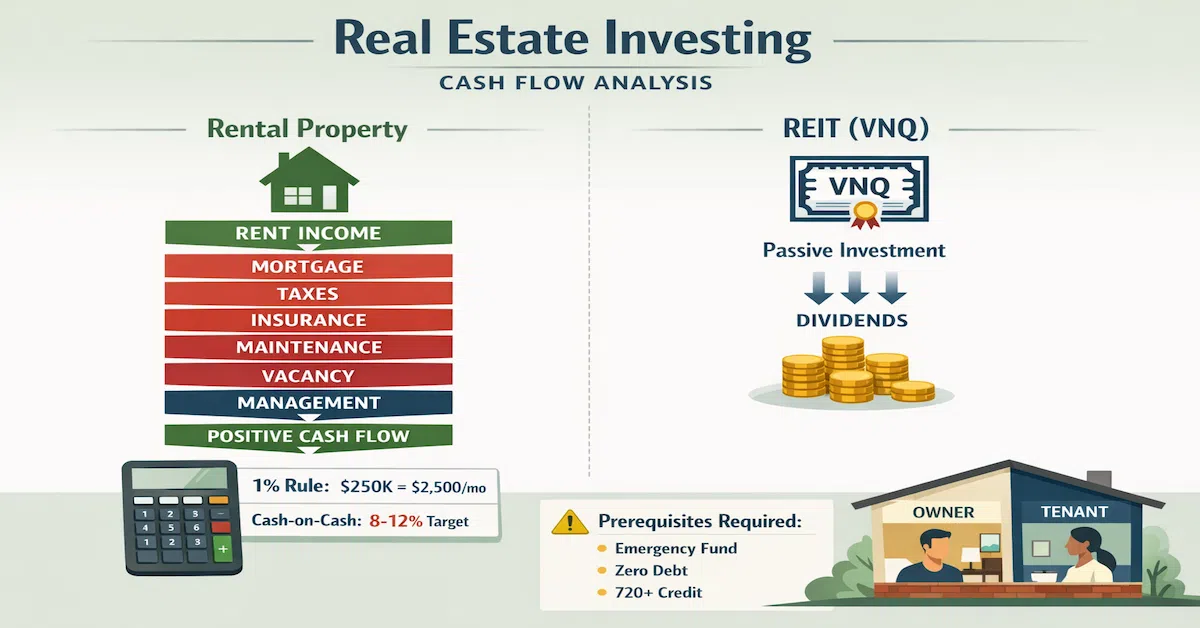
Monthly Cash Flow = Rent − (Mortgage + Taxes + Insurance + Maintenance + Vacancy + Management)
A Worked Example
Here is a simplified analysis of a $250,000 rental. These figures are illustrative; property taxes, insurance, and rents vary widely by location.
| Item | Amount |
|---|---|
| Purchase price | $250,000 |
| Down payment (20%) | $50,000 |
| Loan amount / interest rate | $200,000 at 6.5% |
| Monthly rent | $2,500 |
| Mortgage (principal and interest) | $1,264 |
| Property taxes | $200 |
| Insurance | $100 |
| Maintenance (1% of value per year, monthly) | $208 |
| Vacancy allowance (10% of rent) | $250 |
| Property management (10% of rent) | $250 |
| Total monthly expenses | $2,272 |
| Monthly cash flow | $228 ($2,736 per year) |
Measured against the $50,000 down payment, that is a 5.5% return. Is that good? It is marginal. PersonalOne's minimum target for direct ownership is 8% to 12%. Below 8%, your money would likely work harder in a diversified fund or a high-yield savings account, with no management burden and far less risk.
The Three Real Estate Math Rules
Three simple rules let you screen deals, estimate expenses, and measure performance before you spend hours on a detailed analysis.
The 1% Rule: A Quick Deal Screener
Monthly rent should equal at least 1% of the purchase price. A $250,000 property needs $2,500 a month in rent, a $150,000 property needs $1,500, and a $400,000 property needs $4,000. Properties that fail the 1% rule rarely produce positive cash flow after all expenses, so it is a fast way to eliminate weak deals before you invest time in them.
The honest caveat is that in expensive markets such as coastal California, New York, or Seattle, the 1% rule is often impossible. Properties there commonly rent for 0.5% to 0.7% of their value, which is why those markets tend to favor appreciation over rental cash flow. If you live in one, the rule is still a useful warning about how thin the margins are.
The 50% Rule: Estimating Expenses
Expect roughly half of your rental income to go to non-mortgage expenses: taxes, insurance, maintenance, vacancy, management, repairs, and capital expenditures. A property renting for $2,500 will likely consume about $1,250 a month in those costs before the mortgage payment.
New investors routinely skip this step. They subtract the mortgage from the rent, see $1,236 of apparent profit, and stop there. Once real expenses are counted, the true figure is closer to $200 to $250. The 50% rule keeps you honest about that gap before you sign anything.
Cash-on-Cash Return: The Performance Metric
Cash-on-cash return is annual cash flow divided by the total cash you actually put in. That total includes the down payment, closing costs, initial repairs, and reserves, not just the down payment. Using the same $250,000 property:
| Cash Invested | Amount |
|---|---|
| Down payment | $50,000 |
| Closing costs | $7,500 |
| Initial repairs | $5,000 |
| Reserves | $15,000 |
| Total cash invested | $77,500 |
Annual cash flow of $2,736 divided by $77,500 is a 3.5% return. That is the real number, and it is far weaker than the 5.5% you get by counting only the down payment. At 3.5%, this deal would earn less than a high-yield savings account with none of the risk or effort. PersonalOne's target is 8% to 12% at minimum; 12% or better is an excellent deal and is rare in competitive markets.
House Hacking: The Easiest Entry Point
House hacking means buying a property and living in one unit while renting out the others. For most people it is the most accessible form of direct ownership, because it uses owner-occupant financing instead of investment-property financing.
Why House Hacking Works for Beginners
— Lower down payments: owner-occupied loans generally require far less down than investment-property loans. An FHA loan can require as little as 3.5% down with a qualifying credit score, which is $8,750 on a $250,000 property instead of $50,000 or more.
— Better loan terms: owner-occupied mortgages typically carry lower interest rates than loans on pure investment properties, which adds up over 30 years.
— A safety net while you learn: you live on-site, so you see maintenance problems and tenant issues immediately, and you learn landlording at lower stakes.
— Rent offsets your housing cost: the rent from the other units covers part or most of your own payment.
One rule matters here. FHA financing requires that you move in within 60 days of closing and live in the property as your primary residence for at least a year. It cannot be used to buy a pure investment property, and misrepresenting your occupancy on a mortgage application can be treated as mortgage fraud.
Common House Hacking Strategies
— Duplex, triplex, or fourplex: live in one unit and rent the rest. FHA financing covers owner-occupied properties of up to four units.
— Single-family home with roommates: buy a three- or four-bedroom house and rent rooms, so roommates cover much of the mortgage.
— Accessory dwelling unit (ADU): live in the main house and rent a backyard cottage or finished basement apartment.
An Example House Hack
| Item | Amount |
|---|---|
| Duplex purchase price | $300,000 |
| Down payment (5%) | $15,000 |
| Mortgage payment (principal and interest, $285,000 at 6.5%) | $1,801 |
| Taxes and insurance | $350 |
| Total monthly housing cost | $2,151 |
| Rent collected from the other unit | $1,600 |
| Your net housing cost | $551 per month |
Compared with renting a one-bedroom apartment for $1,500, that saves about $949 a month, or roughly $11,388 a year, while you build equity and learn how to manage a rental. These figures exclude mortgage insurance, which FHA and other low-down-payment loans add, and assume the second unit stays rented. A vacancy would cut into the savings, so keep reserves on hand. House hacking is the lowest-risk path into direct ownership, but it is not risk-free.
Property Management: DIY vs Professional
Rental property is not passive income unless someone else is managing it, and that someone costs money. Being clear-eyed about this before you buy is what separates realistic returns from disappointing ones.
What Property Management Involves
Management covers marketing vacant units, screening tenants, and signing leases; collecting rent and handling late payments or evictions; responding to emergency maintenance at any hour; coordinating routine upkeep like HVAC service, lawn care, and pest control; inspecting the property; resolving tenant disputes; and keeping the records you need at tax time.
Managing It Yourself
Doing it yourself saves the management fee, which is often around 10% of rent, or about $3,000 a year on a $2,500-a-month property. You also keep more control and can respond faster. The tradeoff is time, often ten or more hours a month per property, plus being on call and carrying the legal responsibility if something goes wrong. It suits handy owners with a single local property and a high tolerance for tenant drama.
Hiring a Professional
A professional manager makes ownership genuinely hands-off, handles screening and evictions, and scales easily across multiple properties. The costs are the fee, less control, and uneven quality, because some managers are excellent and some are not. It fits out-of-state properties, multiple properties, and busy owners who value time over money.
The Honest Recommendation
If a deal cannot support a management fee and still reach at least an 8% cash-on-cash return, it is not good enough. Budget for professional management from day one, even if you plan to manage the property yourself. That way your returns still hold up if you later decide your time is worth more than the fee.
When Real Estate Makes Sense, and When It Doesn't
Real Estate Makes Sense When
— You have a solid financial foundation: emergency fund, no consumer debt, and strong credit.
— You have roughly $65,000 to $100,000 in liquid cash available.
— The property passes the 1% rule, or you have a clear reason it does not.
— Cash-on-cash return exceeds 8% after including a management fee.
— You can afford a 20% to 25% down payment plus three to six months of reserves.
— You are willing to manage the property or pay someone to.
— You understand landlord-tenant law in your state; HUD's tenant rights overview is a starting point.
— You have a time horizon of ten years or more, since real estate is illiquid.
— You can absorb a $10,000 to $20,000 surprise expense without financial distress.
— You are comfortable with concentration risk, meaning one property is a large bet.
Real Estate Does Not Make Sense When
— You carry consumer debt or have fewer than six months of emergency savings.
— Your credit is weak enough that your mortgage rate would make the deal unworkable.
— You can only afford a minimal down payment on a pure investment property, which leaves almost no cushion.
— The property fails the 1% rule and produces negative cash flow.
— You do not yet understand cash flow analysis or basic real estate math.
— You believe real estate always goes up. The 2008 housing crisis says otherwise.
— Your income is unstable, such as gig work, commission, or an early-stage startup.
— You could not cover a $12,000 roof, an $8,000 HVAC replacement, or a costly eviction.
— You refuse to either manage the property or pay for management.
— The market is overheated, with bidding wars, waived inspections, and emotional buying.
If you fall on the wrong side of these lists, REITs are a sensible alternative. A broad REIT fund can give you real estate exposure as one slice of a diversified portfolio while you build savings, learn the math, and work toward the point where direct ownership makes sense.
Not ready for real estate yet?
A funded emergency fund is the first requirement. Build that foundation and everything else in this guide gets safer.
Build Your Financial StabilityCommon Real Estate Investing Mistakes
Mistake 1: Buying Before Your Foundation Is Solid
No emergency fund and lingering credit card debt turn the first vacancy or major repair into a crisis. You end up selling at a loss or borrowing more. The fix is simple: complete the foundation steps first.
Mistake 2: Underestimating Expenses
"$2,500 rent minus a $1,200 mortgage leaves $1,300" ignores taxes, insurance, vacancy, maintenance, management, and capital expenditures. Apply the 50% rule so half of the rent is assumed to go to non-mortgage costs.
Mistake 3: Buying a Property That Fails the 1% Rule
A $400,000 property renting for $2,000 a month, which is 0.5%, has negative cash flow from day one. Screen every deal with the 1% rule before you run the detailed numbers.
Mistake 4: Using Owner-Occupant Financing for a Pure Investment
FHA financing requires owner occupancy, and misstating your intentions on a loan application can be treated as mortgage fraud. Even legitimate low-down-payment purchases leave little equity cushion, so a modest price drop can put you underwater. For pure investment property, plan on a 20% to 25% down payment.
Mistake 5: Believing It Is Passive Income
Even with a manager, you still make capital decisions, approve major repairs, and field escalated tenant issues. Budget for professional management and accept that rental property is semi-active, not passive.
Mistake 6: Skipping Tenant Screening
Renting to the first applicant is how you end up with a tenant who stops paying in month two. An eviction can take months and cost thousands, plus the lost rent. Run credit checks, verify employment, call prior landlords, and run a background check. A screening fee is cheap insurance against a very expensive problem.
Mistake 7: Buying in a Declining Area Because It Is Cheap
A very low price often reflects high crime, failing schools, or jobs leaving the area. Values fall, good tenants are hard to find, and problems compound. Paying more for a stable or growing area with strong job growth usually pays off over time.
Official Resources
Investor.gov: Real Estate Investment Trusts (REITs) — The SEC's plain-language overview of how REITs work, the different types, and the risks to weigh before investing.
IRS Publication 527: Residential Rental Property — The IRS guide to reporting rental income, deductions, and depreciation for residential rental property.
HUD: Tenant Rights, Laws and Protections — HUD's overview of tenant rights, laws, and protections, a useful starting point for understanding landlord-tenant rules.
Continue Learning About Real Estate Investing
Real estate is one piece of a larger investing system. The complete framework for building long-term wealth is in the Investing & Wealth Growth guide.
Go Deeper
Alternative Real Estate Investing
Explore ways to invest in real estate beyond buying traditional rental property.
How to Invest in Real Estate Without Owning Property
Compare REITs, real estate crowdfunding, and fractional ownership side by side.
How to Invest in Real Estate With Just $100
See what a first $100 buys, how it grows with recurring contributions, and how to open your first account.
Learn what qualifies as a REIT, how FFO and AFFO work, and how REIT dividends are taxed.
How Leveraging Debt in Real Estate Can Build Wealth
Learn the leverage math, the three readiness conditions, and what rising interest rates do to a rental property's cash flow.
Frequently Asked Questions
Should I invest in real estate or index funds? For most beginners, start with index funds. The barrier to entry is lower, they are truly passive, and they offer instant diversification and liquidity. Add real estate after you have a solid investing base and meet the readiness checklist above. House hacking is a reasonable way to get real estate exposure while also solving your own housing. Avoid going all-in on real estate at the expense of diversification.
How much money do I need to start real estate investing? It depends on the path. REITs can start at the price of a single share. Direct ownership of a $250,000 rental typically takes about $65,000 to $100,000 once you count the down payment, closing costs, and reserves. House hacking with a low-down-payment loan may take roughly $15,000 to $25,000 including closing costs and repairs. If you have less, build your foundation first.
Can I use a mortgage for my first investment property? Yes, but with a meaningful down payment. Plan on 20% to 25% for a pure investment property, because leverage amplifies both gains and losses. With 20% down you have a cushion against a 20% price drop; with 3.5% down, a 10% drop can leave you underwater. The exception is house hacking, where you live in the property and use owner-occupant financing.
What if I live in an expensive market where the 1% rule is impossible? You have four realistic options: invest locally and accept lower cash flow while betting on appreciation, invest out of state in cheaper markets with professional management, house hack to lower your entry cost, or use REITs for real estate exposure while you build wealth elsewhere. Not every market supports cash-flowing rentals, and that is worth knowing before you buy.
Should I buy a single-family home or a multifamily property? Single-family homes are usually easier to finance, sell, and manage, but a vacancy means losing all of the income. Multifamily properties tend to produce better cash flow, and a vacancy only affects part of the income, but they are harder to sell and more complex to manage. For a first property, a single-family home or a small multifamily building of two to four units is common.
How long does it take to become profitable in real estate? Cash flow can be positive from the first month if the property was analyzed correctly. Equity builds gradually through mortgage paydown over five to ten years or more. At 3% to 4% annual appreciation, a property takes roughly 18 to 24 years to double in value. This is long-term wealth building; if you need the money in two or three years, real estate is the wrong vehicle.
PersonalOne Money System
This content is researched, written, and owned by PersonalOne — a free financial education platform built to help Millennials and Gen Z build real financial systems.
This content is for educational purposes only and does not constitute financial advice. PersonalOne is not a licensed financial advisor, broker, or investment professional. Individual financial situations vary — consult a qualified financial professional for personalized guidance.