Published: February 20, 2026
Home › Banking Systems › Account Separation for Different Life Stages
About the Author
Don Briscoe is a financial systems coach with more than 12 years of experience helping Millennials and Gen Z escape the paycheck-to-paycheck cycle. His framework-first approach focuses on building financial infrastructure that works automatically — less willpower, more systems. He founded PersonalOne.org to make structured, honest financial education free and accessible.
TL;DR — What You Will Learn
— Why a one-size-fits-all banking structure breaks down as your life gets more complex
— The exact account setup students need before making their first financial mistake
— How early career professionals should restructure the moment a real paycheck arrives
— The multi-account framework families need to keep household money organized and protected
— Why entrepreneurs need the strictest separation of all — and how to build it correctly
Here is something most financial advice skips: the bank account structure that worked perfectly at 22 will quietly break down by 28. The setup that works for a single professional is the wrong structure for a household running on two incomes and a mortgage. And the system built for a salaried employee is completely wrong for someone running a business.
Your financial life does not stay still. Your banking architecture should not either.
Account separation is not just about having more than one account — it is about designing a structure that matches where you are right now, and knowing when that structure needs to evolve. The right setup gives you visibility, control, and protection. The wrong setup quietly bleeds money into categories it was never meant to reach.
This guide walks through four distinct life stages — student, early career, family, and entrepreneur — and gives you the specific structure each one requires.
Why Life Stage Changes Everything in Banking
Most people set up a checking and savings account at 18 and never revisit the decision. The problem is that their financial complexity has grown — income sources, fixed obligations, savings goals, shared finances, business income — and two accounts were never designed to handle all of that.
What creates financial stress at each life stage is not always a lack of money. It is a lack of separation. When spending and savings live in the same account, you overspend without realizing it. When personal and business income share an account, taxes become a nightmare. When a family runs household bills through one person's personal checking, everything becomes fragile.
The solution at every stage is the same principle applied differently: contain your money into purpose-driven accounts so that each dollar has a designated lane. Here is how that looks across four life stages.
Stage 1: The Student Structure (Ages 18–22)
Students are learning two things at once: how to manage money and how to resist spending all of it. The student banking structure needs to be simple enough to actually use, but firm enough to build real habits.
The Core Setup: Two Accounts
At the student stage, the goal is a hard separation between money you can spend and money you cannot touch.
The Student Account Structure
Account 1 — Spending Checking: Receives all income. The only account used for daily purchases. If it is not in this account, you do not spend it.
Account 2 — Savings (HYSA preferred): Funded immediately when any money arrives. Treated as untouchable. This is the beginning of your emergency buffer — even if it starts at $200.
Why it works: Limits spending to one visible pool. Creates the savings habit before income is large enough to make saving feel easy. Prevents the "I will save what is left" trap — because there is never anything left.
The most common student banking mistake is not overspending — it is having no structure at all. Without a dedicated savings account, every dollar in checking feels like spending money. Students who move even $25 per paycheck into a separate account before spending anything else build a habit that compounds over decades.
Look for student checking accounts or online banks with no monthly fees and no minimum balance requirements. The FDIC insures deposits at member institutions up to $250,000 — verify your bank's insured status at FDIC.gov.
Stage 2: The Early Career Structure (Ages 22–30)
The first real paycheck changes everything. Rent, student loans, insurance, retirement contributions, and discretionary spending all arrive at the same time competing for the same dollars. This is where the two-account system breaks. You need more structure, not just more money.
The Core Setup: Three to Four Accounts
The Early Career Account Structure
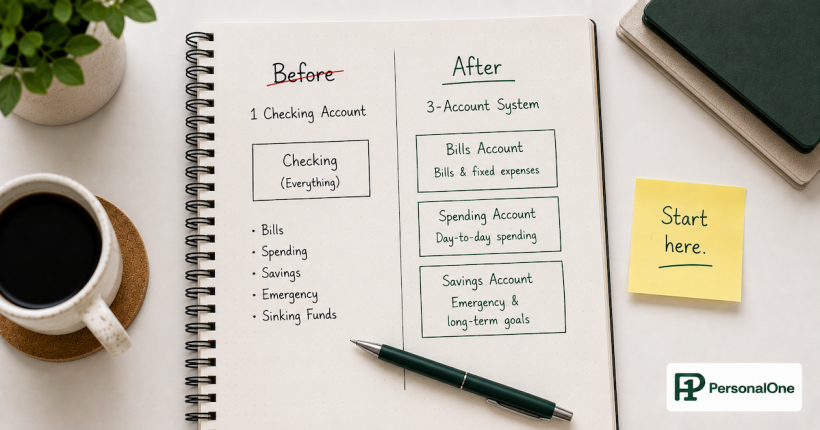
Account 1 — Primary Checking (Income Hub): All income arrives here. No spending happens directly from this account. It is the distribution hub only — money flows in, then immediately routes out to designated accounts.
Account 2 — Bills Account: Receives only enough to cover fixed monthly obligations — rent, utilities, subscriptions, loan payments. Bills automate from here so they never compete with discretionary spending.
Account 3 — Spending Account: The only account used for daily purchases, groceries, dining, and entertainment. When this account is empty, spending stops — no spreadsheet required.
Account 4 — High-Yield Savings: Emergency fund and savings goals. Ideally at a separate bank to create friction against impulse withdrawals. Funded automatically from Account 1 on payday.
The critical shift at this stage is automating the routing. When your paycheck hits Account 1, automatic transfers move money to bills, savings, and spending within 24 to 48 hours. You never manually move money — the structure does it for you.
This eliminates the most common early career money problem: the paycheck disappearing before the bills are paid. With a dedicated bills account, rent is protected before discretionary spending gets funded. The CFPB provides guidance on direct deposit splitting and account management at consumerfinance.gov.
Stage 3: The Family Structure (Shared Finances)
Once a household runs on shared income and shared obligations, the individual account structure is no longer enough. Couples consistently report that money disagreements come less from income levels and more from unclear boundaries — whose money pays for what, and where does individual spending come from.
A well-designed family banking structure creates transparency without surveillance and autonomy without resentment.
The Core Setup: Five to Six Accounts
The Family Account Structure
Joint Bills Account: Both incomes contribute proportionally. Covers all shared fixed expenses — mortgage, utilities, insurance. Automated. Neither partner uses this account for personal spending.
Joint Household Spending Account: Groceries, household supplies, shared dining, family activities. Refilled on a set schedule from proportional contributions.
Personal Spending Accounts (one per partner): Each person receives an equal monthly allocation — no questions asked. Individual clothing, hobbies, personal dining. No accountability required, which is exactly the point.
Joint High-Yield Savings: Emergency fund, home repairs, vacations, large planned expenses. Minimum three to six months of household expenses.
Individual Retirement Accounts: Separate by definition. Tracked jointly but owned individually.
The personal allowance account is the single feature that prevents the most money conflict in households. When each partner has a defined, equal pool of personal money that requires no explanation to spend, the constant negotiation over individual purchases disappears. The amount matters less than the structure itself.
Stage 4: The Entrepreneur Structure (Self-Employed and Business Owners)
Entrepreneurs face a challenge salaried employees never encounter: personal income and business income arriving through the same channels. Mixing them is the single most costly banking mistake self-employed people make. It creates tax complexity, destroys liability protection, makes accurate profit calculation impossible, and makes a business nearly impossible to scale.
The Core Setup: Complete Separation
The Entrepreneur Account Structure
Business Operating Account: All business revenue lands here. All business expenses paid from here. This is the only account your accountant sees for business activity.
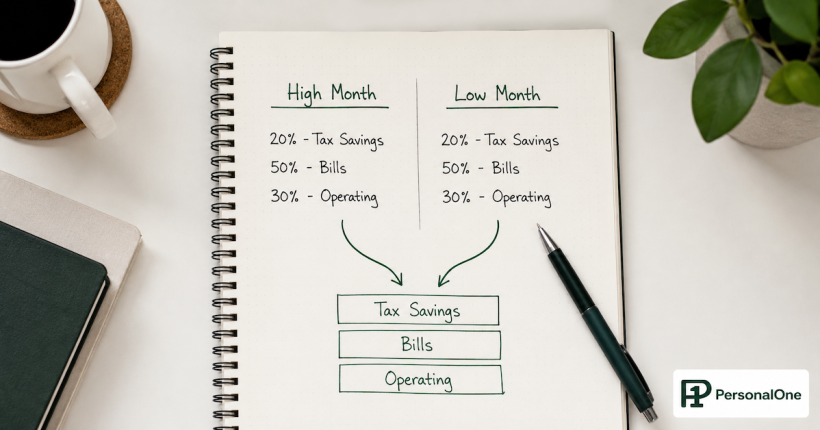
Business Tax Reserve Account: 25–30% of every deposit moves here automatically. Never touched except for quarterly estimated tax payments. This prevents the most common entrepreneur financial crisis — an unexpected tax bill.
Business Operating Reserve: Three to six months of business expenses. Protects against slow months and client payment delays without touching personal funds.
Personal Checking (Owner's Draw): The only money crossing from business to personal is a defined monthly owner's draw. Personal expenses are paid from personal accounts only — never directly from business income.
Personal Savings: Personal emergency fund and goals. Funded from personal checking only.
The most critical discipline for entrepreneurs is paying yourself a consistent, defined amount — not whatever is in the business account when money is needed. A regular owner's draw is what makes business finances meaningful and the profit number real.
Entrepreneurs who maintain complete separation also preserve LLC liability protection. Commingling personal and business funds — known as piercing the corporate veil — can eliminate the legal protections the LLC was designed to provide. The IRS Self-Employed Tax Center covers estimated payment obligations at IRS.gov.
When to Know It Is Time to Restructure
Life stages do not always announce themselves. Sometimes the trigger is obvious — a new job, a marriage, launching a business. Other times the signal is quieter: money stress that will not resolve, savings that never grow, or a paycheck that disappears before any intentional decisions were made about it.
Signs Your Structure Has Outgrown Your Life Stage
— You cannot tell what is safe to spend without checking every pending transaction
— Bills and discretionary spending compete in the same account
— You and a partner argue about money without clear rules for how it is allocated
— Business income and personal income share an account
— Your savings balance has not grown in three months despite having income
— One unexpected expense creates a crisis that takes weeks to recover from
Restructuring does not require closing everything and starting over. Most life-stage transitions require adding one or two accounts and adjusting where money flows. The goal is always the same: more lanes, clearer purpose, less money stress.
Build the Complete Banking Architecture
Account separation by life stage is one layer of the full system. The PersonalOne guide on how to structure your bank accounts covers the complete framework — income routing, multi-account structure, bills containment, and the stability infrastructure that makes every life stage transition manageable. Free, no signup required.
Framework-first. Less willpower. More infrastructure.
Frequently Asked Questions
How many bank accounts do I actually need?
It depends on your life stage. Students need two. Early career professionals do well with three to four. Families typically need five to six. Entrepreneurs need at least five. The number is not the goal — purpose-driven separation is. Each account should have a defined function and a defined funding rule.
Will having multiple accounts hurt my credit score?
No. Checking and savings accounts are not reported to credit bureaus and have no impact on your credit score. The only accounts that affect credit are credit cards, loans, and lines of credit.
Do I need accounts at different banks, or can everything be at one institution?
You can run most of this structure at a single bank. Your high-yield savings will almost always earn more at a dedicated online bank, however. Many people keep checking and bills accounts at one institution and savings at a high-yield online bank — the added friction also helps prevent impulse withdrawals.
How do I transition between life stage structures without disrupting my finances?
Transition incrementally. Open the new accounts first before changing anything. Set up the new routing and run it in parallel for one full pay cycle. Once bills are covered and transfers are confirmed working, reduce the old structure. Never make all changes in a single day.
What if I am between life stages?
Build toward the next stage, not back from the current one. If you are leaving college and starting your first professional role, set up the early career structure from day one. The structure creates the behavior that makes the transition feel natural.
Resources
FDIC — Verify Your Bank's Insured Status — Confirm FDIC membership and deposit insurance coverage for any bank you use.
CFPB — Bank Account Tools and Guidance — Federal consumer guidance on checking, savings, and direct deposit management.
IRS — Self-Employed Individuals Tax Center — Estimated payment schedules, quarterly filing requirements, and self-employment tax obligations.
Federal Reserve — Consumer Information on Bank Accounts — Overview of account types, consumer rights, and banking protections.
Disclaimer: The content on PersonalOne.org is for informational and educational purposes only and does not constitute financial, legal, or tax advice. Account structures and banking recommendations may not apply to every individual situation. Tax obligations for self-employed individuals vary — consult a qualified financial professional or tax advisor before making significant changes to your banking or business structure. FDIC insurance limits are subject to change — verify current coverage directly with the FDIC.