Updated: April, 2026
Home › FinTech & Modern Money Tools › Wealth Management Technology
Best Robo-Advisors and Wealth Management Apps: The Complete Guide to Automated Investing Technology
PersonalOne Money System
This resource is part of the PersonalOne framework for building financial systems that run automatically — covering the tools, strategies, and infrastructure that replace willpower with structure. PersonalOne provides free financial education for Millennials and Gen Z.
What This Guide Covers
— The best robo-advisors and wealth management apps do automatically what used to require a human financial advisor — diversified portfolio construction, rebalancing, and tax-loss harvesting — at 0.25% annually or less
— Low fees compound dramatically: the difference between 0.25% and 1.00% over 30 years on a $50K portfolio is approximately $59,000 in additional wealth
— Automation is the advantage, not market intelligence — robo-advisors maintain consistent, disciplined exposure to markets without emotional interference
— Digital financial planning tools have replaced expensive advisors for most everyday needs — net worth tracking, retirement projections, goal planning, and cash flow analysis are all available free or near-free
— Wealth management technology is the bridge between budgeting and investing — once your cash flow system is stable, these tools automate the path to long-term wealth
How Technology Opened Wealth Management to Everyone
The best robo-advisors and wealth management apps have done something that was impossible a generation ago: they made professional-grade investment management available to anyone with $1 and a smartphone. For most of financial history, personalized wealth management required minimum investments of $250,000 or more, annual advisory fees of 1–2%, and access gated behind referrals and relationships. Robo-advisors changed that equation entirely by automating the core functions of portfolio management — asset allocation, rebalancing, tax optimization — and removing the human labor cost that made professional wealth management expensive. The full context for how wealth management technology connects to neobanks, payment tools, and financial automation is covered in the FinTech & Modern Money Tools guide.
This is not just a story about investing. Digital wealth management tools now cover the full spectrum of financial planning — net worth tracking, retirement projections, goal-based savings, insurance analysis, and estate planning basics — at price points that were unimaginable a decade ago. The democratization of professional financial tools is one of the most consequential FinTech developments of the past decade, and it directly affects what you can achieve financially regardless of your starting balance.
This cluster covers the full landscape of wealth management technology: what robo-advisors are and how they work, the fee math that makes them compelling over time, how to choose between platforms, when a human advisor still adds value, and how automated investing fits into a complete financial system once the foundation is in place.
What Is a Robo-Advisor and How Does It Work?
A robo-advisor is an automated investment platform that builds and manages a diversified portfolio on your behalf based on answers to a risk tolerance questionnaire. You provide your investment goals, time horizon, and risk comfort level — the platform constructs a portfolio of low-cost index funds or ETFs calibrated to your profile. From that point, the robo-advisor handles three core functions automatically without any ongoing decisions required from you.
Portfolio Rebalancing
As markets move, your portfolio drifts from its target allocation. The robo-advisor automatically sells overweight assets and buys underweight ones to restore balance — consistently and without emotion. Most investors never do this manually. The robo-advisor does it every time it is needed.
Dividend Reinvestment
Dividends paid by funds in your portfolio are automatically reinvested — buying additional shares rather than sitting as idle cash. This keeps every dollar working and compounds returns over time without requiring any action from you.
Tax-Loss Harvesting
When investments in your taxable account decline in value, the robo-advisor automatically sells them to realize a tax loss — offsetting capital gains elsewhere — then immediately reinvests in a similar fund to maintain market exposure. Previously reserved for high-net-worth investors. Now automated and included at most major platforms.
The Fee Difference — and Why It Matters More Than You Think
The difference between a 0.25% robo-advisor fee and a 1.00% human advisor fee looks small in year one. Over 30 years, it is not small. On a $50,000 starting investment at 7% average annual return, the gap between paying 0.25% and paying 1.00% annually is approximately $59,000 in additional portfolio value — money that stays in your account instead of paying for human management a diversified index portfolio does not require.
| Platform Type | Annual Fee | 30-Year Value* | Total Fees Paid |
|---|---|---|---|
| Robo-Advisor (e.g. Betterment) | 0.25% | ~$355,000 | ~$26,000 |
| Traditional Financial Advisor | 1.00% | ~$296,000 | ~$85,000 |
| High-Fee Managed Fund | 1.50% | ~$262,000 | ~$129,000 |
*Illustrative projection based on $50,000 starting investment, 7% average annual return. Not a guaranteed outcome.
Robo-Advisor vs Human Advisor: Which Do You Actually Need?
The honest answer for most Millennials and Gen Z investors in the accumulation phase is that a robo-advisor handles the core investing function better than most human advisors would at the same price point. The question is not which is more prestigious — it is which one matches your actual financial complexity.
Robo-Advisor Is Right When:
✓ You are in the accumulation phase — saving and growing
✓ Your portfolio is under $500K
✓ You want low-cost, hands-off investing
✓ Your needs are straightforward: retirement, general wealth building
✓ You value automation over a personalized relationship
Human Advisor Adds Value When:
— Portfolio exceeds $500K–$1M
— Complex tax situation: business income, RSUs, inheritance
— Estate planning and legacy goals require legal coordination
— Significant life transitions: divorce, inheritance, retirement
— Business owner financial planning with entity complexity
For most people reading this: start with a robo-advisor. The automation, low cost, and discipline it provides outweigh the personalization of a human advisor at most portfolio sizes. Add a human advisor when your situation genuinely requires one — not because paying more feels more legitimate.
Net Worth Tracking: The Number That Actually Matters
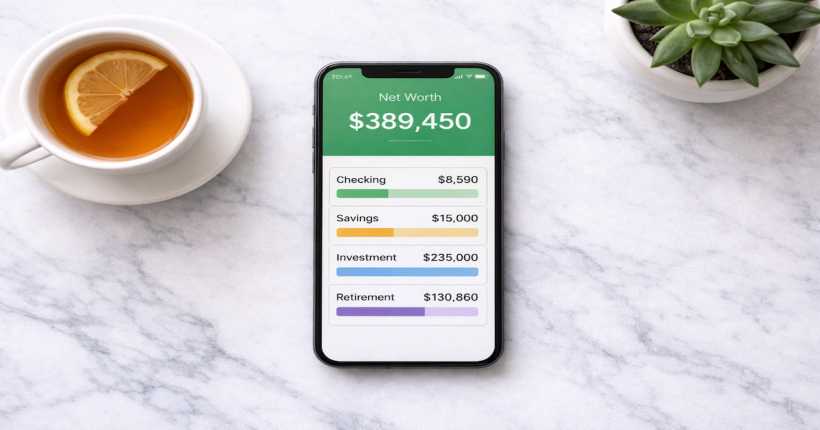
Income is what you earn. Net worth is what you keep. The difference between people who build wealth and people who do not often comes down to which number they track most closely. Net worth is straightforward: everything you own (assets) minus everything you owe (liabilities). Your checking account balance, investment accounts, home equity, and retirement funds are assets. Your mortgage, student loans, car loan, and credit card balances are liabilities.
Tracking net worth monthly does three things that manual budget tracking does not. It captures the full picture — a month where you spent over budget but your investments gained significantly was a net positive month, which income-and-expense budgeting misses entirely. It motivates debt payoff, because watching liabilities decrease and assets grow creates a compounding motivation loop that categorizing grocery spending never achieves. And it connects daily decisions to long-term outcomes — when you can see your net worth in real time, every savings contribution and debt payment becomes visibly meaningful rather than abstractly important.
Tools like Monarch Money (affiliate) aggregate all accounts — checking, savings, investment, retirement, and debt — into a single net worth view that updates automatically. That single number, tracked over time, is one of the most powerful motivating forces in personal finance.
Track your wealth — all of it, in one place.
Before you optimize your investments, make sure you can see all of them. The complete framework for how wealth management technology connects to the full FinTech system is in the FinTech & Modern Money Tools guide.
Resources
Official Sources
SEC Investor.gov — Robo-Advisors — Plain-language SEC investor guidance on what robo-advisors are, how they are regulated, and what to evaluate before opening an account.
FINRA — Automated Investment Tools — FINRA guidance on evaluating robo-advisor fee structures, risk questionnaires, and how to verify registration and disciplinary history through BrokerCheck.
SIPC.org — Verify Securities Investor Protection Corporation membership and understand what protections apply to your investment accounts if a broker-dealer fails.
The Bigger Picture
Wealth management technology is the growth layer of a complete financial system. The full framework for how it connects to banking infrastructure, budgeting automation, and FinTech tools lives in the FinTech & Modern Money Tools guide.
Continue Learning: Wealth Management Technology & Robo-Advisors
Each article in this cluster covers a specific aspect of wealth management technology — from how automated platforms are replacing traditional advisors to how to set up automated investing from scratch.
How Wealth Management Technology Is Replacing Traditional Advisors
How automated investing platforms and digital financial planning tools are delivering services that previously required a human advisor — and the specific situations where human advisors still add irreplaceable value.
How Wealth Management Technology Is Redefining Money
How digital wealth management platforms are making sophisticated financial planning accessible to everyday investors — portfolio construction, goal-based investing, automated rebalancing, and what institutional-grade tools now look like at consumer prices.
Robo-Advisors vs Real Advisors: Which One Is Right for You?
The honest head-to-head comparison of automated investing platforms versus human financial advisors — covering fee structure, service scope, portfolio performance, and the specific financial situations where each type genuinely outperforms the other.
Coinbase vs Robinhood: Which Platform Is Right for You?
A detailed comparison of Coinbase and Robinhood — two of the most widely used self-directed investing and crypto platforms — covering fees, asset selection, security practices, and which type of investor each platform is actually designed for.
Best Investing Apps for Beginners
How to evaluate investment platforms based on your goals, risk tolerance, and investing experience rather than marketing claims and promotional offers.
Acorns vs Stash: Which Micro-Investing Platform Fits Your Strategy
Detailed comparison of automated round-ups versus self-directed theme investing — fee structures, automation levels, and which approach builds better long-term investing habits.
Best Investing Apps for Managing Market Volatility
How platform features support discipline during market swings, which automation prevents behavioral mistakes, and why apps don't protect against volatility but help maintain strategy despite it.
Coming Soon
Betterment vs Wealthfront: Which Robo-Advisor Wins?
Head-to-head comparison of the two leading robo-advisors — fees, minimums, tax-loss harvesting quality, direct indexing, and which platform fits which investor situation.
Best Robo-Advisors for Beginners in 2026
The clearest starting point for first-time investors — which robo-advisor platforms have the lowest minimums, the simplest setup, and the best educational support for someone opening their first investment account.
How to Set Up Automated Investing in 30 Minutes
Step-by-step walkthrough for opening a robo-advisor account, funding it, connecting it to your banking setup, and configuring automatic contributions — from zero to invested in one session.
What Is Tax-Loss Harvesting and Is It Worth It?
Plain-language explanation of how tax-loss harvesting works, which robo-advisors do it automatically, how much it actually saves annually, and whether the benefit justifies choosing one platform over another.
Frequently Asked Questions
How much money do I need to start using a robo-advisor?
Most major robo-advisors have no minimum or a very low minimum. Betterment starts at $0. Wealthfront requires $500. Schwab Intelligent Portfolios requires $5,000. Fidelity Go has no minimum. The $0 minimums mean there is no financial reason to delay. Starting with $100/month builds the investing habit and lets you learn the platform before larger deposits. The best time to start is now — the second best time is after you have built your emergency fund.
Do robo-advisors beat the market?
No — and they are not designed to. Robo-advisors invest in diversified portfolios of index funds that track the market rather than trying to beat it. The goal is to capture market returns consistently while minimizing fees, taxes, and behavioral mistakes that cause most human investors to underperform the market they are trying to beat. Decades of research consistently shows that low-cost index investing outperforms actively managed strategies over long time periods — robo-advisors automate exactly that approach.
Is a robo-advisor safe? What happens to my money if the company fails?
Reputable robo-advisors hold investments at a broker-dealer registered with FINRA and are SIPC-insured up to $500,000 per account (including up to $250,000 in cash). If the robo-advisor company fails, your underlying investments — held separately in your name at the custodian — are protected. Your ETF shares do not disappear if Betterment ceases operations; they remain yours at the underlying custodian. Always verify SIPC membership and FINRA registration at BrokerCheck before opening an account.
Should I use a robo-advisor or invest in index funds myself?
Both are excellent choices. DIY index fund investing through Fidelity or Vanguard costs essentially nothing — no advisory fee at all. A robo-advisor charges 0.25% for the automation layer: automatic rebalancing, tax-loss harvesting, and behavioral guardrails. For most first-time investors, that 0.25% is worth it to remove decisions and prevent emotional mistakes. Experienced, disciplined investors comfortable managing their own portfolio can skip the advisory fee entirely.
Can I use a robo-advisor for retirement accounts?
Yes. Most major robo-advisors support Traditional IRA, Roth IRA, and SEP-IRA accounts in addition to taxable brokerage accounts. Opening a Roth IRA at a robo-advisor is one of the most efficient ways to begin retirement investing — tax-free growth, automated portfolio management, and a 2026 contribution limit of $7,000/year ($8,000 if you are 50+). The robo-advisor handles everything except the contribution decision itself.
Financial Disclaimer & Affiliate Disclosure: This page contains affiliate links to Monarch Money. PersonalOne may earn a commission when you use links marked “(affiliate)” at no additional cost to you. Robo-advisor fees, minimums, features, and SIPC/FINRA status are subject to change — verify current terms directly with each platform before opening an account. Fee impact projections are illustrative estimates based on assumed 7% annual returns and are not guaranteed outcomes. This content provides financial education only and does not constitute personalized investment advice. Investing involves risk including potential loss of principal.