January 15, 2026
Home › FinTech & Modern Money Tools › Wealth Management Technology & Robo Advisors › Wealth Management Technology
About the Author
Don Briscoe is a financial systems coach with 12+ years helping Millennials and Gen Z escape paycheck-to-paycheck cycles. He founded PersonalOne to provide the financial education he wished existed—structured, honest, and free.
- ✓Wealth management technology has democratized access — robo-advisors, AI-powered platforms, and digital tools now serve investors with $100, not just $100,000.
- ✓Traditional advisors charged 1–2% annually — modern tools deliver similar or better outcomes for 0.25% or less, saving investors tens of thousands over decades.
- ✓Technology shifts control to individuals — automated rebalancing, tax-loss harvesting, and portfolio optimization happen without manual intervention.
- ✓Millennials and Gen Z prefer self-directed digital tools — research consistently shows younger investors trust algorithmic tools for routine wealth management.
- ✓The future is hybrid — technology handles routine tasks, humans provide complex guidance for major life decisions.
The Wealth Management Revolution Nobody Saw Coming
For decades, wealth management was gatekept. You needed $100,000 minimum just to get a meeting with most financial advisors. Fees averaged 1–2% of assets annually. Services were opaque. And unless you were already wealthy, the system wasn’t built for you.
Then technology changed everything.
Robo-advisors launched in the early 2010s promising automated investing at a fraction of traditional costs. At first, legacy firms dismissed them as toys for young people with tiny portfolios. But those “toys” now manage over $2.5 trillion globally and continue growing at 25%+ annually.
This isn’t just about lower fees — though that matters enormously. It’s about fundamentally restructuring who gets access to wealth-building tools. The shift from human-centric to technology-centric wealth management represents the biggest democratization of financial services since the mutual fund.
This transformation is part of a broader revolution in how FinTech is changing personal finance — from daily banking to investing to insurance. Understanding these connected changes helps you navigate the modern financial landscape more effectively.
What Wealth Management Technology Actually Is
Wealth management technology encompasses digital tools and platforms that automate or enhance financial planning, investment management, and wealth building — tasks traditionally performed by human financial advisors.
The category includes:
- Robo-advisors — automated investment platforms that build and manage diversified portfolios based on your goals and risk tolerance
- Portfolio management tools — software that tracks investments across multiple accounts, analyzes performance, and suggests optimizations
- Financial planning platforms — comprehensive tools that model retirement scenarios, tax strategies, and long-term wealth trajectories
- Tax optimization software — systems that automatically harvest losses, manage asset location, and minimize tax drag on portfolios
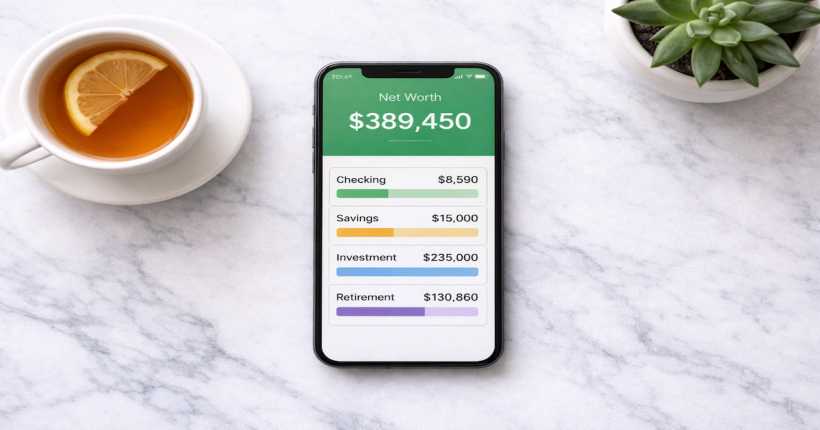
- Aggregation platforms — dashboards that consolidate all financial accounts for complete net worth visibility
What makes these tools “wealth management” rather than just “budgeting apps” is their focus on growing and preserving assets over time. They answer questions like: Am I on track for retirement? How should I allocate $50,000 across investment accounts? What’s my optimal tax strategy?
Want to see wealth management technology in action? Our Retirement Readiness Score calculator analyzes your current savings, income, and timeline to show whether you’re on track for retirement — the exact type of personalized assessment that once required paying an advisor hundreds of dollars.
Why Traditional Advisors Are Losing Ground
Traditional wealth management operated on a simple model: human advisors charged percentage-based fees (typically 1% of assets under management) to provide investment advice, portfolio construction, and financial planning.
For clients with $500,000 invested, that’s $5,000 annually. For a million-dollar portfolio, $10,000 per year. Forever. Compounded over decades, those fees consume 20–30% of potential portfolio value.
The Cost Problem
Technology-driven alternatives charge 0.15–0.50% for similar services. On that same $500,000 portfolio:
- Traditional advisor: $5,000 annually ($150,000+ over 30 years)
- Robo-advisor: $750–$2,500 annually ($22,500–$75,000 over 30 years)
- Savings: $75,000–$127,500 that stays invested and compounds
For younger investors starting with smaller amounts, traditional advisors weren’t even an option. Most required $100,000 minimums. Technology eliminated those barriers entirely — you can start with $100 or even $1. For a full breakdown of getting started, see our investment fundamentals guide for beginners.
The Accessibility Problem
Traditional advisors served the already-wealthy by design. High minimums, percentage-based fees, and geographic limitations meant most Americans couldn’t access professional wealth management even if they wanted it. Technology flipped the model: instead of serving 1,000 wealthy clients at high fees, platforms serve millions at low fees.
The Performance Problem
Research consistently shows that most actively managed portfolios underperform low-cost index funds over time. Traditional advisors claimed their value came from “beating the market,” but data revealed they rarely did — especially after fees. Robo-advisors don’t try to beat the market. They build diversified portfolios of low-cost index funds, automatically rebalance, harvest tax losses, and maintain target allocations. This boring, algorithmic approach outperforms most human advisors simply by avoiding expensive mistakes and minimizing costs.
How Modern Wealth Management Technology Works
The Onboarding Process
Modern platforms start with questionnaires assessing your:
- Financial goals (retirement, home purchase, education funding)
- Time horizon (how long until you need the money)
- Risk tolerance (how you’d react to portfolio fluctuations)
- Current financial situation (income, debts, existing investments)
- Tax considerations (income level, account types)
Automated Portfolio Management
Once invested, platforms continuously:
- Monitor allocations — as markets move, your portfolio drifts from target allocations
- Rebalance automatically — selling winners and buying underperformers maintains intended risk levels
- Harvest tax losses — selling losing positions to offset gains, then buying similar investments to maintain market exposure
- Reinvest dividends — automatically purchasing additional shares without manual action
- Optimize contributions — directing new deposits to underweight asset classes
Advanced Features
- Goal-based investing — separate portfolios for different objectives with customized time horizons and risk levels
- Tax coordination — placing tax-inefficient investments in retirement accounts and tax-efficient ones in taxable accounts
- Smart withdrawals — optimizing which accounts to draw from in retirement to minimize tax burden
- Financial planning projections — Monte Carlo simulations showing retirement readiness probabilities
- Scenario modeling — “what if” analysis for major decisions like buying a home or changing careers
Traditional Advisors vs. Robo-Advisors vs. Hybrid Models
| Feature | Traditional Advisor | Robo-Advisor | Hybrid Model |
|---|---|---|---|
| Minimum Investment | $100,000–$500,000 | $0–$500 | $25,000–$100,000 |
| Annual Fee | 1.0–2.0% of assets | 0.15–0.50% of assets | 0.30–0.75% of assets |
| Human Access | Regular meetings | Email/chat support only | Unlimited advisor calls |
| Portfolio Management | Human-directed | Fully automated | Automated with oversight |
| Financial Planning | Comprehensive custom plans | Automated tools/calculators | Professional plans on demand |
| Tax Optimization | Strategic, personalized | Automated tax-loss harvesting | Both automated + strategic |
| Best For | Complex situations, high net worth | Straightforward investing, DIY preference | Want automation + human guidance |
Technology Is Shifting Control to Individuals
Perhaps the most significant change isn’t cost or access — it’s empowerment. Wealth management technology enables self-directed financial management without requiring extensive expertise.
Now, individuals can:
- See complete financial pictures across all accounts in real-time
- Understand how current decisions affect long-term trajectories
- Implement sophisticated strategies (tax-loss harvesting, asset location) automatically
- Make informed adjustments without paying for advisor consultations
- Build wealth progressively without meeting arbitrary minimums
This self-directed approach appeals particularly to Millennials and Gen Z, who grew up with technology and prefer autonomy over delegating financial decisions to a third party.
Taking control of your financial future requires the right tools. Monarch Money (affiliate) tracks net worth, coordinates multiple accounts, and provides visibility into whether your current trajectory aligns with long-term goals.
The Major Players Reshaping Wealth Management
Betterment
Pioneer robo-advisor launched in 2010. Offers automated investing, retirement planning tools, and access to human advisors at higher tiers. Known for tax-loss harvesting and socially responsible portfolio options. 0.25% annual fee for digital-only, 0.40–0.65% for advisor access.
Wealthfront
Comprehensive wealth management platform including investment accounts, high-yield savings, stock investing, and cryptocurrency. Strong tax optimization features including direct indexing for higher balances. 0.25% annual advisory fee, no advisor tiers.
Vanguard Personal Advisor Services
Hybrid model combining Vanguard’s low-cost index funds with human advisor access. Requires $50,000 minimum. Appeals to investors wanting both automation and human guidance. 0.30% annual fee.
Schwab Intelligent Portfolios
No advisory fees — Schwab earns money through cash allocations and proprietary funds. Premium tier ($30/month + $300 initial planning fee) includes unlimited human advisor consultations. Appeals to existing Schwab customers wanting integrated services.
Fidelity Go
No fees on balances under $25,000, making it excellent for beginners. 0.35% annual fee above $25,000. Integrates with Fidelity’s broader platform including retirement accounts and brokerage services.
When Human Advisors Still Make Sense
Technology handles routine wealth management brilliantly, but certain situations still benefit from human expertise:
Complex financial situations. Multiple income streams, business ownership, stock options, inheritance planning, trust management — these scenarios involve nuances algorithms can’t fully navigate.
Major life transitions. Divorce, sudden windfall, career change, early retirement — emotional and strategic complexity benefits from human guidance.
Estate planning. Coordinating wills, trusts, beneficiaries, and tax implications requires legal and financial expertise beyond portfolio management.
Behavioral coaching. Preventing panic selling during market crashes or overconfidence during bull markets — human advisors provide emotional discipline some investors need.
Preference for relationships. Some people simply prefer discussing finances with humans rather than algorithms. That’s valid.
The key question isn’t “technology or human” but “which services require human expertise versus algorithmic efficiency?” Many investors find hybrid approaches optimal — technology handles routine portfolio management while humans provide strategic guidance for complex decisions.
How to Evaluate Wealth Management Technology
Fees and Minimums
Advisory fees range from 0% to 0.50% annually. Lower is better, but evaluate total cost including underlying fund expenses. Some “no fee” platforms hide costs through cash drag or expensive funds. $0 minimums let you start immediately; $25,000+ minimums might offer premium features but delay getting started.
Investment Approach
- Index-based — passive exposure to market returns through low-cost ETFs
- Direct indexing — individually owned stocks mimicking index performance, enabling sophisticated tax optimization
- Thematic portfolios — ESG, halal, or sector-specific options
Tax Optimization
Tax-loss harvesting can add 0.50–1.50% annually to after-tax returns — potentially worth more than advisory fees saved. Evaluate:
- Does the platform harvest losses automatically?
- How sophisticated is the tax strategy (daily monitoring vs. annual)?
- Is asset location optimized across account types?
Human Access
- Email/chat support only?
- Scheduled calls with CFPs?
- Unlimited access or limited consultations?
The Role of Financial Institutions in This Shift
Traditional banks and investment firms aren’t disappearing — they’re adapting. Most major institutions now offer digital wealth management options alongside traditional services.
Choosing the right bank in today’s landscape increasingly means evaluating not just checking and savings features but also whether their integrated wealth management tools align with your investing approach. For a full breakdown of the digital banking options available, see the Neobanks & Digital Banking Platforms hub.
Privacy and Security Considerations
Regulatory oversight. Is the platform registered with the SEC as an investment advisor? Are accounts protected by SIPC insurance (up to $500,000 including $250,000 cash)?
Security infrastructure. Two-factor authentication, encryption, regular security audits. Read their security documentation — if it’s vague or absent, that’s a red flag.
Data usage policies. Who has access to your financial data? Is it sold to third parties? Used for advertising? Understand what you’re authorizing.
Account access method. Some platforms require read-only access to external accounts for tracking. Others need full credentials. Minimize risk by limiting access where possible.
The Future: AI, Personalization, and Hybrid Models
AI-powered personalization. Machine learning analyzes spending patterns, income volatility, and life circumstances to provide hyper-personalized recommendations beyond standard risk questionnaires.
Conversational interfaces. Natural language AI advisors that answer complex financial questions conversationally rather than through rigid questionnaires and calculators.
Predictive analytics. Systems that identify financial risks before they materialize and suggest proactive solutions.
Embedded wealth management. Investment and planning tools built directly into banking apps and employer platforms — making wealth building automatic rather than a separate activity.
Democratized sophisticated strategies. Direct indexing, options strategies, and alternative investments previously reserved for ultra-high-net-worth individuals becoming accessible to average investors through technology.
Making the Transition to Technology-Driven Wealth Management
Questions to Ask Yourself
- What am I actually paying my current advisor for? (Portfolio management? Financial planning? Tax strategy? Emotional support?)
- Which of those services could technology deliver at lower cost without quality loss?
- Do I have complex situations that genuinely require human expertise?
- Am I comfortable with self-directed investing using automated tools?
- Would a hybrid approach work better — technology for routine management, humans for strategic decisions?
Test Before Committing
Most platforms allow opening accounts with minimal deposits. Test interfaces, features, and customer support before moving significant assets. Run parallel systems temporarily — keep your existing advisor while testing robo-alternatives. Compare performance, costs, and experience over 3–6 months.
Don’t Rush Major Changes
Transitioning IRAs or large taxable accounts can trigger taxes or fees. Understand all implications before moving money. Sometimes gradual transitions make more sense than immediate wholesale changes.
Explore the full FinTech ecosystem
See how digital banking, robo-advisors, and modern financial tools are reshaping how people build wealth.
FinTech & Modern Money Tools →Frequently Asked Questions
Are robo-advisors safe?
Reputable platforms are registered with the SEC as investment advisors and accounts are protected by SIPC insurance up to $500,000. Always verify registration and insurance before transferring assets.
How much do I need to start with a robo-advisor?
Many platforms have $0 minimums. Betterment, Wealthfront, and Fidelity Go all allow you to open accounts with very small amounts. The barriers that kept younger investors out of wealth management no longer exist.
Can I still use a human advisor alongside a robo-advisor?
Yes — this is the hybrid approach and it’s increasingly common. Use technology for routine portfolio management and a human advisor selectively for complex decisions, estate planning, or major life transitions.
What is tax-loss harvesting and do I need it?
Tax-loss harvesting is the practice of selling investments at a loss to offset capital gains taxes, then immediately reinvesting in similar assets to maintain market exposure. It can add meaningful value in taxable accounts, particularly for investors in higher tax brackets. Most robo-advisors handle it automatically.
Resources & Related Reading
- FinTech & Modern Money Tools: Authority Hub
- Neobanks & Digital Banking Platforms: Cluster Hub
- Investment Fundamentals for Beginners
- Retirement Accounts: 401(k), IRA & Roth
- Retirement Readiness Score Calculator
- SEC — Robo-Advisers Guidance
- FINRA — Choosing an Investment Professional
- SIPC — Securities Investor Protection Corporation
Disclaimer: The information provided on PersonalOne is for educational purposes only and does not constitute financial, legal, tax, or investment advice. PersonalOne and its content creators are not licensed financial advisors, attorneys, CPAs, or investment professionals. Investment involves risk including potential loss of principal. Past performance does not guarantee future results. The frameworks, systems, and strategies presented here are general approaches to personal finance management and may not be suitable for every individual’s unique circumstances. Before making significant financial decisions, consult with qualified professionals such as a licensed financial advisor, CPA, or attorney who can assess your specific situation. PersonalOne receives no compensation for recommending specific financial products or services unless explicitly disclosed as sponsored content or affiliate relationships.