July, 2026
Home › Credit, Banking & Cash Flow › Cash Flow Timing & Credit Utilization › Why Your Credit Score Drops Even When You Pay On Time
What You Need to Know
— Paying on time is only one part of your credit score. Credit utilization is the second most significant factor — and it is measured at statement date, not payment date.
— If your balance is high when the statement closes, that high utilization gets reported to the bureaus — even if you pay it in full a week later.
— This means perfect payment history can coexist with a suppressed credit score if the utilization is being measured at the wrong point in the billing cycle.
— The fix is a credit utilization timing strategy that aligns payment timing with the statement close date rather than just the due date.
— No change in spending required. Just a change in when payments are made.
A credit score that drops despite on-time payments is one of the most confusing and demoralizing experiences in personal finance. You did everything right — the payment was made, the due date was not missed, the account is in good standing. And yet the score went down. The explanation almost always comes down to credit utilization timing, and understanding how utilization is measured changes the entire strategy for managing it.
Payment history and credit utilization are the two largest factors in standard credit scoring models. Most people focus entirely on the first and misunderstand the second — not what it is, but when it is measured. That timing gap is what causes on-time payers to see unexpected score drops month after month.
How Utilization Is Actually Measured
Credit utilization is the ratio of your credit card balance to your credit limit, expressed as a percentage. A $500 balance on a $2,000 limit card is 25% utilization. Most credit scoring guidance recommends keeping utilization below 30%, with lower being better for score optimization. What that guidance usually fails to specify is when utilization is measured — and that timing is everything.
Credit card issuers report your balance to the credit bureaus once per month, at the close of your statement period. The balance reported is whatever the account shows on that specific date — not the balance after your payment, not the balance at due date, not an average over the month. The snapshot taken at statement close is the number that appears on your credit report and feeds into your score.
This means that if you spend $1,800 on a $2,000 limit card throughout the month and pay the full balance on the due date — which is typically 21 to 25 days after the statement closes — the credit bureaus see the $1,800 balance. The fact that you paid in full shortly afterward does not change what was reported. From the credit bureau’s perspective, you carried 90% utilization that month.
The Statement Date vs. Due Date Confusion
The gap between statement date and due date is where most of the confusion originates. These are two different dates that serve two different purposes, and conflating them produces a credit strategy that optimizes for the wrong metric.
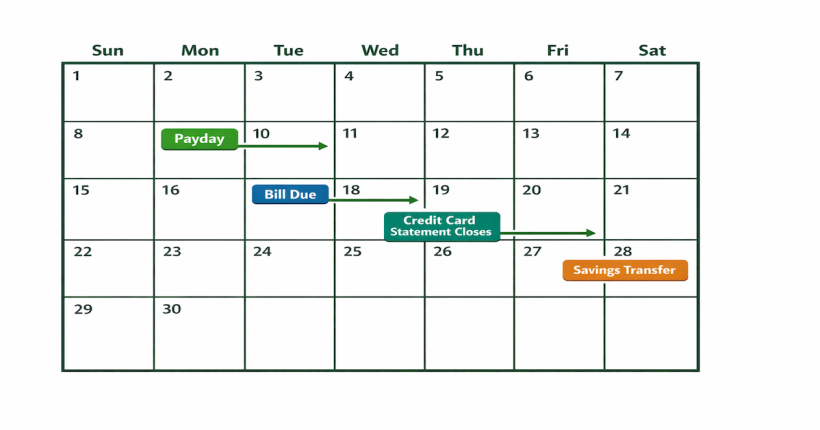
The statement date — also called the statement close date or billing cycle end date — is when your issuer calculates the balance for the period, generates your statement, and reports that balance to the credit bureaus. This is the date that matters for utilization measurement. The due date — typically three weeks later — is the deadline for payment to avoid late fees and interest. This is the date most people optimize around. Paying by the due date keeps payment history clean. It does nothing to reduce the utilization that was already reported at statement close.
The CFPB’s credit reporting guidance confirms that issuers report balances at the close of the billing cycle. Understanding the distinction between these two dates is the foundation of an effective credit utilization timing strategy — because optimizing payment timing requires knowing which date is the relevant one for credit score purposes.
Why High Utilization Suppresses Scores Even Temporarily
Credit scores recalculate based on the most recent data reported by creditors. There is no smoothing or averaging across months — if high utilization was reported this month, the score reflects that high utilization this month, regardless of what was reported last month or what will be reported next month. This means utilization damage is monthly and recurring for anyone who consistently carries high statement-date balances.
For people who pay in full every month, this pattern is particularly counterintuitive. The behavior — spending freely and paying completely — is financially sound. No interest is accrued. No balance carries forward. But the credit score does not measure financial soundness. It measures the snapshot of reported data, and if that snapshot consistently shows high utilization at statement close, the score will consistently reflect it regardless of the subsequent payment behavior.
The practical implication is significant for anyone applying for a mortgage, auto loan, or any credit product where the score at application date determines the rate. A score suppressed by high utilization at statement close — even in a household that pays in full every month — will produce a worse rate than the same household with the same spending behavior and a pre-payment strategy timed before the statement closes.
The timing fix requires no change in spending. Just a change in when you pay.
The full cash flow timing and credit utilization framework covers exactly how to align payment timing with statement dates to report lower utilization without reducing what you spend.
Explore Cash Flow Timing & Credit Utilization →The Structural Fix: Paying Before Statement Close
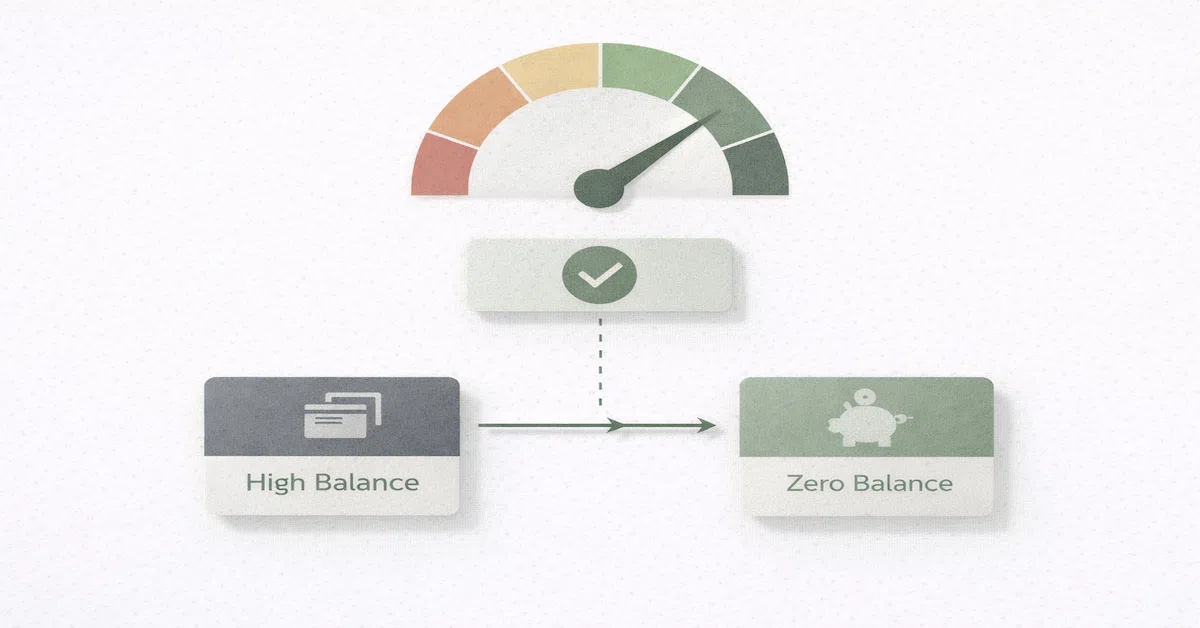
The solution to statement-date utilization spikes is straightforward once the timing mechanics are understood: make a partial or full payment before the statement closes rather than waiting for the due date. A payment made three to five days before the statement close date reduces the balance that gets reported to the bureaus. The due date payment is still required to avoid late fees, but the pre-statement payment is what determines what utilization appears on the credit report.
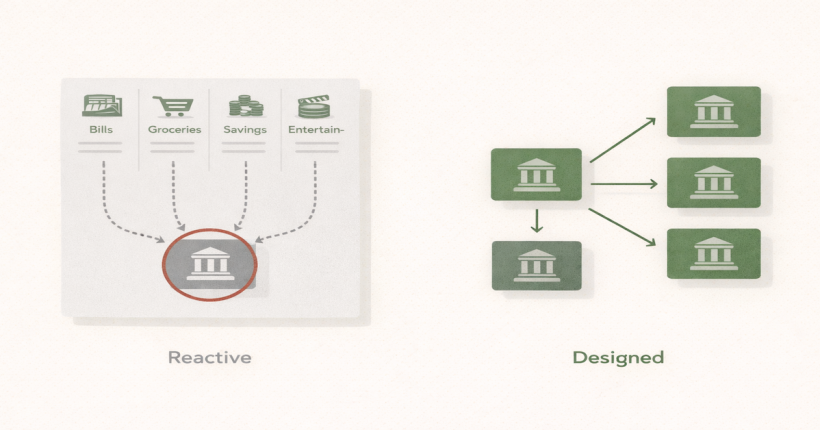
For households using a well-designed banking structure, this payment can be automated as a scheduled transfer from the bills account to the credit card on a date that precedes the statement close by several days. The bill is being paid in two stages: a pre-statement payment that reduces reported utilization, and the remaining balance payment by the due date if needed. Both are captured in the account automation. Neither requires ongoing management or memory.
The specific mechanics of how paycheck timing interacts with this strategy — particularly for households paid biweekly or semi-monthly whose income arrives at different points in the billing cycle — are covered in detail in the paycheck timing and credit utilization article in this cluster.
Resources
CFPB — Credit Reports and Scores
CFPB — What Is a Credit Utilization Rate?
Federal Reserve — Survey of Consumer Finances
This article is part of the Credit, Banking & Cash Flow integration system on PersonalOne — the complete framework for building a personal finance infrastructure that runs reliably by design.
Frequently Asked Questions
Does paying in full every month protect my credit score?
It protects your payment history, which is the largest factor in credit scoring and the most important one to maintain. But it does not necessarily protect your utilization, which is the second largest factor. If your balance is high at statement close before you make the full payment by due date, high utilization was already reported. Paying in full prevents interest and keeps payment history clean — but you also need to manage the balance at statement date to keep utilization from suppressing the score.
How much does high utilization actually affect the score?
The impact varies by scoring model and by the rest of the credit profile, but high utilization is consistently among the most immediately impactful score factors. Utilization above 30% begins to suppress scores noticeably in most models. Utilization above 50% produces significant suppression. Utilization above 90% on any individual card can produce a substantial negative impact even if the overall profile is otherwise strong. The effect is also largely reversible — reducing utilization in a single reporting cycle improves the score in the following cycle once the lower balance is reported.
When does my card issuer report to the bureaus?
Most issuers report within a few days of the statement close date. You can find your statement close date on any credit card statement or in your online account under billing information. If it is not clearly labeled, contact the issuer and ask specifically for the statement close date and the date they report to the credit bureaus — some issuers report on a slightly different date than the statement close. Knowing the exact reporting date allows you to time pre-statement payments with precision.
What utilization percentage should I target?
For score optimization, the general guidance from credit scoring research is to keep each individual card below 30% and total utilization across all cards below 30%. For maximum score optimization in the period before a major credit application — mortgage, auto loan, refinance — getting utilization below 10% across all cards for one to two billing cycles before the application date produces the best score result. Normal utilization management targets below 30% as the sustainable baseline.
Disclaimer: This content is for educational purposes only and does not constitute financial advice. Individual financial situations vary — consult a qualified financial professional for personalized guidance.