June, 2026
Home › Financial Stability › Long-Term Resilience › How Much to Save Before a Recession
How Much Should You Have Saved Before a Recession Hits?
What You Need to Know
— The generic "3–6 months" emergency fund target is not calibrated for recession risk — recession savings targets are higher and depend on your specific employment vulnerability
— How much to save before a recession depends on four variables: your industry recession sensitivity, your household income concentration, your fixed expense ratio, and your current debt load
— The recession savings target for most households in recession-sensitive employment is 9–12 months of essential expenses
— Liquid cash savings and invested assets are not interchangeable for recession preparation — investments can decline in value exactly when you need the money most
— Building toward a recession savings target is valuable regardless of whether a recession materializes — the same cash strengthens your financial position in any economy
How Much to Save Before a Recession: The Variable-Based Calculation
The question of how much to save before a recession does not have a single universal answer — and the advice that says it does is giving you generic guidance calibrated for a standard individual disruption, not the extended, correlated disruption that a recession creates. A recession savings target requires accounting for how likely your specific income is to be disrupted, how long a disruption might last in your industry, and how much your current financial structure can withstand without a cash cushion. The long-term financial resilience framework this savings target is part of is in the Long-Term Resilience guide.
The financial cushion recession preparation requires is genuinely different from the standard emergency fund because recessions change the rules: unemployment is higher, job searches take longer, and income disruption often lasts longer than the single events a standard emergency fund is calibrated for. The financial stability guide covers how the recession savings target connects to the complete financial resilience system in the financial stability guide.
The Four Variables That Determine Your Target
Variable 1: Industry recession sensitivity. Some industries contract significantly during recessions and recover slowly. Historically recession-sensitive industries include hospitality, retail, construction, real estate, media and advertising, financial services, and manufacturing. Recession-resistant industries include healthcare, utilities, government employment, essential consumer goods, and education. If you work in a recession-sensitive industry, your savings target should be toward the higher end of the range. If you work in a recession-resistant field, the standard emergency fund guidance is closer to appropriate.
Variable 2: Household income concentration. A single-income household is more recession-vulnerable than a dual-income household because all income comes from one source. A dual-income household where both incomes are in recession-sensitive industries is more vulnerable than one where incomes come from different sectors. The more concentrated your household income, the larger the cash reserve target.
Variable 3: Fixed expense ratio. A household with low fixed obligations can survive on significantly less income during a recession than one with a high fixed expense ratio. Calculate your bare-bones monthly number (rent, utilities, food, transportation, minimum debt payments only) and use that as your savings target base rather than your total current monthly spending.
Variable 4: Current debt load. High-interest debt creates fixed minimum payments that continue during income disruption. The more high-interest debt you carry, the higher your bare-bones monthly number — and therefore the higher the absolute amount of cash you need to cover a recession-length disruption. Eliminating high-interest debt before a recession simultaneously reduces your savings target and reduces your monthly financial vulnerability. The Debt Relief and Credit Repair guide covers the complete framework for eliminating debt strategically.
The Recession Savings Target Matrix
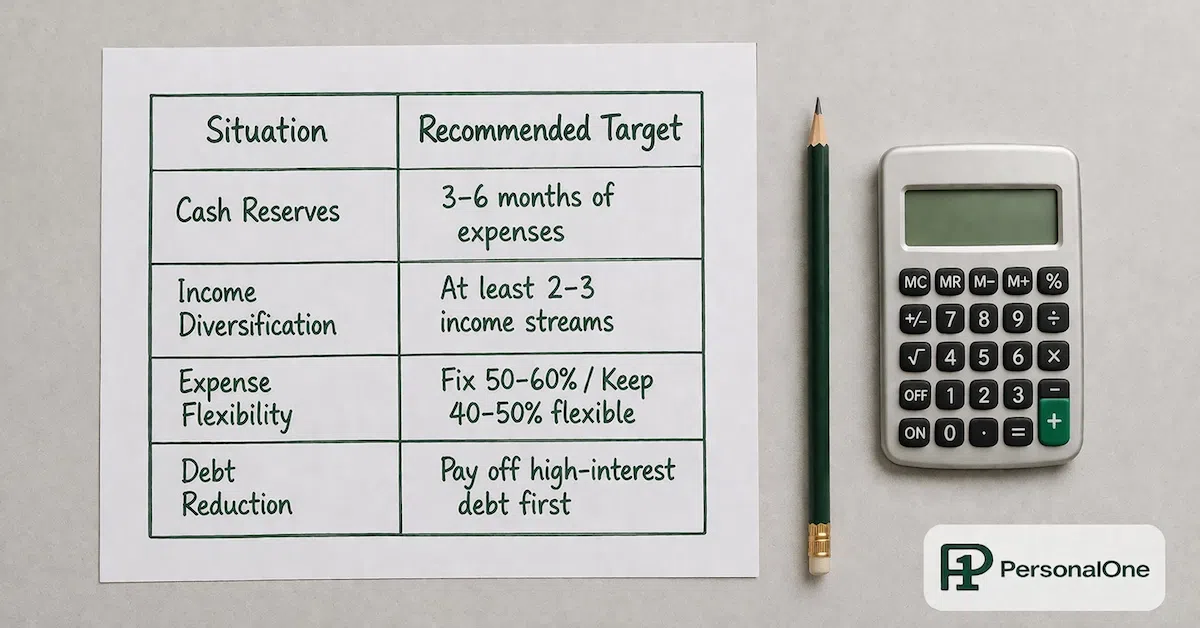
| Situation | Recommended Target |
|---|---|
| Recession-resistant industry, dual income, low debt | 3–4 months bare-bones expenses |
| Mixed industry sensitivity, dual income, moderate debt | 5–6 months bare-bones expenses |
| Recession-sensitive industry, single income, moderate debt | 7–9 months bare-bones expenses |
| Recession-sensitive industry, single income, high debt or self-employed | 9–12 months bare-bones expenses |
Why Investments Do Not Count as Recession Savings
The most dangerous recession savings mistake is counting invested assets as part of your recession cushion. Recessions are characterized by declining investment values — stock markets typically fall 20–40% during recessions. This means the moment you most need to access your “savings” is exactly when your investments are most likely to be worth significantly less than you contributed. Liquidating investments during a market decline to cover living expenses converts paper losses into permanent losses and eliminates the assets that would otherwise recover and grow during the subsequent expansion.
Recession savings must be held in liquid, FDIC-insured cash accounts — high-yield savings accounts, money market accounts, or short-term CDs with accessible maturity dates. The lower return compared to investments is the cost of the liquidity and stability guarantee. For recession preparation specifically, that trade-off is unambiguously correct. The Banking Systems guide covers how to structure accounts to hold your recession savings efficiently across multiple FDIC-insured institutions.
The right savings target is specific to your situation — not a generic formula.
The complete Long-Term Resilience framework covers the full recession preparation system including savings targets, income diversification, and expense structure.
Explore Long-Term Resilience →Resources
Official Sources
FDIC — Consumer Resource Center — How to structure recession savings across multiple FDIC-insured accounts to maintain full deposit insurance coverage when balances exceed the per-institution limit.
Federal Reserve — Economic Well-Being of U.S. Households — Annual data on household savings rates, emergency fund adequacy, and financial vulnerability across income levels and industries.
Return to the financial stability guide for the complete system this cluster is part of.
Frequently Asked Questions
Should I stop investing to build my recession savings target faster?
Reduce above-match retirement contributions temporarily if needed to accelerate recession savings building, but do not stop employer-match contributions entirely. The match is a guaranteed return no savings account rate can replicate. Once your recession savings target is funded, restore full investment contributions. The interruption to compounding from a 6–12 month reduction in above-match contributions is significantly smaller than the financial risk of entering a recession without adequate cash reserves.
What if I cannot reach my recession savings target before economic conditions worsen?
Build as much as you can as fast as you can. Partial recession preparation is significantly better than none. A household with 4 months of savings targeting 9 months is more resilient than one with 1 month of savings. Simultaneously implement the other recession preparation moves: reduce fixed expenses, eliminate high-interest debt, contact creditors proactively, and develop secondary income. Each move adds resilience independently of the savings target.
Is a money market account appropriate for recession savings?
Yes — FDIC-insured money market accounts at banks (not money market funds at brokerage firms, which are not FDIC-insured) are appropriate for recession savings. They offer competitive rates, same-day or next-day access, and FDIC coverage up to $250,000 per depositor per institution. Confirm FDIC insurance status before depositing at any institution using the FDIC BankFind tool at FDIC.gov.
Disclaimer: This article is for informational and educational purposes only. Economic conditions, interest rates, and employment markets change. This content does not constitute financial or investment advice.