2026
Home › Financial Stability › Long-Term Financial Resilience
What You Need to Know
— Stability that does not evolve becomes fragility over time. Long-term financial resilience is the bridge between stabilization and wealth building — a system that strengthens through every life stage rather than requiring a rebuild every time circumstances change.
— Every major life transition — a new job, a partner, a child, a home, a career change, a health event — creates new financial complexity. A system built only for your current circumstances will be strained by the next transition.
— The seven systems that build long-term resilience are sequenced: emergency fund first, then debt elimination, automated budget infrastructure, early investment contributions, credit profile management, insurance layer, and specific time-bound goals.
— Long-term resilience is not built through single large decisions. It is built through habits that run automatically in the background — infrastructure that outlasts willpower through every disruption.
— This is the final stability layer before investing and income expansion become possible without risk of regression. The complete Financial Stability framework sits beneath it.
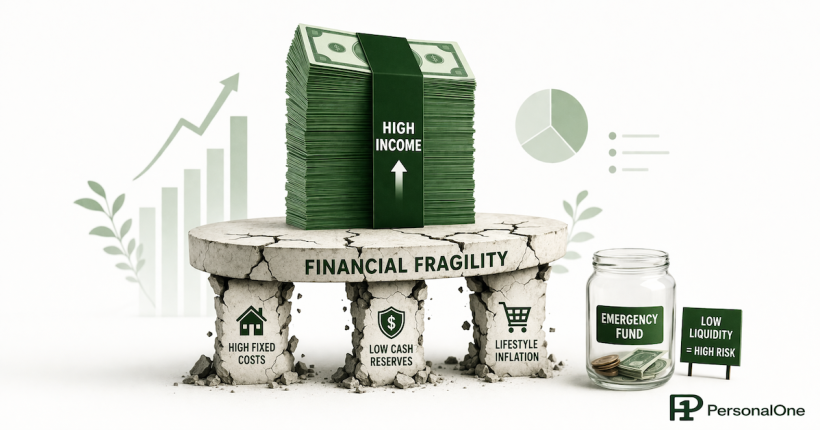
Most people treat financial stability as a destination — something you reach and then maintain indefinitely. The reality is that every major life transition creates new financial complexity that the existing system was not built to handle. A financial system calibrated for a single person with one income stream and no dependents will be structurally inadequate for a household with two incomes, a mortgage, and children in school. The emergency fund target changes. The insurance requirements change. The estate planning needs emerge. A system that does not update with these changes is not stable — it is brittle.
Long-term financial resilience is not about having more money. It is about having a system designed to absorb change — one that strengthens through transitions rather than requiring a complete rebuild each time life moves to a new stage.
This cluster hub covers the habits, systems, and frameworks that build resilience across decades rather than just months. For the complete Financial Stability system that this cluster sits within, the Financial Stability hub covers all six layers.
Why Stability Must Evolve or It Becomes Fragility
Long-term resilience is the practice of reviewing and updating your financial system before transitions break it rather than after. The households that maintain financial stability through major life changes are the ones with systems designed for adaptability — not the ones with the highest incomes or the most savings at any single point.
Financial complexity does not grow linearly — it compounds. Each life stage adds new variables that the previous stage did not require the system to handle. A system built for your 20s will not hold up in your 40s without deliberate updates. The question is not whether your financial system will need to change. The question is whether you make those changes proactively or in response to a crisis that forced the issue.
The Seven Systems That Build Long-Term Resilience
The Resilience Stack — Built in Sequence
1. Emergency fund: The foundational protection layer. Without it, every other system is vulnerable. Build to three to six months of survival expenses before any other major financial goal.
2. High-interest debt elimination: Debt at 20%+ APR produces a guaranteed negative return on every dollar it holds. Eliminating it is the highest-certainty financial move available at any income level.
3. Automated budget infrastructure: A system where bills pay themselves, savings transfer automatically, and the remaining balance is genuinely spendable without mental accounting. Infrastructure outlasts willpower.
4. Early investment contributions: The most important variable in long-term investing is time — not amount. A dollar invested at 25 does significantly more work than a dollar invested at 35. Start the compounding clock as early as possible, even at small amounts.
5. Credit profile management: Credit built carefully in your 20s is still working for you in your 40s. Account age compounds. Payment history compounds. A strong credit profile is access infrastructure — it determines mortgage rates, rental approvals, and in some industries, employment eligibility.
6. Insurance layer: Insurance transfers catastrophic risk away from your financial system at a known, manageable cost. A single uninsured event can eliminate years of stability progress. Health, renter's, auto, and disability coverage are the minimum layer for most households.
7. Specific, time-bound financial goals: Systems without goals are technically functional but motivationally fragile. Specific goals with defined timelines convert abstract financial intentions into monthly actions with measurable progress.
Financial Complexity by Life Stage — What Changes and When
Complexity by Life Stage
20s — Foundation building: Emergency fund, high-interest debt, first investment contributions, credit building, basic insurance. The leverage window for compounding is widest here — every system built now produces disproportionate long-term benefit.
30s — System expansion: Income growth, potential home purchase, partnership finances, potential dependents. Tax complexity increases. Insurance requirements expand. Estate planning basics become necessary. The system must scale to accommodate more variables without losing the stability foundation.
40s — Acceleration and protection: Peak earning years for most households. Retirement savings acceleration, college funding if applicable, mortgage progress, career transition risk. Health costs begin to increase as a planning variable. Estate documents must be current.
50s and beyond — Transition preparation: Retirement timeline becomes concrete. Social Security strategy matters. Healthcare cost planning becomes critical. Estate settlement infrastructure must be fully in place. The system's primary job shifts from accumulation to preservation and distribution.
Sustainable Financial Habits That Compound Over Decades
Long-term resilience is not built through single large decisions — it is built through the daily and monthly habits that run in the background of a well-structured financial system. The habits that produce lasting results are not the dramatic ones. They are the ones that require the least ongoing effort because they have been automated and systemized.
Automated savings transfers prevent the spending-first pattern that consistently defeats good financial intentions. Automated investment contributions keep the compounding clock running through every life disruption. Regular review cycles — annual at minimum, triggered by major life events — keep the system calibrated to current circumstances rather than past ones.
The households that maintain financial stability over decades are not the ones with the best financial discipline. They are the ones with the best financial infrastructure — systems designed to run without requiring constant willpower, updated regularly to match current reality, and resilient enough to absorb the transitions that life inevitably delivers.
Build the Complete Financial Stability System
Long-term resilience is the final stability layer. The Financial Stability Authority Hub maps all six clusters — from the first $1,000 emergency fund to the long-term habits that compound over decades.
Explore the Financial Stability Hub →Go Deeper: Long-Term Financial Resilience Guides
This hub covered the framework. For specific life stages, transitions, recession planning, and long-term strategy, use these supporting guides:
Stability Before Investing: Why Most People Get This Wrong
Why financial stability must be in place before investing begins — the three stability layers required, what happens when investors skip them, and how to know when you are genuinely ready to shift from stabilization to wealth building.
How to Build Financial Resilience
The complete framework for building a financial system that absorbs disruption without collapsing — how to sequence each resilience layer and what the system looks like when it is fully operational.
How to Recession-Proof Your Finances
The structural preparations that protect a household through an economic downturn — what to build before a recession hits, how to adjust during one, and how to recover without permanent setback afterward.
Income Diversification Strategy
How to build multiple income streams that reduce dependence on any single source — the sequencing of active income stabilization, passive income development, and investment income that produces durable long-term financial security.
How Much to Save Before a Recession
The specific savings targets that provide genuine protection during an economic contraction — how to calculate your number based on income type, fixed obligations, and employment vulnerability.
Financial Habits That Build Long-Term Resilience
The specific habits — automated, low-effort, high-impact — that compound quietly across decades and produce lasting financial stability without requiring constant attention or willpower.
How to Build a Financially Resilient Life
The complete life architecture for financial resilience — how to build a household financial system that handles career transitions, relationship changes, income shifts, and major life events without structural failure.
Financial Resilience at Every Income Level
How the resilience framework scales across income levels — what financial resilience looks like on a minimum wage income versus a six-figure salary, and why the structure matters more than the amount.
How to Stress-Test Your Finances
How to run a financial stress test before a crisis forces one — the scenarios to model, the vulnerabilities to identify, and the specific system upgrades that close the gaps stress testing reveals.
Resources
Official Sources
IRS — Retirement Plans: Contribution Limits and Rules
CFPB — Planning for Retirement
Social Security Administration — Retirement Benefits
National Institute on Aging — Financial Security in Later Life
Related PersonalOne Guides
Financial Stability Hub — The complete stability framework across all six clusters
Emergency Fund Strategy — The foundational protection layer that long-term resilience is built on top of
Financial Shock Absorption — How the layered protection system handles disruptions through every life stage
Investing & Wealth Growth — The next system after financial stability is established
Frequently Asked Questions
When should I start saving for retirement?
Earlier than feels urgent. The compound growth advantage of early contributions is structural — money invested in your 20s has decades more of compounding than money invested in your 40s. The specific amount matters less than starting the account and the habit while the window is open. If the number feels overwhelming, start with whatever the employer match requires and increase by one percentage point annually.
How do I balance retirement savings with paying off debt?
Capture the full employer 401(k) match first — it is a guaranteed return that no debt payoff rate matches. Build a $1,000 emergency fund. Then eliminate high-interest debt above 7% APR aggressively. Once high-interest debt is clear, increase retirement contributions toward the 15% benchmark. Other goals sequence after the retirement foundation is established.
How often should I review my financial system?
At minimum, annually — once per year to verify that accounts, insurance, beneficiary designations, and estate documents reflect current circumstances. Beyond that, any major life event triggers an immediate review: marriage, divorce, new child, job change, home purchase, significant income change, death of a family member. The system should always reflect current reality, not the circumstances of when it was first set up.
Is it too late to start if I am in my 40s or 50s?
No — but the math changes. Catch-up contributions are available for retirement accounts for those 50 and older. More importantly, the decision to start or increase contributions at 45 or 50 is always better than not doing so. The compounding window is shorter but still open. People who start later often need to work longer, reduce retirement expenses, or draw down from other assets — but none of those are catastrophic outcomes if the savings direction is correct from this point forward.
PersonalOne Money System
This content is researched, written, and owned by PersonalOne — a free financial education platform built to help Millennials and Gen Z build real financial systems.
Disclaimer: This content is for educational purposes only and does not constitute financial advice. Individual financial situations vary — consult a qualified professional before making financial decisions.