June, 2026
Home › Financial Stability › Long-Term Resilience › How to Stress-Test Your Finances
What You Need to Know
— A financial stress test is a structured exercise that reveals how your finances would actually perform under specific disruption scenarios — before those scenarios happen
— Most people significantly overestimate their financial resilience because they have never calculated how long their resources would actually last under a realistic disruption
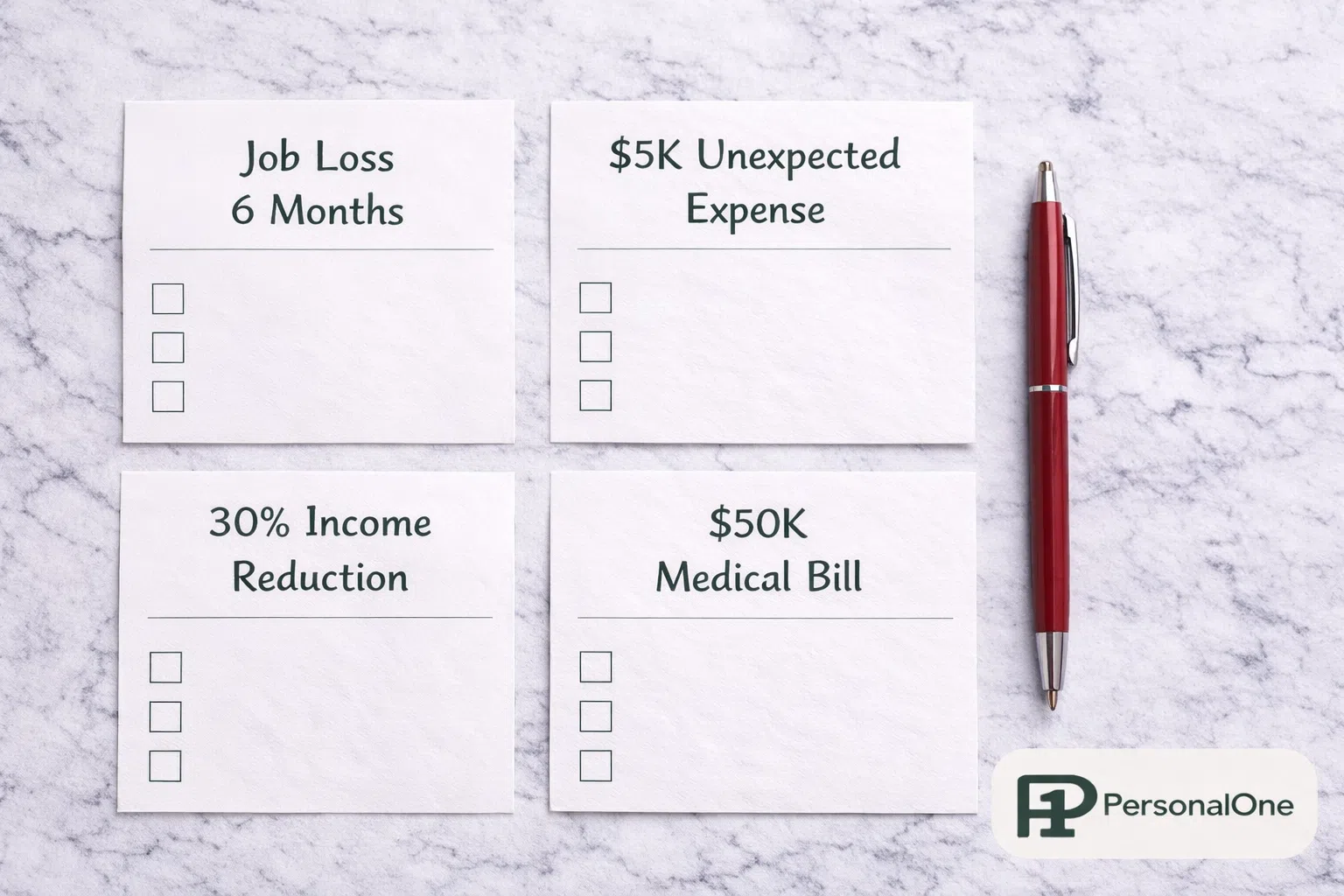
— The four stress test scenarios that reveal the most about financial vulnerability: job loss, major unexpected expense, income reduction, and extended income gap
— A financial vulnerability audit takes 1–2 hours and produces a specific list of structural improvements ranked by impact
— The goal of stress testing is not to find a perfect financial system — it is to identify the highest-leverage improvements before a real crisis reveals them expensively
Learning how to stress test your finances is one of the most valuable exercises in the long-term financial resilience toolkit — and one of the least commonly performed — and one of the least commonly performed. A financial vulnerability audit is what banks, investment firms, and large corporations do routinely to understand where their systems are most vulnerable before a crisis reveals those vulnerabilities under pressure. The same framework applies to personal finances: run the scenarios on paper, identify the gaps, and fix them before a real event forces you to discover them with real consequences. The complete long-term resilience framework that a financial stress test evaluates is in the Long-Term Resilience guide.
The recession readiness checklist approach to financial stress testing is built around four specific disruption scenarios. Each scenario reveals different vulnerabilities in your financial system. Running all four gives you a complete picture of where your finances are genuinely resilient and where they are structurally fragile. The financial stability system that stress testing measures against is in the financial stability guide.
Stress Test 1: Complete Job Loss for 6 Months
The scenario: Your primary income stops entirely tomorrow. Your employer-provided health insurance ends in 30 days. You file for unemployment and receive 50% of your previous income for up to 26 weeks.
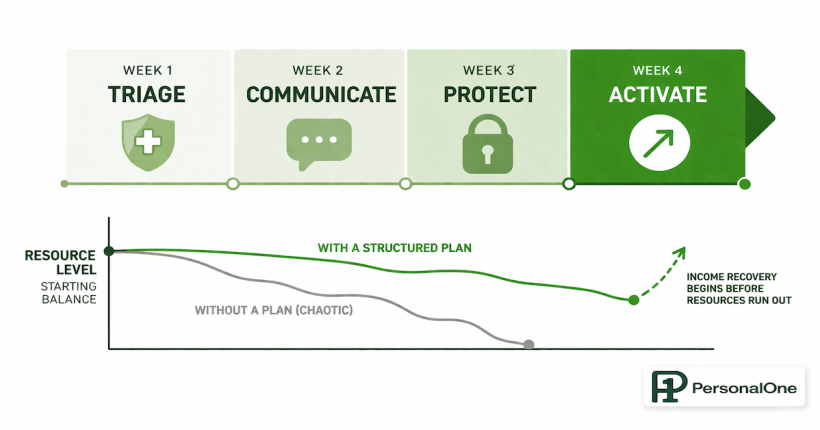
What to calculate: How many months can you cover your bare-bones monthly expenses (rent, utilities, groceries, transportation, health insurance replacement, minimum debt payments) using unemployment benefits plus emergency fund drawdowns? What is your runway in months? What happens at month 3, 6, and 9 if income has not been restored?
What this test reveals: The adequacy of your emergency fund relative to your actual monthly expenses, the resilience impact of high-interest debt minimums, and whether your fixed expense structure allows you to survive on unemployment benefits alone or requires significant emergency fund drawdowns immediately. If this scenario produces a runway of less than 4 months, emergency fund building is your highest-priority resilience improvement. The Emergency Fund Strategy guide covers how to build to an adequate runway level.
Stress Test 2: A $5,000 Unexpected Expense This Month
The scenario: An unexpected expense of $5,000 arrives this month — a major car repair, a medical bill after insurance, an urgent home repair, or a family emergency requiring immediate funds.
What to calculate: Can you cover this expense without going into debt? If your emergency fund covers it, what is the remaining balance and how does that change your job loss stress test result? If it requires debt, how long does it take to pay off at your current discretionary income, and what does the total cost including interest become?
What this test reveals: Whether your emergency fund is adequate for realistic single-event emergencies, whether you have the behavioral discipline to use the fund for its intended purpose, and how quickly you could replenish it after use. If a $5,000 expense requires credit card debt, the starter emergency fund target needs to be higher or the full emergency fund build needs acceleration. The Buffer Account Systems guide covers how the buffer and emergency fund work together to absorb this type of shock.
Stress Test 3: A 30% Income Reduction for 12 Months
The scenario: Your income drops by 30% for 12 months — through a reduction in hours, a career transition, a business slowdown, or a shift from full-time to part-time employment. Your income continues; it is just significantly reduced.
What to calculate: Can your bare-bones monthly expenses be covered by 70% of your current income? If not, what is the monthly shortfall? Can your emergency fund bridge the gap for 12 months? What discretionary expenses would you need to eliminate to bring spending in line with reduced income?
What this test reveals: Your fixed expense ratio and its relationship to income resilience. If a 30% income reduction creates an immediate cash flow crisis, your fixed obligations are too high relative to income. This test also reveals whether your lifestyle is structured around your current income or around your income minus a resilience buffer. If income reduction requires eliminating every non-essential expense to survive, your expense flexibility is low. The Budgeting and Savings guide covers how to restructure spending to increase expense flexibility.
Stress Test 4: Coverage Gap — What Would a $50,000 Medical Bill Do?
The scenario: A serious medical event generates a $50,000 bill after your insurance pays its portion. This is within the realistic range for a hospitalization, surgery, or serious diagnosis with high out-of-pocket exposure.
What to calculate: What is your current health insurance out-of-pocket maximum? Is that amount covered by your emergency fund? If not, what is the gap? Would this event create a debt situation that takes years to resolve and undermines every other financial goal?
What this test reveals: Whether your insurance coverage is adequate relative to your financial resilience level and whether your emergency fund target accounts for your specific out-of-pocket exposure. If your out-of-pocket maximum exceeds your emergency fund balance, either the insurance coverage needs improvement or the emergency fund target needs to be recalibrated to include the coverage gap. The Insurance and Financial Protection guide covers how to evaluate and improve coverage adequacy.
Building Your Financial Vulnerability Priority List
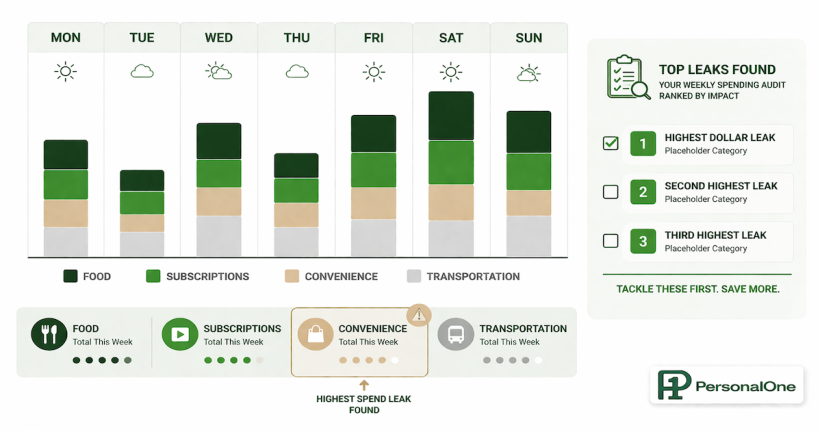
After running all four stress tests, you have a specific vulnerability profile. Rank the vulnerabilities by the severity of outcome they produce — which scenario creates the most financial damage most quickly? That is your highest-priority resilience improvement. Build toward fixing it before moving to lower-priority vulnerabilities. Repeat the stress tests annually and after any major life transition to ensure your resilience system scales with your changing financial situation.
Run the tests now. Find the gaps. Fix them before a real crisis does.
The complete Long-Term Resilience framework covers every structural improvement the stress test reveals — from cash reserves through income diversification and protective coverage.
Explore Long-Term Resilience →Resources
Official Sources
CFPB — Savings Tools and Resources — Consumer Financial Protection Bureau guidance on emergency savings adequacy, how to calculate savings targets, and how to structure reserves across disruption scenarios.
DOL — Unemployment Insurance — Department of Labor guidance on unemployment benefit amounts by state — the data you need to calculate the income replacement in Stress Test 1 accurately for your specific state.
Return to the financial stability guide for the complete system this cluster is part of.
Frequently Asked Questions
How often should I run a financial stress test?
Annually at minimum — ideally at the same time each year such as during tax season when you already have your financial documents in front of you. Additionally, run a targeted stress test after any major financial life change: new job, new housing, significant income change, new debt, new dependent, or major insurance change. Each of these events changes your vulnerability profile enough to warrant re-running the relevant scenarios.
What if the stress test reveals I am more vulnerable than I thought?
That is the correct outcome of a stress test — it reveals real vulnerabilities before they become real crises. The appropriate response is not anxiety but prioritization: identify the highest-severity vulnerability and make it your primary financial focus until it is resolved. A household that discovers a 3-month job loss runway when they thought they had 6 months has not made their situation worse by discovering it — they have given themselves the information needed to extend that runway before a job loss tests it.
Is it possible to have a perfect stress test result?
Not perfectly, but you can reach a state where all four scenarios produce outcomes you can manage without financial catastrophe. The target is not zero vulnerability — it is managed vulnerability. A household with 9 months of emergency fund runway, secondary income covering 15% of total income, fixed obligations at 42% of income, and adequate insurance coverage will handle all four stress test scenarios without financial collapse. That is the achievable target, and it produces genuine financial resilience in practice.
Disclaimer: This article is for informational and educational purposes only. Stress test scenarios are illustrative frameworks — actual outcomes vary based on individual circumstances, state unemployment rules, insurance terms, and creditor policies.