June, 2026
Home › Financial Stability › Long-Term Resilience › Financial Resilience at Every Income Level
What Financial Resilience Actually Looks Like at Every Income Level
What You Need to Know
— Financial resilience on any income is achievable — the principles are the same regardless of income level, though the timeline and scale differ
— Most people at every income level significantly underestimate what financial resilience looks like in practice at their specific income — both by overestimating what is required and underestimating what is achievable
— Building resilience on a tight budget requires prioritizing structural moves over lifestyle improvements, which is harder psychologically but more durable financially
— The most important resilience variable at lower incomes is expense flexibility — keeping fixed obligations low relative to income creates proportionally more resilience than at higher incomes
— Income growth improves resilience only when it is not fully consumed by lifestyle inflation — the gap between income and fixed obligations is the resilience variable, not the income level itself
Financial Resilience on Any Income: What It Actually Requires
The most damaging myth about financial resilience on any income is that it requires a specific income level to achieve. Building long-term financial resilience is possible at every income level when the right structural relationships are managed intentionally. Federal Reserve survey data consistently shows that people at every income level report living paycheck to paycheck — and people at every income level report having built genuine financial security. The variable that separates the two groups is not income; it is the structural relationship between income, fixed obligations, savings, and debt. Financial security at any income level is achievable when those structural relationships are managed intentionally. The complete framework is in the Long-Term Resilience guide.
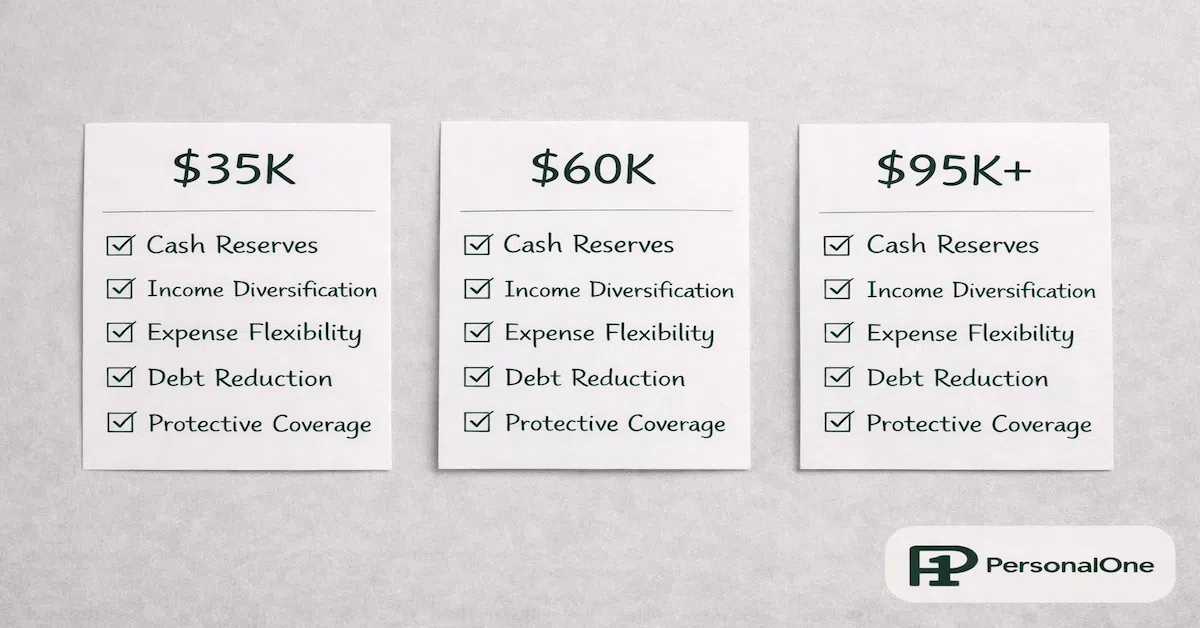
What financial resilience looks like in practice differs by income level — not in principle but in scale, timeline, and specific trade-offs. A household earning $35,000 and a household earning $95,000 face different absolute numbers but the same structural challenge: building cash reserves, diversifying income, keeping fixed obligations manageable, and maintaining protective coverage within their specific financial constraints. The financial stability guide covers the complete framework both households are working within.
Financial Resilience at $30,000–$45,000 Annual Income
At this income level, building resilience on a tight budget requires making the structural moves that create the most resilience per dollar rather than trying to build all layers simultaneously. The priority sequence: establish the $1,000 starter emergency fund as the first and most urgent priority. This alone breaks the most common debt cycle at this income level. Then build the buffer account (one month of fixed expenses) to eliminate timing-related financial stress. Then address high-interest debt aggressively, as the interest drain at this income level has the highest proportional impact.
Income diversification at this income level is often the highest-leverage long-term move. A secondary income stream of $400–$600/month represents 10–20% income growth that dramatically accelerates every other resilience goal. The Side Hustles and Entrepreneurship guide covers income diversification frameworks specifically calibrated for people building secondary income alongside primary employment. At this income level, government benefit programs (SNAP, LIHEAP energy assistance, CHIP healthcare for families) may also be available and worth investigating through Benefits.gov.
Financial Resilience at $45,000–$75,000 Annual Income
This income range is where the structural choices about fixed expenses have the highest long-term impact. Housing and vehicle decisions made at this income level tend to persist for years and determine whether the household has meaningful expense flexibility or whether income growth gets fully consumed by fixed obligations. Keeping total housing costs below 30% of take-home and avoiding vehicle financing above 10% of take-home preserves the margin that builds every other resilience layer.
Financial security at any income in this range is achievable within 3–5 years with consistent focused effort. The full emergency fund (3–6 months) is achievable within 12–24 months if fixed expenses are managed. Retirement contributions at the employer match level should run in parallel with emergency fund building. The Budgeting and Savings guide covers the specific budget structures that build resilience at this income level without requiring extreme spending restriction.
Financial Resilience at $75,000+ Annual Income
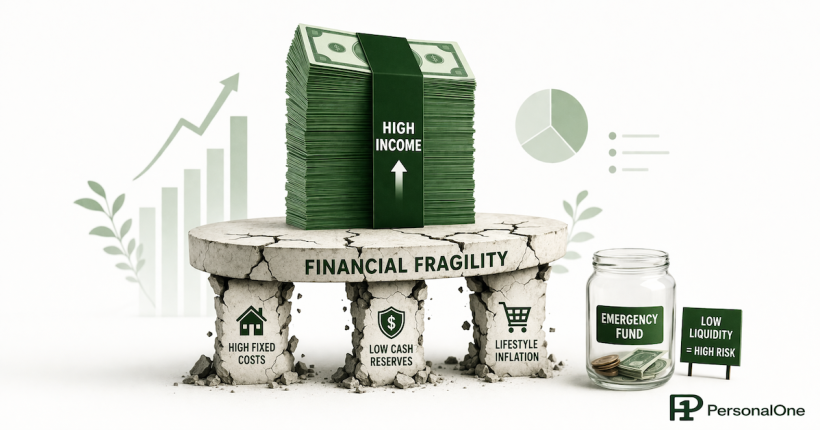
At higher income levels, the primary resilience risk is lifestyle inflation that converts income growth into fixed obligations rather than expanded resilience. A household earning $95,000 with $75,000 in annual fixed obligations has the same structural vulnerability as a household earning $40,000 with $32,000 in fixed obligations — the ratio is the risk, not the absolute level. Income growth only improves resilience when the gap between income and fixed obligations grows alongside it.
At this income level, all five resilience pillars are achievable: a fully funded 6–month emergency fund, diversified income across at least two sources, fixed obligations below 40% of income, full retirement contributions, and comprehensive insurance coverage. The most important financial decision at this income level is whether income growth above a comfortable lifestyle target is deployed toward wealth-building assets or consumed by upgraded fixed obligations. The Investing and Wealth Growth guide covers the frameworks for deploying surplus income toward long-term wealth after resilience layers are fully built.
Resilience is a structure, not an income level. It is achievable where you are.
The complete Long-Term Resilience framework covers the specific moves that build financial durability at every income level.
Explore Long-Term Resilience →Resources
Official Sources
Benefits.gov — Federal Benefits Finder — Official federal government tool for identifying benefit programs available to households at lower income levels — energy assistance, nutrition programs, healthcare, and housing assistance that can reduce financial vulnerability while resilience is being built.
Federal Reserve — Economic Well-Being of U.S. Households — Annual survey data showing financial resilience outcomes across all income levels — the data source that demonstrates resilience is achievable at any income, not only above a threshold.
Return to the financial stability guide for the complete system this cluster is part of.
Frequently Asked Questions
What is the minimum income required to build financial resilience?
There is no universal minimum — but the practical floor is the point where monthly income exceeds bare-bones survival expenses with at least $50–$100 of margin. At that margin, even a $50/month automatic savings contribution begins building the emergency fund. Below that margin, the income side of the equation needs attention as the prerequisite. Benefit programs, income diversification, or expense reduction to create the minimum margin is the first priority when income genuinely does not exceed bare-bones expenses.
Does earning more money automatically make me more financially resilient?
Not automatically — only if the income growth expands the gap between income and fixed obligations. Research consistently shows that income increases are frequently consumed by proportionally increased spending and fixed obligations, leaving the resilience ratio unchanged. The deliberate decision to deploy at least a portion of income growth toward resilience-building (emergency fund, debt reduction, insurance) rather than fully into lifestyle improvements is what converts income growth into resilience improvement.
Is financial resilience harder to build now than it was for previous generations?
Specific structural factors make resilience harder to build for Millennials and Gen Z than for prior generations at comparable life stages: higher housing cost-to-income ratios, higher student debt burdens, reduced pension coverage, and greater income volatility from gig and contract employment. These are real structural headwinds that require acknowledging rather than minimizing. They make the timeline longer and the path less linear — they do not make financial resilience unachievable. The PersonalOne system is built specifically for this economic reality.
Disclaimer: This article is for informational and educational purposes only. Income ranges and financial scenarios described are illustrative. Individual financial situations vary significantly.