2026
Home › Financial Stability › Income Volatility Management › How to Plan Your Budget Around a Variable Paycheck
What You Need to Know
— A variable paycheck requires a budget built in layers, not percentages — the structure must adapt to income changes without being rebuilt every month
— Your income floor is the single most important number to calculate — it sets the maximum your fixed expenses are allowed to reach
— The variable spending tier creates a floor-to-ceiling range that compresses in low months and expands in normal months without requiring active decisions
— A pre-defined overflow rule for high-income months determines whether those months build wealth or simply fund a temporarily elevated lifestyle
— Automation reduces the decision load that variable income creates and keeps the system running even when income is stressful
Building a budget around a variable paycheck is genuinely different from building a budget around a salary. The conventional approach — list your income, subtract your expenses, allocate what remains — assumes a stable input. When the input changes by 40 or 60 percent between months, a static budget framework fails.
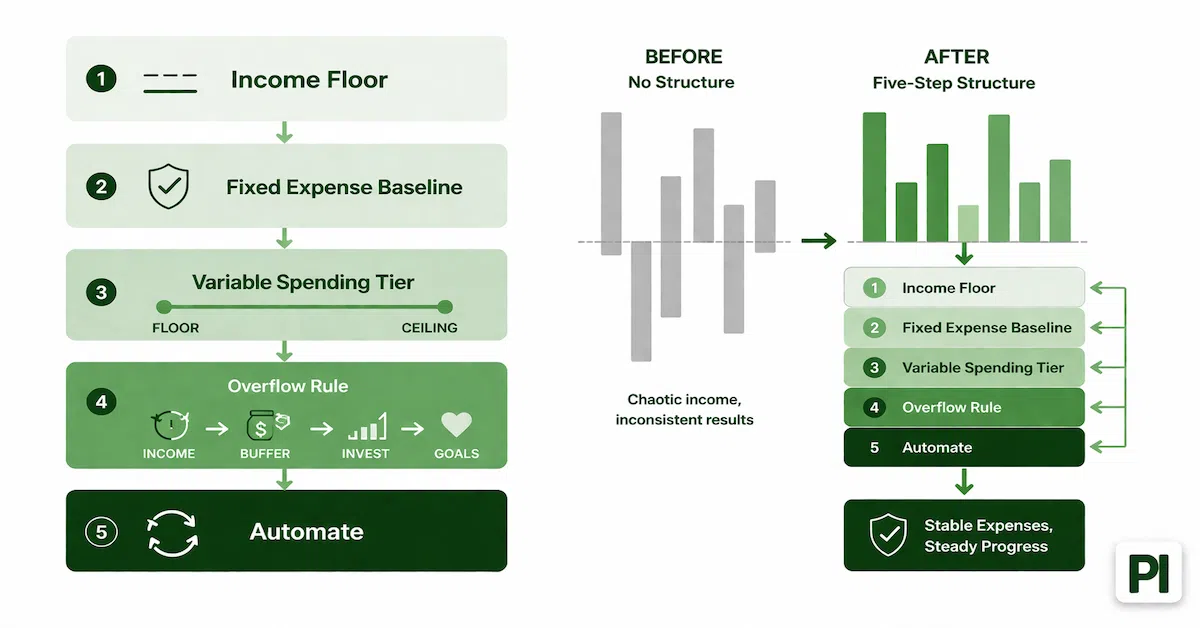
The challenge is not math. It is architecture. You need a budget structure that adapts to income variation without requiring you to rebuild it from scratch every month. The income volatility planning system below gives you that structure — five distinct steps that create a functional, scalable budget for any variable income situation.
This framework applies to commission-based workers, freelancers, gig earners, seasonal workers, and anyone whose monthly deposit amount changes significantly. The method is the same regardless of the income source. It is designed to function as a standalone planning tool or as part of the full cluster system. If you are new to variable income and need foundational context first, the irregular income survival guide covers the core concepts before you work through this framework.
Step 1: Calculate Your Income Floor
The income floor is the foundation of a variable paycheck budget. It is not your average monthly income, your best month, or your projected income. It is the lowest amount you realistically earned in any single month over the past 6 to 12 months.
To calculate it: pull your bank statements or income records for the past year. Find the single lowest month. That number is your floor. If you are new to variable income and do not have 6 months of history, use your most conservative estimate — the minimum you could reasonably expect to earn with minimal pipeline. Err toward caution.
The floor has one purpose: it is the maximum number your fixed expenses are allowed to reach. If your income floor is $2,800 and your fixed expenses total $3,100, you have a structural problem to solve before you build the budget. Every fixed expense above the floor creates guaranteed financial stress in your worst months. Understanding why your income floor matters more than your average income is the clearest way to see why solving this problem comes before any other financial goal.
Step 2: Build the Fixed Expense Baseline
Fixed expenses are the non-negotiable monthly costs that exist regardless of income: rent or mortgage, debt minimums, insurance premiums, phone, utilities, and subscriptions you cannot or choose not to cancel. These costs are predictable in both timing and amount.
List every fixed expense and total them. Compare the total to your income floor. The gap between those two numbers determines how much margin your budget has in a low-income month. Larger margin means more flexibility. No margin means every low month creates a real financial crisis.
If fixed expenses exceed or closely match the floor, take action on one of two levers: reduce fixed costs by downsizing housing, eliminating subscriptions, or accelerating debt payoff to remove minimums — or systematically raise the income floor through additional clients, rate increases, or a secondary income source. The budget cannot work until the math works at the floor level. Once fixed expenses fit within the floor, these costs become your locked budget baseline, funded first from every income deposit before any other allocation.
Step 3: Define the Variable Spending Tier
Variable expenses are costs that flex with circumstance: groceries, dining, clothing, personal care, entertainment, gas. Unlike fixed expenses, these can be compressed or expanded based on income level. This flexibility is the primary lever in a low-income month.
Set a monthly variable spending ceiling rather than a fixed amount. The ceiling represents your comfortable spending level when income is at or above average. Separately, define a floor for variable spending — the minimum level you can realistically compress to in a difficult month without creating additional stress. The range between the floor and ceiling becomes your variable tier.
In a normal income month, you operate near the ceiling. In a low month, you drop toward the floor. The tier eliminates the all-or-nothing pattern many variable earners fall into — either spending freely or shutting down entirely. It is also worth noting that how inflation affects your variable expenses can shift your ceiling and floor over time, so revisiting those numbers annually is part of keeping the system calibrated.
Step 4: Set the Overflow Rule for High-Income Months
The overflow rule is the single decision that determines whether high-income months build wealth or simply fund a temporarily elevated lifestyle. Without a predefined rule, income above average gets absorbed into spending without intentional allocation.
Define an overflow allocation order in advance. A functional order for most variable earners: first, restore the income buffer to its target level if it was drawn down in a prior low month. Second, fund the tax reserve for the current income — 25 to 30 percent of net self-employment income if taxes are not already being withheld. Third, contribute to the emergency fund until it reaches its target. Fourth, allocate to defined savings goals such as sinking funds or investment accounts. Fifth, discretionary spending from whatever remains at the ceiling of the variable tier.
The overflow rule is not restrictive — it is clarifying. It answers the question of what to do with money before the money arrives, which eliminates the spending drift that erodes financial progress in high-income periods. Building a dedicated reserve specifically for income gaps is part of this: how to build an emergency fund that protects income gaps walks through the target amounts and account structure that work alongside the overflow rule.
Step 5: Automate What You Can
Automation reduces the decision load that variable income creates. When income and expenses are consistent, the budget almost runs itself. When they are not, every month requires active decision-making — and decisions made under financial stress are rarely optimal.
The goal is to handle everything that can be systematized, leaving active decisions only for the parts that genuinely require judgment. Fixed expenses auto-pay from a dedicated bills account funded from the income buffer — income volatility does not touch the bills account. A recurring transfer to the tax reserve moves a fixed percentage within 24 hours of each deposit. A small automatic savings contribution on the first of each month creates consistency regardless of income level, with manual top-ups in high months. A scheduled calendar reminder on the first or fifteenth of each month replaces spontaneous decision-making with a routine check-in on buffer level and tier position.
See the complete variable income framework
This article covers the five-step budget structure. The cluster hub connects this framework to account architecture, buffer strategy, and the full Income Volatility Management system.
Income Volatility Management →Adjusting the Budget Month to Month
A variable paycheck budget is not static. It recalibrates each month based on actual income received. The structure stays constant — floor, fixed baseline, variable tier, overflow rule — but the active tier you operate within shifts based on the current period's income.
At the start of each month, do a brief budget reset. Total the income received in the prior period. Confirm the buffer balance. Determine whether you are operating at the floor tier, average tier, or overflow tier for the current month. Set the variable spending ceiling accordingly. The reset takes fewer than ten minutes once the system is built — and it eliminates the constant anxiety of not knowing where you stand financially.
Over time, the monthly reset becomes a high-value habit. It keeps the budget accurate, identifies patterns in income timing, and builds the financial awareness that accelerates every other goal. Pairing this reset with a structured approach to how to build a budget that actually works gives you the full picture of where money is going and how to direct it more effectively each cycle.
Official Sources
CFPB: How to Budget When Your Income Is Irregular — Consumer Financial Protection Bureau guidance on building a budget designed for variable and inconsistent income.
IRS: Estimated Taxes for Self-Employed Individuals — Official IRS guidance on quarterly estimated tax payment requirements, deadlines, and calculation methods.
DOL: Wages and Hours Worked — Department of Labor resources on wage standards, pay requirements, and worker classification.
BLS: Employment Situation Summary — Bureau of Labor Statistics monthly report on employment, income, and labor market conditions.
Continue Learning About Financial Stability
This article is one part of the complete income volatility framework. The full system — including buffer architecture, account structure, and allocation protocols — is in the Budgeting & Savings guide.
Frequently Asked Questions
What if my income floor changes over time?
Recalculate the floor every 6 months using the most recent income history. As you take on more clients, raise rates, or add income streams, the floor naturally rises. Wait until the new floor is consistent across multiple months before treating it as stable. Do not raise fixed expenses in anticipation of a higher floor that has not yet proven consistent.
Should I use zero-based budgeting with variable income?
Zero-based budgeting works well in concept but becomes complicated when income is genuinely unknown at the start of the month. A better approach: use zero-based budgeting for fixed and known expenses, and use tier-based allocation for variable expenses. This gives you the structure of zero-based budgeting with the flexibility a variable income requires.
How do I handle biweekly or inconsistent income timing within a monthly budget?
This is where the income buffer account becomes essential. Rather than matching income timing to bill timing — which is unreliable for variable earners — income flows into the buffer first and bills pull from the buffer on their own schedule. The buffer decouples income arrival from bill payment, which eliminates the timing crisis even when deposits are irregular.
What budgeting tools work best for variable income?
Look for tools that allow manual income entry, flexible category ceilings rather than fixed amounts, and multi-account tracking. Apps designed for salary earners will work against how your income actually flows. A simple spreadsheet that you control is often more effective because you can structure it exactly to your floor-and-ceiling framework without working around assumptions built for W-2 earners.
How long does it take for this system to feel stable?
Most variable earners feel meaningfully more stable within 60 to 90 days of consistently operating within this structure — primarily because the income buffer is built up during that period and the first few low months get absorbed without a crisis. The psychological shift from reactive to structured typically follows the first month where a shortfall hit and the system handled it without requiring debt or emergency fund access.
Disclaimer: This article is for informational and educational purposes only and does not constitute financial, tax, or legal advice. Tax treatment of compensation components changes and varies by individual circumstances — consult a qualified tax professional for guidance specific to your situation. PersonalOne is not a licensed financial advisor.