May 2, 2026
Home › Banking Systems › Banking for Irregular Income › How to Set Up a Tax Reserve Account as a Freelancer
What You Need to Know
— A tax reserve account holds the portion of every client payment that belongs to the IRS — not next month, not at year-end, right now, every time income arrives.
— Set aside 25–30% of gross freelance income as the default starting percentage — adjust with a tax professional once you know your actual bracket and deductions.
— The account should be a high-yield savings account at a separate institution — out of sight, earning interest, structurally inaccessible for anything except tax payments.
— Automation is the only reliable method — manual discipline fails because good months feel like the wrong time to send money away.
— The tax reserve is not part of your buffer, emergency fund, or salary system — it is a liability account you are pre-funding before you spend anything else.
— Quarterly estimated payments are due in April, June, September, and January — your reserve should be funded continuously so these dates are never a crisis.
If your income changes month to month, you need a system — not guesswork. This is where banking for irregular income becomes critical for freelancers trying to stay ahead of taxes. Without a structural approach, every quarterly payment becomes a scramble, and every good month gets quietly consumed by a liability you knew was coming but never formally prepared for.
The goal is not just saving money — it is building a banking system for money management that automatically separates what you owe before you ever spend it. A tax reserve account is the mechanism that makes this structural. The decision to set aside taxes is made once, during setup. After that, the system executes it on every payment — regardless of how good or bad the month is.
A tax reserve account for freelancers is a dedicated high-yield savings account where the tax portion of every client payment lands immediately, accumulates between quarterly due dates, and exists for one purpose only: paying the tax bill. This guide covers how to calculate your reserve percentage, where to open it, how to automate the transfer, and how to use the reserve correctly across the full quarterly payment cycle.
Why Most Freelancers Fall Behind on Taxes
The root cause is structural, not behavioral. When a freelancer receives $5,000 from a client, the deposit hits their business checking and the full $5,000 is visible, accessible, and psychologically available. Nothing automatically withholds $1,250 for federal income tax and self-employment tax the way an employer’s payroll system does. The freelancer must do that mentally — every time, on every payment — or it does not happen.
Mental accounting at this scale fails. A slow month arrives and the $1,250 that should have been reserved gets used to cover operating expenses. A high month arrives and the sense of financial comfort makes the tax transfer feel less urgent. By Q3, the trailing tax liability is significant but invisible, living somewhere in the aggregate checking balance rather than in a dedicated account where its size would be obvious.
Without a buffer account for freelancers, one slow month can wipe out the money you planned to use for taxes. When operating income and tax reserves share the same pool, the most immediate pressure always wins — and taxes are rarely the most immediate pressure until the quarterly due date arrives.
The Compounding Effect of Not Reserving
Freelancer earns $80,000 gross in a year. Effective tax rate: approximately 28% (self-employment + federal + state). Tax owed: ~$22,400.
Without a reserve: $22,400 must be produced from cash flow at filing time. If slow months have eroded the buffer, the entire operating system comes under pressure to generate the payment.
With a reserve at 28%: $22,400 was transferred incrementally across the year — roughly $430 per week on average — and is sitting in a high-yield account earning interest. Tax day is an administrative event, not a financial emergency.
What a Tax Reserve Account Actually Is
Terminology matters because conflating the tax reserve with other accounts leads to misuse.
A tax reserve account is: A dedicated savings account that holds pre-allocated tax funds. Every time client income arrives, a percentage transfers here immediately. The balance represents a liability you owe to the IRS — not money you have earned and can spend, but money the government is temporarily allowing you to hold on their behalf.
A tax reserve account is not: An emergency fund. Emergency reserves cover unexpected life events. The tax reserve covers a completely predictable, recurring liability. Treating these as interchangeable means you will either raid your emergency fund for taxes or use your tax reserve as emergency backup — both outcomes leave you exposed.
A tax reserve account is not: Part of your income buffer. The buffer absorbs cash flow variability and funds your monthly personal transfer. The tax reserve is carved out before the buffer calculation begins. Income arrives, taxes are reserved, then the remaining amount flows into the buffer system. Sequence matters.
A tax reserve account is not: A savings goal. Savings goals grow your wealth. The tax reserve prevents a known liability from becoming a cash crisis. Psychologically, the tax reserve balance is not yours — thinking of it as savings you are accumulating creates the temptation to borrow from it.
How Much to Set Aside: Calculating Your Reserve Percentage
The most common question freelancers ask about tax reserves is the percentage. The standard range is 25–30% of gross income, but that range exists because tax liability varies significantly based on income level, business structure, deductible expenses, and state of residence. The right number for you is specific to your situation — and a tax professional is the correct source for precision.
That said, 25–30% gross is a reliable conservative default for most U.S.-based freelancers operating as sole proprietors or single-member LLCs who have not yet completed a full year of self-employment taxes. Here is why:
Why 25–30% Is the Starting Default
Self-employment tax: 15.3% on net self-employment income (Social Security + Medicare). This applies before federal income tax. Employees pay half; freelancers pay both halves.
Federal income tax: Varies by total income, filing status, and deductions. For a single filer earning $60,000–$90,000 net, the effective federal rate typically lands between 12–22%.
State income tax: 0% in states like Florida and Texas; 5–13% in high-tax states like California and New York.
Combined effective rate for a typical freelancer: 22–35% of gross income depending on all the above. Reserving 25–30% positions most freelancers to cover their liability without overpaying or underpaying significantly.
Percentage Adjustment Guide
Use 20–25% if you have significant business deductions (home office, equipment, professional development, health insurance premiums) that reduce net income meaningfully below gross, or if you are in a no-income-tax state with moderate federal liability.
Use 25–30% if you have minimal deductions, live in a state with moderate income tax (5–7%), and earn $50,000–$100,000 gross annually. This is the most common scenario for new-to-mid-career freelancers.
Use 30–35% if you earn above $100,000 gross, live in a high-tax state (California, New York, New Jersey, Oregon), or have relatively low deductible business expenses relative to income.
Recalibrate annually. After your first full year of self-employment taxes is filed, your accountant can give you an actual effective rate based on real numbers. Use that rate going forward instead of the default range.
The cost of over-reserving is a small surplus that comes back as a refund or rolls forward. The cost of under-reserving is a tax bill you cannot pay, penalties for underpayment, and the cash flow emergency that follows. Reserve conservatively until you have real data.
How to Automatically Separate Taxes From Freelance Income
Automatic separation is the only method that works consistently across good months and slow months, high-income periods and lean ones. A tax reserve account for freelancers is a separate account where you automatically move a percentage of every payment before using the rest — not after bills are paid, not if something is left over, but first, every time, as the initial act the moment income arrives.
The separation system runs in three steps. Each step builds on the one before it. None of them require willpower after the initial setup — only automation.
Step 1 — Tax First: Reserve Before You Touch Anything Else
Every client payment lands in your business checking account. Within 24 hours of every deposit, your reserve percentage — 25–30% of the gross amount — transfers to a separate high-yield savings account at a different institution. This transfer is non-negotiable and fires before any other allocation: before the buffer, before operating expenses, before salary.
Banks like Found automate this natively on every deposit. For standard business checking accounts, a recurring percentage-based transfer rule or a weekly fixed-amount automation achieves the same result with minimal setup.
The tax account accumulates. It earns interest. It is never borrowed from. On quarterly due dates, the estimated payment transfers directly from this account to the IRS. Tax day becomes an administrative event, not a financial emergency.
Step 2 — Split Every Payment Immediately
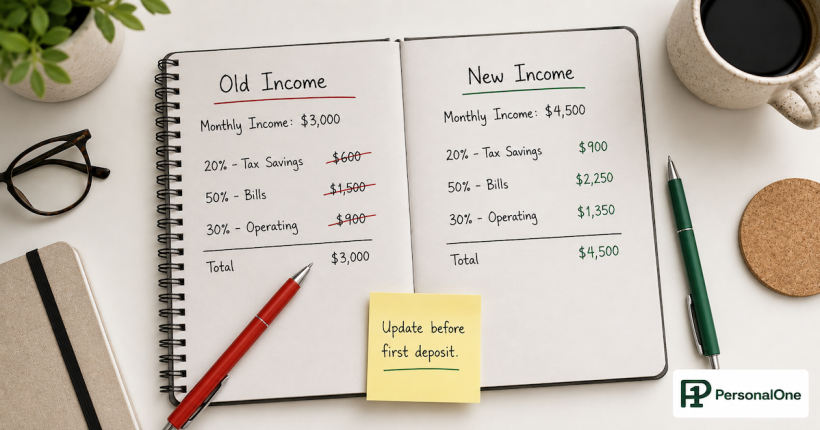
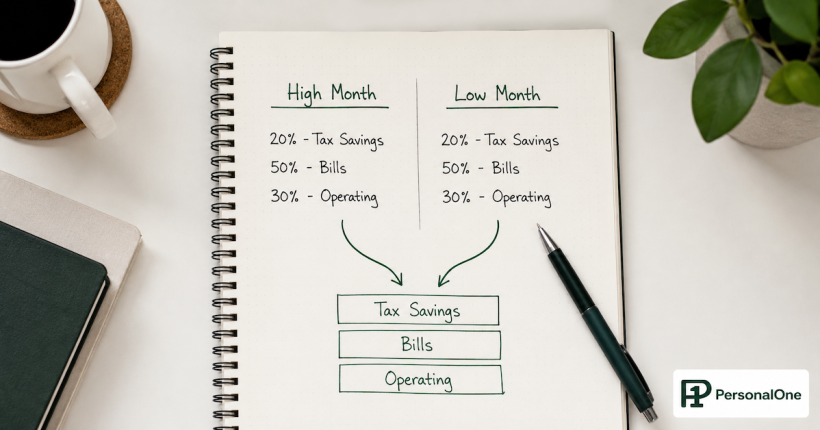
The easiest way to stay consistent is to route variable income across multiple accounts the moment it hits your bank. After the tax percentage transfers, the remaining income flows into the business buffer account where it is distributed across operating expenses and personal salary on a fixed schedule.
This split happens automatically, not as a decision you make each time a payment clears. The routing rules are configured once. Every subsequent deposit follows the same path: tax reserve first, then buffer, then salary. The sequence never changes regardless of the payment amount.
When income routing is automated, the system runs whether income arrives on a predictable schedule or not. Variable income does not require variable discipline — it requires fixed automation applied proportionally to whatever arrives.
Step 3 — Pay Yourself Last, Not First
Once taxes are separated, you can safely pay yourself a consistent salary as a freelancer without guessing what is left. Personal salary is the final allocation — the output of the entire system running above it. It draws from what remains in the buffer after taxes and operating expenses are handled.
This is the structural reversal most freelancers need to make. Most pay themselves first, then hope the taxes and expenses work out. The correct sequence is the opposite: taxes first, expenses second, salary third from what remains in the buffer on the scheduled transfer date.
The personal salary transfer executes on the same date every month regardless of how much income arrived. The buffer absorbs the variability above it. The salary below it is consistent. That consistency is what makes personal budgeting, savings goals, and investment contributions finally work for freelancers.
Where the Tax Reserve Account Should Live
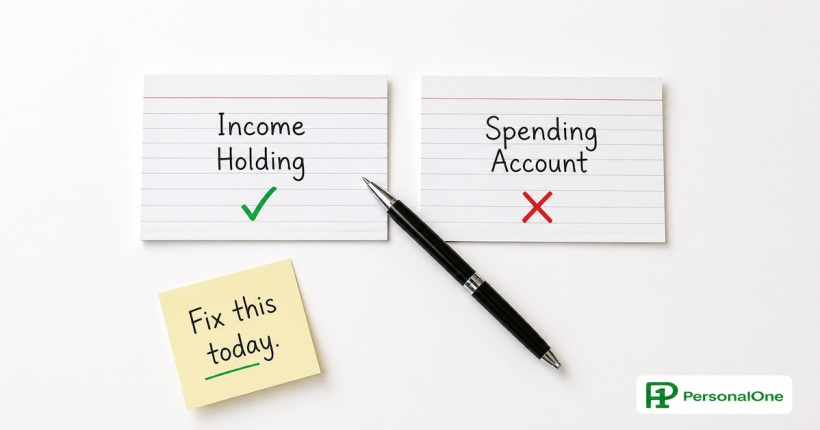
The tax reserve account needs two characteristics above all others: it must be a different institution from your business checking account, and it must be a high-yield savings account rather than another checking account.
Different institution is non-negotiable. When your tax reserve lives at the same bank as your business checking, the balance is visible alongside your operating funds and psychologically accessible. A slow month hits, the buffer is thin, the tax reserve shows $8,000, and the temptation to borrow from it is immediate. A two-to-three day ACH transfer window between institutions is the friction that intercepts this impulse. The money is there — but getting it requires a deliberate act and a wait, which is usually enough time to find a better solution.
High-yield savings account is the right vehicle because the tax reserve holds money for weeks to months before it is needed. At a 4–5% APY, a freelancer with a $15,000 tax reserve earns $600–$750 per year in interest on money they were going to pay in taxes anyway. This is a real, meaningful return that costs nothing except choosing the right account type. A standard savings account at 0.1% APY on the same balance earns $15. The account selection matters.
For the question of which institution to use for the tax reserve and the broader business checking setup, the guide on personal vs business bank accounts for freelancers covers the decision framework. And for a ranked comparison of the top no-fee options built specifically for freelancers in 2026, the best banks for freelancers guide includes institutions that offer native tax withholding features alongside high-yield savings.
The Tax Reserve in the Full Freelance Money System
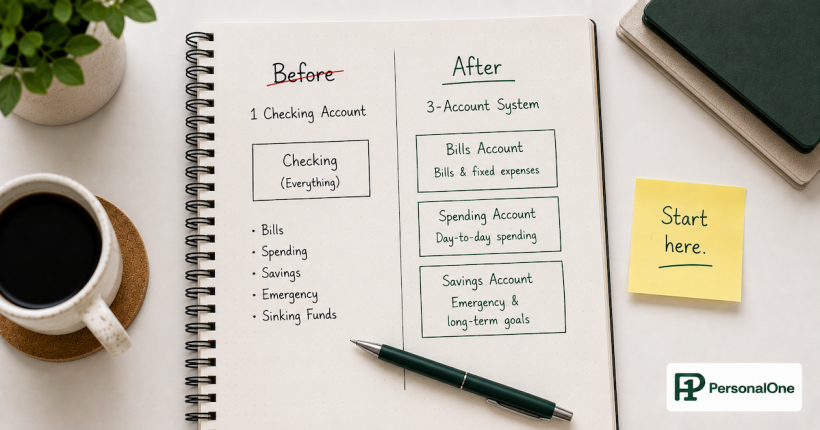
The tax reserve does not operate in isolation. It is the first layer of a complete freelance money system — the layer that gets funded before anything else. Understanding where it sits in the sequence helps you protect it from being raided by other financial pressures.
The Complete Freelance Money System: Sequence of Allocations
Layer 1 — Tax Reserve (first, every time): 25–30% of every gross client payment transfers to the high-yield tax savings account within 24 hours of arrival. This happens before anything else is calculated or transferred.
Layer 2 — Business Buffer (operational backbone): The remaining 70–75% of gross income enters the business buffer account. This is the operating account that holds income until it is distributed as salary and business expenses. A properly built freelance income buffer absorbs income variability so the layers below it run consistently regardless of when clients pay.
Layer 3 — Business Operating Expenses: Software, tools, subscriptions, contractor payments, and professional fees autopay from the buffer account. These are the cost of generating revenue and come before personal salary.
Layer 4 — Personal Salary Transfer: A fixed amount transfers from the buffer to personal checking on the same date every month. This is your paycheck. It does not change based on how much arrived this month. It is the output of the entire system running above it.
Layer 5 — Personal Financial System: Bills, spending, emergency fund, savings goals, and investments all draw from the personal salary as if it were a conventional paycheck. The irregularity of freelance income never touches this layer — it is absorbed upstream.
The tax reserve sits at the top of this sequence specifically because it represents the highest-priority obligation. Federal tax liability accrues on every dollar earned. There is no negotiating it away if you spend it. Placing the tax allocation first — before buffer calculations, before salary, before any spending decision — ensures the obligation is always funded from the income that generated it.
Quarterly Estimated Taxes: How to Use the Reserve
Freelancers who earn more than $1,000 in self-employment income are generally required to make quarterly estimated tax payments to the IRS. These payments are due on four dates each year — mid-April, mid-June, mid-September, and mid-January — and cover both income tax and self-employment tax owed through that quarter.
The tax reserve account is designed to fund these payments. By the time each quarterly date arrives, the reserve should hold approximately one quarter of your annual estimated tax liability — assuming you have been depositing consistently since the previous payment date.
Quarterly Payment Walkthrough
Q1 (January–March income): Reserve accumulates. Payment due mid-April. Transfer the calculated Q1 payment from your tax reserve to IRS Direct Pay or your state equivalent. Remaining reserve balance carries forward.
Q2 (April–May income): Reserve continues accumulating. Payment due mid-June. Transfer Q2 payment. Balance continues forward.
Q3 (June–August income): Payment due mid-September. Same process.
Q4 (September–December income): Payment due mid-January of following year. Any remaining balance in the reserve after the final estimated payment stays in the account to cover the year-end true-up at filing time.
At annual filing: If you over-reserved, you receive a refund or apply the credit to next year. If you under-reserved, the gap should be small enough to cover from operating cash without a crisis. Adjust the reserve percentage for the following year.
The IRS provides Form 1040-ES worksheets and payment vouchers for calculating estimated payments. The EFTPS system (Electronic Federal Tax Payment System) allows direct online payments. Your state tax authority has an equivalent system. Both accept payments from a savings account, so you can pay directly from the tax reserve without transferring to checking first.
What Counts as Deductible: Reducing the Liability Before You Reserve
The tax reserve percentage applies to gross income before deductions. But deductible business expenses reduce the net income on which you actually owe tax — which means tracking and claiming every legitimate deduction directly reduces the amount your reserve needs to cover.
Common deductible expenses for freelancers include software and subscriptions used for business, home office deduction (if you use a dedicated space), professional development and courses, health insurance premiums (for self-employed individuals), business equipment, professional memberships, and a portion of phone and internet costs used for work.
The Deduction Impact on Your Reserve
Gross income: $80,000. Deductible business expenses: $12,000. Net taxable income: $68,000.
At a 28% effective rate: tax on $80,000 gross = $22,400. Tax on $68,000 net = $19,040.
The $12,000 in deductions saved $3,360 in taxes — money that stays in the business instead of going to the IRS.
This is why tracking deductible expenses throughout the year matters as much as the reserve percentage. Consult a tax professional to identify which expenses qualify for your specific business.
The reserve percentage should be based on your effective rate net of deductions once you have a year of tax history. Until then, use the gross-income-based default and let any over-reserve come back as a refund or credit. The cost of over-reserving is minimal. The cost of under-reserving is a tax bill you cannot pay plus penalties.
Four Ways Freelancers Destroy Their Tax Reserve
Mistake 1 — Treating the reserve as an emergency fund backup
When an emergency hits and the emergency fund is thin, the tax reserve looks like the obvious solution. It is available, it is liquid, and it is in a savings account. But borrowing from the tax reserve means your Q2 or Q3 payment will be short, which either requires scrambling to fund it or filing an underpayment that generates penalties. The tax reserve has one job. Keep it.
Mistake 2 — Reserving only during good months
Some freelancers skip the tax transfer during slow months because the income feels too low to give any away. The problem is that every dollar earned — even a small payment in a slow month — creates a tax liability. A slow $1,200 month still generates roughly $300–$360 in tax owed. Reserving only during good months creates a gap the reserve cannot cover when the full year is filed.
Mistake 3 — Keeping the reserve at the same bank as the buffer
When tax reserve and buffer accounts share an interface, the combined balance is visible and psychologically available. A $22,000 combined balance feels safe even when $8,000 of it is owed to the IRS. Separate institutions create the visual and friction-based separation that keeps the tax reserve mentally off-limits.
Mistake 4 — Not accounting for state taxes
Freelancers in states with income tax often calculate their reserve against federal liability only and discover at filing that state taxes add 5–10% to the bill. The reserve percentage must account for both federal and state obligations to be accurate. If your state has income tax, your reserve rate should reflect that before you set the automation.
Building the Tax Reserve Into Your System From Day One
The best time to set up a tax reserve account is the day you receive your first freelance payment. The second-best time is today, regardless of how long you have been freelancing without one.
If you are behind on reserving — if you have already earned income this year without setting aside the tax portion — the path forward is straightforward: calculate what you owe so far, transfer that amount to the new reserve account immediately using whatever operating cash is available, then start the automated reserve going forward. You may need to make a larger-than-usual quarterly payment to catch up. Do it. The penalty for underpayment is 8% annualized as of 2026, which is more expensive than the discomfort of making the catch-up transfer.
The tax reserve connects directly to the other layers of the freelance system. A complete income architecture — tax reserve first, then buffer, then salary transfer, then personal financial system — is what makes the freelance income model stable rather than stressful. Each layer depends on the others. Without the tax reserve in place, the buffer is always at risk of being raided in April. Without the buffer, the consistent freelancer salary system has no stable source to draw from.
The system works as a whole or it does not fully work at all. The tax reserve is the foundational layer. Start here.
Setting up a tax account is just one part of managing unpredictable income.
Continue building your complete freelance money system:
→ Learn how to build a buffer account for freelancers that absorbs income variability so your salary transfer runs every month without fail
→ Create a plan to pay yourself a consistent salary as a freelancer once taxes and the buffer are handling the layers above it
→ Set up automation to automate your freelance income routing across accounts so every payment flows to the right destination the moment it arrives
Explore the Banking Systems Hub →Resources
IRS — Estimated Taxes for Self-Employed Individuals
IRS — Self-Employment Tax: Social Security and Medicare
EFTPS — Electronic Federal Tax Payment System
IRS — Form 1040-ES: Estimated Tax for Individuals
FDIC — Deposit Insurance: How Your Accounts Are Protected
This article is part of the Banking Systems hub on PersonalOne — a complete framework for building the account structure and cash flow infrastructure that controls your financial outcomes automatically.
Frequently Asked Questions
How much should I set aside for taxes as a freelancer?
The standard starting range is 25–30% of gross income for most U.S.-based freelancers. This covers self-employment tax (15.3% on net earnings), federal income tax, and a buffer for state taxes where applicable. Once you have filed a full year of self-employment taxes, work with a tax professional to calculate your actual effective rate and adjust the reserve percentage accordingly.
Can I use a regular savings account for my tax reserve?
You can, but a high-yield savings account is significantly better. The tax reserve holds money for weeks to months before it is needed. At current HYSA rates of 4–5% APY, a $15,000 reserve earns $600–$750 per year in interest on money you were going to pay in taxes regardless. A standard savings account at 0.1% earns $15 on the same balance. Use the account that earns while it waits.
What happens if I under-reserve and cannot cover my quarterly payment?
The IRS charges an underpayment penalty based on the federal funds rate plus 3 percentage points — approximately 8% annualized as of 2026. The penalty applies to the shortfall amount from the due date until you pay. Making a partial payment is always better than no payment. If you cannot cover the full quarterly amount, pay what you have, then adjust the reserve percentage and catch up in the next quarter. Contact a tax professional if the underpayment is significant.
Should the tax reserve be at the same bank as my business checking?
No. The tax reserve should be at a different institution from your business checking account. When both accounts share an interface, the tax reserve balance is visually and psychologically accessible as general funds. The 2–3 business day ACH transfer window between institutions creates protective friction that prevents impulse borrowing during slow months or cash flow pressure points.
Do I still need to make quarterly estimated payments if I set aside taxes monthly?
Yes. The IRS requires quarterly estimated payments regardless of how often you set aside money internally. Monthly reserving is how you fund those quarterly payments — not a substitute for them. Think of the monthly reserve as the funding mechanism and the quarterly payment as the required disbursement. Both are necessary. The reserve account holds the accumulating funds; the quarterly payment is when you transmit them to the IRS.
What if my income fluctuates so much that a fixed percentage does not match my actual liability?
A fixed percentage of gross income is proportional by design — when income is high, the reserve amount is higher; when income is low, the reserve amount scales down accordingly. This is precisely why percentage-based reserving works better than fixed-dollar reserving for freelancers with variable income. If a very high-income month means you over-reserve relative to actual liability, the surplus sits in the account earning interest and reduces your next quarterly payment or generates a year-end refund.
What is the best way to save for taxes as a freelancer?
The most reliable way to save for taxes as a freelancer is to automate the separation before you can spend the money. Open a dedicated high-yield savings account at a separate institution from your business checking. Every time a client payment arrives, transfer your reserve percentage — 25–30% of gross — to that account within 24 hours. The account accumulates continuously between quarterly due dates. The key is that the transfer fires on every deposit, not just during good months. Freelancers who try to save for taxes manually — setting aside what they can when they remember to — consistently underpay. The system works because it removes the decision entirely.
Disclaimer: This content is for educational purposes only and does not constitute financial or tax advice. Self-employment tax obligations, deductible expenses, quarterly payment requirements, and state tax rates vary based on income level, business structure, location, and individual circumstances. Consult a qualified tax professional for guidance specific to your situation. FDIC insurance covers up to $250,000 per depositor per institution — verify coverage directly with the FDIC before opening accounts.