April 30, 2026
Home › Banking Systems › Banking for Irregular Income › How to Pay Yourself a Consistent Salary as a Freelancer
What You Need to Know
— Paying yourself a consistent salary as a freelancer is a structural decision, not a bookkeeping one — it requires a buffer account, a calculated transfer amount, and an automated schedule.
— The salary number is built from your actual expenses, not your income — it is the minimum your personal life requires each month to run normally.
— The buffer account is what makes consistent pay possible — client income accumulates there and the salary transfer draws from it on a fixed date, independent of whether payments arrived this week.
— Calibration is annual, not monthly — the salary should not change based on how good last month was. It changes when your actual expense baseline changes.
— Surplus beyond salary goes back into the buffer, not into personal spending — that is what keeps slow months survivable.
— A functioning salary system is what makes personal budgeting, savings automation, and investment contributions finally work for freelancers.
Salaried employees have a structural advantage that most people never stop to appreciate: they know exactly what will hit their bank account on payday and they can build a financial life around that number. Budgets work. Automatic savings work. Bill autopay works. Everything downstream of income becomes manageable when income is predictable.
Freelancers typically lack that predictability — which is why most standard personal finance advice fails them. “Set up automatic savings” does not work when you do not know what will arrive this month. “Build a budget” does not work when income swings by 300% between your best and worst months.
The fix is not better discipline or tighter tracking. The fix is building the structural infrastructure that makes freelance income behave like a salary — a fixed, predictable monthly transfer to personal accounts, delivered on the same date every month, regardless of what clients did or did not pay this particular cycle. This guide covers how to pay yourself a consistent salary as a freelancer — the calculation, the account structure, the automation, and how to calibrate it so the system survives both exceptional months and genuinely slow ones.
The Core Principle: Separate When Money Arrives From When You Spend It
A freelance salary system has one central design principle: money arriving in your business is not the same as money available for personal use. These are two different events that happen on two different timelines — and separating them structurally is what makes consistent pay possible.
In a conventional employment relationship, your employer handles this separation for you. Payroll processes your gross income, withholds taxes, and deposits a net amount on a fixed schedule. You never interact with the gross number — only the processed, timed result.
As a freelancer, you have to build that processing layer yourself. The tool is a buffer account: a business-side account where all client income lands first. The buffer accumulates income across irregular arrival times and releases a fixed amount to your personal accounts on a set schedule. Your personal financial life interacts only with the scheduled transfer, not with the underlying income volatility.
The buffer is the prerequisite for consistent pay. If you have not yet built one, the guide on building a buffer account for slow months covers the sizing, setup, and mechanics in full. This article assumes the buffer is in place and focuses on what sits on top of it: the salary calculation and the personal pay structure it supports.
Step 1: Calculate Your Salary Number
Your freelance salary is not what you want to earn. It is not your average monthly revenue. It is the minimum your personal life requires to function normally each month — and that number comes from your actual expenses, not your income aspirations.
Calculating it requires three components:
The Salary Calculation
Component 1 — Fixed personal expenses:
Rent or mortgage, utilities, insurance (health, renter’s/homeowner’s, car), minimum loan payments, fixed subscriptions. Add every expense that recurs monthly at a predictable amount. This is your non-negotiable floor.
Component 2 — Variable personal expenses:
Groceries, gas, dining, personal care, clothing, entertainment. Pull three to six months of statements and calculate a realistic average. Do not use your best month or your worst month — use the middle. This is your sustainable discretionary baseline.
Component 3 — Personal savings contributions:
Emergency fund (if not yet fully funded), specific goals (house down payment, car replacement, vacation fund), retirement contributions. These should be fixed monthly amounts treated exactly like expenses — not “what is left over” amounts.
Salary = Component 1 + Component 2 + Component 3
Example: $2,200 fixed + $1,400 variable + $600 savings = $4,200/month salary
This is the amount that transfers from your buffer to your personal account on the same date every month. It is your salary. It does not change when a good month arrives. It changes only when your actual expense baseline changes — annually at most.
If the calculated salary feels uncomfortably high relative to what you have been paying yourself, start at 80% and plan to reach the full number once the buffer is built to its target. Do not set the salary at your aspirational lifestyle cost — set it at your actual expense baseline and increase it deliberately as income grows.
Step 2: Account Structure That Makes Consistent Pay Work
The salary calculation gives you a number. The account structure determines whether that number actually functions as a salary or just as an intention.
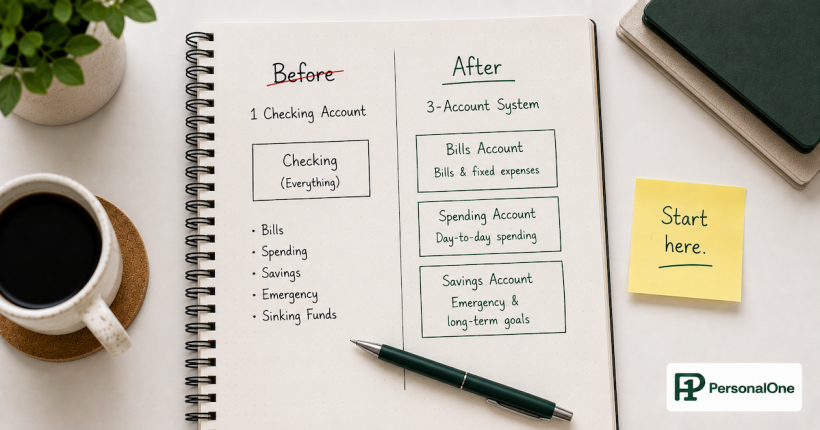
A complete freelance salary system requires four distinct accounts:
Account 1 — Business Buffer Account (income landing account)
Purpose: All client income arrives here. Business operating expenses autopay from here. The personal salary transfers out from here on a fixed date.
Type: Business checking account at a separate institution from personal accounts.
Balance target: One to two months of total outflows (salary + business expenses) as a running reserve.
Account 2 — Tax Reserve Account
Purpose: Holds the pre-allocated tax percentage from every client payment. Used exclusively for quarterly estimated tax payments and annual filing.
Type: High-yield savings account. Separate institution from buffer.
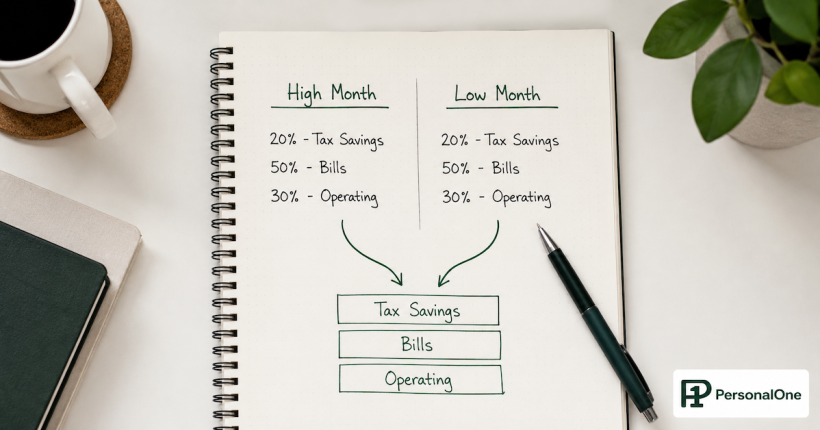
Allocation: 25–30% of gross income per deposit, moved before the personal salary transfer. Never accessed except for tax payments.
Account 3 — Personal Checking (salary landing account)
Purpose: Receives the fixed monthly salary transfer from the buffer. Funds personal bills and daily spending. All personal autopay draws from here.
Type: Personal checking account with no monthly fees and a debit card for daily spending.
Behavior: Treated exactly like a salaried employee’s checking account — the salary arrives, bills are paid, spending stays within the allocated amount.
Account 4 — Personal Savings (emergency fund + goals)
Purpose: Holds emergency fund and specific savings goals funded by the salary’s savings component. Separate from the buffer, separate from the tax reserve.
Type: High-yield savings account. Funded by automated transfer from personal checking as part of the salary structure.
Protection: At a different institution from personal checking to add withdrawal friction. Not accessible for buffer backup.
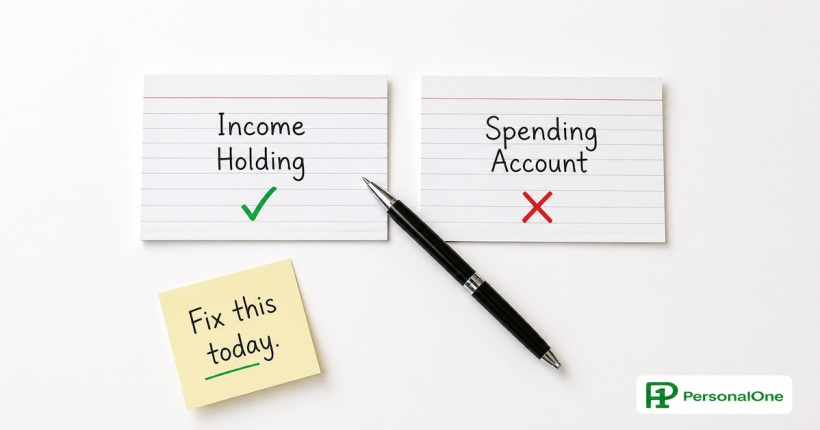
If you have not yet separated business and personal banking, this account structure is the reason to do it now. Mixing business income and personal spending into shared accounts makes the salary system impossible to maintain. For an overview of how to make that separation cleanly — including whether you need a business account versus a personal one — the guide on personal vs business bank accounts for freelancers covers the decision criteria.
Step 3: The Automation Sequence
The salary system only works if it runs automatically. Manual transfers create a decision point every month, and decisions get skipped when life is busy, when income is low and you are avoiding the numbers, or when a good month tempts you to hold the money for something else.
Configure the following automated transfers and do not deviate from the sequence:
The Automated Salary Sequence
Triggered by each incoming client payment:
1. Client payment arrives in buffer account.
2. Immediately (same day or next business day): transfer 25–30% of gross payment to tax reserve account. This is a rule that fires every time income arrives, not a monthly calculation.
Scheduled monthly on the 1st:
3. Fixed salary amount transfers from buffer to personal checking.
4. Fixed savings contribution transfers from personal checking to personal savings. (Or configure this as part of the salary transfer if your bank supports split transfers.)
Ongoing (already configured, not new):
5. Business operating expenses autopay from buffer.
6. Personal fixed bills autopay from personal checking.
Result: You interact with personal checking. Everything above it is automated and invisible to daily spending decisions.
The salary transfer on the 1st executes regardless of the buffer balance above a set minimum floor. Configure the transfer as an unconditional recurring ACH. If the buffer is thin, that is a signal to examine the buffer health — not a reason to skip the transfer.
How to Calibrate the Salary Across Income Seasons
The salary is calibrated annually, not monthly. This is the rule that separates freelancers who escape the feast-or-famine cycle from those who do not.
Monthly recalibration — adjusting the salary based on how the previous month went — is just a slower version of the same problem the system is designed to solve. When last month was great, monthly recalibration raises the salary. When last month was bad, it triggers anxiety about whether to lower it. The unpredictability of monthly income is imported directly into the personal salary, which is exactly what the buffer is supposed to prevent.
Annual calibration works differently. Once per year — a specific review date you set and keep — you revisit the salary calculation with twelve months of actual expense data. Did your expense baseline change? Did your savings goals change? Did rent increase? These are legitimate reasons to adjust the salary. Last month’s income is not.
Annual Salary Review Checklist
☐ Calculate total personal expenses for the past 12 months from statements.
☐ Identify any fixed expense changes (new rent, new insurance, paid-off loan).
☐ Review savings goals — any completed goals free up contribution space; any new goals require new funding.
☐ Recalculate salary: fixed expenses + variable average + updated savings contributions.
☐ Check buffer health: is the reserve still at target after a full year of withdrawals?
☐ Update automated transfer if salary changes.
☐ Update tax reserve percentage if income level or deductible expenses changed significantly.
Between annual reviews, the salary stays fixed. When a strong month tempts you to raise it, leave the money in the buffer instead. That surplus is the reserve for the slow months that will inevitably follow. When a slow month feels tight, the buffer’s job is to cover the gap without touching the personal transfer amount. Trust the system.
What to Do With Surplus Above the Salary
Once the system is running, you will periodically have more in the buffer than the one-to-two-month reserve target. What happens to that surplus is a deliberate decision, not a default one.
First priority: Fully fund the buffer reserve. If the buffer is below its two-month target, every surplus dollar belongs in the buffer until the target is met. A fully funded buffer is the system’s most important asset. Do not redirect surplus until the reserve is where it needs to be.
Second priority: Fund the personal emergency fund if not yet at target. Three to six months of personal expenses held in a separate high-yield savings account. This is personal insurance, not business cash flow. Once the buffer reserve is met, this is next.
Third priority: Accelerate specific savings goals. Down payment, major purchase, sabbatical fund. Transfer surplus to the designated goal account. Keep it labeled so it does not become vague “extra savings” that gets absorbed.
Fourth priority: Investment contributions. Once cash reserves are in order, surplus belongs in tax-advantaged accounts (SEP-IRA, Solo 401k) or taxable investment accounts for long-term growth.
What surplus does not do: automatically increase the personal salary. The salary is calibrated to expenses, not to income performance. Raising it because the buffer is full — rather than because your expense baseline increased — is how the system gets slowly dismantled during good years.
Choosing the Right Bank for Your Business Buffer
The buffer account is where the entire salary system originates, which means its banking infrastructure matters. The wrong account creates friction that slowly breaks the system: fees that erode the reserve, transfer delays that cause the personal salary to arrive late, or features absent that make income routing complicated.
The criteria for a buffer account bank: no monthly maintenance fees (a fee-charging buffer undermines the entire point), fast ACH transfers with next-day or same-day capability, no minimum balance requirements that penalize low-income months, and ideally direct integration with major invoicing and payment platforms so client payments route automatically without manual intervention.
The full ranked comparison of banks built for freelancers — including the top 2026 options for no-fee business and income-holding accounts — is in the guide to the best banks for freelancers. If you are still deciding whether the buffer should be a personal or business account, the freelancer account separation guide covers the decision criteria and practical tradeoffs.
What Changes When the Salary System Is Running
Once the buffer is funded, the salary transfer is automated, and the tax reserve is running, the most immediate change is psychological: financial decisions become simpler.
You stop checking the business account to decide whether you can afford groceries this week. You stop calibrating personal spending to whatever arrived from clients recently. You stop experiencing the anxiety of a slow income month as a personal financial crisis, because your personal finances are no longer connected to the timing of client payments.
The downstream effects follow from that stability. Personal budgeting becomes straightforward because monthly income is now predictable. Automatic savings contributions run reliably because the transfer amount does not fluctuate. Emergency fund building proceeds on schedule. Investment contributions become possible. The standard personal finance advice that did not work before — because it assumed predictable income — starts working, because you have structurally created the predictability it requires.
The salary system does not solve every freelance financial challenge. It does not grow your income, find you clients, or replace the need for good business practices. What it does is ensure that the financial infrastructure of your personal life is stable and protected regardless of how irregular the revenue side of your work happens to be.
The salary system is one layer of a complete banking architecture for irregular income.
How the salary transfer connects to your buffer account, tax reserve, personal emergency fund, and long-term investment strategy — that is the full system. The Banking Systems hub covers the complete architecture.
Explore the Banking Systems Hub →More From Banking for Irregular Income
How to Build a Buffer Account That Survives Your Slow Months — The account that absorbs income volatility so your salary transfer runs whether or not clients paid this week
Personal vs Business Bank Accounts: What Freelancers Need to Know — Why separating accounts solves cash flow problems that discipline alone cannot fix
Best Banks for Freelancers in 2026 — The top no-fee options built for income that does not arrive on a fixed schedule
You are here: How to Pay Yourself a Consistent Salary as a Freelancer
Resources
IRS — Self-Employment Tax: Social Security and Medicare
IRS — Estimated Taxes for Self-Employed Individuals
CFPB — Bank Account Tools and Consumer Resources
FDIC — Deposit Insurance: How Your Accounts Are Protected
This article is part of the Banking Systems hub on PersonalOne — a complete framework for building the account structure and cash flow infrastructure that controls your financial outcomes automatically.
Frequently Asked Questions
What if my income varies so much that I cannot set a fixed salary?
Set the salary at the level your worst realistic months can sustain across a full year. If your worst quarters produce $3,000/month on average and your best produce $9,000, set the salary at $3,000 — or slightly below that with a thin buffer to start. As the buffer builds from high-income months, the system stabilizes. The salary is the minimum the business can reliably fund, not the maximum your best months support. Increase it after twelve months of data confirm the buffer can sustain the higher level sustainably.
Should I pay myself weekly or monthly?
Monthly is simpler and creates less administrative overhead. A single transfer on the 1st of each month is easy to automate, easy to track, and aligns with how most personal bills are structured. Some freelancers prefer biweekly to mirror a traditional pay cadence — that works too, but requires halving the transfer amount and scheduling two monthly executions. Whatever cadence you choose, keep it fixed. The consistency is the point.
What happens to the salary when I take on a major client and income jumps significantly?
The salary stays fixed. The excess stays in the buffer, building the reserve. If the income increase appears sustainable after twelve months of observation, recalibrate the salary at the next annual review. Acting on a one-time jump or even a strong six months as though it is permanent is the most common way freelancers set a salary that is unsustainable when income normalizes. Twelve months of data before a salary increase is the rule.
Do I need a business bank account, or can this work with personal accounts?
The system technically functions with a dedicated personal account used as the buffer, but a proper business account creates cleaner separation, simplifies tax preparation by isolating business transactions in one place, and is often required as income grows. The structural requirement is that the buffer is at a different institution from personal accounts — whether it is a business or personal account matters less than the institutional separation.
How do I handle months when the buffer drops below the salary amount?
If the buffer cannot cover the full salary transfer, transfer what the buffer holds and treat the shortfall as a temporary loan to yourself that gets replenished in the next high month. Do not skip the transfer entirely — partial execution maintains the habit and the system. Simultaneously: initiate any outstanding invoices, pursue faster payment from slow clients, and assess whether the buffer target needs to be higher for your income pattern. A buffer that repeatedly falls short is too small for your income volatility, not a sign the system does not work.
Disclaimer: This content is for educational purposes only and does not constitute financial, legal, or tax advice. Self-employment tax obligations, retirement account contribution limits, and business banking requirements vary based on income level, business structure, jurisdiction, and individual circumstances. Consult a qualified financial professional or tax advisor for guidance specific to your situation. FDIC insurance covers up to $250,000 per depositor per institution — verify coverage directly with the FDIC before opening any account.