2026
Home › Debt Relief & Credit Repair › Debt Settlement Options › The Tax Bill That Comes After Debt Settlement
Part of Debt Settlement Options — a guide to understanding when settlement makes sense, what it costs, and what comes next.
Don Briscoe is a financial systems strategist with 12+ years of experience helping Millennials and Gen Z build income and financial stability. He founded PersonalOne to provide the financial education he wished existed — structured, honest, and free.
What You Need to Know
— When a creditor forgives $600 or more in debt, they are required to report it to the IRS using Form 1099-C, and you owe income tax on the forgiven amount.
— The forgiven amount is added to your taxable income for the year the settlement occurred — at your regular marginal tax rate, not a flat rate.
— The insolvency exclusion is the most important relief option: if your total debts exceeded your total assets at the moment of settlement, you may owe little or no tax at all.
— You claim the insolvency exclusion on IRS Form 982 — it does not happen automatically. You must file it with your tax return.
— Most people in debt settlement qualify for at least a partial insolvency exclusion. Running the numbers before tax season is the difference between a manageable situation and an expensive surprise.
Most people who settle a debt feel relief the moment the creditor accepts the offer. The account is closed. The calls stop. The balance goes to zero. What they do not expect is a tax bill arriving four months later.
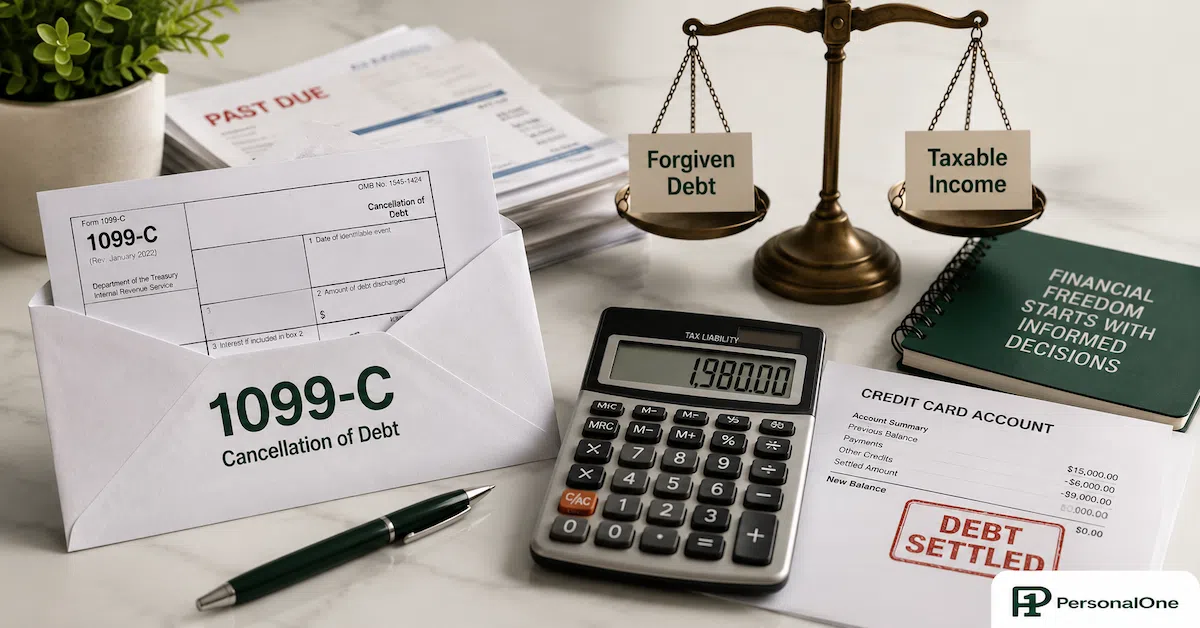
The debt settlement tax consequences most people encounter start with a single form: the 1099-C. It arrives in January, it reports the amount of debt the creditor forgave, and the IRS treats that amount as income. If you settled $15,000 in credit card debt for $6,000, you did not just eliminate $9,000 in debt — you also received $9,000 in taxable income according to the federal government, whether you see it that way or not.
This article explains exactly how debt settlement tax consequences work, how to calculate your potential liability, and — most importantly — the insolvency exclusion that can reduce or eliminate that liability entirely. This is part of a broader look at debt settlement options and what they actually cost when all the factors are counted.
Why the IRS Treats Forgiven Debt as Income
The logic is straightforward, even if the timing feels jarring. When a creditor lends you money, you do not pay tax on it — that is expected, because you are obligated to pay it back. When the creditor agrees to forgive part of what you owe, the economic benefit you received no longer has an obligation attached. In the eyes of the IRS, that is functionally the same as receiving income.
Section 61 of the Internal Revenue Code defines gross income as "all income from whatever source derived." Cancellation of debt has been included in that definition for decades. It is not a gray area or an aggressive interpretation — it is settled tax law.
The $600 threshold matters primarily because it triggers the creditor's reporting requirement. If a creditor forgives $600 or more, they must file Form 1099-C with the IRS and send you a copy. If the forgiven amount is under $600, they are not required to report it — but technically you may still owe tax on it. In practice, amounts under $600 are rarely pursued, and the real situations people encounter involve settlements where thousands of dollars are forgiven.
How to Calculate What You Owe
The calculation itself is not complicated. The forgiven amount gets added to your other taxable income for the year, and you pay tax at your marginal rate — the rate applied to the top portion of your income.
A straightforward example: You owe $15,000 on a credit card. You settle for $6,000. The creditor forgives the remaining $9,000 and sends a 1099-C reporting $9,000 in canceled debt. You earn $52,000 from employment that year. For federal tax purposes, your taxable income is now $61,000. At a 22% marginal bracket, the forgiven debt costs you approximately $1,980 in additional federal income tax.
That $1,980 does not feel like relief — especially when the settlement itself required scraping together $6,000. But there is an important step that most people skip: determining whether the insolvency exclusion eliminates some or all of it.
The Insolvency Exclusion: The Most Important Number Nobody Runs
The insolvency exclusion is the IRS provision that most directly helps people who have been through debt settlement. The rule is simple: if your total debts exceeded your total assets immediately before the debt was forgiven, you were insolvent — and insolvent taxpayers can exclude the forgiven amount from income, up to the amount by which they were insolvent.
Here is what that means in practice. Immediately before your $9,000 debt was forgiven, you had:
- $3,200 in a checking account
- A car worth $8,500 with a $6,000 loan balance (net equity: $2,500)
- $1,800 in personal property
- Total assets: $7,500
And your total debts — including the debt being settled — were:
- $15,000 credit card debt (being settled)
- $6,000 car loan
- $4,500 in other personal debts
- Total debts: $25,500
Your insolvency amount: $25,500 − $7,500 = $18,000. Because you were insolvent by $18,000, and the forgiven amount was only $9,000, you can exclude the entire $9,000 from taxable income. Your tax bill on the settlement: zero.
If your insolvency amount had been only $4,000, you could exclude $4,000 of the $9,000. The remaining $5,000 would still be taxable, but your liability drops from $1,980 to roughly $1,100 — still meaningful, but manageable.
What I've Seen
One of the hardest conversations I've had with someone going through debt settlement happened after they thought the process was already over. They had settled nearly $18,000 in credit card debt the previous year and felt like they were finally stabilizing again. Then January came, multiple 1099-C forms arrived, and suddenly they were facing a tax bill they never planned for. What made it worse was that they actually qualified for the insolvency exclusion — but nobody had explained it to them during the settlement process, and they assumed the IRS automatically knew they couldn't afford the tax. We ended up reconstructing their financial position from old bank statements, vehicle loan balances, and credit reports months later just to prove insolvency after the fact. That's why I tell people now: document everything before tax season arrives. The debt settlement itself is only part of the financial decision. The tax consequences are the part most people don't realize they're still walking into.
How to Claim the Insolvency Exclusion
The insolvency exclusion does not happen automatically. You must claim it by filing IRS Form 982, Reduction of Tax Attributes Due to Discharge of Indebtedness, with your federal tax return for the year the debt was forgiven.
Form 982 is a one-page form, but it requires you to attach a worksheet showing your assets and liabilities at the moment immediately before the discharge. The IRS does not provide a mandatory worksheet format, but Publication 4681 includes guidance and an informal worksheet you can use to document your calculation.
A few things to keep in mind when completing this process:
The snapshot date matters. Insolvency is measured at the moment immediately before the debt was canceled — not at the end of the year, not at the time of filing. If you have documentation of your financial position from around the time of settlement (bank statements, loan balances, property values), preserve it.
All assets count, not just financial accounts. Furniture, electronics, jewelry, vehicles, retirement accounts (with some limitations), and ownership interests in any business are all included. Retirement accounts in IRAs and 401(k)s are generally included at their fair market value, though they are subject to their own complexity in bankruptcy proceedings.
All debts count. Every liability you owed at the moment of settlement — student loans, car loans, medical bills, other credit cards — counts toward your insolvency calculation. More debt you owed means a higher insolvency number and potentially a larger exclusion.
If you are uncertain, work with a tax professional. Form 982 is not difficult, but the asset valuation is subjective and the stakes are real. A tax preparer familiar with canceled debt situations can often pay for themselves in a single filing if they catch a valuation error.
What Happens If You Don't Report the 1099-C
This question comes up frequently, and the answer is worth being direct about. When a creditor files a 1099-C with the IRS, it goes into a matching system. The IRS compares what was reported on 1099s against what was reported on tax returns. If there is a discrepancy — a 1099-C with no corresponding income on your return — the system flags it.
The result is typically a CP2000 notice: a letter from the IRS stating that income appears to be underreported and proposing additional tax, penalties, and interest. These notices do not represent an audit, but they do require a response. If you ignore them, the IRS can proceed to assess the additional tax and begin collection.
The more important point is that if you qualify for the insolvency exclusion, responding to a CP2000 notice with Form 982 documentation typically resolves the matter without owing anything — but it takes considerably more time and stress than simply filing correctly in the first place.
Other Exclusions Worth Knowing
Insolvency is the most commonly applicable exclusion, but the IRS recognizes several others that may apply depending on your situation.
Bankruptcy discharge. Debt canceled through a bankruptcy proceeding is fully excluded from income, regardless of whether you were insolvent. If you are weighing settlement against bankruptcy and the tax liability is a significant factor, this is one of the comparative considerations worth discussing with an attorney. The guide to debt settlement vs. bankruptcy vs. credit counseling covers this comparison in more depth.
Student loan forgiveness programs. Certain student loan forgiveness programs — including Public Service Loan Forgiveness — are currently excluded from federal taxable income under the American Rescue Plan Act provisions extended through 2025. Tax treatment of student loan forgiveness has been subject to legislative changes, so verify current law at the time you file.
Qualified farm or real property debt. Specific exclusions apply to certain types of agricultural debt and some qualified real property business debts. These are narrower exclusions that apply to specific circumstances rather than consumer credit card debt.
Certain non-recourse debt. When property is repossessed or foreclosed and the debt is non-recourse (meaning the lender can only claim the property, not pursue you for a deficiency), different tax treatment may apply. This is more relevant to mortgage situations than credit card settlements.
The debt relief and credit repair framework is built around understanding exactly these kinds of downstream consequences — the ones that determine whether a settlement actually improves your financial position or simply trades one problem for another.
Multiple Settlements in the Same Year
If you are working through a debt settlement program, you may settle multiple accounts in the same tax year or across multiple years. Each forgiven amount is treated separately for the 1099-C reporting requirement, but the insolvency calculation is done at the moment each debt is canceled.
This matters because your insolvency position changes over time. If you settle a $10,000 account in March when you are significantly insolvent, you may qualify for a full exclusion. If you settle a second account in October after your financial position has improved — maybe you've paid down other debts or accumulated more savings — you may be less insolvent or not insolvent at all at that moment. Each settlement stands on its own insolvency snapshot.
Debt settlement programs that span multiple years require tracking each cancellation event separately, with documentation of your financial position at the time of each one. This is one area where keeping records throughout the settlement process pays dividends at tax time.
State Tax Treatment
Federal tax treatment of canceled debt is relatively uniform. State tax treatment varies. Some states follow federal law and accept the insolvency exclusion as reported on Form 982. Others have their own rules, their own forms, or different threshold requirements.
A handful of states — including California — have historically not conformed to certain federal canceled debt exclusions, which can create a situation where you owe no federal tax on a forgiven amount but still owe state income tax. The details change with state legislative sessions, and state tax guidance is worth confirming with your state's department of revenue or a local tax professional at the time you file.
What to Do Before Tax Season If You've Settled Debt
The most effective approach to debt settlement tax consequences is preparation rather than reaction. If you have completed a settlement or are in the process of one, here is what to do before January arrives:
Document your financial position at the time of each settlement. Print bank statements, pull credit reports showing balances, note car values using Kelly Blue Book private-party estimates, and list any other assets and liabilities. Store this with your tax documents for the year.
Run the insolvency calculation informally. You do not need to wait for the 1099-C to estimate whether you qualify. Add up your assets at fair market value. Add up all your debts. If debts exceed assets, you have an insolvency amount, and it likely covers the forgiven debt entirely.
Flag it for your tax preparer. If you use a tax professional, let them know before the appointment that you received a 1099-C. Many preparers who are not specialized in debt situations will process it as standard income without asking about insolvency. You need to initiate that conversation.
Use IRS Publication 4681. This free publication covers canceled debt in detail, includes the informal insolvency worksheet, and explains how to complete Form 982. It is worth reading even if you work with a professional — it gives you enough context to have an informed conversation about your situation.
Track Every Account. Know Your Full Picture.
Monarch Money connects all your accounts in one place — so you can see exactly where you stand before any financial decision, including debt settlement.
Try Monarch Money FreeGovernment & Official Sources
IRS Publication 4681 — The IRS's complete guide to canceled debt, foreclosures, repossessions, and abandonments. Includes the insolvency worksheet and Form 982 instructions.
IRS Form 982 — The form used to claim the insolvency exclusion or bankruptcy exclusion when canceled debt is excludable from income.
IRS Tax Topic 431 — The IRS's plain-language overview of when canceled debt is taxable and when it is not.
More From PersonalOne
Return to the Debt Relief & Credit Repair hub for a complete overview of your options — from settlement to credit repair to recovery timelines.
Frequently Asked Questions
Do I always owe taxes when debt is forgiven? Not always. If the forgiven amount is under $600, the creditor is not required to report it. More importantly, if you qualify for the insolvency exclusion or the debt was discharged through bankruptcy, the forgiven amount may be fully excluded from taxable income. The key is running the insolvency calculation before assuming you owe.
What if I never received a 1099-C? The creditor's reporting requirement and your tax obligation are separate. Even if you do not receive a 1099-C — due to a mailing error, creditor oversight, or because the forgiven amount was under $600 — you may still technically owe tax on the forgiven amount. That said, the practical enforcement mechanism is the 1099-C matching system. If no 1099-C was filed with the IRS, the likelihood of an automatic CP2000 notice is significantly lower.
How does the insolvency exclusion work if I settled multiple debts? Each forgiven debt is evaluated separately. Insolvency is measured at the moment immediately before each specific debt was canceled. Your insolvency position may differ from one settlement to the next if your financial situation changed between them — meaning you could qualify for a full exclusion on one settlement and only a partial exclusion on another in the same year.
Can I avoid the tax by negotiating differently? No. The tax consequence flows from the legal forgiveness of the debt, not from how the settlement agreement is worded. Some companies market debt restructuring or settlement products that claim to avoid 1099-C reporting — these claims are generally misleading. If a creditor is canceling debt, the tax treatment follows federal law regardless of how the transaction is framed.
Does my state follow the same insolvency exclusion rules as the federal government? Not always. Most states conform to federal treatment of canceled debt, but some do not — or conform only partially. California is a notable exception where state tax treatment of canceled debt has differed from federal treatment in certain situations. Verify your state's current rules with your state tax authority or a local tax professional at the time you file.
If I file Form 982 and claim insolvency, will it trigger an audit? Filing Form 982 is standard procedure for canceled debt situations and does not by itself trigger an audit. The IRS designed the form specifically for this purpose. What matters is that your insolvency calculation is documented and defensible — accurate asset values, complete debt listing, and a snapshot date that matches the cancellation event.
Continue Learning
Debt Settlement Explained: When It Helps, When It Hurts, and What It Really Costs — The complete picture on how settlement works, what it costs in fees and credit damage, and the scenarios where it makes the most sense.
Debt Settlement vs Bankruptcy vs Credit Counseling — A side-by-side comparison of the three main paths out of serious debt, including how each one handles tax treatment of forgiven balances.
Debt Relief & Credit Repair — The full authority hub covering every phase of recovery from serious debt, from settlement through credit rebuilding.
Disclaimer: This article is for educational purposes only and does not constitute financial or tax advice. Tax treatment of canceled debt depends on individual circumstances. PersonalOne is not a licensed financial advisor, tax professional, or attorney. Consult a qualified tax professional before making decisions related to Form 982, insolvency calculations, or canceled debt reporting. PersonalOne is not responsible for decisions made based on this content.