Updated: August 2026
Home › Debt Relief & Credit Repair › Rebuilding After Debt Relief › Preventing Debt From Returning
What You Need to Know
— Preventing debt from returning is rarely a discipline problem — research shows even people handed a completely clean slate return to debt within weeks if nothing structural changes.
— A cash buffer, a banking structure, and real monthly surplus have to exist before relying on credit again, not after.
— Credit itself isn't the enemy — using it as a lifeline instead of a tool is what recreates the cycle.
— The goal isn't more motivation. It's a system that doesn't require motivation to hold.
Researchers at the University of Chicago ran an experiment that cuts through most of what gets written about preventing debt from returning: they simply paid off high-interest debt for a group of borrowers directly, no strings attached, no financial coaching required. Most of them were back in debt within six weeks. One to two years later, they were borrowing at the same rate as people who'd received no help at all. A clean slate, on its own, didn't hold.
That finding matters because it contradicts almost every popular article on this topic, which frames staying debt-free as a matter of willpower — resist temptation, track your spending, notice your triggers, stay disciplined. If willpower were the real lever, a debt-free bank balance and a fresh start should have worked for the people in that study. It didn't, because debt doesn't usually return due to a single moment of weakness. It returns because the financial structure underneath the person never actually changed, so the exact same pressure that created the debt the first time is still sitting there, waiting quietly for the next disruption. This article, part of the Rebuilding After Debt Relief cluster, covers what actually needs to change instead.
Why Willpower-Based Approaches Fail
Willpower is a finite, situational resource — it's strong on a good week and nearly absent during a stressful one, which is exactly when a financial decision is being made under pressure. Advice that depends on willpower is, by design, least available at the moment it's needed most. A job loss, a medical bill, a car repair — these don't wait for a week when your discipline is running high.
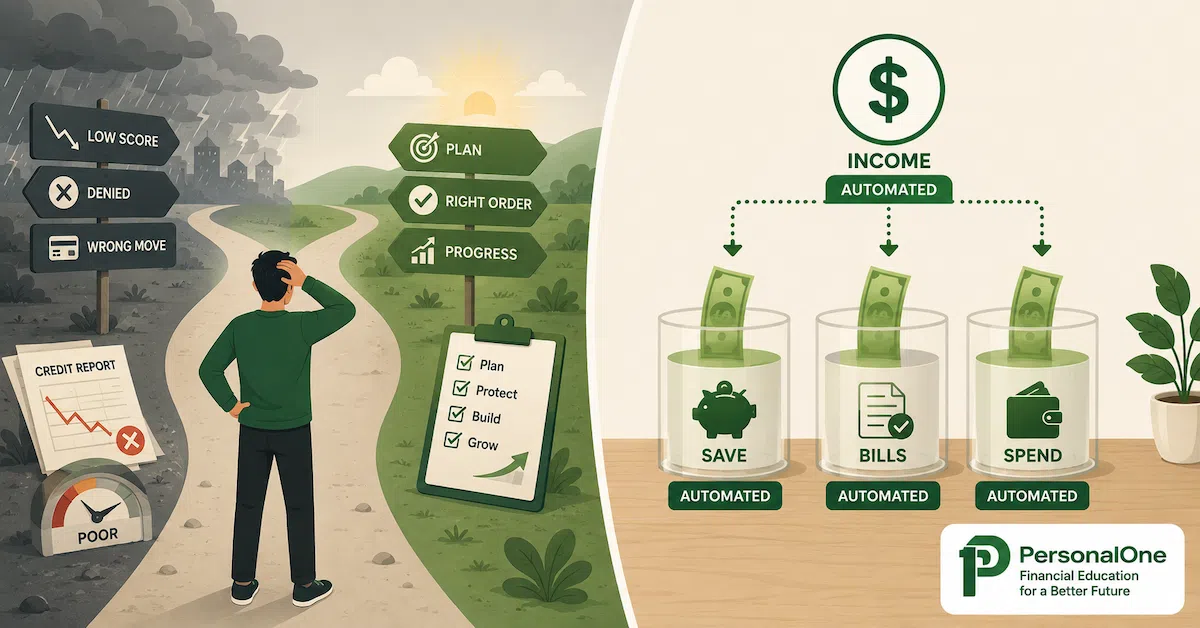
The behavioral research backs this up beyond the Chicago study. People who rely on discipline alone to avoid debt are making a fresh decision every single time a financial pressure point appears, with no system doing any of that work for them. Compare that to someone whose bills, spending, and savings are already separated into different accounts by design — for that person, avoiding overspending doesn't require a decision at all, because the structure already routes the money before a decision is even necessary. One approach depends on you being strong every time. The other only depends on you setting it up once.
This is not a character flaw, and it's worth saying directly and plainly: needing structure instead of relying on discipline alone isn't a weakness unique to people who've gone through debt relief specifically. It's simply how decision-making works under financial stress, for anyone. The people in the Chicago study weren't less disciplined than average — they were given money with no infrastructure change, which is precisely the condition under which discipline-based advice is weakest. The lesson isn't "try harder next time." It's "build something that doesn't require trying this hard in the first place."
There's also a timing problem with willpower-based advice that rarely gets named. Most of it assumes you'll notice the moment temptation arrives and consciously choose differently. In practice, the moments that matter most — an unexpected bill landing the same week as a slow month at work, a medical copay showing up right after a car repair — don't announce themselves as tests of discipline. They just look like normal life, and the credit card is simply the fastest tool sitting there. Structure works precisely because it doesn't require you to recognize the moment at all; the money is already routed somewhere else before the moment arrives.
The Real Reason the Cycle Repeats
Debt relief resolves a balance. It doesn't resolve the conditions that produced the balance. If there was no cash buffer before, and none was built during the relief process, the next unexpected expense finds the exact same gap it found the first time — and a credit card fills it the exact same way. The account changed. The vulnerability didn't.
From My Experience
One mistake I've seen people make after settling debt is assuming the hardest part is over. Emotionally, it feels like crossing the finish line. Financially, it's actually the starting line for rebuilding.
When I was developing the PersonalOne Money System, I noticed that many people focused entirely on getting balances to zero but never verified how those accounts were reported afterward. Months later they were frustrated that their credit wasn't improving, only to discover an account still showed a balance or the wrong status. By then, valuable time had already been lost.
That's why I encourage treating debt settlement like closing a business transaction instead of celebrating and moving on. Keep copies of every settlement agreement, verify each account reports correctly with all three credit bureaus, and don't assume every creditor updates your file accurately. Spending an hour checking your reports can save months of unnecessary credit recovery.
The Financial Infrastructure You Need Before Relying on Credit Again
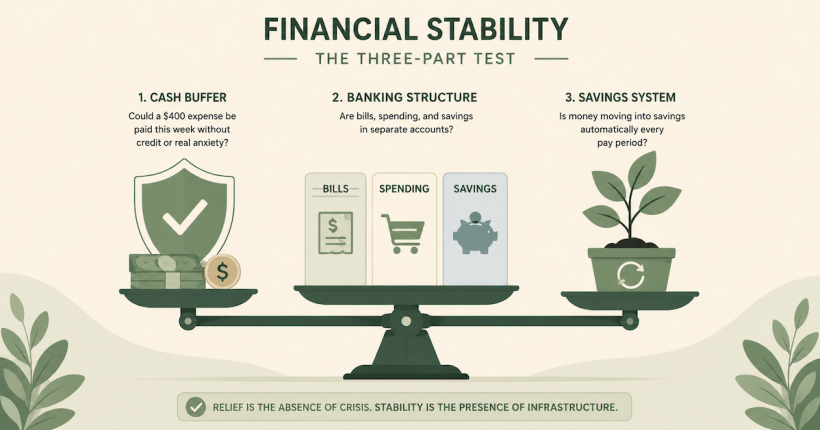
Infrastructure, in this context, means the parts of your financial life that work whether or not you're paying close attention that week. Three pieces need to exist before it's safe to lean on credit again at all.
A Cash Buffer That Exists Before the Emergency
Even a modest $500 to $1,000 buffer changes the entire equation, because it means the next small emergency has somewhere to draw from that isn't a credit account. This buffer needs to exist before you feel fully ready to build it — waiting until things feel comfortable is exactly how the gap stays open long enough for the next disruption to hit it.
The size of the buffer matters less than its existence. A $500 cushion that's actually there beats a theoretical $3,000 goal that isn't funded yet, because the theoretical goal provides zero protection against the car repair that happens next week. Start with whatever amount is realistically achievable in the next month or two, fund it deliberately, and treat reaching it as the actual finish line for this piece — not a milestone on the way to something bigger you'll get to eventually.
A Banking Structure That Makes Overspending Structurally Harder
Separating your bills, spending, and savings into distinct accounts does something willpower can't: it makes the wrong decision require deliberate extra effort instead of being the path of least resistance. When everything sits in one account, spending money earmarked for rent is just as easy as spending money meant for groceries. When the accounts are separated, moving money out of the bills account to cover a discretionary purchase requires noticing, deciding, and acting — friction that a single shared account never provides. Read the full Banking Systems account structure guide for exactly how to build this.
The mechanism here is worth naming plainly: friction is protective. Every extra step between "I want to spend this" and "the money is spent" is a moment where the decision can be reconsidered. A single account with everything mixed together has zero friction — the money is right there, already available, with no separation signaling that it belongs to next week's rent rather than this week's discretionary spending. Multiple accounts recreate that separation automatically, every single pay period, without requiring you to remember why the separation matters each time.
A Budget That Creates Real Monthly Surplus
A budget that just barely covers expenses with nothing left over isn't actually protective — it's one unexpected cost away from needing credit again. The goal isn't a perfectly balanced budget; it's a budget with genuine breathing room built in, so a single bad month doesn't immediately force a choice between a bill and a credit card.
This surplus doesn't need to be large to matter. Even a modest, consistent monthly cushion — enough to absorb a higher-than-usual grocery bill or a slightly larger utility payment without touching the buffer account — changes how a bad week feels. Without it, every unexpected cost, however small, becomes a mini-crisis requiring a decision about where the money comes from. With it, most small disruptions simply get absorbed by the surplus and never become a decision at all.
Using Credit as a Tool, Not a Lifeline
None of this means avoiding credit entirely — credit itself isn't the problem, and used well it's one of the more useful financial tools available. The distinction that actually matters is what role it's playing. A credit card used deliberately, for a planned purchase you could otherwise cover in cash, paid in full every month, is a tool. A credit card reached for because there's nowhere else for the money to come from is a lifeline — and a lifeline, by definition, gets used again the next time the same gap reappears.
The test is simple: if using credit right now is closing a gap that a cash buffer or a banking structure should have closed instead, that's the lifeline pattern reasserting itself, not a normal, planned use of credit. Recognizing which one is happening in the moment is only possible once the infrastructure above actually exists — without it, every use of credit looks and feels the same, whether it's a tool or a trap.
There's a version of this that trips people up specifically after debt relief: the sudden availability of credit that wasn't there during the crisis. A newly opened secured card, or an existing account that's finally usable again, can feel like proof that things are better now — and using it for something that would have gone on the buffer account instead quietly starts rebuilding the exact pattern that led to trouble the first time. Access to credit and readiness to use it responsibly are two different things, and the gap between them is exactly where recurrence tends to happen.
A Simple Monthly Check
Once a month, ask one question: did I use credit this month because I chose to, or because I had to? "Because I had to" is the signal that a piece of the infrastructure above still has a gap — not a reason for self-criticism, just information about where to direct attention next.
This check works precisely because it's quick and non-judgmental. It's not a full budget review or a guilt exercise — it's a five-minute question that either confirms the system is holding or points directly at which piece needs attention. Over a few months, a pattern usually emerges: maybe the buffer keeps getting drained by the same category of expense, which means the budget surplus in that category is too thin, not that the buffer itself failed.
What This Looks Like When It's Actually Working
Structural prevention isn't usually dramatic when it's actually working — that's part of the whole point. It looks like a car repair bill arriving and being paid from a buffer account without a second thought, rather than becoming a decision about which credit card has room on it. It looks like a slow month at work not triggering a scramble, because the budget already had breathing room built in rather than being calculated to the exact dollar every month.
Contrast that directly with the willpower version of the same two events. A car repair with no buffer means an immediate decision under pressure — credit card, or don't get the car fixed at all. A slow income month with no budget breathing room means every discretionary choice becomes a small negotiation with yourself, dozens of times over a few weeks, any one of which can go the wrong way when you're tired or stressed. The structural version removes the negotiation entirely. The willpower version demands it constantly, for as long as the debt-free period lasts.
This is also why debt recurrence so often surprises people who genuinely felt committed to staying out of debt. Commitment was never the missing ingredient — infrastructure was. Someone can be completely sincere about never wanting to go back into debt and still end up there, simply because the same structural gap that existed the first time was still open the second time a real disruption hit.
A system doesn't need your willpower to hold.
Build the cash buffer, banking structure, and budget that make staying out of debt automatic — not a daily decision.
Explore the 7-Stage Money System →Frequently Asked Questions
Why do people go back into debt even after paying it off completely? Because paying off a balance resolves the debt itself but not the underlying structural gap — no cash buffer, no banking structure, no real budget surplus — that created it in the first place. Research on debt relief interventions shows this pattern clearly: a clean slate alone, without structural change, tends not to hold.
How big does my emergency fund need to be to actually prevent debt recurrence? A starting buffer of $500 to $1,000 handles most small disruptions immediately; the longer-term goal of three to six months of expenses is what protects against larger ones, but the small buffer is what matters most in the first few months after debt relief.
Is it bad to use credit cards at all after getting out of debt? No — credit itself isn't the problem, and used well it remains one of the more useful financial tools available. The distinction that actually matters is whether credit is being used as a planned tool for a purchase you could otherwise afford, or as a lifeline filling a gap that a cash buffer should have covered instead.
What's the very first infrastructure piece to build after debt relief? The small cash buffer, before anything else — it's the fastest to build and it's what prevents the very next minor emergency from becoming new debt while the rest of the structure is still being put in place.
How do I know if I'm using credit as a tool or falling back into the old pattern? Ask yourself whether this particular use of credit is closing a gap your cash buffer or budget surplus should have closed instead. If the honest answer is yes, that's the lifeline pattern reasserting itself — a signal to look at which piece of infrastructure still has a gap, not a reason for self-criticism.
This is one piece of the full recovery path. See where it fits inside the Rebuilding After Debt Relief cluster guide, or explore the complete Debt Relief & Credit Repair hub. Research source: University of Chicago Booth — Debt Traps research.