Home › Debt Relief & Credit Repair › Debt Settlement Options › When Do Creditors Accept Debt Settlements
About the Author
Don Briscoe is a financial systems coach with 12+ years helping Millennials and Gen Z escape paycheck-to-paycheck cycles. He founded PersonalOne to deliver the financial education he wished existed — structured, honest, and framework-first.
TL;DR — Quick Summary
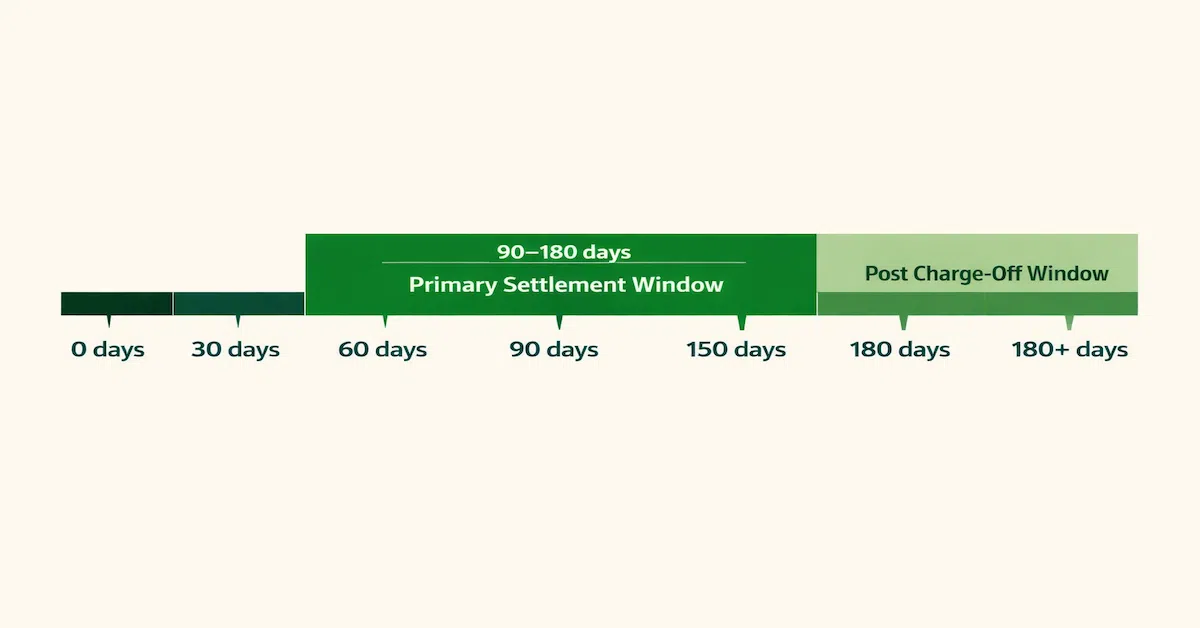
- Creditors are most likely to accept settlements when accounts are 90–180 days past due — this is the primary negotiation window.
- After charge-off (typically at 180 days), the debt is often sold to a third-party collector at a steep discount — opening a second, different negotiation window.
- Original creditors typically accept 40–60% of the balance. Third-party collectors may accept 20–40% because they paid much less for the debt.
- Lump sum offers are far more likely to be accepted than payment plans. Creditors want certainty of payment.
- Never pay before receiving the settlement agreement in writing. Verbal agreements are not enforceable.
The most common question people have before pursuing debt settlement is also the most practical one: will they actually say yes? The answer depends less on the amount you owe and more on when you ask, who you’re asking, and what you put on the table. Settlement is not a coin flip — there’s a logic to how creditors make these decisions, and understanding that logic is the difference between a negotiation and a guess.
For the full framework on how settlement fits into your debt resolution options, see the Debt Settlement Options cluster hub before going deeper here.
How Creditors Think About Bad Debt
To understand when creditors settle, you have to understand what a delinquent account means to them financially. Credit card companies and lenders operate on a model where some percentage of debt will never be fully repaid. They account for this through loan loss reserves — money set aside to absorb expected defaults. By the time your account is 90–120 days past due, their internal systems have already partially written it down.
This matters because it changes the calculus on settlement. A creditor who has internally reserved against a loss isn’t comparing your settlement offer to the full balance — they’re comparing it to what they realistically expect to recover. If they think you’ll eventually pay 30% through collections or write the account off entirely, a lump sum offer of 45% looks better than the alternative.
Settlement is not charity on the creditor’s part. It’s a business decision about which outcome recovers the most money with the least cost.
The Two Primary Negotiation Windows
Debt settlement timing follows a predictable arc. There are two distinct windows where creditors are most likely to accept reduced offers — and they involve very different parties with different motivations.
Window 1: 90 to 180 Days Past Due (Original Creditor)
Once an account goes 90 days delinquent, creditors begin internal recovery efforts and start making realistic assessments about collectability. This is when they become receptive to settlement conversations. The window runs roughly through 180 days — the standard charge-off point for most major lenders.
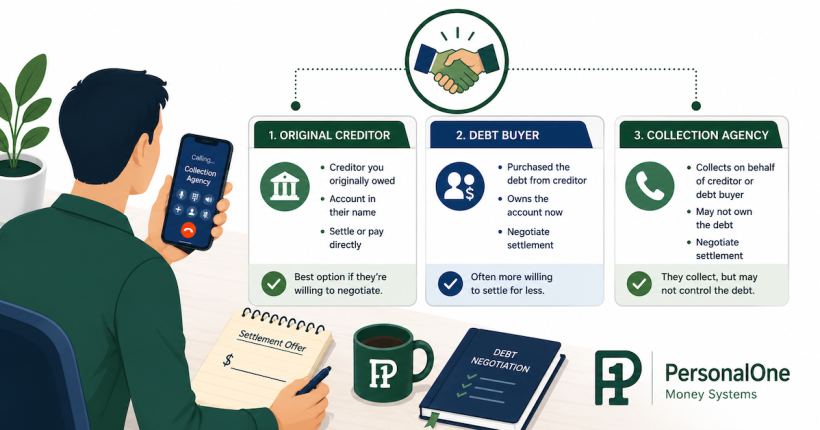
During this window you’re negotiating with the original creditor, who still owns the debt. They have the most authority to settle for a meaningful reduction and the most financial motivation to recover something before they have to take the full loss on their books.
What to Expect: Original Creditor Settlement
Favorable conditions
- 90–150 days past due
- Lump sum available immediately
- Documented hardship (job loss, medical)
- Account not yet in active litigation
Typical acceptance range
- 40–60% of outstanding balance
- Higher balances ($10K+) tend to get better percentages
- End of quarter timing can help
- First offer is rarely the final offer
Window 2: After Charge-Off (Third-Party Debt Collectors)
At approximately 180 days of non-payment, most lenders charge off the account — meaning they take the full loss on their books and either assign the debt to a collection agency or sell it outright to a debt buyer. This transaction typically happens at 5–15 cents on the dollar for the debt buyer.
This creates a second, often more favorable negotiation window. The collection agency or debt buyer paid so little for the debt that they can profit even on a 25–35% settlement. Their breakeven is much lower than the original creditor’s was — which is why post-charge-off settlements often come in at lower percentages of the original balance.
What to Expect: Third-Party Collector Settlement
Favorable conditions
- Recently purchased debt (collector paid less)
- Statute of limitations approaching
- Lump sum available
- Multiple accounts with same collector
Typical acceptance range
- 20–40% of original balance
- Sometimes lower on very old debt
- Verify collector owns the debt before paying
- Get debt validation letter first
Continue Learning About Debt Settlement Options
- Debt Settlement Explained: When It Helps, When It Hurts
- Debt Settlement vs. Bankruptcy vs. Credit Counseling
- How Debt Settlement Affects Your Credit Score
- When Debt Settlement Actually Makes Sense
- What to Know Before Hiring a Debt Relief Company
- Debt Relief 2026: How to Pay Off Credit Cards Without Losing Your Mind
Factors That Increase Acceptance Likelihood
Timing is the most important variable, but it’s not the only one. These factors move the probability of acceptance up or down independent of where you are in the delinquency timeline.
Lump Sum vs. Payment Plan
Creditors strongly prefer lump sum settlements over payment plans, and for straightforward reasons: a lump sum is certain. A payment plan means continued risk that you default again mid-settlement and they end up with nothing. When you offer to pay the full settlement amount immediately upon agreement, you eliminate that uncertainty — and that’s worth a lower percentage to most creditors.
Payment plan settlements do exist, but they typically require a higher total percentage than lump sum offers and are harder to negotiate. If you don’t yet have a lump sum, this is why settlement companies have you build a dedicated savings account first — you’re accumulating the leverage before you make the call.
Documented Financial Hardship
Creditors are more receptive when hardship is verifiable. Job loss, divorce, medical debt, or a documented income reduction gives them a legitimate reason to approve a reduced settlement internally — and protects the representative approving the deal. Vague claims of difficulty are harder to act on than specific documented circumstances.
You don’t need to submit formal documentation in most cases, but being specific and consistent about your hardship during the negotiation strengthens your position.
Balance Size
Larger balances tend to attract better settlement percentages. A creditor who can recover $6,000 on a $15,000 balance has more incentive to negotiate than one recovering $600 on a $1,500 balance. The cost of processing a settlement is similar regardless of balance — so higher balances produce better economics for both sides.
Small balances under $2,000 may be harder to settle at significant reductions because the cost of pursuing collections is lower relative to the amount at stake.
Statute of Limitations Timing
Every state has a statute of limitations on debt — a window after which creditors can no longer sue to collect. As a debt approaches that limit, the creditor’s leverage drops significantly. A lawsuit is their strongest collection tool, and when that option expires, settlement becomes more attractive because the alternative is writing the debt off entirely. Statute of limitations periods vary by state and debt type, typically ranging from 3–10 years.
Important caveat: making any payment on a time-barred debt can restart the statute of limitations in some states, resurrecting the creditor’s right to sue. Verify your state’s rules before engaging with very old debt.
End-of-Quarter Timing
This is a tactical detail that experienced negotiators use: creditors and collection agencies operate on quarterly performance targets. Representatives who close settlements before quarter-end may have more authority to approve deals — or more internal motivation to do so. Initiating settlement conversations in the last few weeks of a quarter (March, June, September, December) can marginally improve outcomes. It’s not a guarantee, but it’s a real pattern.
What Creditors Will Not Settle
Not all debt is negotiable in the same way. Understanding where settlement doesn’t work prevents you from pursuing the wrong strategy for the wrong account type.
Secured debt — mortgages, auto loans, and any loan backed by collateral — is generally not settled through the same process as unsecured debt. The creditor holds the asset as security. If you stop paying, they repossess or foreclose. Settlement of secured debt is a different and more complex process than unsecured debt negotiation.
Federal student loans are not eligible for standard settlement. They operate under a separate set of rules, have their own hardship programs (income-driven repayment, forbearance, forgiveness programs), and don’t respond to the same delinquency-based negotiation timeline. Private student loans are technically negotiable but creditors are much less flexible than credit card issuers.
Recent tax debt owed to the IRS has a separate program called an Offer in Compromise — not standard debt settlement. The IRS has its own eligibility criteria and application process entirely separate from the commercial creditor settlement process.
Accounts in active litigation are harder to settle directly. Once a creditor has filed suit, any settlement typically requires attorney-to-attorney negotiation and may need court approval to discharge the judgment. This is still possible — but it’s not DIY territory.
The Non-Negotiable: Get Everything in Writing
This is the most important operational rule in all of debt settlement and it cannot be overstated: do not pay anything until you have the settlement agreement in writing, signed by the creditor or collector.
The written agreement must specifically state the account number, the settlement amount, and that payment of that amount satisfies the full debt and will result in the account being reported as “settled in full” or “paid in full” (the latter is better for your credit). Verbal commitments made over the phone are not legally enforceable. Collectors sometimes “forget” verbal agreements or claim the representative who made the offer wasn’t authorized to do so.
After payment, keep the written agreement and your payment confirmation permanently. Settled debts sometimes reappear on credit reports or are resold to other collectors in error. Your documentation is your proof that the debt is resolved.
When to Use a Settlement Company vs. DIY
You can negotiate directly with creditors. Creditors deal with consumers every day. The question is whether the 15–25% fee a settlement company charges is worth what you get in return.
DIY settlement makes sense when you have one or two accounts, you’re comfortable handling creditor calls directly, and you have the lump sum ready to deploy. The process: stop paying the account, document your hardship, wait until the account reaches the 90–150 day window, then call the creditor’s hardship or resolution department (not the general customer service line) and make your offer. Start lower than your target — there will be a counter.
Professional settlement through a company like CuraDebt makes more sense when you have multiple accounts to resolve simultaneously, you want someone else handling creditor communications and collection calls, or your total enrolled debt is high enough that the company’s established creditor relationships could produce meaningfully better terms than you’d get on your own. The fee is real but so is the operational lift they absorb.
Not Sure If Creditors Will Settle Your Accounts?
CuraDebt offers a free consultation to assess your specific accounts, balances, and timing — and tell you honestly what settlement looks like for your situation.
Get Your Free Assessment →Affiliate link — PersonalOne may earn a commission at no cost to you if you enroll.
What Happens to Your Credit During and After Settlement
The credit damage from settlement is real and starts before any settlement is agreed to. The moment you stop making payments to build your settlement fund, the delinquency clock starts and your score drops. By the time you’re in the negotiation window (90–180 days past due), you’ve already absorbed most of the score impact — which is part of why the settlement window opens at all.
Once settled, the account is reported as “settled” or “settled for less than the full amount” and remains on your credit report for seven years from the original delinquency date — not from the settlement date. The scoring impact of the settled account diminishes over time, especially as you build positive history on other accounts.
The tax consequence is separate from the credit consequence: the IRS requires creditors to issue a Form 1099-C for any cancelled debt over $600, and that amount is treated as taxable income unless you qualify for the insolvency exception. This is a real cost that affects the total economics of settlement and should be factored into your decision.
Ready to See the Full Debt Relief Picture?
Settlement timing is one piece of a larger system. The debt relief and credit repair guide maps every option available — from the first missed payment through full credit recovery — so you can choose the path that fits your actual situation.
View the Full Debt Relief System →Continue Learning About Debt Settlement Options
- Debt Settlement Explained: When It Helps, When It Hurts
- Debt Settlement vs. Bankruptcy vs. Credit Counseling
- How Debt Settlement Affects Your Credit Score
- When Debt Settlement Actually Makes Sense
- What to Know Before Hiring a Debt Relief Company
- Debt Relief 2026: How to Pay Off Credit Cards Without Losing Your Mind
Resources
Official Sources
- CFPB — What to Know When Settling a Debt
- Federal Trade Commission — Coping with Debt
- IRS — Cancelled Debt: Is It Taxable or Not? (Topic 431)
This article is part of the Debt Relief & Credit Repair authority hub — the complete framework for understanding your options, resolving debt, and rebuilding on solid ground.
Frequently Asked Questions
How many months past due do I need to be before a creditor will settle?
Most creditors become meaningfully receptive to settlement offers around 90 days past due. The strongest window runs from 90 to 150 days — after that, many accounts are approaching charge-off and the creditor may be preparing to sell the debt rather than negotiate. Some creditors will settle earlier with strong documented hardship, but 90 days is the general threshold where serious negotiation becomes realistic.
What percentage of the balance should I offer to start?
Open lower than your target. If you can comfortably pay 50% and want to settle at 45%, start at 30–35%. Creditors expect a counter and the opening number anchors the negotiation. Starting too high leaves no room to move and signals that you have more available than you’re letting on. Be prepared for the first one or two offers to be rejected before reaching an agreement.
Can a creditor sue me while I’m trying to settle?
Yes. Settling a debt and being sued for a debt are not mutually exclusive. Creditors can initiate legal action at any point while your account is delinquent — typically after 180 days but sometimes sooner for large balances. A lawsuit changes the negotiation dynamic significantly and typically requires attorney involvement. If you receive a summons, consult a debt attorney immediately rather than trying to handle it yourself.
Will a settled debt still appear on my credit report?
Yes. A settled account remains on your credit report for seven years from the original delinquency date. It will be marked as “settled” or “settled for less than the full amount,” which is negative but less severe than an unpaid collection. If you can negotiate “paid in full” status as part of the settlement agreement, that’s preferable — though most creditors won’t agree to this unless pressed.
What is pay-for-delete and does it work?
Pay-for-delete is a negotiation where you offer to pay the settlement in exchange for the creditor removing the negative entry from your credit report entirely — rather than just marking it settled. The major credit bureaus’ agreements with creditors technically prohibit this practice, and most original creditors won’t agree to it. Third-party debt collectors are more likely to offer pay-for-delete since they have less contractual obligation to the bureaus. Even when agreed to, deletion isn’t guaranteed — get any such agreement in writing as part of the settlement terms.
Does settling one account hurt my other credit accounts?
Not directly — but the delinquency process required to reach the settlement window affects your overall credit profile, which can trigger risk reviews on other accounts. Some creditors routinely review accounts and may lower credit limits or increase rates if your score drops significantly. This is a real secondary effect of the settlement process that’s worth understanding before you start, especially if you have accounts you want to protect.