June, 2026
Home › Banking Systems › Account Separation for Different Life Stages › How Entrepreneurs Should Separate Personal and Business Accounts
Part of Account Separation for Different Life Stages — how to structure your banking as your income, responsibilities, and financial goals evolve.
What You Need to Know
— Mixing personal and business money in the same account is the most common financial mistake entrepreneurs make — and approximately 50% of small business owners who do it face significant fiscal challenges as a result.
— The problem is not just legal exposure or messy taxes. It is that without separation, you cannot tell how much the business actually earns, what your personal finances actually look like, or whether you can afford to pay yourself.
— Separating personal and business accounts is not about opening one business checking account. It is about building two parallel financial systems — one for the business, one for personal life — that connect in exactly one place: your salary.
— How you pay yourself determines whether your personal financial system stays stable regardless of business volatility. Getting that one mechanism right protects both sides of the separation.
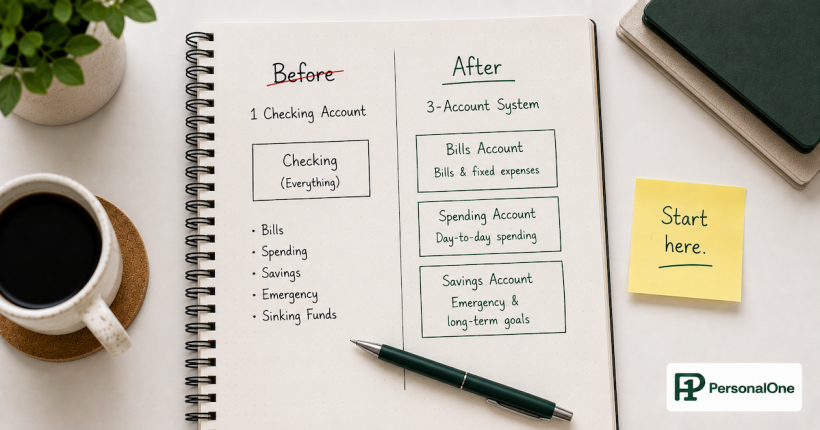
— The personal side of your account structure does not change just because you run a business. The same bills account, spending account, and savings account system that works for everyone else works for entrepreneurs — funded by a consistent personal salary drawn from the business.
Most guides about separating personal and business accounts focus on the business side: open a business checking account, keep records clean, protect yourself legally. That advice is correct but incomplete. It addresses one account and ignores the full architecture both sides of the separation require.
The entrepreneur who separates personal and business money correctly does not just open a business account. They build two distinct financial systems — a business system that tracks revenue, covers operating expenses, and builds business reserves, and a personal system that funds their life through a consistent salary regardless of what the business is doing month to month. The connection between those two systems is a single, deliberate payment: the owner's salary.
This guide covers the complete account separation for entrepreneurs — both the business account structure and the personal account structure it funds, and the salary mechanism that connects them correctly. The broader framework for how personal account structure works at every life stage is in the banking systems account structure guide.
IRS Publication 583 states that one of the first things you should do when starting a business is open a business checking account and keep it separate from your personal account. The reasons go well beyond IRS compliance — and most entrepreneurs do not fully understand them until the mixing has already caused a problem.
Why Mixing Personal and Business Money Creates Compounding Problems
Approximately 50% of small business owners who mix personal and business finances face significant fiscal challenges according to recent research. The problems compound in three directions simultaneously.
You cannot see the business clearly. When personal and business money share an account, every transaction is ambiguous. Is this withdrawal a business expense or personal spending? Is this deposit business revenue or a personal transfer? Generating accurate profit and loss numbers — which every business decision depends on — becomes an exercise in forensic accounting rather than straightforward reporting.
Your personal finances become hostage to business volatility. A slow business month bleeds directly into your personal bill-paying ability. A large business expense competes with your rent. You cannot build a personal emergency fund because you are never sure how much of your savings is personally yours versus business reserves. Your personal financial life has no stability because it is not structurally separate from a business that is inherently variable.
You lose legal protection. For any business structure beyond sole proprietorship — LLC, S-Corp, C-Corp — mixing personal and business money can pierce the corporate veil, meaning courts can hold you personally liable for business debts and lawsuits even if you formed a legal entity specifically to prevent that. The legal protection that a business entity provides exists only if the financial separation is real and documented.
The Two-System Architecture: Business Side and Personal Side
The correct approach to separating personal and business accounts is not a single decision — it is building two parallel financial systems that never interact except through the owner's salary payment. Here is what each system needs.
The Business System: Three Business Accounts
Business Checking Account — Operations. All business revenue deposits here. All business operating expenses pay from here — supplier payments, software subscriptions, contractor payments, business insurance, marketing costs. This is the primary business account. It should never receive personal deposits or pay personal expenses. The balance in this account tells you what the business has available for operations.
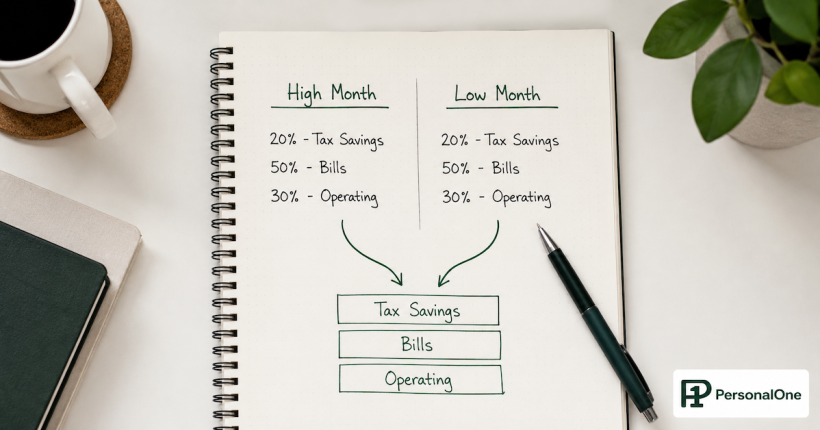
Business Tax Reserve Account — Obligations. A percentage of every revenue deposit moves here immediately — typically 25–30% for most self-employed entrepreneurs covering federal income tax and self-employment tax. This account is untouchable except for quarterly estimated tax payments and annual tax obligations. The single most common financial crisis for entrepreneurs is a large unexpected tax bill. This account prevents it by funding the obligation in real time rather than scrambling at tax time.
Business Savings Account — Reserves. A business emergency fund covering two to three months of business operating expenses. This protects the business from slow months, client payment delays, and unexpected costs without requiring the owner to inject personal money into the business or take on debt. A high-yield business savings account earns competitive interest while the reserves accumulate.
The Personal System: Three Personal Accounts
Personal Bills Account. Rent or mortgage, utilities, insurance, subscriptions, any fixed personal obligations. Funded by the owner's salary on a fixed schedule. Autopay handles everything. Never receives business revenue directly.
Personal Spending Account. Groceries, dining, personal transportation, personal entertainment, discretionary lifestyle spending. The balance is always genuinely available because the bills are in a separate account. This is the account the personal debit card is attached to.
Personal Savings Account (High-Yield). Personal emergency fund, personal financial goals, retirement contributions if not handled through a business retirement vehicle. This account earns competitive interest and is completely separate from business reserves. The best savings accounts for 2026 covers the top FDIC-insured options for personal savings that work regardless of employment type.
The Salary Mechanism: How the Two Systems Connect
The only connection between the business system and the personal system should be a single, regular owner's salary payment — a fixed amount that transfers from business checking to personal checking on a defined schedule.
This is the mechanism that most self-employed entrepreneurs get wrong. Instead of paying themselves a fixed salary, they spend from the business account when they need personal money, transfer irregular amounts based on what the business has available, or blend personal and business spending without a defined payment. Each of those approaches destroys both systems simultaneously.
How to Set the Salary Amount
Step 1 — Calculate your personal financial needs. Add up your personal bills account requirement plus your personal spending allocation plus your savings contribution. This is the minimum salary the business needs to pay you to fund your personal life.
Step 2 — Assess what the business can consistently afford. Look at average monthly business revenue over the past three to six months. Subtract operating expenses and the tax reserve contribution. The remainder is available for owner compensation. Your salary should be sustainable at the business's average revenue level — not its best month.
Step 3 — Set a fixed salary at or below the sustainable amount. The salary should not fluctuate with business performance. Fixed salary means your personal finances are stable regardless of business volatility. If the business has an exceptional month, the surplus stays in business reserves rather than flowing to personal spending.
Step 4 — Automate the transfer. The salary transfers from business checking to personal bills account on a fixed date — biweekly or monthly, whichever mirrors a traditional employment cadence. Then the personal payday sequence runs exactly as it would for any employed person: bills funded first, savings next, spending money last.
The Tax Reserve: The Account Most Entrepreneurs Skip and Regret
The business tax reserve account is not optional infrastructure. For a self-employed entrepreneur paying both income tax and self-employment tax, the annual tax obligation on $80,000 of business profit can exceed $20,000. Without a dedicated account accumulating that obligation in real time, that $20,000 is not available when it is due — because it was spent on operations, personal salary, and business growth along the way.
The correct approach is automatic: a fixed percentage of every deposit into the business checking account transfers immediately to the tax reserve. Most self-employed entrepreneurs should set aside 25–30% of gross revenue. The exact percentage depends on business structure, deductions, and state tax obligations — a tax professional can confirm the right rate for your specific situation. The structural principle is the same regardless of rate: the obligation is funded in real time, not scrambled for at tax time.
Quarterly estimated tax payments come from this account. The annual tax payment comes from this account. If the reserve has accumulated more than the actual tax obligation — a good outcome — the surplus can remain as additional business reserves or transfer to business savings. It never transfers to personal spending because it was never personal money.
When You Have Both a Job and a Side Hustle
The majority of entrepreneurs starting out are not full-time business owners — they have employment income alongside business income. This is the stage where the mixing problem starts most commonly, because the business is small, the income is irregular, and opening a full business account structure feels like overkill.
It is not overkill. Even a small side hustle generating $500–$1,000 per month benefits from a dedicated business checking account for the same reasons a full-time business does — clean records, accurate profit tracking, and tax reserve accumulation. The scale is smaller but the structure is identical.
For a side hustle alongside employment, the personal financial system is already funded by your salary. Side hustle revenue deposits into the business checking account, the tax reserve percentage transfers immediately, and the remainder can either stay in the business as reserves or transfer to personal savings as a supplemental savings contribution. It does not get spent from the business account on personal expenses — ever. The side hustle income that routes through a correct structure builds both business reserves and personal savings. The same income routed through a single personal account typically disappears into lifestyle spending without either outcome.
Two Financial Systems. One Salary. Total Separation.
The entrepreneur account structure is one configuration of the broader account separation framework. For the complete architecture — how accounts work at every life stage, how income routes correctly, and how the full system runs automatically — see the PersonalOne banking systems account structure guide.
Frequently Asked Questions
Do I need an LLC to open a business bank account?
No. Sole proprietors can open a business checking account using their legal name and Social Security number or an Employer Identification Number (EIN) obtained free from the IRS. Many banks require a DBA (Doing Business As) registration if you want the account in a business name rather than your personal name. An LLC is not required — but if you have formed one, opening a business account in the LLC's name is essential for maintaining the liability protection the LLC provides.
How do I pay myself from a single-member LLC?
A single-member LLC taxed as a sole proprietorship pays its owner through an owner's draw — a transfer from the business account to the personal account. This is not a W-2 salary. The entire business profit is taxable to you personally regardless of how much you draw, so the tax reserve account must reflect total business profit, not just what you transfer to personal use. An S-Corp election changes this — S-Corp owners pay themselves a reasonable salary subject to payroll taxes, with remaining profits distributed separately. Consult a tax professional to determine the right structure for your income level.
What percentage should I put in the tax reserve account?
As a starting point, 25–30% of gross business revenue covers most self-employed entrepreneurs' federal income tax and self-employment tax obligations. If you live in a high-income-tax state, add 3–8% for state taxes. Your actual obligation depends on total income, deductions, business structure, and filing status. A tax professional can give you a specific rate — set the automatic transfer percentage as soon as you have that number and do not adjust it downward unless your professional confirms a lower rate is accurate.
Can I use a personal high-yield savings account for business reserves?
No. Business reserves should be in an account that is clearly designated as a business account — ideally a business savings account. Using a personal savings account for business reserves reintroduces the mixing problem the separation is designed to solve. It also complicates tax records and, for LLC owners, creates the same corporate veil risk as mixing checking accounts.
What if my business income is too irregular to set a fixed salary?
When income is highly variable, a business cash buffer in the reserves account allows you to smooth salary payments. The approach: set a conservative fixed salary based on your average lower-income months. In high-revenue months, the surplus above operating expenses and tax reserve builds the business cash buffer. In low-revenue months, the buffer supplements the salary payment to keep it consistent. The goal is a personal life that does not feel every fluctuation in business revenue — which is only achievable through a business reserve large enough to absorb the variance.
Official Sources
IRS — Self-Employed Individuals Tax Center
IRS Publication 583 — Starting a Business and Keeping Records
More From This Cluster
Return to Account Separation for Different Life Stages for the complete framework on how account structure evolves at every stage of your financial life.
This content is for educational purposes only and does not constitute financial, legal, or tax advice. PersonalOne is not a licensed financial advisor, attorney, or tax professional. Business structure, tax obligations, and account requirements vary by entity type, state, and individual situation. Always consult a qualified tax professional and legal advisor before making decisions about business structure, owner compensation, and tax reserve amounts. Always verify FDIC insurance status before opening any account.