July 2026
Home › Credit Building & Protection › Credit Monitoring & Protection › How Often Should You Check Your Credit Report?
What You Need to Know
— "Once a year" is the minimum for one situation only: someone who is fully protected, not building credit, and not planning a major financial decision. That describes fewer people than you'd think.
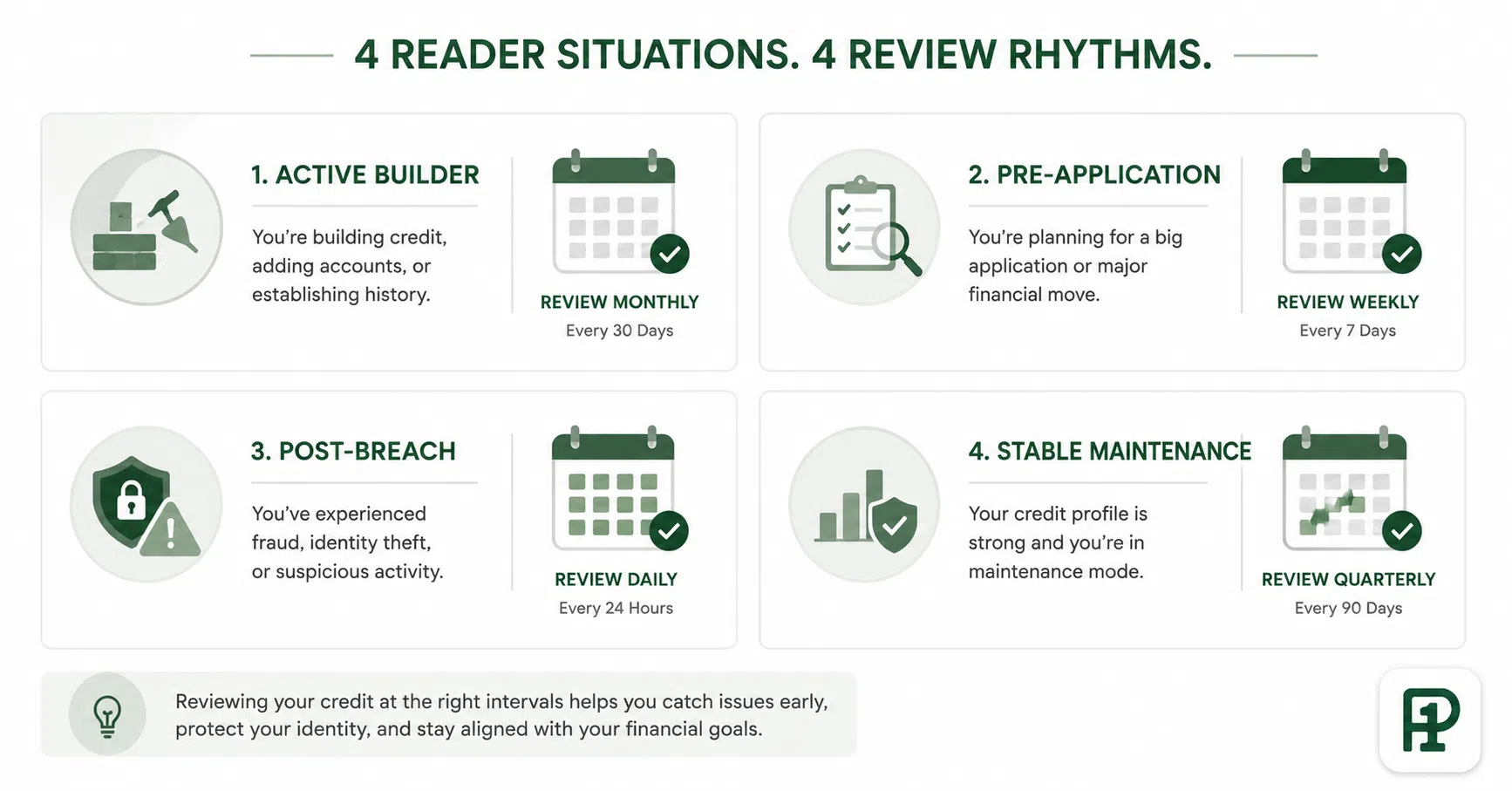
— The right check frequency depends entirely on where you are in your credit journey — actively building, actively rebuilding, pre-application, post-breach, or stable maintenance mode.
— Checking your own credit report is a soft inquiry and has zero impact on your credit score. There is no frequency penalty — you can check every week with no scoring consequence.
— A credit monitoring service and a full report review serve different purposes. Monitoring catches real-time changes. A full report review catches what monitoring misses — errors that accumulate gradually, outdated items, and data integrity issues.
— The most damaging errors are the ones that sit undetected for years. A review cadence that matches your actual situation prevents that from happening.
How often you should check your credit report is one of those questions that looks simple but has a genuinely different correct answer depending on who's asking. Every finance site gives the same response: once a year at minimum, quarterly is better. That advice is technically accurate and practically incomplete. A 28-year-old actively building credit toward a mortgage application in 18 months needs a completely different review schedule than a 45-year-old with an 800 score, a credit freeze in place, and no major financial decisions on the horizon.
The problem with the generic "once a year" recommendation isn't that it's wrong — it's that it creates a false sense of adequacy for people in situations where annual reviews leave dangerous gaps. Errors introduced in month three of a 12-month cycle can suppress your score for nine months before you find them. A fraudulent account opened in January won't surface in your annual December review until the damage is a full year old. For someone actively building credit or approaching a major loan application, that gap is expensive. This guide gives you a situation-based review framework — one that matches your actual monitoring needs to where you are right now, not a number that works for the median consumer in a median situation.
Why "Once a Year" Is the Floor, Not the Answer
The CFPB's official recommendation is to review your credit reports at least once a year. That is the regulatory floor — the minimum frequency below which you are genuinely undermonitored regardless of your situation. Below that threshold, errors and fraud have sufficient runway to cause significant damage before detection. But treating the floor as the target is the mistake most people make, and it's a mistake that's driven largely by the friction of older credit monitoring systems where pulling reports required planning and paperwork.
That friction no longer exists. AnnualCreditReport.com provides free weekly access to reports from all three bureaus — Equifax, Experian, and TransUnion — with no cost and no scoring impact. The barrier to more frequent reviews is essentially zero. The only remaining question is how to calibrate your review frequency to your actual situation so that you're doing enough monitoring to catch problems quickly without creating unnecessary overhead in your financial routine.
The underlying principle is simple: the higher the stakes and the more active your credit file is, the more frequently you should review it. A credit report that rarely changes because no new accounts are opening and no existing accounts are updating is lower risk than one where new accounts are being built, existing balances are being reported monthly, and utilization is actively being managed. The review schedule should match the activity level and the cost of missing something.
The Four Situations That Determine Your Review Schedule
Rather than a universal frequency recommendation, here is a situation-based framework. Identify which profile best describes your current credit situation and use the corresponding schedule.
Situation 1: Actively Building or Rebuilding Credit
Recommended cadence: Monthly full report reviews, timed to statement close dates.
When you are actively building credit — opening new accounts, accumulating on-time payment history, managing utilization — your credit report is changing every single month. New accounts appear. Payment history updates. Balances report. The feedback loop between your banking behavior and your credit file is immediate and continuous. Monthly reviews let you confirm that positive activity is being reported correctly, catch errors before they compound, and verify that utilization is reporting at the levels you're managing toward.
The most useful timing for a monthly review during active building is 3 to 5 days after each statement close date — that's when your card issuers have reported the new balances to the bureaus and the report reflects your most recent utilization. Reviewing at that point tells you whether your utilization management is actually working, not whether it worked six weeks ago when the balance was different.
For anyone in an active rebuild, the structured review process in how to do a credit checkup and fix report errors provides the specific line-by-line framework for what to look for at each monthly review — what each section of the report should show, what changes are expected, and what unexpected changes signal a problem worth investigating.
Situation 2: Pre-Application Window
Recommended cadence: Immediately upon entering the 90-day pre-application window, then monthly until application.
Any major credit application — mortgage, auto loan, personal loan, business credit — deserves a full three-bureau review at least 90 days before you intend to apply. Ninety days is the minimum window to identify an error, dispute it, and have the dispute resolved before the lender pulls your file. Sixty days is tight. Thirty days is often not enough time for a dispute to complete and for the correction to propagate across bureaus.
Pull all three reports in the same session at the start of the 90-day window. Review each one specifically for items that could affect the rate tier you'll land in — derogatory marks, high utilization, any accounts reporting incorrectly. If you find anything disputable, initiate both the bureau dispute and the furnisher dispute immediately. Then review again monthly until the application date to confirm corrections landed and no new issues appeared. The cost of a 0.5% better mortgage rate over 30 years is worth far more than the time this takes.
Situation 3: Post-Breach or Elevated Risk Period
Recommended cadence: Weekly for the first 90 days after a confirmed breach, then monthly for the following six months, then quarterly.
When your personal information has been exposed in a data breach — or when you receive a breach notification letter — the risk window for fraud is elevated and front-loaded. Most fraudulent account applications occur in the weeks immediately following a breach, when stolen data is fresh and being actively exploited. Weekly reviews during the first 90 days catch fraudulent activity at the earliest possible point, before accounts age and become harder to dispute.
A credit freeze placed immediately upon learning of a breach provides the most effective prevention layer — blocking new account applications entirely while you monitor for any activity that preceded the freeze. A credit freeze is free, takes ten minutes, and is the correct first response before any monitoring adjustment. After the freeze is in place, monitoring during the elevated-risk window serves as confirmation that the freeze held and as early detection for any fraud on existing accounts, which a freeze does not prevent.
Situation 4: Stable Maintenance Mode
Recommended cadence: Quarterly, using the rotation method.
A consumer with an established score, no active building goals, no major financial decisions on the horizon, and a credit freeze already in place is in stable maintenance mode. The quarterly review cadence recommended by most financial institutions is appropriate here — frequent enough to catch problems within a reasonable window, infrequent enough to be sustainable without becoming overhead.
The most practical implementation of quarterly reviewing is the rotation method: pull one bureau report every four months rather than all three simultaneously once a year. Equifax in January, Experian in May, TransUnion in September. This gives you continuous coverage across all three bureaus throughout the year — a problem that appears at one bureau in March is caught in May rather than the following January. All three remain accessible for free through AnnualCreditReport.com at any time.
What I've Seen
The clients who get the most value from credit report reviews are the ones who time them intentionally rather than randomly. The person who pulls their report the day before a mortgage application finds an error they can't fix in time. The person who pulled it 90 days before application had the same error, disputed it in week two, and had a corrected report by week six — which moved them into a better rate tier and saved them more than $40,000 over the life of the loan. The review cadence itself isn't what matters. The timing relative to when the information actually gets used is what matters.
Credit Report Reviews vs. Credit Score Monitoring: Understanding the Difference
Most people conflate checking their credit score with reviewing their credit report. These are different activities that serve different purposes, and understanding the distinction is what determines whether your monitoring setup is actually catching what it needs to catch.
A credit score check — whether through your bank's app, Credit Karma, or Experian Free — gives you a number and a brief list of the factors currently influencing it. It tells you your score went up or down and roughly why. It does not show you the underlying data driving those factors. It does not show you whether an account is reporting correctly, whether a late payment notation is accurate, or whether an address in your file matches yours.
A full credit report review shows you the raw data — every account, every payment notation, every inquiry, every piece of personal identifying information. Errors live in the report data, not in the score. A score can be moving in the right direction while an error sits quietly in a section you haven't reviewed, waiting to matter when you apply for something. Score monitoring is the alert system. Report review is the inspection.
For most people, the right monitoring setup combines both: a free score monitoring tool for continuous alerts plus periodic full report reviews on the schedule matching their situation. The full breakdown of free vs paid credit monitoring covers what each tool tier actually provides and which situations justify upgrading from free to paid coverage — relevant context for building the monitoring stack that fits your situation.
What to Look For at Each Review
Knowing how often to review is only part of the equation. A review that takes five minutes and scans for nothing specific is unlikely to catch the errors that matter. Here is what each review should actually be checking — organized by how frequently each item changes.
Every review: New accounts you don't recognize — the most important single check, particularly for anyone without a credit freeze in place. Hard inquiries you didn't authorize. Changes to personal identifying information — address, employer, or phone number listed — particularly if entries appear that don't match your history.
Monthly reviews (for active builders and rebuilders): Balances reported on each revolving account versus what you expected based on your statement close date. Payment status on each account — confirming on-time payments are being recorded as on-time. New account reporting accuracy — credit limit, account type, and open date are all correct for any accounts opened in the past 60 days.
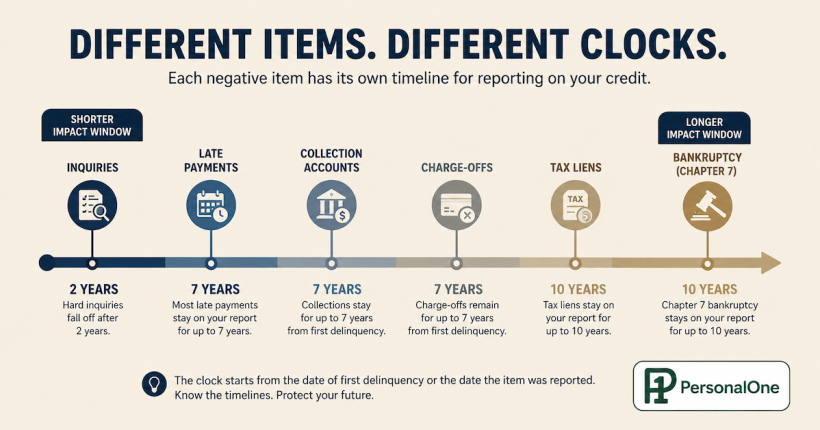
Quarterly reviews: Negative item accuracy — late payments and derogatory marks are correctly dated and not being re-aged. Accounts listed as open that you've closed. Zero-balance accounts that should still be open and reporting. Outdated negative items approaching or past their seven-year removal window.
Annual or pre-application reviews: Full audit of all personal information. Account history accuracy across all tradelines. Public records section — bankruptcies, judgments, or liens that should no longer appear. Cross-bureau comparison — pulling all three simultaneously to identify any bureau-specific discrepancies where the same account is reporting differently at different bureaus.
The Tools That Make Your Review Schedule Sustainable
A review schedule you can't maintain is no schedule at all. The practical barrier to frequent credit report reviews has historically been friction — requesting reports, receiving them by mail, reading them manually. That friction is largely gone. Here's how to build a zero-friction monitoring system that makes your review cadence automatic rather than effortful.
AnnualCreditReport.com for full report access. Free weekly access to all three bureau reports. No account required beyond initial identity verification. Set a recurring calendar reminder at your chosen cadence — monthly, quarterly, or at specific triggers — and the review takes 20 to 30 minutes per bureau for a thorough read.
Free score monitoring for between-review alerts. A free monitoring tool running continuously means you don't have to wait for your next scheduled review to learn that something changed. An alert that a new account appeared, a hard inquiry posted, or a significant balance changed triggers a targeted report pull immediately — outside your regular schedule. Many people have strong opinions about which free tool is most reliable for this purpose. The detailed review of whether Credit Karma is worth using for credit monitoring evaluates the strengths and limitations of the most widely used free option — including where its two-bureau coverage is sufficient and where it falls short.
A credit freeze as the low-maintenance protective layer. For anyone in stable maintenance mode, a freeze at all three bureaus reduces the risk from infrequent reviews significantly — because new account fraud, the most common and damaging form of credit fraud, is prevented by the freeze before it appears in a report. This allows a quarterly review cadence to be genuinely adequate rather than a compromise. The process for placing a freeze takes about 15 minutes total and is covered in full in the article on credit freeze setup and identity theft protection.
A fraud alert for active identity theft situations. If you've confirmed or suspect active fraud on your file, a fraud alert provides an additional layer of protection while you conduct reviews and work through disputes. Understanding how a fraud alert protects your credit file — and how it differs from a freeze in both coverage and duration — helps you choose the right tool for your specific situation.
Build Your Complete Credit Protection System
Review cadence is one layer. The Credit Monitoring & Protection cluster covers monitoring tools, freezes, fraud alerts, dispute processes, and identity theft recovery — the complete system for protecting your credit file at every stage of your financial journey.
Explore the Full Protection SystemWhen You Find Something Wrong: The Next Step
A review that finds an error is only valuable if you act on it. The window between finding an error and disputing it matters — errors that are disputed quickly, before they propagate to multiple bureaus or accumulate additional incorrect reporting, are resolved faster and more completely than ones that have been sitting for months.
When you identify a potential error — an account you don't recognize, a payment marked late that you paid on time, a balance that doesn't match your records — the correct immediate action is documentation. Pull the specific evidence that contradicts the report entry. Bank statements, payment confirmations, payoff letters, or dispute history. Then file with both the bureau and the data furnisher simultaneously, not just the bureau. The full step-by-step process for how to dispute a credit report error with the bureaus covers the furnisher-first strategy that resolves disputes more reliably than bureau-only submissions — including what to include, how to submit, and how to escalate if the first round closes incorrectly.
If the score app you're using to monitor between report reviews is showing movements you don't understand, the article on the truth about credit score apps clarifies why the number you see in a free app frequently differs from the score a lender pulls — and how to read those discrepancies correctly rather than chasing a number that may not reflect your actual credit position.
Government Resources
AnnualCreditReport.com — The only federally mandated source for free credit reports from all three bureaus. Weekly free access currently available.
CFPB — When Should I Review My Credit Report? — Official CFPB guidance on review frequency and what to look for.
FTC — Disputing Errors on Your Credit Reports — What to do when a review uncovers an inaccuracy.
CFPB — Credit Reports and Scores — Complete consumer guidance on accessing, reading, and protecting your credit file.
Return to the full credit building and protection guide for a complete overview of every credit strategy covered on PersonalOne.
Frequently Asked Questions
Does checking your credit report hurt your credit score?
No. Checking your own credit report — whether through AnnualCreditReport.com, a monitoring service, or directly through a bureau — is classified as a soft inquiry and has zero impact on your credit score. Only hard inquiries, triggered when a lender pulls your file as part of a new credit application, affect your score. You can check your own credit report every week for a year and your score will not move as a result of the checks themselves. The myth that checking hurts your score persists because people sometimes confuse self-checks with lender-initiated hard pulls — they're entirely different inquiry types with entirely different consequences.
Is checking my credit score the same as checking my credit report?
No, and the distinction matters significantly. A credit score is a number calculated from your credit report data at a point in time. Checking your score tells you where that number sits and which broad factors are influencing it. A credit report is the underlying data — every account, every payment notation, every inquiry, every piece of personal information. Errors live in the report, not the score. Your score can look fine while an error in your report is quietly waiting to matter. Score monitoring is useful for trend tracking. Report review is the only way to verify the underlying data is correct.
How is checking my credit report different from credit monitoring?
Credit monitoring is an automated alert service that watches your credit report for changes and notifies you when something new appears — a new account, a new inquiry, a significant balance change. It's a detection system that operates continuously between your scheduled reviews. A full report review is a deliberate, manual inspection of all the data currently on your report. Monitoring catches sudden changes. Reviews catch gradual errors, outdated items, and data integrity issues that accumulate without triggering alerts. Most monitoring services don't alert you to gradually incorrect information — they alert to changes. If an error has been on your report for six months without changing, most monitoring tools won't flag it. Only a full review catches it.
Can I check all three bureau reports at once or do I need to space them out?
Both approaches are valid for different purposes. Pulling all three simultaneously gives you a complete cross-bureau comparison at a single point in time — useful for pre-application reviews where you need to know your file at each bureau before a lender pulls them. Spacing them out on a rotation — one bureau every four months — gives you continuous coverage throughout the year, so a problem that appears at one bureau in March is caught in May rather than December. For stable maintenance mode, the rotation method is more practical. For pre-application preparation or active building, simultaneous pulls give you the complete picture you need before making a decision.
What is the fastest way to get all three credit reports?
AnnualCreditReport.com is the fastest, most reliable, and only federally authorized source. You can pull all three reports in a single session at no cost. The process takes about ten minutes from start to finish — you verify your identity, select which reports you want, and view them immediately online. You can also download them as PDFs. Weekly free access is currently available, meaning you can return to pull updated reports as frequently as once per week per bureau without restriction or cost. There is no faster legitimate method, and any third-party site that claims to provide free reports but requires a credit card for a "free trial" is not the authorized source.
This article is for educational purposes only and does not constitute financial, legal, or credit repair advice. Credit monitoring practices and report access may change — verify current availability directly with AnnualCreditReport.com and the three major bureaus. PersonalOne is a free financial education platform.