June, 2026
Home › Debt Relief & Credit Repair › Debt Settlement Options › How to Negotiate a Debt Settlement Yourself
Part of the debt settlement options cluster — the intelligence settlement companies treat as proprietary, not just a generic script.
What You Need to Know
— Settlement companies don't get better deals because they negotiate better — creditors often offer the identical terms directly to consumers. The advantage is knowing which creditors negotiate, when, and how much room each one actually has
— Who you're negotiating with — the original creditor, a debt buyer, or a collection attorney — changes the realistic settlement percentage more than any negotiating skill you bring to the call
— A hardship letter is a positioning document, not a sympathy plea — its job is to make settlement the creditor's rational choice, not your emotional ask
— The percentage a creditor counters with tells you how much settlement authority that person actually has, and whether you need a different department entirely
— A written settlement agreement needs five specific elements to actually protect you — most creditor-drafted letters are missing at least one of them
If you're researching how to negotiate a debt settlement yourself, you've already decided that paying a company 15% to 25% of your enrolled debt doesn't make sense for your situation — that decision is covered elsewhere. What you actually need now is the part settlement companies don't advertise: they don't succeed because they're better negotiators than you'd be on the same call. Creditors frequently offer the exact same settlement terms directly to a consumer as they would to a company calling on that consumer's behalf. What the company actually has is intelligence — which creditors negotiate readily, at what point in delinquency, at what percentage, and which ones are more likely to sue than settle. That intelligence is what no consumer guide publishes, and it's the difference between a DIY negotiation that works on the first call and one that stalls for months. This is that intelligence layer, plus the actual script, letter, and agreement language to use it.
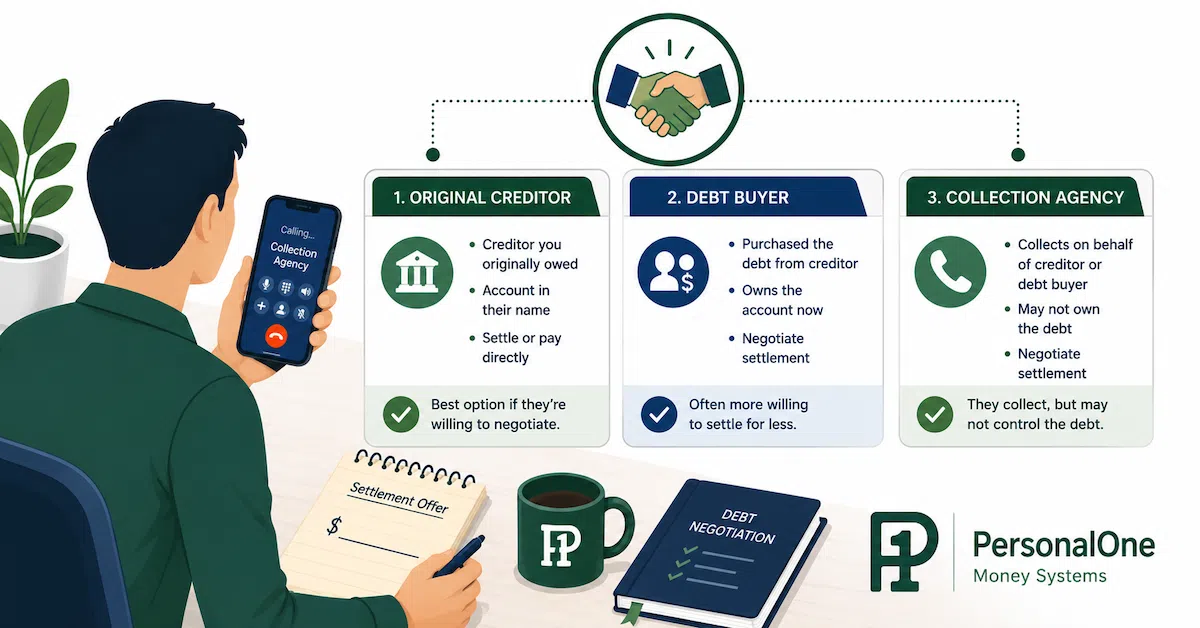
The Creditor Behavior Map: Who You're Actually Negotiating With
Not every creditor negotiates the same way, and knowing which type you're dealing with tells you what to expect before you ever pick up the phone.
Original creditor, pre-charge-off. Many major card issuers have a dedicated financial hardship department with real settlement authority, but they're the most reluctant to negotiate meaningfully while your account is still current or only briefly delinquent — they have little incentive to accept less than full payment from someone who hasn't shown sustained inability to pay. Settlements at this stage, when they happen at all, tend to land on the higher end, often 70 to 80 cents on the dollar.
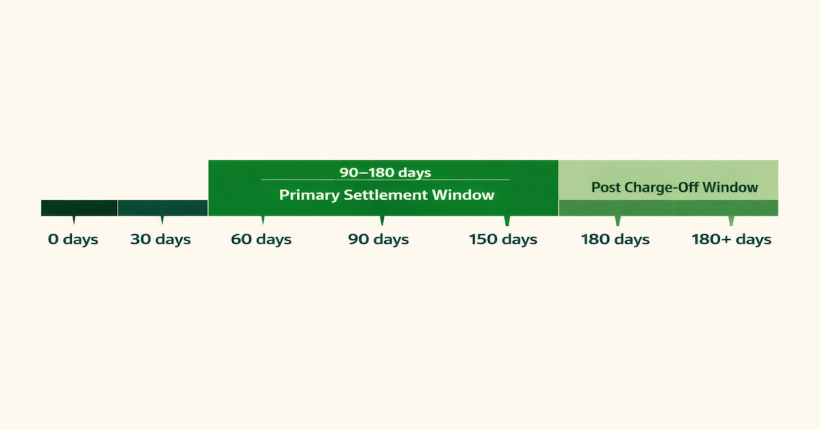
Original creditor, post-charge-off. Once an account charges off, typically around 180 days delinquent, the creditor has already written the debt down as a loss for accounting purposes. This shifts their incentive meaningfully — recovering even a partial amount on a debt they've already absorbed as a loss is pure upside, which tends to open room for settlements in the 50 to 65 cent range.
Debt buyers. After charge-off, many creditors sell the debt to a third-party company that purchased it for a small fraction of face value — often 5 to 15 cents on the dollar. This is where the most negotiating room exists. A debt buyer accepting 35 to 45 cents on the dollar is still making a significant profit relative to what they paid, which gives you genuinely more room than the original creditor relationship ever offered.
Collection agencies working on commission. Some accounts stay with the original creditor but get assigned to a collection agency working on a percentage-of-recovery basis rather than having been sold outright. These agencies are generally motivated to close a deal — any recovery earns them a commission — which makes them comparatively willing to negotiate, though typically not as low as a debt buyer that owns the account outright.
Collection attorneys. If an account has been referred to an attorney or law firm for collection, treat this differently — it signals the creditor is seriously considering or has already initiated legal action. Attorneys can still negotiate settlements, but the calculus includes their own legal costs and the strength of their case, and a lawsuit may already be in motion regardless of an active settlement conversation. If you've received anything indicating a lawsuit has been filed, address that with an attorney of your own promptly rather than relying on a phone negotiation alone.
What I've Seen
A client once assumed every creditor on their list would negotiate the same way and approached all of them with an identical opening offer. The original creditor on a still-current account flatly declined anything below 75%. A debt buyer holding a charged-off account from the same original lender, purchased months earlier, accepted 38% within one call. Same original lender, same type of debt — completely different outcome, because the two were never actually the same negotiation. Knowing which one you're calling changes the entire conversation before you say a word.
The takeaway: the creditor type tells you more about your realistic settlement range than anything you say on the call. Identify it first.
The Hardship Letter: A Positioning Document, Not a Sympathy Plea
Most guidance on hardship letters treats them as an explanation of why your life is hard. That's the wrong frame, and it's why so many hardship letters get a form rejection. A hardship letter's actual job is to establish three specific facts that make settlement the creditor's rational choice, not your sympathetic one.
Fact one: genuine inability to pay in full. State this plainly and briefly — a job loss, a medical event, a reduction in income — without an extended narrative. One or two sentences establishing the fact is stronger than a page explaining the emotional weight of it.
Fact two: a specific lump sum available now. Name the actual amount you can offer. This is the single most persuasive fact in the letter, because it converts an abstract hardship claim into a concrete, immediately actionable proposal.
Fact three: the realistic alternative is worse for them. Without being adversarial, the letter should make clear that the alternative to accepting this offer is continued non-payment, which for an already-delinquent account typically means eventual charge-off and recovery through a debt buyer at an even lower rate than what you're offering now. You're not threatening the creditor — you're describing the actual trajectory their own recovery data already shows them, which is precisely why settlement companies use this framing and consumers writing their own letters usually don't.
Reading the Negotiation: What Each Counteroffer Actually Tells You
Opening at 20% to 30% of the balance leaves room to move upward toward a realistic settlement, typically landing somewhere between 40% and 50% depending on creditor type. But the more useful skill is reading what each counteroffer actually signals about the person you're talking to.
A counteroffer around 80% of the balance generally means you're talking to someone with limited settlement authority, working from a script that allows only minor concessions. This is a strong signal to ask directly whether you're speaking with someone who can authorize a larger reduction, or to request a transfer to a hardship or recovery specialist.
A counteroffer in the 55% to 65% range typically signals real settlement authority and a genuine negotiation underway — this is where most productive conversations actually live, and where moving gradually toward your target percentage, rather than jumping straight to your ceiling, gets the best result.
A counteroffer already near 40% to 45% on the first response is a strong signal you're dealing with a debt buyer eager to close — there's often room to settle even slightly lower than their opening counter if you hold steady rather than accepting immediately. In any of these cases, pausing before responding rather than reacting instantly signals that you're evaluating the offer seriously, not just relieved that someone is finally negotiating with you.
Watch your score move once the settlement reports.
Credit Karma gives you free, ongoing access to your score so you can confirm the account reports the way you negotiated.
Check Your Score Free (affiliate)The Five Elements a Written Settlement Agreement Must Contain
Every guide says "get it in writing before you pay." Almost none specify what the writing actually needs to say to protect you, and most creditor-drafted settlement letters are written to protect the creditor's interests first, not yours. Before sending payment, confirm the written agreement includes all five of these elements.
1. The exact settled amount. The specific dollar figure, not a percentage or a range.
2. The account number. Tied explicitly to the debt being settled, so there's no ambiguity about which account this agreement covers if you have more than one with the same creditor.
3. A statement that payment satisfies the debt in full. Language explicitly stating that, upon receipt of the agreed amount, the debt is considered paid and closed — not partially resolved, not subject to further collection on the remaining balance.
4. A commitment on credit bureau reporting. If you negotiated specific reporting language — "settled" versus "paid in full for less than owed," for instance — that commitment needs to be in writing, since a verbal promise about reporting is unenforceable if the creditor doesn't follow through.
5. A statement that no further collection action will be taken. Explicit confirmation that once payment is received, the creditor or any agency acting on their behalf will not pursue any additional collection, including selling the remaining balance to another collector. Without this, a technically "settled" account could theoretically still be pursued for the unpaid remainder by a different party. If a creditor sends you a letter missing any of these five elements, it's reasonable to request a revised version before paying — this is a normal, expected part of the process, not an unusual demand.
Putting It Together: A Full Negotiation Walkthrough
Here's how these pieces work together on a $6,000 balance, already 120 days delinquent and recently sold to a debt buyer.
You confirm the creditor type first — a quick look at the account on your credit report or a contact letter typically identifies whether this is the original creditor or a debt buyer. In this case it's a debt buyer, which means you're working from the most favorable end of the realistic settlement range.
You send a short hardship letter establishing the three facts: a specific, brief statement of hardship, a lump sum offer of $1,500 — 25% of the balance — available immediately, and a clear statement that the alternative is continued non-payment with no resolution in sight. On the follow-up call, the representative counters at $3,000, exactly 50%. That counteroffer level signals real settlement authority and a genuine negotiation, not a scripted minimum response.
You move up to $1,900, citing the same hardship constraints from the letter. They counter once more at $2,400. You hold at $2,000, your actual predetermined ceiling, and the call closes there — roughly 33% of the original balance. You request the written agreement before sending payment, confirm all five required elements are present, and only then send a cashier's check with a copy of the agreement kept in your own records.
If You Haven't Decided Whether DIY Is Right for You Yet
Everything above assumes you've already decided to negotiate this yourself rather than hire a settlement company. If you're still weighing that decision, what to know before hiring a debt relief company covers the actual tradeoff, including the specific questions worth asking any company you're considering as the alternative to the process above.
Government Resources
CFPB: What Is Debt Settlement? — Federal guidance on the settlement process, including negotiating directly with creditors.
CFPB: Your Rights With Debt Collectors — What collectors can and cannot do during negotiation.
For the complete picture on resolving unmanageable debt, visit the debt relief and credit repair guide.
Frequently Asked Questions
Why would a debt buyer accept a lower settlement than the original creditor?
Because a debt buyer typically purchased the account for a small fraction of its face value, often 5 to 15 cents on the dollar. A settlement at 35 to 45 cents on the dollar is still a substantial profit for them, while the original creditor is recovering against the full amount they're actually owed, which makes them far less willing to accept a steep discount.
How do I find out who actually owns my debt right now?
Check your most recent collection letter or your credit report, both of which should identify the current creditor or collection agency. If you're unsure whether an account has been sold, you can also ask directly during any contact — collectors are required to identify themselves and the debt they're collecting.
Should my hardship letter include specific financial details like my income?
Generally, keep it high-level rather than itemized. The letter's job is to establish that hardship exists and that a specific lump sum is available, not to provide a full financial disclosure that could be used against you in further collection efforts or a potential lawsuit.
What if the written agreement is missing one of the five required elements?
Request a revised version before sending payment. Most legitimate creditors and collectors will provide this without issue — it's a normal part of finalizing a settlement, not an unusual or suspicious request, and any creditor that refuses to put basic terms in writing is itself worth treating cautiously.
Does it matter which department or person I reach when I call?
Yes, significantly. A general customer service line often has no settlement authority at all. Ask specifically for the hardship, recovery, or loss mitigation department, and if the person you reach can only offer minor concessions, that's a signal to request a transfer rather than continue negotiating with someone who lacks the authority to go lower.
Is it risky to call a creditor about settlement if I'm still current on payments?
It can be, since raising the possibility of settlement while current may prompt a creditor to scrutinize the account more closely, and most won't offer meaningful terms at that stage anyway. If you're not yet delinquent, it's often more productive to wait until the account has aged further before opening a settlement conversation, unless your hardship is severe enough that falling behind is genuinely unavoidable regardless.
Disclaimer: This content is for educational purposes only and does not constitute financial or legal advice. PersonalOne is not a licensed financial advisor, broker, or investment professional. Individual financial situations vary — consult a qualified financial professional before negotiating debt settlements.