Updated: August 2026
Home › Debt Relief & Credit Repair › Rebuilding After Debt Relief › Rebuilding Financial Stability After Credit Damage
What You Need to Know
— Rebuilding financial stability after credit damage is a different milestone than resolving the debt itself — relief and stability are two different states.
— That lingering feeling of fragility, even once the balances are gone, is often an accurate read on your actual situation, not a mindset to correct.
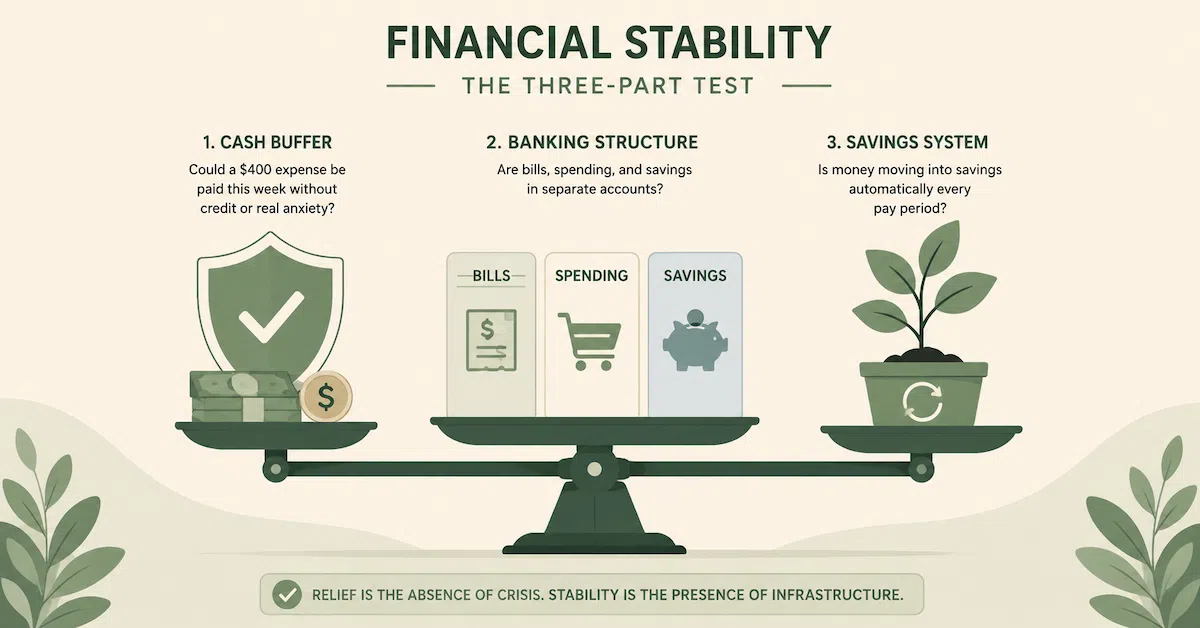
— There's a concrete way to test whether you're actually stable: a cash buffer, a banking structure, and a real savings system.
— Until those three exist, what you have is the absence of crisis, not stability — and the difference matters.
The debt is finally gone. The calls have stopped, the score is climbing, and by every external, measurable standard things are genuinely better now. And yet the feeling of standing on solid ground hasn't arrived. If that sounds deeply familiar, most advice on this exact feeling will tell you it's a mindset issue — practice self-compassion, celebrate the win, give yourself time to trust the progress. That advice isn't wrong, but it skips a question worth asking first: what if the feeling is accurate? Rebuilding financial stability after credit damage isn't just an emotional process — it's an infrastructure one, and the unease often means the infrastructure isn't actually finished yet, whatever the credit score says. This article, part of the Rebuilding After Debt Relief cluster, covers how to tell the difference and what to actually build.
The Two States People Confuse: Relief and Stability
Relief is the absence of an active crisis. The collection calls stop, the settlement is final, the bankruptcy is discharged — and the acute pressure that defined daily life for months or years simply lifts. It's real, and it deserves to be felt as the milestone it is.
Stability is a different thing entirely: it's the presence of infrastructure that can absorb the next disruption without a repeat crisis. Relief tells you the fire is out. Stability tells you the house won't catch fire again the next time a spark lands near it. Most people, understandably, experience relief and assume stability has arrived alongside it — because for years, the absence of the crisis was the whole goal, and reaching it feels like the finish line. But relief is a status update on the past. Stability is a property of your current setup, and it doesn't arrive automatically just because the crisis ended.
This distinction matters because the two states get treated as interchangeable almost everywhere else you'll read about this topic. Articles about "healing after debt" tend to focus entirely on the emotional side — processing shame, celebrating milestones, being patient with yourself — as though relief and stability were the same experience separated only by time and self-compassion. They're not the same thing at all. A person can be years past their last late payment, fully at peace with what happened, and still genuinely lack the infrastructure that would prevent the exact same situation from recurring if the same kind of disruption showed up again. Emotional peace and structural readiness are both worth having, and neither one substitutes for the other.
Recognizing which state you're actually in matters practically, not just semantically. If you mistake relief for stability, the natural next move is to relax the vigilance that got you through the crisis — which is reasonable if stability is real, and premature if it isn't. Getting this distinction right determines whether the next few months are spent building the remaining infrastructure, or spent assuming the hard part is already finished.
The Three-Part Test — Are You Actually Stable?
Instead of trying to talk yourself into feeling stable through willpower or positive thinking, check for it directly instead. Three things need to be true.
Test 1: The Cash Buffer
Could a $400 car repair or a higher-than-usual medical bill get paid this week without a credit card and without real anxiety about the checking account balance afterward? If the honest answer is no, that's not a confidence problem — it's an accurate report that the buffer piece isn't built yet. A cash buffer doesn't need to be large to pass this test; even $500 to $1,000 changes the answer from no to yes for most everyday disruptions.
Notice this test is deliberately specific rather than vague or abstract in nature. "Do I feel prepared for emergencies" is a mood question, easy to answer optimistically on a good day and pessimistically on a stressful one. "Could I pay this specific dollar amount today without reaching for credit" is a factual question with a real answer, and that's exactly why it works better than a self-assessment of confidence.
Test 2: The Banking Structure
Are bills, spending, and savings sitting in separate accounts, or still mixed together in one place the way they likely were before things went wrong? A single shared account is exactly the setup that made the original debt easy to accumulate — nothing about paying off the balance changes that underlying structure unless it's deliberately rebuilt. Read the full Banking Systems account structure guide for how to build this correctly.
This test often produces an uncomfortable but useful answer: many people who feel generally optimistic about their recovery discover, on checking, that their banking setup looks identical to how it looked before the debt started. The relief is real. The structural change simply hasn't happened yet, because nothing about paying off a balance automatically reorganizes how future money gets handled.
Test 3: The Savings System
Is there a real, automated system moving money into savings every pay period, or does saving depend on remembering to do it once things feel calm enough? A savings system that only functions when you're paying close attention isn't a system — it's a hope. The test isn't the account balance today; it's whether money keeps arriving there without requiring an active decision each time.
This is the test people most often want to skip past, because it's easy to point to a savings account that exists and treat its existence as a pass. But an account that occasionally receives a deposit when things feel comfortable behaves very differently under pressure than an account funded automatically on a fixed schedule. The first quietly stops receiving deposits the moment life gets stressful again — precisely when the money is needed most. The second keeps running regardless of how the month is going.
From My Experience
One pattern I've noticed is that people often tell me, "I thought I'd feel different by now." Their debt is gone, their credit score is improving, and they're doing everything they believed would finally bring peace of mind. Yet they still check their bank balance several times a day or worry that one unexpected expense will undo all of their progress.
In almost every case, the problem isn't that they're failing to move on emotionally. It's that the systems underneath their finances haven't changed yet. Their paycheck still lands in one account, bills compete with everyday spending, and savings only happen if there's money left over at the end of the month. From the outside, the crisis is over. Underneath, the same structure that allowed the crisis to happen is still there.
The turning point usually isn't a higher credit score. It's the moment they build a cash buffer, separate their banking into clear purposes, and automate saving so progress no longer depends on motivation or memory. That's when the constant feeling of being "one emergency away" finally begins to fade—not because they convinced themselves everything was okay, but because their financial system actually became capable of handling the next disruption.
Why This Feeling Shows Up Even When Nothing's Gone Wrong Yet
The fragility often surfaces during ordinary, uneventful weeks — nothing dramatic has happened, and yet the sense of precariousness persists anyway, sometimes strongest on the calmest days. This makes sense once stability is understood as infrastructure rather than emotion: the gap identified by the three-part test above doesn't announce itself with a crisis. It simply sits there, quietly, as a real vulnerability, and some part of the person who lived through the original debt is tracking that vulnerability even when nothing has triggered it yet. That's not anxiety malfunctioning. That's an accurate internal read of an incomplete setup.
This is also why the feeling can persist for months after every external number looks good — the credit score recovering, the checking account no longer overdrafting, the bills getting paid on time. Those are real, positive signs, but none of them are the same as the three-part test above. A rising credit score reflects rebuilt trust with lenders. It doesn't reflect whether a bad month can be absorbed without new debt. The two often move on different timelines, and treating the score as proof of stability is a common reason people feel confused by their own continued unease.
Building the Infrastructure, Not Just Waiting for Confidence
The fix isn't waiting to feel ready — confidence built this way tends to arrive after the infrastructure exists, not before it. Build in this order: the cash buffer first, since it's the fastest to establish and immediately changes how the next small disruption gets handled. Then the banking structure, separating bills, spending, and savings so the system itself does the work that used to depend on remembering and deciding correctly every time. Then the automated savings system, so growth continues without requiring ongoing attention.
Each piece completed is one part of the three-part test that now passes — and unlike a feeling, that's something you can verify directly rather than hope for. Confidence that follows verified infrastructure tends to hold up under pressure in a way that confidence built on "it's been a while since anything went wrong" usually doesn't, because the second kind hasn't actually been tested yet.
The Mistake of Treating Time as the Fix
A common, well-intentioned piece of advice tells people to simply give it time — trust will rebuild on its own, confidence will return eventually, the feeling will fade naturally. Time does help with the emotional side of recovery, but time alone does nothing to the three-part test above. A year passing without incident doesn't create a cash buffer, doesn't separate a banking structure into distinct accounts, and doesn't set up an automated savings transfer. Those require a deliberate action, not a calendar.
This is worth naming directly because "give it time" can quietly become a reason to defer the actual infrastructure work indefinitely. Each month that passes without a disruption can feel like evidence that things are fine, when it may simply mean the next disruption hasn't arrived yet. The three-part test doesn't get easier to pass by waiting — it gets passed by building the specific pieces, whenever that building actually happens.
What Happens When the Test Passes
Once all three pieces are in place, the experience of an unexpected expense changes noticeably. A car repair becomes an inconvenience handled from the buffer account, not a financial event requiring new debt or a stressful scramble. A slower income month gets absorbed by the surplus already built into the banking structure, rather than triggering a decision about which bill to delay. The savings balance keeps growing in the background regardless of whether that particular month felt calm or chaotic.
This is also usually the point where the lingering unease genuinely starts to fade — not because enough time has passed, but because the specific vulnerabilities that were producing that unease have actually been closed off, one at a time. The feeling was tracking something real the whole time; once the real thing changes, the feeling changes with it, often faster than expected. This is a meaningfully different experience than trying to reason yourself into confidence while the underlying gaps are still open, which tends to work only until the next disruption tests it directly.
Rebuilding Stability Doesn't Require Starting From Zero
If some of the infrastructure already exists — a checking account you've had for years, a small savings habit that somehow survived the debt period, an emergency fund that's partially funded already — the work is completing what's there, not rebuilding from scratch. Run the three-part test honestly against your current setup before assuming a full rebuild is necessary. It's common to discover that one piece is genuinely solid, one is partially there, and one hasn't been started, which changes the plan considerably from assuming all three need to be built from nothing.
This matters because a full rebuild can feel overwhelming in a way that finishing one missing piece doesn't. Someone who already has a banking structure in place but no automated savings system has a much smaller task ahead than someone starting from a single shared account with nothing separated at all — even though both people might describe themselves the same way when asked if they feel financially stable.
Stop waiting to feel stable. Build the infrastructure that makes it real.
Get the tools for the cash buffer, banking structure, and savings system that pass the three-part test.
Explore the 7-Stage Money System →Frequently Asked Questions
Why do I still feel financially unstable even though my debt is paid off? Because paying off debt resolves the crisis, not the underlying infrastructure — a cash buffer, banking structure, and savings system — that determines whether you can absorb the next disruption without a repeat cycle. The feeling is often an accurate signal that this infrastructure isn't fully built yet.
Is a rising credit score proof that I'm financially stable again? Not on its own, and this trips up more people than any other single assumption in this process. A credit score reflects rebuilt trust with lenders, which is a real and valuable outcome, but it doesn't measure whether you have a cash buffer or a banking structure that can absorb a bad month without new debt.
How long does it typically take to feel truly stable after credit damage? It varies, but building the three infrastructure pieces — buffer, banking structure, savings system — in that order tends to produce a more durable, verifiable sense of stability faster than waiting for confidence to arrive on its own.
What's the fastest way to start closing the gap? Start with the cash buffer — even $500 to $1,000 immediately changes how the next small disruption gets handled, and it's the quickest of the three pieces to establish, usually achievable within a month or two of consistent, deliberate saving.
Do I need to rebuild all three pieces from scratch? Not necessarily, and it's worth checking before assuming the worst — run the three-part test against your current setup first. It's common for one piece to already be solid, which means the real remaining task is completing what's missing rather than starting completely over from nothing.
This is one piece of the full recovery path. See where it fits inside the Rebuilding After Debt Relief cluster guide, or explore the complete Debt Relief & Credit Repair hub. Government source: CFPB — Save and Build Wealth.