Updated: June 9, 2026
Home › Credit Building & Protection › Credit Utilization & Payment Strategy › How to Increase Your Credit Score Quickly
What You Need to Know
— A 100-point credit score increase is achievable in three to six months with consistent action on the right variables.
— Payment history and credit utilization together control 65% of your FICO score — fix those two and most of the work is done.
— The fastest wins are paying on time, keeping reported balances below 10% of your credit limits, and disputing any errors pulling your score down.
— What to avoid: closing old accounts, applying for multiple credit products at once, and ignoring your credit report.
The fastest way to increase your credit score quickly is not a secret, a service, or a workaround — it is understanding which two variables control the majority of your score and applying consistent pressure on both. Most people spread their effort across five factors equally. The data does not support that approach. Two factors alone account for 65% of a FICO score, and both can be moved within a single billing cycle when you know what to target.
This guide covers all seven strategies, ranked by impact and speed, along with a realistic timeline for what a 100-point increase actually looks like depending on where your score starts.
How Credit Scores Are Actually Calculated
A FICO credit score runs from 300 to 850 and is calculated using five factors, each weighted differently. Understanding what moves the number — and by how much — is the starting point for any serious improvement effort. The mistake most people make is treating all five factors as roughly equal. They are not.
Payment history accounts for 35% of the score. Credit utilization accounts for another 30% — this is the percentage of your available credit being reported as used at the time your statement closes. Together, these two factors control 65% of your total score. Everything else is secondary. The full framework for managing all five factors lives in the Credit Building & Protection authority hub.
Length of credit history makes up 15%, reflecting how long your accounts have been open and how recently they have been used. New credit — meaning hard inquiries and recently opened accounts — accounts for 10%. Credit mix accounts for the remaining 10%. For the complete picture of what each factor is, how it's calculated, and which specific actions produce the fastest results across all five, the article on what actually moves your credit score maps every factor to its scoring mechanism precisely.
Strategy 1: Pay On Time, Every Time
Payment history is the single largest factor in your credit score, and it is also the most binary: payments are either on time or they are not. There is no partial credit for paying a few days late, and there is no score benefit from paying early rather than on time. The goal is simply to never have a payment reported as 30 or more days late.
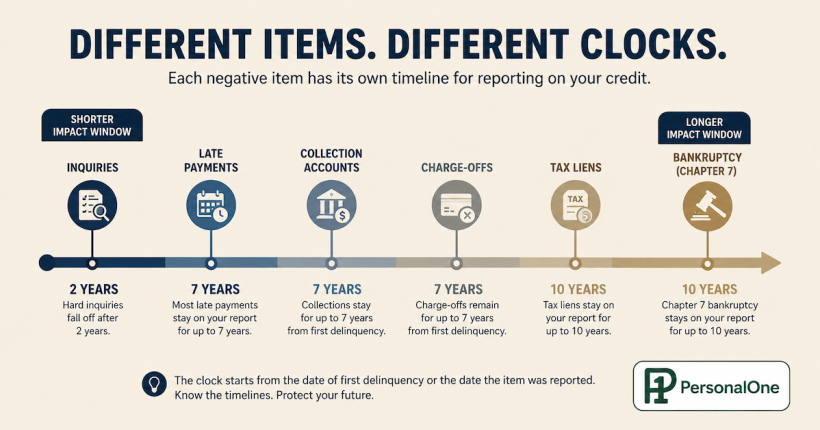
The most reliable way to achieve this is automation. Set minimum payment autopay on every credit account so that even during a disorganized or financially stressful month, the minimum posts before the 30-day reporting threshold. Minimum payment autopay does not prevent interest accumulation or manage utilization — but it prevents the worst outcome, which is a late payment mark that can stay on your credit report for seven years.
If you have missed payments in your history, the impact diminishes over time as newer positive history accumulates. A late payment from three years ago matters less than one from six months ago. The fastest path forward is building an unbroken streak of on-time payments from today forward. For the full picture of how long each credit-building milestone actually takes — including how payment history accumulates and when it starts producing score momentum — the article on how long it takes to build a 700 credit score maps the realistic timeline.
Strategy 2: Lower Your Reported Credit Utilization
Credit utilization is the fastest-moving variable in your score because it resets every month. Unlike late payment marks, which carry a historical penalty that lingers for years, utilization reflects only your current reported balance. A score suppressed by high utilization can recover fully in a single billing cycle once the balances are reduced and reported. Understanding how credit card payments are reported to the bureaus — specifically the statement close date mechanic — is the foundation of getting this right.
The threshold most people know is 30% — keep your balance below 30% of your credit limit. That is the floor, not the target. The optimal range for FICO scoring is below 10%, and the highest scorers tend to show utilization in the 1 to 5% range. On a $5,000 limit, that means letting no more than $250 report as the outstanding balance when your statement closes. The full breakdown of why each utilization band produces a different score response — and why managing to 28% still leaves significant points behind — is covered in the article on what credit utilization is and why the 30% rule is a myth.
The key timing point: your card issuer reports your balance on your statement closing date, not your payment due date. If you spend $3,000 in a month and pay the full balance on the due date — which is typically three weeks after the statement closes — the bureaus still see the $3,000 balance from closing day. To lower reported utilization, reduce the balance before the statement closes, not after. The two-payment strategy — one payment before close to control utilization, one by the due date to protect payment history — is covered in full in the guide on paying your credit card twice a month to protect your score.
What I've Seen
One of the most common patterns I've seen with people trying to increase their credit score quickly is focusing on everything except the one factor that moves fastest — utilization.
In one case, someone had a score in the low 600s and assumed it would take a year or more to improve. They had no recent late payments and a decent credit history, but they were consistently carrying balances in the 60% to 80% range on their cards without realizing how much it was suppressing their score.
Instead of changing spending, the only adjustment was timing and balance management. They paid down their cards to below 10% utilization before the statement closing date and kept them there for one billing cycle.
Within 30 days of the new balances reporting, their score jumped by over 70 points. Nothing else changed — no new accounts, no disputes, no credit repair services. Just controlling what the credit bureaus actually saw.
The takeaway: if your goal is to increase your credit score quickly, utilization is the highest-leverage move available. It is the one factor that can produce meaningful results in a single billing cycle when handled correctly.
Strategy 3: Check Your Credit Report for Errors
Credit report errors are more common than most people assume. Accounts that do not belong to you, duplicate entries, incorrect late payment marks, and wrong credit limits are all documented categories of bureau errors. Any one of them can be suppressing your score without your knowledge.
Pull your reports from all three bureaus — Equifax, Experian, and TransUnion — through AnnualCreditReport.com. Weekly free reports are now available. Review each report separately because information reported to one bureau is not automatically corrected at the others. If the same account appears incorrectly, you need to dispute it at each bureau individually.
File disputes directly through each bureau's online portal. The bureau is required to investigate within 30 days and correct or remove items that cannot be verified. If a legitimate error — particularly a late payment mark that was applied incorrectly — is removed, the score improvement can be significant and immediate. If the errors are part of a larger credit damage picture, the step-by-step process in how to fix your credit in 90 days covers the full recovery sequence.
Strategy 4: Request a Credit Limit Increase
Requesting a higher credit limit on an existing card is one of the most underused utilization strategies. If your credit limit increases while your balance stays the same, your utilization percentage drops automatically — no additional payment required.
A $600 balance on a $2,000 limit is 30% utilization. The same $600 balance on a $3,000 limit is 20% utilization. On a $5,000 limit it is 12%. The balance did not change — only the denominator did. Most card issuers will approve a limit increase request after six to twelve months of on-time payment history with no recent delinquencies. The complete strategy for requesting a limit increase — including timing, which issuers use soft versus hard inquiries, and how much to request — is covered in the article on how to request a credit limit increase to lower your utilization.
The critical discipline is to not increase spending when the limit increases. A limit increase that allows you to carry a higher balance defeats the purpose entirely. The goal is to widen the gap between what you owe and what you could borrow — not to use the additional capacity.
Strategy 5: Keep Old Accounts Open
The length of your credit history contributes 15% to your FICO score, and your oldest account sets the ceiling for that factor. Closing an old credit card — even one you rarely use — can shorten your average account age and simultaneously reduce your total available credit, which raises utilization on your remaining accounts. The combination can produce a meaningful score drop without any change in spending or payment behavior.
If an old card carries an annual fee you do not want to pay, call the issuer and ask to downgrade it to a no-fee version. Most issuers have a product change option that preserves the account's age and credit limit while eliminating the fee. If the card has no annual fee, keep it open and put a small recurring charge on it — a streaming subscription or a single monthly bill — and set autopay. This keeps the account active without requiring ongoing attention.
Strategy 6: Build a Healthy Credit Mix
Credit mix accounts for 10% of your score and reflects whether you have experience managing different types of credit — specifically both revolving accounts like credit cards and installment accounts like auto loans, student loans, or personal loans. Having only one type limits what the scoring model can evaluate about your credit management capability.
This does not mean opening accounts you do not need. Adding a loan product purely for the credit mix benefit is rarely worth the cost. If you have existing installment loans — a car payment, student loans, or a mortgage — those already contribute positively to your mix. If you have only credit cards, a credit-builder loan through a credit union is a low-cost way to add an installment account. Credit mix is the lowest-priority factor to optimize deliberately. Fix payment history and utilization first — mix will often improve naturally over time as part of building good credit wisely.
Strategy 7: Manage New Credit Applications
Each application for new credit triggers a hard inquiry, which temporarily reduces your score by approximately 5 to 10 points. Hard inquiries remain on your report for two years and affect your score for the first twelve months. A single inquiry is a minor and recoverable event. Multiple inquiries in a short period signal credit-seeking behavior that lenders read as elevated risk.
Space out credit applications by at least six months. When you do need to rate shop — for a mortgage or auto loan — complete all applications within a 14 to 45-day window. FICO treats multiple inquiries for the same loan type within that window as a single inquiry for scoring purposes. Use pre-qualification tools that run soft inquiries to assess your approval odds before formally applying. Soft inquiries do not affect your credit score regardless of how many you run.
How Long Does a 100-Point Increase Actually Take?
The timeline depends on where your score starts and which factors are suppressing it. If high utilization is the primary issue, the improvement can be dramatic and fast — a single billing cycle of reduced balances can move a score by 50 to 100 points once the new balances are reported. Utilization has no historical component; only the current month's reported balance counts.
If the primary issue is a thin file with limited credit history, the timeline is slower. In the first one to two months, error disputes resolve and utilization improvements appear in reported balances. Between months three and six, payment history begins to strengthen and scores typically climb noticeably. Between six and twelve months, the improvements solidify and any recently opened positive accounts begin to age. If high balances or missed payments are the core problem, the process of paying off credit cards and how it accelerates score improvement runs in parallel with these strategies and compounds the result.
A 100-point increase for someone starting in the 580 to 620 range — where utilization and payment history issues are the most common culprits — is achievable within three to six months of consistent action. For someone starting in the 700s, a 100-point increase is a longer project because the factors that drive the highest scores are primarily age-dependent and cannot be accelerated. The complete realistic timeline — including what scores are achievable at each stage and which actions produce momentum at each level — is covered in the article on how long it takes to build a 700 credit score.
Build the Full Credit System
Payment history and utilization get you most of the way there. The Credit Utilization & Payment Strategy cluster covers every lever — payment timing, limit increases, multi-card management, and the reporting mechanics that determine what your score sees each month.
Explore the Full StrategyGovernment Resources
AnnualCreditReport.com — Pull your free weekly credit reports from all three bureaus to check for errors and verify reported balances.
USAGov — Improve Your Credit Score — Federal government guidance on credit reporting, disputing errors, and consumer credit rights.
Return to the full credit building and protection guide for a complete overview of every credit strategy covered on PersonalOne.
Frequently Asked Questions
Can I really increase my score by 100 points?
Yes, for many people — particularly those starting in the 550 to 650 range where utilization and payment history issues are the primary drag. The fastest path is reducing reported utilization and establishing an unbroken on-time payment streak. The timeline is typically three to six months for significant improvement, with the largest single-cycle gains coming from utilization reductions.
Does checking my own credit score hurt it?
No. Checking your own credit triggers a soft inquiry, which has no impact on your score. Hard inquiries — the type that affect your score — only occur when you apply for new credit and the lender pulls your file to make a lending decision. You can check your own score and pull your own credit reports as frequently as you want without any scoring consequence.
Should I pay off installment loans early to boost my score?
Not necessarily — and in some cases paying off a loan early can cause a small score drop. An open installment loan with a positive payment history contributes to both your credit mix and your payment history while it remains active. Once it is paid off, the account closes and stops generating new positive payment history. Prioritize eliminating high-interest debt for financial reasons, but do not expect a score boost from early payoff of a low-rate installment loan.
Will closing a credit card help my score?
Almost never. Closing a credit card reduces your total available credit, which raises your utilization ratio on remaining cards. If the card being closed is one of your older accounts, it can also shorten your credit history once it ages off your report. The only scenario where closing a card makes sense from a credit perspective is if keeping it open creates a financial risk — for example, a card with a high annual fee where a product downgrade to a no-fee version is not available.
How many points will a hard inquiry cost me?
Typically 5 to 10 points, and the impact recovers within a few months as the inquiry ages. Hard inquiries remain on your credit report for two years but only affect your score for approximately twelve months. A single hard inquiry for a credit product you genuinely need is not a significant concern. The risk is applying for multiple credit products in quick succession, which creates a pattern that scoring models penalize more substantially than any individual inquiry.
This content is for educational purposes only and does not constitute financial or credit advice. Credit score changes vary by individual profile, scoring model, and credit history. Results from implementing these strategies will vary. PersonalOne is not a credit repair organization and does not offer credit repair services.