Updated: May 23, 2026
Home › Debt Relief & Credit Repair › Rebuilding After Debt Relief › What It Actually Takes to Break Free From Debt
Part of Rebuilding After Debt Relief — a guide to financial recovery after debt, including the systems that prevent debt from returning once it is gone.
What You Need to Know
— Most debt payoff plans fail not because of bad math but because of bad structure. Knowing that you should use the Avalanche method does not mean you will execute it consistently for two to five years without a system that runs the behavior automatically.
— Average credit card interest rates exceed 20% as of 2026. A $5,000 balance paid only by minimum payments takes over 20 years to eliminate and costs more than $11,000 in interest — more than double the original balance.
— Two payoff methods have strong evidence behind them: Avalanche (highest interest rate first) saves the most money. Snowball (smallest balance first) sustains motivation through faster account closures. The right choice depends on what has failed for you before.
— Breaking free from debt requires stopping new debt accumulation before any payoff strategy can work. You cannot fill a bucket with a hole in it.
— A $1,000 emergency fund built before aggressive debt paydown prevents the most common reason plans derail: an unexpected expense forces new borrowing and resets progress.
— When total minimum payments exceed 40% of take-home pay, DIY strategies alone may not be sufficient. Professional debt relief options — settlement, management plans — exist for situations where the structural problem is larger than the payoff plan can resolve.
Breaking free from debt is not a knowledge problem. Most people who are carrying credit card debt, student loans, or personal loans already know they should pay more than the minimum, choose a payoff method, and stop adding to the balances. The knowledge is not the gap. The structure is.
The difference between people who eliminate debt and people who carry it for a decade is not intelligence or discipline. It is whether they built systems that make the right behavior automatic — so that the decision to pay extra, to stay on the plan, and to stop new accumulation is already made before the month starts. This guide covers the complete approach: the debt inventory, the behavioral choice between payoff methods, the structural decisions that make execution consistent, and the systems that prevent debt from returning once it is gone. For the full framework on what comes before and after this process, the debt relief and credit repair hub covers every phase of the recovery path.
What Debt Actually Costs: The Numbers Most People Avoid
Debt's most damaging characteristic is not the balance — it is the compounding cost of carrying that balance over time. This is the number worth confronting before choosing a strategy, because it changes the urgency of the decision.
A $5,000 credit card balance at 22% APR, paid only by minimum payments, takes approximately 22 years to eliminate. The total interest paid over that period exceeds $11,000 — more than double the original balance. The minimum payment feels manageable each month precisely because it is designed to feel manageable. It is also designed to maximize the total amount you pay the creditor over the life of the debt.
Debt limits more than money. When a significant portion of monthly income is committed to debt payments, career choices narrow — the stable paycheck becomes necessary even when it is not fulfilling. Emergency situations create cascading failures because there is no margin to absorb them. The psychological weight of carrying debt produces measurable increases in financial anxiety, which in turn makes the clear-headed decision-making that debt elimination requires more difficult. These are not motivational observations — they are the practical consequences of carrying debt that makes the structural case for eliminating it systematically.
Step 1: Build a Complete Debt Inventory
The debt inventory is the starting point of every effective payoff plan, and the step most people rush or skip entirely. A plan built on incomplete information produces incomplete results.
For every debt you carry, write down: the creditor name, current balance, interest rate (APR), minimum monthly payment, due date, and whether the account is current or delinquent. Total the minimum payments across all accounts. This is your floor — the amount leaving your account every month regardless of strategy.
This exercise is uncomfortable for most people. The full picture is worse than the number in their head because it includes accounts they have mentally minimized, balances that have grown since they last looked, and interest rates they have not checked in years. The discomfort is information. A plan built on the actual numbers is the only plan that works.
If the total minimum payments across all accounts represent more than 40% of your take-home pay, note that separately. That is the threshold where the structural problem may be too large for a DIY payoff plan to resolve without professional intervention — a point covered at the end of this guide.
Step 2: Stop the Accumulation Before Choosing a Payoff Method
No payoff method works if new debt continues to accumulate alongside it. This sounds obvious but it is the most commonly violated condition of debt elimination plans. People begin the Avalanche method on their credit cards while continuing to use those cards for discretionary purchases, effectively paying down the balance with one hand and charging it with the other.
Before choosing a payoff strategy, the accumulation problem needs a structural solution — not a behavioral one. Behavioral solutions (deciding to use the card less) fail under stress, inconvenience, and the ordinary friction of daily life. Structural solutions (removing the card from digital wallets, keeping it physically inaccessible, or placing a temporary hold with the issuer) work because they eliminate the decision point rather than requiring a correct decision under pressure every time.
This does not mean closing every credit card — closing accounts reduces available credit and can hurt your utilization ratio and credit score. It means making new accumulation structurally difficult while the paydown plan runs.
Step 3: Build a $1,000 Emergency Fund First
The single most common reason debt paydown plans derail is an unexpected expense — a car repair, a medical bill, a home maintenance issue — that forces new borrowing and resets months of progress. A $1,000 emergency buffer does not cover every emergency, but it covers the category of expenses that most frequently interrupt paydown plans.
Building this buffer before beginning aggressive paydown feels counterintuitive when high-interest debt is accumulating daily. The math favors paying down the debt immediately. The behavior science favors the buffer. People who encounter their first unexpected expense without a buffer typically borrow to cover it, experience the setback as evidence that the plan is not working, and abandon the plan. People who have the buffer absorb the expense and continue. The behavioral insurance value of the buffer exceeds its mathematical cost in almost every real-world scenario.
Once the buffer exists, do not rebuild it between every expense. Replenish it to $1,000 after drawing it down, then return to aggressive paydown. The buffer is not a savings goal — it is structural protection for the payoff plan.
What I've Seen
I've seen people start the Avalanche method with full motivation, sending an extra $600 or $700 every month toward a high-interest card with a $14,000 balance. Mathematically, the plan was correct. Emotionally, they went four or five months without seeing a single account close, and the progress started feeling invisible. In several cases, they eventually stopped making the extra payments entirely because it felt like nothing was changing. Meanwhile, clients who started with a $900 or $1,200 balance using Snowball often stayed engaged because the first account disappeared quickly. The best payoff method is the one that survives the middle months when motivation drops.
Step 4: Choose the Payoff Method That Fits Your Psychology
Two methods have the strongest evidence for debt elimination. The choice between them is not mathematical — it is behavioral. Choose based on what has failed for you before, not on which method saves more money in a spreadsheet you will not finish.
The Avalanche Method. Extra payments go to the account with the highest interest rate first. When that account reaches zero, the full payment amount rolls to the next highest-rate account. This method minimizes total interest paid across all debts — often by hundreds to thousands of dollars compared to the Snowball. The trade-off is that high-interest accounts frequently carry large balances, which means the first account closure takes the longest. If you have tried Avalanche before and stopped because progress felt invisible, you already know this is the wrong method for your psychology.
The Snowball Method. Extra payments go to the account with the smallest balance first, regardless of interest rate. When that account closes, the full payment rolls to the next smallest balance. Account closures come faster, producing visible proof that the system is working. Research on debt paydown behavior consistently shows that account closures — not interest savings — are the primary motivation driver that sustains plans through the middle period when momentum is hardest to maintain. If motivation has been the failure point in previous attempts, Snowball is the more reliable choice even at a higher total cost.
Both methods work when executed consistently. Neither method works when abandoned. The only question is which one you will actually finish.
Step 5: Design the Payment Structure — Not Just the Strategy
Choosing Avalanche or Snowball is the strategy. Designing how money flows from paycheck to debt account is the structure. Most people complete step four and skip step five, which is why most people's plans work for two months and then drift.
Effective debt paydown structure has three components. First, autopay for the minimum on every account — protecting your payment history regardless of what else happens that month. Second, a dedicated debt payment account that receives a fixed amount from your paycheck via direct deposit split, separate from your spending account, with one job: send extra payments to the priority debt. Third, automatic transfer from the dedicated account to the priority account within 24 to 48 hours of payday — so the extra payment is already gone before it can be spent.
When money reaches spending before it reaches the debt account, it competes with every other spending decision. When it reaches the dedicated debt account first, it never enters the spending decision at all. This is the structural design that makes the payoff plan run without daily willpower. The full architecture for this system is covered in the guide to building an automated debt payoff system.
Step 6: Accelerate With Income, Not Just Cuts
Expense reduction has a floor — there is a limit to how much can be cut before quality of life suffers enough to cause plan abandonment. Income has no ceiling in the same way. Directing any additional income — irregular work, side projects, overtime, sold items, tax refunds, bonuses — entirely to the priority debt account produces acceleration that expense management alone cannot match.
The rule is simple: any income above regular pay goes 100% to the priority debt account until that account closes. Not 50%. Not split between savings and debt. One hundred percent, until closure, then reassess. This is the rollover mechanic applied to income — the same logic that makes automated paydown systems accelerate over time, applied to irregular cash.
On the expense side, a subscription audit — pulling 90 days of bank and credit card statements and listing every recurring charge — typically reveals $100 to $300 per month in unused or forgotten charges. This freed cash goes directly to the dedicated debt account, not back into the spending account where it will be absorbed by other expenses.
The Mistakes That Reset Progress
Closing credit cards after paying them off. Closing a paid-off card reduces total available credit, which raises your utilization ratio and can drop your credit score. Keep paid accounts open with a small monthly charge to keep them active — the utilization benefit and the continued account age are worth the minor management overhead.
Addressing the symptom without addressing the cause. If overspending created the debt, paying off the balances while continuing the same spending behavior produces the same outcome. The structural changes to spending — removed card access, dedicated accounts, real-time spending alerts — matter as much as the paydown plan itself.
Abandoning the plan at the first setback. A missed payment, an unexpected expense, or a month where the extra payment was smaller than planned is not a plan failure. It is a data point. The only plan failure is stopping. The structural design of the system — autopay, dedicated account, paycheck splitting — is specifically built to run through the months where motivation is low, because those months happen in every multi-year paydown.
Reducing payments when accounts close. When a debt account closes, the minimum payment that was going to that account does not return to spending. It rolls forward to the next priority account. This is the single most important mechanical discipline in any paydown plan. Returning closed-account payments to spending eliminates the compounding acceleration that makes paydown plans finish years earlier than the original timeline projected.
What Comes After Debt: Building Forward From a Zero Balance
The month the last debt account closes, a significant amount of cash flow becomes available — the total of all the minimum payments plus extra payments that had been going to creditors. This cash flow is the most important financial decision point after debt elimination, and it arrives without warning for most people because the plan focused entirely on getting to zero.
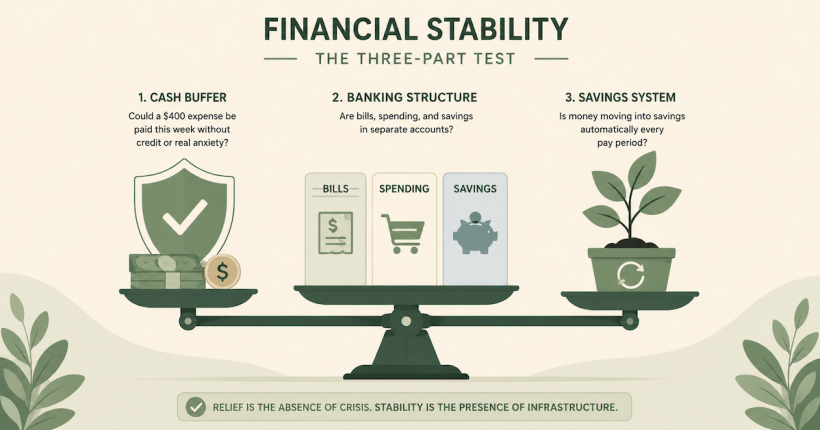
The sequence that produces the most durable financial stability: first, expand the emergency fund from $1,000 to three to six months of essential expenses — this is the structural protection that prevents returning to debt after the next unexpected cost. Second, direct the freed cash flow toward investing — the same amount that was going to creditors, now compounding for you instead. Third, use the improved credit profile that results from closed accounts, reduced utilization, and consistent payment history to access better financial products — lower rates on any future borrowing, better terms on housing.
The debt-free position also restores optionality that debt removed: the ability to take career risks, to respond to opportunities, and to absorb financial disruption without borrowing. These are not aspirational outcomes — they are the practical result of eliminating fixed monthly obligations that constrain every other financial decision.
When Professional Debt Relief Is the Right Path
The approach described in this guide works for debt that is structurally manageable on current income — where minimum payments are below 40% of take-home pay and where consistent extra payments can reach zero balances within a realistic timeframe. Not every debt situation fits this profile.
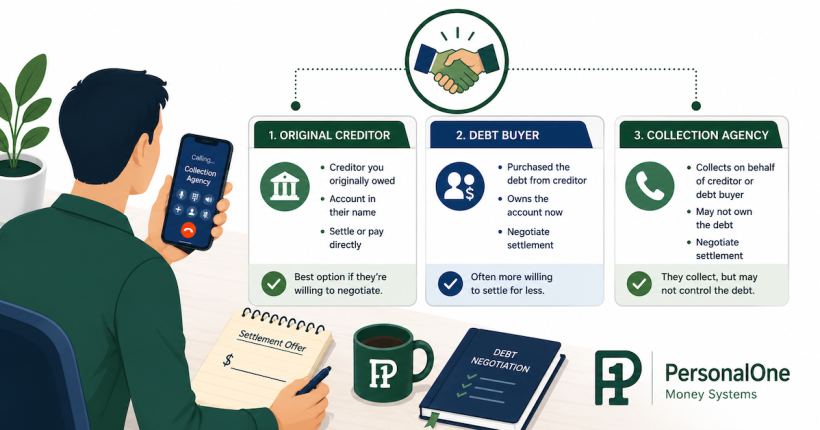
If accounts are already in collections, if legal action is pending, if total debt significantly exceeds annual income, or if minimum payments alone leave no room for extra paydown, the problem is structural rather than behavioral. A better-designed paydown plan does not resolve a structural debt problem. Professional debt relief — settlement, debt management plans through a nonprofit credit counselor, or bankruptcy evaluation — addresses the structure in a way DIY approaches cannot.
CuraDebt specializes in negotiating directly with creditors to reduce total balances owed, often by 30 to 50%, and offers a free consultation with no obligation. Schedule a free CuraDebt consultation (affiliate). For evaluating which path fits your specific situation, the CFPB's debt resources and the National Foundation for Credit Counseling directory of nonprofit credit counselors are the authoritative starting points.
See Every Debt. Track Every Payment.
Monarch Money connects all your accounts in one dashboard — so you can see exactly what you owe, track your paydown progress in real time, and confirm the rollover mechanic is working every month.
Try Monarch Money Free(affiliate)
Government & Official Sources
FTC — Coping With Debt — The Federal Trade Commission's complete guide to managing debt, your rights with collectors, and how to evaluate debt relief services.
CFPB — What Is a Debt Relief Program? — The Consumer Financial Protection Bureau's explanation of debt relief programs, what to watch for, and how to evaluate companies before committing.
CFPB — Managing Debt — Complete CFPB resource on debt repayment options, negotiating with creditors, and your legal rights when accounts go to collections.
More From PersonalOne
Return to Rebuilding After Debt Relief for the complete guide to financial recovery — from breaking free from debt through rebuilding credit and building the systems that prevent debt from returning.
Frequently Asked Questions
How long does it take to break free from debt? It depends on total debt, income, and how much can be directed to extra payments each month. With a consistent strategy and a structured paydown system, most people carrying $10,000 to $40,000 in consumer debt can reach zero balances within two to seven years. The range is wide because income, interest rates, and the ability to direct extra income vary significantly. The more important variable than timeline is whether the system runs consistently — a slower plan that runs without interruption reaches zero. A faster plan that stalls does not.
Will debt settlement hurt my credit score? Yes, in the short term. Settling a debt for less than the full amount is reported as "settled" rather than "paid in full," which carries negative weight on a credit report. The impact is less severe than bankruptcy but more severe than a standard late payment. For people in serious debt situations, the credit score trade-off of settlement is usually worth the structural relief — a score can be rebuilt over 24 to 48 months of consistent positive behavior. The alternative of continuing to carry unmanageable debt while it compounds typically produces worse outcomes for both the score and the financial position.
Should I use retirement savings to pay off debt? In almost all cases, no. Early withdrawal from a 401(k) or IRA triggers a 10% penalty plus ordinary income tax on the withdrawn amount — meaning a $10,000 withdrawal might net $6,500 to $7,000 after taxes and penalties depending on your bracket. The math is almost never favorable compared to the debt interest rate being avoided. The exception is a Roth IRA contribution withdrawal (not earnings), which avoids penalty but still loses future compound growth. Exhaust all other options — income increases, expense cuts, balance transfers, negotiation with creditors — before touching retirement accounts.
Is debt consolidation always the right move? Only when it lowers the effective interest rate meaningfully and does not enable continued accumulation on the consolidated accounts. A personal loan at 12% consolidating credit cards at 22% saves money on interest and simplifies payments — but if the cards continue to be used after consolidation, the total debt position gets worse, not better. Balance transfer cards with 0% promotional APR follow the same logic: the window of interest-free paydown is valuable only if the full balance is cleared before the promotional period ends and the rate resets, often to 25% or higher.
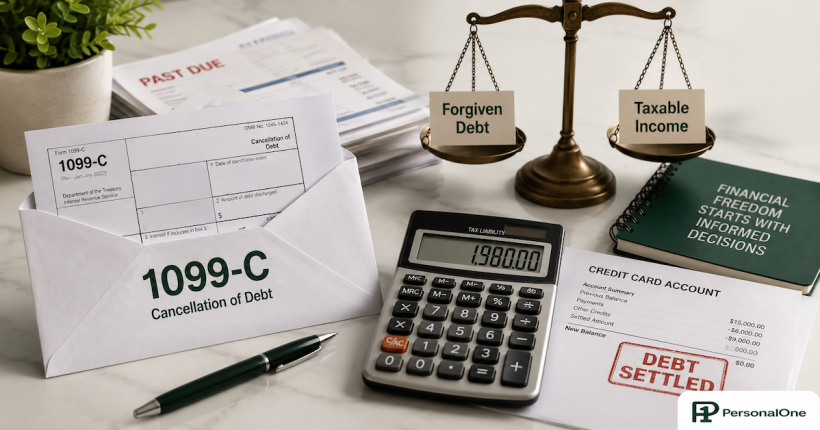
What is the difference between debt consolidation and debt settlement? Debt consolidation combines multiple debts into a single payment — either through a personal loan, a balance transfer card, or a debt management plan through a nonprofit credit counselor. The full amount owed is still repaid, usually at a lower interest rate. Debt settlement negotiates with creditors to accept less than the full balance owed — typically 40 to 60 cents on the dollar — in exchange for closing the account. Settlement produces a larger credit score impact and a potential tax liability on forgiven amounts, but resolves accounts that consolidation cannot address when balances are unmanageable.
Disclaimer: This article is for educational purposes only and does not constitute financial or credit advice. Individual results vary based on debt profile, income, and personal circumstances. Some links are affiliate links — PersonalOne may earn a commission at no extra cost to you. All affiliate recommendations reflect products PersonalOne stands behind editorially. Consult a qualified financial professional before making significant financial decisions. PersonalOne is not responsible for decisions made based on this content.