Updated: May 20, 2026
Home › Debt Relief & Credit Repair › DIY Credit Recovery › Debt Repair Hacks That Actually Move Your Score
Part of DIY Credit Recovery — a guide to repairing your credit and eliminating debt on your own terms, without paying for services you don't need.
What You Need to Know
— Most debt repair hacks fail because they are applied in the wrong order. The sequence matters: stop adding new damage first, then cut existing balances, then build new positive history, then accelerate with income.
— Credit utilization is the fastest-moving factor in your score. Getting below 30% on each card can show measurable improvement within one billing cycle — 30 to 45 days.
— Disputing errors on your credit report is the only action that can improve your score immediately rather than gradually. One in five Americans has at least one error on a credit report. It costs nothing to dispute.
— Paying minimums only is a debt trap, not a debt strategy. On a $5,000 balance at 22% APR, minimum payments extend payoff to over 20 years and cost more than $7,000 in interest.
— Rent reporting, authorized user status, and credit-builder loans all add positive history without requiring new debt — and most people in debt repair skip all three.
— When DIY methods are insufficient — collections, active lawsuits, debt exceeding annual income — professional debt relief exists and can negotiate balances down significantly.
Most debt repair hacks are presented as disconnected tips — dispute this, pay that, cancel the other thing. Applied randomly, they produce random results. The people who move their scores meaningfully in 90 to 180 days are not doing more things. They are doing the right things in the right order.
This guide organizes debt repair hacks around the sequence that actually works: stop the damage that is still happening, cut the balances that are already pulling your score down, build new positive history alongside that payoff, and accelerate the timeline with income you are not currently directing toward debt. That is the full system. These are the DIY credit recovery tactics that produce results within it.
Phase 1: Stop the Damage That Is Still Happening
Nothing in Phase 2, 3, or 4 works if you are still actively damaging your score in Phase 1. This is where most people waste months — making extra payments on old debt while missing current payments or running up new balances on cards they thought they had handled. Stop the bleeding before anything else.
Automate every minimum payment. A single payment that goes 30 days late can drop a score with no prior negative history by 60 to 110 points. One missed payment. The prevention is structural, not behavioral: set up autopay for the minimum on every account. This eliminates the possibility of accidentally missing a due date regardless of what else is happening in your life. Autopay the minimum at minimum — manually pay more when you can.
Stop adding to the balances you are trying to pay down. This sounds obvious but it is the most commonly violated rule in debt repair. Carrying a card balance while also using that card for new purchases means you are paying down with one hand and charging with the other. If you cannot freeze spending on a card psychologically, freeze it literally: remove it from your digital wallets, put it somewhere inconvenient to access, or call the issuer and request a temporary hold.
Dispute errors before doing anything else. Pull your reports from all three bureaus at AnnualCreditReport.com. Look for late payments that were actually paid on time, accounts that are not yours, balances reported higher than they should be, and duplicate entries. Errors on credit reports are common — and disputing them is the only action in debt repair that can produce an immediate score improvement rather than a gradual one. File disputes online at each bureau separately. The Fair Credit Reporting Act requires investigation within 30 days.
Cancel the recurring charges quietly bleeding your cash flow. Pull 90 days of bank and credit card statements and list every recurring charge. Cancel anything unused in the past 30 days. The goal here is not dramatic deprivation — it is redirecting waste toward intent. Most people find $100 to $300 per month in forgotten subscriptions. That is money currently going nowhere that can go directly to accelerating debt payoff. If you want a structured four-week system built around exactly this starting point, the 30-day debt repair challenge runs the full sequence from subscription audit through payoff automation.
What I've Seen
I've worked with people making $300–$500 extra payments toward old charge-offs while simultaneously missing minimum payments on current cards by $40 or $60 because cash flow was stretched too thin. On paper, they felt like they were making progress. In reality, they were creating fresh late payments every month while trying to clean up older damage. I've also seen clients pay a card down from $4,200 to $1,900, feel relieved, then slowly charge it back to $3,800 because the spending behavior never changed. The breakthrough usually happened when they stopped focusing on “big payoff moments” and stabilized the active accounts first.
Phase 2: Cut the Balances That Are Pulling Your Score Down
Credit utilization — how much of your available revolving credit you are using — makes up 30% of your FICO score and responds faster to action than any other factor. Payment history takes months to build. Utilization can improve within a single billing cycle. This is where the fastest score movement happens.
Target the card closest to its limit first. If you have two cards — one at 80% utilization and one at 40% — paying down the 80% card first produces faster score improvement than splitting payments evenly. Each card's utilization is calculated individually, and high individual utilization hurts more than high overall utilization. Getting any card below 30% is meaningful. Getting it below 10% is significantly more so.
Request a credit limit increase before your next statement closes. If your account is in good standing — no recent late payments, at least six months of history — contact your issuer and request a credit limit increase. If they use a soft inquiry (ask before they run it), this is a free utilization hack: your balance stays the same but your available credit grows, dropping your ratio immediately. A card with a $2,000 limit and a $1,600 balance is at 80% utilization. That same balance against a $4,000 limit is 40% — a meaningful improvement without paying a dollar extra.
Make payments before the statement closing date, not the due date. Most people pay bills by the due date. But the balance your issuer reports to the credit bureaus is the balance on your statement closing date — which typically falls two to three weeks before the due date. Paying down a card before the closing date means a lower balance gets reported, which means a lower utilization ratio shows up on your credit report that month. Same money, better timing, faster score movement.
Choose Avalanche or Snowball — and actually run it. Avalanche (highest interest rate first) minimizes total interest paid and is mathematically optimal. Snowball (smallest balance first) delivers quick psychological wins that sustain motivation. Both work. The only method that fails is no method. If you have tried Avalanche before and lost momentum before finishing, Snowball is the right choice — a plan you stick with beats an optimal plan you abandon. Pick one, automate your minimum payments across all accounts, and throw every extra dollar at the target account until it is closed.
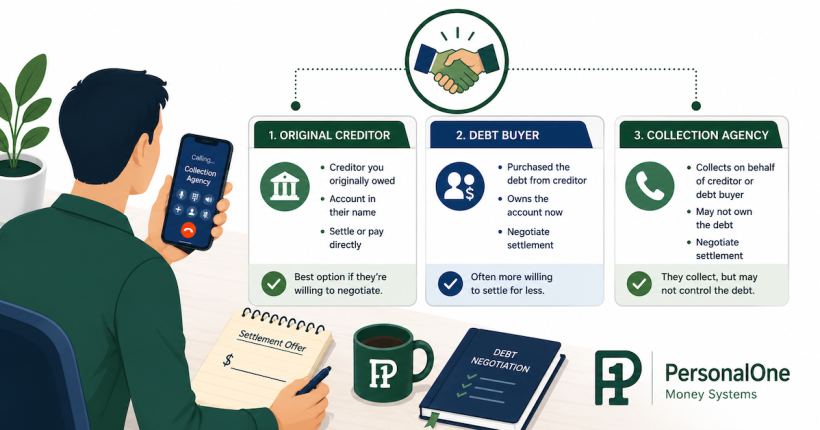
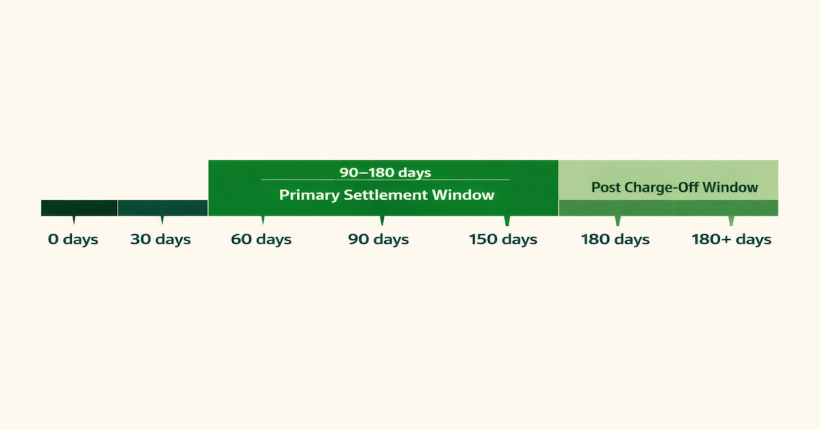
Negotiate with creditors directly before assuming you can't. If you are behind on payments or approaching a point where you cannot make minimums, call the creditor before they send the account to collections. Many issuers have hardship programs — temporary interest rate reductions, deferred payments, modified payment plans — that are not advertised but are available if you ask. The window to negotiate closes once the account is charged off and sold to a collections agency. Use it before that happens.
Phase 3: Build New Positive History While You Pay Down Old Debt
Paying down balances removes the negative pressure from utilization. But it does not add positive history to your file. Positive payment history — the 35% of your score that reflects whether you pay on time — accumulates one month at a time. The faster you start adding it, the faster your score compounds upward. These hacks run alongside your payoff plan, not after it.
Add rent payments to your credit file. If you rent, your largest monthly payment is likely not on your credit report at all. Rent reporting services verify your on-time payments and report them to one or more bureaus as positive payment history. Some services, including Experian Boost, also report utility and streaming payments and offer retroactive reporting of past on-time payments — adding up to 24 months of history at once. For someone with a thin or damaged file, this can produce a meaningful score improvement in a single reporting cycle.
Open one secured card and use it deliberately. A secured credit card requires a cash deposit — typically $200 to $500 — that becomes your credit limit. It reports exactly like a standard credit card. One small recurring charge per month, paid in full before the closing date, adds a clean on-time payment to your file every single month while keeping utilization near zero. This is the most efficient positive history builder available to someone actively repairing credit.
Become an authorized user on a well-managed account. If someone in your life — a parent, partner, or sibling — has a credit card with a long history, low utilization, and no late payments, being added as an authorized user on that account can transfer that history to your credit file. You do not need to use the card or even receive a physical card. The account's history appears on your report as your own. This is one of the fastest positive history hacks available and requires no new debt or payment commitment on your part.
Consider a credit-builder loan. A credit-builder loan works in reverse from a standard loan: the lender holds the loan amount in a savings account, you make monthly payments, and at the end of the term you receive the funds. Every payment is reported as an on-time installment loan payment. Many credit unions and CDFIs offer these in amounts of $300 to $1,000. At the end of the term you have both the positive payment history and the principal you paid in. The cost is modest interest over the loan term — typically far less than a month's worth of minimum payments on a high-interest credit card.
Phase 4: Accelerate the Timeline With Income You're Not Using
Debt repair is a math problem. The faster you reduce balances, the faster utilization drops and the faster positive history accumulates relative to negative marks. Accelerating payoff with additional income is the most direct way to compress a two-year recovery into 12 to 18 months.
The side income rule: 100% to debt until the target is closed. Any income above your regular paycheck — side work, freelance projects, overtime, sold items, cash gifts — goes entirely to your priority debt account until that account is at zero. Not 50%. Not "most of it." One hundred percent. Mixing side income with regular spending diffuses the impact and produces slow results. Concentrating it on one target produces an account closure, which is a psychological and financial milestone that changes the trajectory of the entire payoff plan.
Sell what you own before taking on new debt to pay old debt. Debt consolidation loans can make sense in specific circumstances — primarily when they lower your interest rate meaningfully and you stop using the cards you consolidated. But before going to a lender, audit what you own. Electronics, furniture, clothing, collectibles, equipment — items sitting unused have cash value. Selling $500 to $1,500 worth of possessions costs nothing in interest and can close a small account entirely, creating the snowball rollover that accelerates the rest of the payoff sequence.
Negotiate bills annually, not once. Call your internet, phone, and insurance providers every 12 months and ask for a retention discount, a competitor-match rate, or a current promotional offer. These calls take 20 to 30 minutes and commonly produce $30 to $100 per month in savings — $360 to $1,200 per year that currently goes to providers and can go to debt instead. Set a calendar reminder. The savings compound every year you make the call.
The Tools That Make These Hacks Easier to Execute
Debt repair done manually — tracking every account in a spreadsheet, remembering to pay before statement closing dates, monitoring three separate credit bureaus — is friction that causes people to fall off the plan. The right tools reduce that friction to near zero.
Monarch Money connects every account — checking, savings, credit cards, loans — in one dashboard. You can see your total debt balance, track utilization across all cards simultaneously, set up payment reminders tied to statement closing dates rather than due dates, and watch your net worth move in real time as balances drop. For people running a payoff plan across multiple accounts, this kind of unified visibility is what keeps the system running when motivation is low. Try Monarch Money (affiliate).
Credit Karma provides free credit monitoring with alerts for score changes, new accounts, and hard inquiries — from TransUnion and Equifax — with no hard pull. During active debt repair, monitoring matters: it confirms that your actions are producing score movement, and it catches new problems — an unexpected collections account, a reporting error — before they compound. Check your score free on Credit Karma (affiliate).
For disputes, the three bureau portals — Experian, TransUnion, and Equifax — all offer free online dispute submission. The CFPB also provides sample dispute letters and step-by-step guidance at no cost. If disputes are a significant part of your situation, the full process — what to look for, how to document it, and how to handle errors on multiple bureaus — is covered in detail in the guide to how to rebuild damaged credit.
When DIY Hacks Are Not Enough
These hacks work for people who can still make minimum payments, have accounts in good standing or recently gone delinquent, and are dealing with debt that is manageable relative to their income. They do not work for every situation.
If your debt significantly exceeds your annual income, if you are already in collections or facing legal action, or if minimum payments alone consume more than 40% of your take-home pay, a behavioral and tactical approach is insufficient. The structural problem requires a structural solution — professional debt relief that negotiates balances down, restructures payment terms, or evaluates whether bankruptcy is the appropriate path.
CuraDebt specializes in debt settlement for people in these situations — negotiating directly with creditors to reduce total balances owed, often by 30 to 50%. They offer a free consultation with no obligation to evaluate your specific situation and what resolution options are available. Schedule a free CuraDebt consultation (affiliate).
Understanding where settlement fits relative to bankruptcy and credit counseling matters before making any decision. The full comparison is covered in the debt relief and credit repair framework.
Track Every Account. Watch Every Balance Drop.
Monarch Money connects all your accounts in one dashboard — so you can see utilization across every card, track your payoff progress, and know exactly when the hacks are working.
Try Monarch Money Free(affiliate)
Government & Official Sources
AnnualCreditReport.com — The only federally authorized source for free weekly credit reports from all three bureaus. Required first step in any debt repair or credit repair process.
CFPB — Credit Reports and Scores — Complete CFPB resource on understanding your credit report, disputing errors, and your rights under the Fair Credit Reporting Act.
FTC — Credit Repair: How to Help Yourself — The FTC's plain-language guide on what credit repair companies can and cannot do, and how to do the same work yourself for free.
CFPB — Debt Collection — Your rights when dealing with debt collectors, including what collectors can legally do and how to respond.
More From PersonalOne
Return to the Debt Relief & Credit Repair hub for a complete overview of every recovery path — from DIY debt repair to professional settlement to long-term credit rebuilding.
Frequently Asked Questions
How fast can I see my credit score move with these hacks? Utilization-based improvements can show up within one billing cycle — typically 30 to 45 days after you pay down a card. Dispute-based improvements can appear within 30 days of a bureau investigation completing. Payment history improvements are slower — each on-time payment adds a single data point, and meaningful score movement from positive history alone usually takes three to six months of consistency.
Should I close paid-off credit cards? Generally no. Closing a card reduces your total available credit, which raises your overall utilization ratio. It also removes the account from your active credit history, which can shorten your average account age over time. The exception is a card with an annual fee high enough that keeping it open is not worth the cost. Otherwise, keep paid-off cards open with a small monthly charge to keep them active.
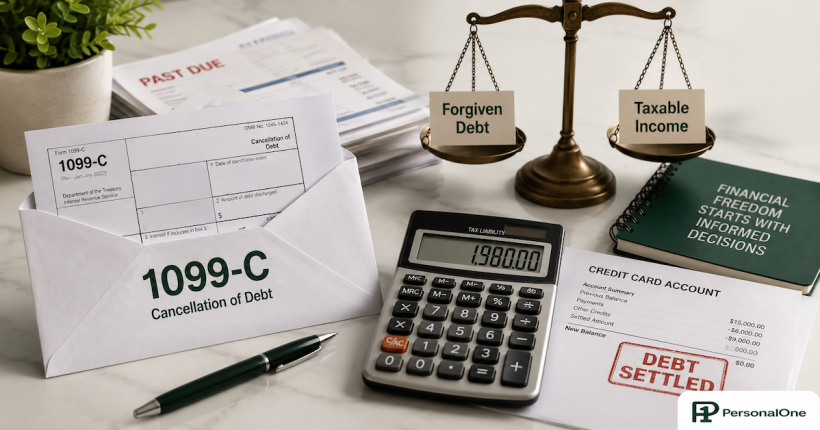
Does negotiating with creditors hurt my credit? Calling to request a hardship plan or interest rate reduction does not trigger a hard inquiry and does not appear on your credit report. Settling a debt for less than the full amount does appear on your report as "settled" rather than "paid in full," which carries some negative weight. But if the alternative is continued non-payment or a charge-off, settlement is a significantly better outcome for your score and your financial position.
Can I really negotiate my own debt down without a company? Yes, in many cases. Creditors negotiate directly with consumers, particularly for accounts that have been delinquent for 90 or more days or have been charged off. The leverage you have is that a partial payment is more than they would recover from selling the debt to a collections agency. Call the creditor directly, state your situation, and ask what settlement options are available. Get any agreement in writing before making any payment. For debts already in collections, the same approach applies with the collections agency.
What is the difference between credit repair and debt repair? Credit repair refers specifically to improving your credit report and score — disputing errors, reducing utilization, adding positive history. Debt repair is a broader term covering the full process of eliminating what you owe — payoff strategies, negotiation, settlement, and behavioral habits that stop debt from accumulating. They overlap significantly, but credit repair is a component of debt repair rather than the same thing.
When does it make sense to use a debt relief company instead of DIY? When the debt is structurally unmanageable. If minimum payments exceed 40% of your take-home pay, if accounts are already in collections or facing legal action, or if total debt significantly exceeds annual income, DIY hacks address symptoms rather than the structural problem. Professional debt relief — settlement, debt management plans, or bankruptcy evaluation — addresses the structure. The CFPB's debt collection resources and a nonprofit credit counselor are good starting points for evaluating which path fits your situation.
Disclaimer: This article is for educational purposes only and does not constitute financial, legal, or credit repair advice. Individual results vary based on credit profile, debt levels, and personal circumstances. Some links are affiliate links — PersonalOne may earn a commission at no extra cost to you. All affiliate recommendations reflect products PersonalOne stands behind editorially. Consult a qualified financial professional before making financial decisions. PersonalOne is not responsible for decisions made based on this content.