

July 18, 2025
February 20, 2026
Home > Banking Systems > The 3-Account System > How to Avoid Bank Fees: 5 Charges Still Draining Accounts in 2026
About the Author: Don Briscoe is a financial systems coach with 12+ years helping Millennials and Gen Z escape paycheck-to-paycheck cycles. He's worked with hundreds of people to build emergency funds, eliminate debt, and start investing using framework-first strategies that require less willpower and more infrastructure. He founded PersonalOne to provide the financial education he wished existed — structured, honest, and free.
TL;DR — Quick Summary
- Bank fees still quietly drain $150–300+ per year from households that haven't switched to fee-free accounts
- Five fees account for the vast majority of bank revenue — overdraft, out-of-network ATM, monthly maintenance, minimum balance, and paper statement charges
- Every one of these fees is avoidable — online banks and credit unions have largely eliminated them without sacrificing FDIC protection or account reliability
- Fees matter more than most people realize — $200/year in avoidable bank fees invested instead at 7% compounds to over $5,000 in 20 years
- The structural fix is choosing the right accounts — not monitoring transactions more carefully or maintaining higher balances
Bank fees are a uniquely frustrating financial drain because they're not the result of anything you did wrong. You didn't overspend. You didn't take on bad debt. You simply held money at an institution that charges you for the privilege — and the charges compound quietly over months and years without ever appearing as a line item in your budget.
The average American household with a traditional bank account pays roughly $150–300 per year in avoidable banking fees. That's not a rounding error. At a 7% investment return, $200 annually invested instead over 20 years becomes more than $10,000. Bank fees are one of the few financial leaks that are completely eliminable — not reducible, not manageable, but eliminated — simply by choosing different accounts.
This matters especially when you're trying to build a structured banking system. Bank fees don't just cost money directly — they undermine the structural discipline your system depends on. An overdraft fee doesn't just charge you $35; it creates an unexpected deficit that cascades into missed savings contributions and disrupted automatic transfers. A monthly maintenance fee isn't just $15 out of pocket; it's $15 that should have moved to your savings account on payday but didn't.
Below are the five bank fees that still drain the most money from everyday accounts in 2026 — how they work, why banks still charge them, and how to eliminate each one permanently.
Fee 1: Overdraft Fees
Overdraft fees are the single most profitable fee category in retail banking, generating billions of dollars annually from the households least able to afford them. The standard fee runs $25–35 per incident at major traditional banks — and "per incident" means per transaction, not per day. A Friday evening with three declined-but-processed purchases can generate $75–105 in fees before you've seen your Monday bank statement.
The mechanism is deliberately opaque. Most traditional banks automatically enroll customers in overdraft "protection" — a service that allows transactions to process even when your balance is insufficient, then charges a fee for the convenience. The enrollment is often buried in account opening paperwork, and the charges appear as separate line items that are easy to miss until you're already in a deficit cycle.
According to the Consumer Financial Protection Bureau, overdraft fees disproportionately impact lower-balance households — the people for whom an unexpected $35 charge creates the most disruption. High-balance customers rarely overdraft and rarely pay these fees. The fee structure is effectively a penalty on financial vulnerability.
How to Eliminate Overdraft Fees
Opt out of overdraft coverage. Federal regulations require banks to get your consent for overdraft coverage on debit card transactions. You can opt out at any time — your card will simply decline when your balance is insufficient rather than processing the transaction and charging a fee. For most people, a declined transaction is far less damaging than a $35 overdraft charge.
Switch to a no-overdraft-fee bank. Chime, SoFi, Ally, and many credit unions have eliminated overdraft fees entirely or replaced them with fee-free buffer programs ($20–200 of coverage at no charge with qualifying direct deposit). The product exists. The only barrier to accessing it is switching accounts.
Maintain a small checking buffer. Keep $200–300 above your actual spending budget as a permanent cushion in checking. In a structured banking system, your spending account holds only what you've budgeted to spend — which means it needs a small buffer to absorb timing differences between when expenses post and when transfers arrive.
Fee 2: Out-of-Network ATM Fees
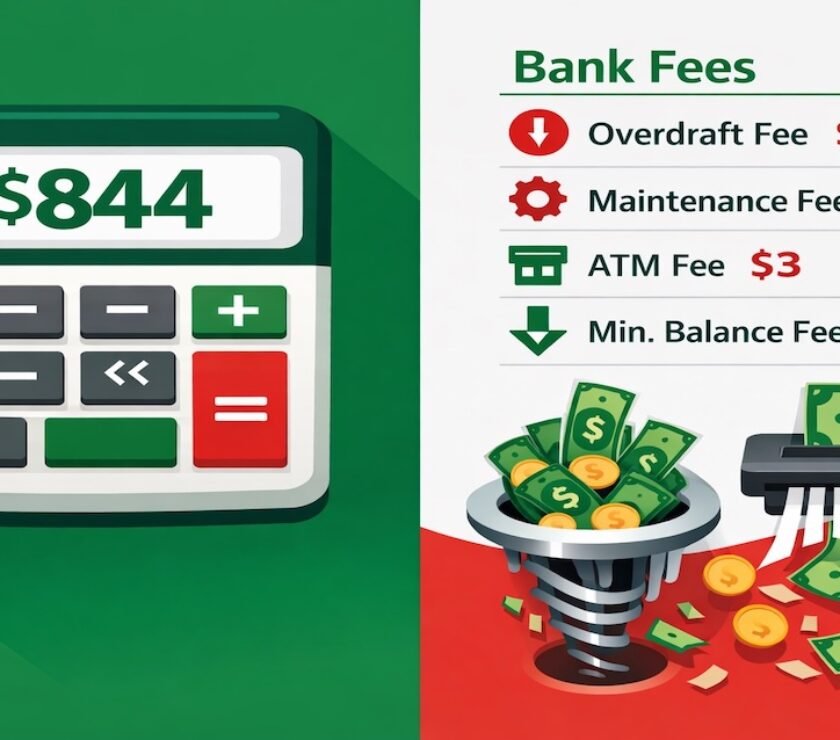
ATM fees are a double charge: the ATM operator charges one fee (typically $3–5), and your bank adds a second surcharge for using an out-of-network machine (typically $2–3.50). A single cash withdrawal can cost $5–8.50 — before you've touched the cash you withdrew. Use out-of-network ATMs twice a week and you're spending $520–884 annually just to access your own money.
Traditional banks with large branch networks justify their fees partly on the basis of ATM network access. The argument has weakened considerably: online banks now partner with Allpoint and MoneyPass networks offering 55,000–60,000 fee-free ATMs nationwide — more locations than most traditional bank networks. And several online banks go further, reimbursing any ATM fee charged by any machine, anywhere, automatically at month end.
How to Eliminate ATM Fees
Choose a bank with a large in-network ATM footprint. Allpoint and MoneyPass networks each have 55,000+ locations in retail stores, pharmacies, and convenience stores nationwide. Before switching banks, search the network locator for your neighborhood and workplace to confirm adequate coverage.
Choose a bank that reimburses ATM fees. Axos Bank, Schwab Bank, and several credit unions offer unlimited out-of-network ATM fee reimbursement. This effectively gives you access to any ATM in the country for free — a better deal than any traditional bank's in-network-only offer.
Reduce cash dependence. Most expenses can be paid by debit card, Zelle, or ACH transfer — all of which are free at every bank. If you're regularly withdrawing cash to pay for things that could be paid digitally, eliminating that habit eliminates the ATM fee exposure entirely.
Fee 3: Monthly Maintenance Fees
Monthly maintenance fees — also called "monthly service fees" or "account upkeep fees" — are flat charges banks collect simply for maintaining your account. At major traditional banks, these run $10–15/month ($120–180/year) and are typically waived only if you meet specific conditions: a minimum daily balance, a direct deposit of a certain size, or a minimum number of monthly transactions.
The waiver conditions create a trap. A month where you're between jobs and your direct deposit doesn't process? Fee. A month where you drew down your balance to cover an emergency and dipped below the minimum? Fee. The accounts most likely to trigger these fees are accounts held by people whose financial situations are most precarious — exactly the people who can least afford to lose $15 to an institution that did nothing to earn it.
From a banking system perspective, maintenance fees are particularly corrosive. A structured system depends on predictable, fixed-amount transfers between accounts. A surprise $15 debit that hits after your savings transfer has already gone out creates a deficit you didn't budget for — which either bounces the transfer or triggers an overdraft.
How to Eliminate Monthly Maintenance Fees
Switch to an account with no maintenance fee and no conditions. Online banks including Ally, Chime, Discover, and SoFi charge $0/month with no minimum balance requirement and no direct deposit condition. The fee is genuinely zero — not waivable-if-you-qualify zero.
If staying at a traditional bank, understand exactly what waives the fee. Read the account terms, not the marketing materials. Confirm whether direct deposit means any ACH deposit or specifically payroll. Confirm whether the minimum balance is a daily minimum or an average monthly balance — the distinction matters significantly.
Set a calendar reminder to audit your bank statement quarterly. Monthly maintenance fees sometimes appear months after account opening when promotional waivers expire. A quarterly statement review catches these before they accumulate into hundreds of dollars of unnecessary charges.
Fee 4: Minimum Balance Fees
Minimum balance fees are a variant of the maintenance fee — charged not monthly by default, but triggered when your balance dips below a set threshold. These often appear in savings accounts and money market accounts at traditional banks, where the stated "no fee" account carries a hidden condition: maintain $2,500 or pay $12/month.
The minimum balance requirement creates a perverse incentive: it's most dangerous for people who are actively building savings toward a goal. Someone who has $2,800 in savings, makes a planned $500 withdrawal for a car repair, and drops below the $2,500 threshold gets charged $12 — penalized for using their savings exactly as intended. The account that was supposed to support their financial progress actively punishes it.
In 2026, there is no functional justification for minimum balance requirements at consumer accounts. Online banks process accounts profitably at any balance. The minimum balance fee is a legacy revenue mechanism that survives only because enough customers don't know better alternatives exist.
How to Eliminate Minimum Balance Fees
Choose accounts with no minimum balance requirement. High-yield savings accounts at Ally, Marcus by Goldman Sachs, American Express, and SoFi require $0 to open and $0 to maintain without fees. The same is true for their checking accounts. Your balance can be $1 or $100,000 — the fee is zero either way.
Audit every account you hold for minimum balance terms. Many people open accounts during promotional periods when fees are waived and don't discover the balance requirement until they're charged. Pull the full fee schedule for each account you hold and confirm whether any minimum balance applies.
Especially relevant for savings accounts. Traditional banks frequently apply minimum balance requirements to savings accounts specifically. If your savings account has a minimum balance condition, you're likely leaving rate advantage AND incurring fee risk simultaneously — strong reasons to move that balance to a fee-free high-yield savings account.
Fee 5: Paper Statement Fees
Paper statement fees are the smallest of the five — typically $1–5/month — but they're worth addressing because they represent a broader problem: banks charging customers for behaviors that cost the bank nearly nothing to provide differently. A paper statement costs a bank roughly $1–2 to print and mail. Charging $5 for it isn't cost recovery — it's a margin play dressed up as a service charge.
More importantly, paper statements are the legacy default at traditional banks — meaning customers who never explicitly chose paper are often enrolled in it by default and charged accordingly. The opt-in should be for paper, not for digital. That it's reversed at most traditional banks tells you whose interests the default serves.
How to Eliminate Paper Statement Fees
Switch to e-statements immediately. Log into every bank account you hold and confirm your statement delivery preference is set to electronic. This takes two minutes per account and eliminates the fee entirely. Most banks send a confirmation email when the change is made.
Download and archive monthly statements. Once on e-statements, create a simple folder structure (bank name → year → month) and download your PDF statement monthly. This gives you a permanent digital record without paying for paper — useful for tax preparation, loan applications, and dispute resolution.
Online banks don't charge for paper statements — and most don't offer them at all. If you genuinely need occasional paper statements (for a landlord or government agency), most banks will print one on request for free or for a nominal one-time fee that's far less than a monthly charge.
What These Fees Actually Cost Over Time
Looking at each fee individually undersells the problem. A household paying all five — even at moderate frequency — loses significant money over time that could have been building wealth instead.
| Fee Type | Typical Annual Cost | Invested at 7% Over 20 Years |
|---|---|---|
| Overdraft fees (4x/year) | $120–140 | $6,200–$7,200 |
| Out-of-network ATM (2x/month) | $120–200 | $6,200–$10,300 |
| Monthly maintenance fee | $120–180 | $6,200–$9,300 |
| Minimum balance fee (2x/year) | $24–30 | $1,200–$1,500 |
| Paper statement fee | $12–60 | $620–$3,100 |
| Total if paying all five | $396–$610/year | $20,400–$31,400 lost |
The compounding column is the one that should motivate action. These aren't dollars you're spending on something that improves your life. They're dollars that leave your account in exchange for nothing — and every one of them is eliminable by switching to accounts designed not to charge them.
Why Fee-Free Banking Actually Works
A reasonable skepticism applies here: if online banks charge no monthly fee, no overdraft fee, and reimburse ATM charges, how do they stay profitable? The question is fair, and the answer matters for evaluating whether these accounts are genuinely sustainable or just promotional.
Online banks generate revenue primarily through interchange fees — a small percentage (typically 1–2%) charged to merchants every time you swipe your debit card. This revenue is invisible to you and costs you nothing directly. Traditional banks collect the same interchange revenue but also layer fees on top. Online banks have eliminated the fee layer because their lower operational overhead (no branches, fewer employees, smaller real estate footprint) makes the interchange revenue alone sufficient to run profitably.
Online banks also earn margin on deposits — the difference between what they earn lending money out and what they pay you in interest. The business model is sound, proven over 15+ years, and FDIC-insured to the same standard as traditional banks. The absence of fees is not a promotional gimmick with a hidden catch. It is the result of a structurally lower cost model.
The institutions to be cautious of are payment apps and fintech companies that market themselves as banks but are not. Venmo, Cash App, and similar apps may hold money and provide FDIC-pass-through insurance through a partner bank — but they are not banks themselves, and the protection pathway is more complicated than a direct FDIC-insured bank account. Before trusting an institution with your primary income and savings, verify their FDIC status directly at FDIC.gov.
How to Switch Banks Without Disrupting Your Financial System
The main friction in switching banks isn't the account opening — that takes 10–15 minutes online. The friction is the transition: moving direct deposit, updating automatic payments, and avoiding a gap where your old account is empty and your new account isn't yet fully funded.
The safest approach runs parallel accounts for 60 days before fully closing the old one:
- Open the new account and fund it with a small initial deposit. Most no-fee online banks have no minimum opening deposit — $25–50 is enough to activate the account and receive your routing and account numbers.
- Update direct deposit with your employer. Log into your payroll portal and redirect your paycheck to the new routing and account number. Allow 1–2 pay cycles for the change to take effect. Keep your old account open and funded during this window.
- List every automatic payment linked to your old account. Review 3 months of bank statements and identify every recurring charge — subscriptions, utility autopay, loan payments, insurance premiums. Update each to the new account before your old account goes unfunded.
- Redirect any transfers from savings or investment accounts. If you have automatic contributions going to a savings or investment account from your old checking, update those transfer sources.
- Wait 60 days, then close the old account formally. Don't just stop using it — call or write to close it properly. Dormant accounts can generate inactivity fees at some institutions, and an open account creates the risk of an unexpected charge hitting a zero balance and triggering overdraft fees at the bank you just left.
Eliminating Fees Is Step One. Building a System Is Step Two.
Switching to fee-free accounts stops the drain. But the reason most people keep paying fees — and keep running out of money before their next paycheck — isn't just bad account selection. It's the absence of a structure that separates spending money from savings money and routes income to its destination before any spending decisions happen. The 3-Account System shows you exactly how to build that structure.
See the 3-Account System →Frequently Asked Questions
Are online banks as safe as traditional banks?
Yes, provided the bank is FDIC-insured. FDIC insurance covers deposits up to $250,000 per depositor per institution regardless of whether the bank has branches. Ally, Marcus, Discover, SoFi, Axos, and Chime (through its partner banks) are all FDIC-insured. You can verify any institution at FDIC.gov before opening. The safety standard is identical to what you receive at a traditional bank — the branch network is what's missing, not the deposit protection.
What if I need to deposit cash — can I still use an online bank?
Online banks handle cash deposits differently depending on the institution. Most partner with retail deposit networks (Green Dot at Walgreens, CVS, and Walmart) where you can deposit cash to your account for a small fee ($3–5). Others allow you to deposit cash at an ATM associated with their network. If you deposit cash frequently, evaluate whether an online bank's cash deposit options work for your situation before fully switching — or consider maintaining a credit union account specifically for cash deposits while using an online bank for your primary checking.
Can I negotiate fee waivers with my current bank instead of switching?
Sometimes, particularly for one-time overdraft fees. If you're a long-standing customer with a clean history and call within a few days of the charge, many banks will waive one overdraft fee per year as a courtesy. Monthly maintenance and minimum balance fees are less often waived — and even when they are, the waiver is typically temporary. If you're paying regular structural fees, a permanent fix (switching accounts) is more reliable than negotiating waivers that may not be repeated.
I have a long relationship with my bank — is it worth switching?
Bank loyalty has limited financial value. Your relationship history doesn't improve your interest rates on deposits, reduce your fees, or provide meaningful advantages that a new account at a better institution wouldn't also provide from day one. The switching cost — 60–90 days of running parallel accounts and updating automatic payments — is a one-time inconvenience. The fee savings and rate improvements are permanent. For most people paying $150–300/year in avoidable fees, the math strongly favors switching.
What about credit unions — are they a better option than online banks?
Credit unions are nonprofit, member-owned institutions that frequently offer fee-free checking, competitive savings rates, and better overdraft policies than traditional banks. They're worth considering — especially if you qualify for one with a strong ATM network and local branch access. The main limitation is membership eligibility: most require you to qualify through employer, geography, military affiliation, or another criterion. If you qualify for a strong credit union, it may be the best of both worlds — fee-free accounts with the in-person service capability that online banks lack.
Resources
- FDIC — Verify Bank Insurance Status
- CFPB — Bank Account Consumer Tools and Your Rights
- CFPB — Research on Overdraft Fee Dependence
- Federal Reserve — Understanding Checking Account Overdraft Programs
Disclaimer: This article provides educational information about banking fees and account options. It does not constitute financial advice. Account terms, fee structures, and FDIC insurance details are subject to change. Always verify current terms directly with financial institutions before opening or closing accounts.