Updated: April 23, 2026
Home › Budgeting & Savings › Budget Foundations › How to Create Your First Budget
TL;DR
— Budgeting is not about restriction — it is about giving your money direction before it disappears.
— Start with your real take-home income, not your salary. What hits your account is what you budget with.
— Track every dollar for one month before changing anything. You cannot fix what you have not measured.
— Choose a budgeting method that fits your actual life — 50/30/20, zero-based, or envelope. Not the one that sounds best in theory.
— Your first budget will be imperfect. That is normal. The goal is to start, not to start perfectly.
Knowing how to create your first budget is one of those skills that sounds straightforward until you actually sit down to do it. Most people have tried at least once — opened a spreadsheet, filled in a few numbers, felt briefly organized, and then watched the whole thing fall apart by week three. That is not a discipline problem. It is a design problem. The budget was built without accounting for how real spending actually behaves.
This guide walks through the exact process of creating a first budget that holds — not a theoretical framework but the actual steps, in sequence, with the reasoning behind each one. If you have never built a budget before, or if you have tried and abandoned the process more than once, this is the place to start. No jargon, no frameworks that only work for people without student loans and a grocery bill that keeps climbing. Just the mechanics, done correctly.
Why Most First Budgets Fail Before the Second Month
Here is what happens without a working budget: you get paid, bills get covered, you spend on things that feel reasonable in the moment, and then two weeks before your next paycheck you are doing mental math and wondering where it all went. That cycle does not break through better intentions. It breaks through better structure.
A budget breaks the cycle by making spending decisions in advance rather than reactively. When money has assignments before it gets spent, every purchase becomes a choice rather than a guess. Saving becomes predictable instead of aspirational. Spending stops feeling guilty because you already know whether it fits the plan.
For Millennials managing student loans, variable income, and rising fixed costs, learning how to create your first budget is not optional. It is the only tool that gives you an accurate picture of what you can actually afford and what needs to change before the gap between income and expenses becomes a problem you cannot close. People who actively budget are more likely to meet savings goals and report lower financial stress than those who manage money reactively — and the gap is not income. It is structure.
The most common reason first budgets fail is not math errors. It is that they are built on estimates rather than actual spending data, set aspirational targets rather than realistic ones, and leave no structural buffer for the inevitable irregular costs that arrive every month. Building on accurate data and realistic targets from the start is what the budget foundations framework is designed to establish. If you want a structured starting point that covers the full setup sequence from scratch, the complete beginner's budgeting blueprint walks through each phase in detail before you start entering any numbers.
Step 1: Find Out How Much Money You Are Actually Working With
Before anything else, you need your real income number. Not your salary. Not your hourly rate times forty hours. What actually hits your bank account after taxes, health insurance deductions, retirement contributions, and anything else taken out before you see it.
If you are salaried, check your most recent pay stub and look at the net pay line. Multiply that by how frequently you get paid to get your monthly total. If you get paid biweekly, multiply by 26 and divide by 12. If you get paid twice a month, multiply by 2. If your income varies, use the average of your last three to six months — and when in doubt, budget conservatively using a lower-end estimate rather than your best month.
Side income counts too. Freelance work, gig economy earnings, and any other consistent income sources belong in this number. Irregular windfalls — tax refunds, one-time bonuses — do not belong in your monthly baseline. Treat those separately when they arrive and assign them intentionally rather than letting them disappear into general spending.
Write this number down. It is the only number your entire budget is built from. Every allocation, every category target, every savings rate starts here.
Step 2: Track Where Your Money Actually Goes Before You Budget It
You cannot create your first budget accurately from memory. This is the step most people skip and the primary reason most first budgets fail. You cannot set realistic category targets for spending you have never actually measured.
Spend one full month tracking every single purchase before building the budget. Rent, subscriptions, groceries, the coffee on the way to work, the delivery fee you forgot about, the impulse purchase at 11 PM. All of it. Not to judge yourself, but to get an honest data set to build from.
The easiest method is to pull your last 30 days of bank and credit card statements and go through them category by category. Most banks already categorize transactions automatically. The goal is a realistic number for each major spending area — not a perfect accounting, but an honest picture. A budget built on what you actually spend will survive the first month. A budget built on what you think you spend will not.
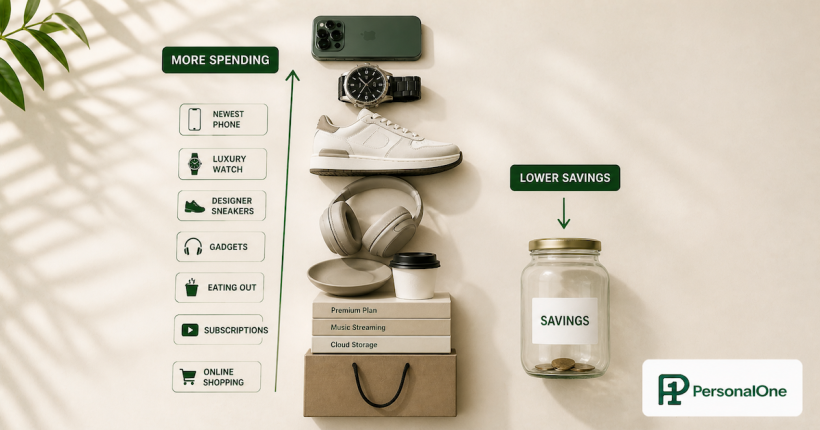
Most people are surprised by at least one category when they do this for the first time. Dining out and subscriptions are the most common surprises. Do not skip this step because you think you already know. The difference between what you think you spend and what you actually spend is exactly where budgets fall apart in week two.
Step 3: Categorize Your Spending Into Three Groups
Once you have your 30 days of tracking data, organize every expense into three categories. Keep this simple at first — you can add granularity later once the system is working.
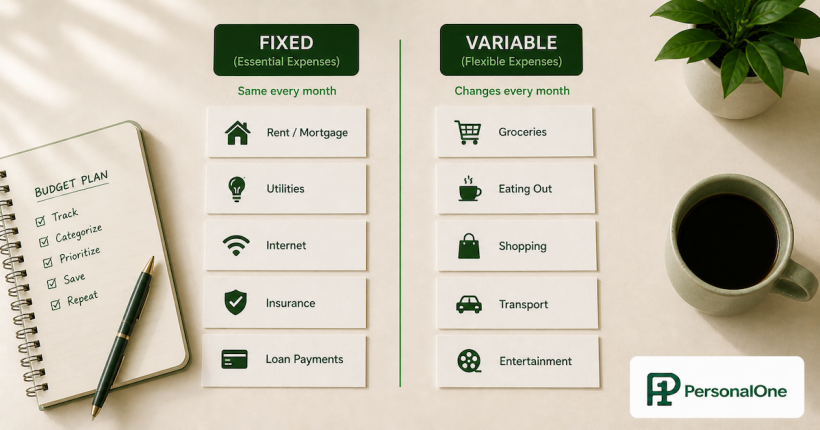
Fixed expenses are the same amount every month and largely non-negotiable in the short term. Rent or mortgage, car payment, insurance premiums, student loan minimums, and recurring subscriptions all belong here. Add these up. This number does not change unless you make a structural decision to change it — refinancing, moving, canceling services. Knowing your fixed expense total tells you the floor your budget must cover before discretionary spending begins.
Variable expenses fluctuate month to month but are predictable in category. Groceries, gas, utilities, and dining out are the most common. These are manageable with targets but will never be exactly the same amount twice. Your 30-day tracking data tells you the realistic range for each category — use that range, not an aspirational minimum.
Savings and goals is the third category that most first-time budgeters either forget entirely or treat as optional. Emergency fund contributions, retirement contributions above what is automatically deducted, debt payoff beyond minimums, and any specific savings goal all belong here. This category is not what is left over after spending. It is an assigned allocation that happens before variable spending begins — treated exactly like a fixed expense.
Once all three categories are totaled, subtract from your take-home income. If the result is negative, you are spending more than you earn. If it is positive, the first question is whether that surplus is actually going somewhere intentional or disappearing into untracked spending drift.
Step 4: Choose a Budgeting Method That Actually Fits Your Life
There is no universally correct budgeting method. The best one is the one you will actually use consistently for more than two months. Here are the three most practical options for most Millennial and Gen Z earners learning how to create their first budget.
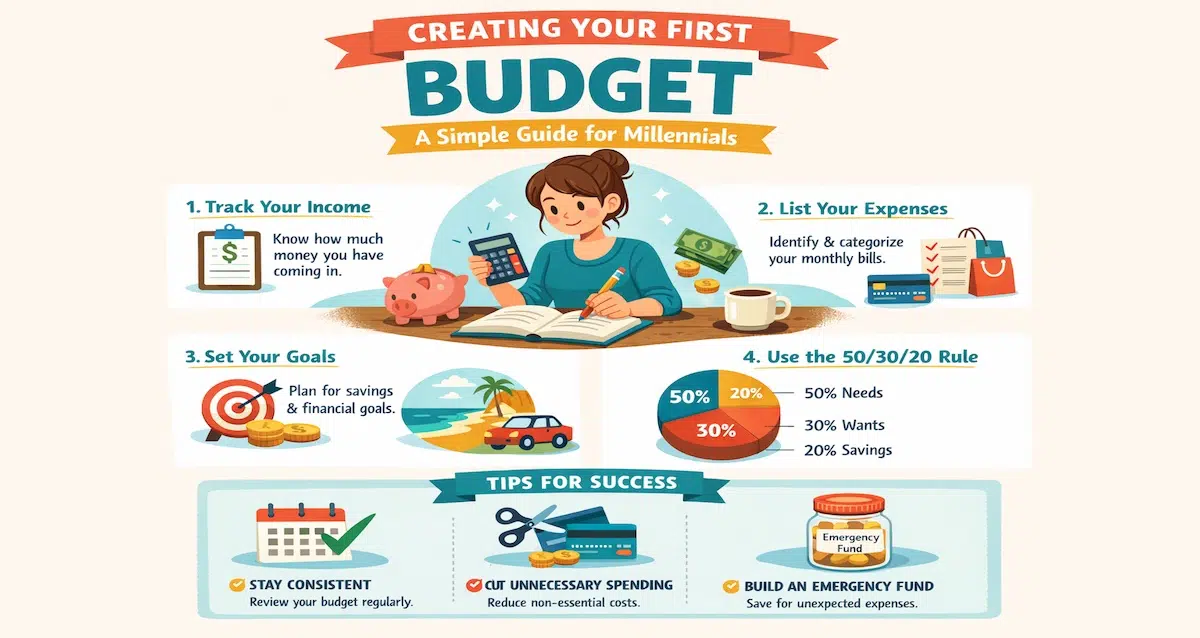
The 50/30/20 rule is the lowest-friction starting point and the most popular simple way to split your income across needs, wants, and savings without tracking every individual transaction. Fifty percent of take-home income goes to needs — rent, utilities, groceries, insurance, minimum debt payments. Thirty percent goes to wants — dining out, entertainment, hobbies, personal care beyond the basics. Twenty percent goes to savings and additional debt payoff. It does not require tracking every dollar once the initial categories are set. It works best for people with relatively stable incomes and expenses who want a simple framework without heavy monthly maintenance. The 50/30/20 budget calculator runs this split automatically from your take-home income if you want to see your category targets before building the full budget.
Zero-based budgeting assigns every dollar of income a specific job. Income minus all assigned expenses and savings equals zero. Nothing is unaccounted for. This method gives maximum visibility and control but requires more time each month to maintain. It works best for people who want to optimize aggressively or who have variable income that needs careful management every pay period.
The envelope system works by assigning a fixed amount to each spending category for the month. When the envelope is empty, spending in that category stops. It creates hard limits that are more behaviorally powerful than soft budget numbers for people who have trouble stopping at a target. The digital version uses separate accounts or sub-accounts for each spending category rather than physical cash.
Pick one. Try it for 60 days before deciding it does not work. Most budgets fail because they are abandoned too early, not because the method was wrong.
Step 5: Build the Budget Using Real Numbers
With your income, your tracked spending data, and a chosen method, you now have everything needed to build the actual budget. This is not about creating a perfect plan. It is about creating an honest one that reflects real life rather than aspirational behavior.
Start with fixed expenses. List every one with its exact monthly cost. These do not get negotiated in the first budget — they are what they are for now. Total them and subtract from your take-home income.
Move your savings allocation next. Even a small fixed amount — $50 or $100 per month toward an emergency fund — matters more than the amount suggests because it establishes the habit and the sequencing before the numbers get larger. Automate this transfer on payday so it happens before variable spending decisions begin.
Allocate variable expenses from what remains. Use your 30-day tracking data to set realistic monthly targets for each category. Not aspirational minimums — realistic numbers based on what you actually spent. If your grocery tracking shows $420 per month and you set a target of $250, you will miss it in week two and abandon the budget by week three. Start with achievable targets and reduce them gradually over time as you identify real waste rather than assumed waste.
Build in a miscellaneous buffer of at least $75 to $100 per month. A budget with no buffer assumes every month will be perfectly normal. No month is completely normal. The buffer absorbs small unexpected costs without requiring a full budget reallocation every time something minor happens.
Total everything. Compare to income. Adjust until the numbers balance. Your first version will not be perfect — that is expected, not a failure. The point is a documented starting point you can improve from month by month.
Step 6: Choose Tools That Reduce the Maintenance Work
A budget you have to manually update every day is a budget you will stop using. The right tools reduce the maintenance burden to something sustainable without removing your visibility into where money is going.
Most major banks now offer basic spending categorization inside their apps. For many people starting out, this is enough. You can see categorized spending, set simple alerts, and track against targets without downloading anything additional. The barrier to entry is zero because the tool is already in your pocket.
Dedicated budgeting apps go further. YNAB (You Need a Budget) is built specifically around zero-based budgeting and is the most structured option available. EveryDollar is simpler and works well with the 50/30/20 approach. Goodbudget uses a digital envelope system. Each has a learning curve, but any of them will reduce the time required to maintain a working budget compared to a spreadsheet updated manually.
The tool matters less than using it consistently. Pick the one that does not feel like a chore to open. Most offer free trials. Try the option that matches your chosen budgeting method rather than the one with the most features.
Step 7: Review, Adjust, and Do Not Quit After the First Imperfect Month
Your first budget will be wrong in at least one category. You will forget an expense, underestimate a variable cost, or have something unexpected arrive that the budget did not account for. That is not failure. That is data. The budget is doing exactly what it is supposed to do — making the gap between plan and reality visible so it can be closed.
At the end of each month, compare what you planned to spend against what you actually spent. Identify the categories that ran over. Ask whether the target was unrealistic or whether the spending was genuinely above where it should be. Adjust targets that are consistently off by significant amounts — a target you never hit is not a budget, it is an aspiration with a number attached. If you want a shortcut to improving accuracy faster, there are easy ways to improve your budget fast that address the most common calibration mistakes most people repeat in the first three months.
The budget gets more accurate every month you run it. By month three, most people have a version that reflects their real spending patterns closely enough to generate reliable monthly surplus. That surplus is what the long-term budgeting strategy that builds real wealth gets constructed on top of. The monthly review habit is what gets you there.
Do not abandon the budget because one month was hard. Adjust it and continue. A budget revised monthly for a full year is infinitely more valuable than a perfect budget used for two weeks and abandoned.
Common First-Budget Mistakes and How to Avoid Them
Being too restrictive from the start. If the budget cuts every discretionary category to zero or near zero, you will quit within two weeks. Build in realistic spending for dining out, entertainment, and personal care. A budget with no room for living your actual life is not a sustainable budget — it is a restriction plan that will be abandoned the first time real life asserts itself.
Forgetting irregular expenses. Annual subscriptions, car registration, holiday gifts, and seasonal costs are not emergencies — they are predictable. Divide the annual cost by twelve and add it as a monthly line item into a dedicated sinking fund account. This prevents your budget from being disrupted by expenses you could have seen coming months in advance.
Checking in only when something goes wrong. A budget reviewed once a month at the end of the month is already too late to course-correct. A quick weekly check — five minutes to see where each category stands — keeps small overspending from becoming large overspending that derails the entire month.
Comparing your budget to someone else's. The person saving 40 percent of their income may be living with family rent-free. The person with a large investment account may have received an inheritance. Your budget is built around your income, your costs, and your goals. The only comparison that produces useful information is this month versus last month on your own numbers.
What to Do When the Budget Breaks Down
Life happens. An unexpected car repair, a medical bill, a week where everything cost more than planned. The budget gets disrupted. This is inevitable and not a reason to abandon the system.
When a budget month goes sideways, the move is to triage rather than restart. Identify which categories ran over and by how much. Pull back on discretionary spending for the remainder of the month or the following month to compensate. If a specific unexpected expense hit, decide whether it belongs in an emergency fund draw or whether a sinking fund category needs to be added going forward to absorb the same type of cost next time.
A disrupted budget that gets adjusted and continued is more valuable than a clean budget that gets abandoned. The habit of returning to the system after disruption is one of the most important financial behaviors you can build — and it is the one most personal finance content ignores entirely. Understanding the budgeting strategies that build wealth over time always starts with this habit of recovery, not perfection.
Your first budget is the foundation. The system is what builds on it.
Once your budget is working, the next step is structuring your cash flow, automating your allocations, and connecting your budget to long-term savings. The complete framework is in the Budgeting & Savings authority hub.
Explore the Budgeting & Savings System →Resources
CFPB — Budget Worksheet and Planning Tools
CFPB — How to Create a Budget and Stick With It
Continue Learning About Budgeting & Savings
This article covers the step-by-step process of creating a first budget. The complete framework for turning that foundation into a wealth-building system is in the Budgeting & Savings authority hub.
Frequently Asked Questions
How long does it take to get good at budgeting?
Most people need two to three months before a budget feels natural and accurate. The first month is data collection. The second month is calibration. By the third month, targets are usually close enough to reality that the budget generates meaningful surplus without constant adjustment. Expecting competence in the first month is one of the most common reasons people abandon the process before it produces results.
What if my income is different every month?
Budget based on your lowest typical month rather than your average. Any income above that baseline gets assigned intentionally when it arrives — extra to savings, extra to debt, or into a buffer account that smooths the leaner months. Variable income budgeting requires a conservative baseline and a clear protocol for what happens with surplus months rather than letting that surplus disappear into expanded spending.
Do I need to track every single dollar?
During the initial 30-day tracking phase, yes. After that, it depends on your chosen method. The 50/30/20 approach does not require transaction-level tracking once categories are established. Zero-based budgeting does. Most people find that tracking discretionary categories specifically — dining, entertainment, shopping — is sufficient after the foundation phase, since fixed and savings categories manage themselves once automated.
What if I am already behind on bills when I start?
Start with housing, utilities, food, and transportation — in that order. These are the categories that protect your living situation and ability to earn income. Once those are covered, work systematically through past-due obligations by smallest balance or highest interest rate depending on your situation. A budget built during financial stress needs to prioritize stability before optimization.
Should I budget for fun and discretionary spending?
Yes, and non-negotiably. A budget with no discretionary allocation fails because it is not sustainable for normal human behavior. Even a modest dining out or entertainment budget creates the psychological release that makes the rest of the budget maintainable month after month. The amount is less important than the category existing at all — a zero discretionary budget is not discipline, it is a setup for abandonment.
What is the hardest part of creating a first budget?
Honesty. Looking at what you actually spend — not what you think you spend or what you wish you spent — is where most people struggle during the 30-day tracking phase. The numbers feel like a judgment rather than data. They are not. They are the raw material the budget is built from. A budget can only be as accurate and sustainable as the information that goes into it.
Disclaimer: This article is for educational purposes only and does not constitute financial advice. Individual financial situations vary significantly based on income, expenses, debt obligations, and personal circumstances. Consult qualified financial professionals before making significant financial decisions. PersonalOne is not responsible for decisions made based on this content.