Updated: August 21, 2026
Home › Budgeting & Savings › Budget Foundations
What You Need to Know
— Most budgets fail because they are built on restriction, not structure. This cluster fixes that.
— Budget foundations means understanding where your money goes before trying to control it.
— You will choose a budgeting method that matches your actual life, not a personal finance textbook.
— The goal is one budget that works automatically, not one you have to force yourself to follow.
— Every article in this cluster builds the base layer your entire financial system depends on.
The standard advice is to track every purchase, assign every dollar a category, and review at the end of the month. For most people, that system lasts about three weeks. Then life happens, the spreadsheet gets abandoned, and the conclusion becomes "I am just bad with money."
That conclusion is wrong. The budget was wrong.
A budget built on restriction requires constant willpower. A budget built on structure runs whether you pay attention or not. Budget Foundations is about building the second kind — starting from a clear picture of your income, your fixed costs, and where the variable money actually goes before you try to redirect any of it.
This cluster is for anyone who has tried budgeting and quit, anyone starting from scratch, and anyone who has a budget on paper that does not reflect real life. The foundational layer is the most important layer. Everything else in this system — structure, automation, audits, savings — depends on getting this right first.
What Budget Foundations Actually Covers
This cluster answers one core question: Where do I start?
That question has several layers. It means understanding what a budget actually is versus what most people think it is. It means knowing your real take-home income, not your gross salary. It means mapping fixed expenses you cannot change, variable expenses you can influence, and discretionary spending that is costing more than you realize.
Budget Foundations also covers method selection. The 50/30/20 rule works for some incomes and fails for others. Zero-based budgeting is powerful but high-maintenance. Pay-yourself-first is simple but requires a functioning savings habit. The articles in this cluster walk through which method fits your income type, your lifestyle, and your current financial situation — so you build something you will actually use.
Three Starting Points, at a Glance
50/30/20: 50% needs, 30% wants, 20% savings and debt payoff. Best for straightforward, single-income households who want a simple percentage split without tracking every category.
Zero-based: every dollar assigned a job until income minus allocations equals zero. Best for people who want maximum control and don't mind revisiting the plan monthly.
Pay-yourself-first: savings comes out automatically before anything else is spent; the rest is unstructured. Best for people who struggle with detailed tracking but can stick to one automated habit.
The foundation is not glamorous. It does not involve investing or debt payoff strategies. It is the unglamorous work of knowing exactly where you stand so that every system you build on top of it actually holds.
The Foundation Sequence: What to Do and In What Order
Building a budget foundation is a sequence, not a checklist. Order matters because each step gives you the information you need for the next one.
Step one is income clarity. This means actual take-home pay after taxes, benefits deductions, and any automatic contributions. Many people budget off their gross salary and wonder why the numbers never work. Your budget starts with what lands in your bank account.
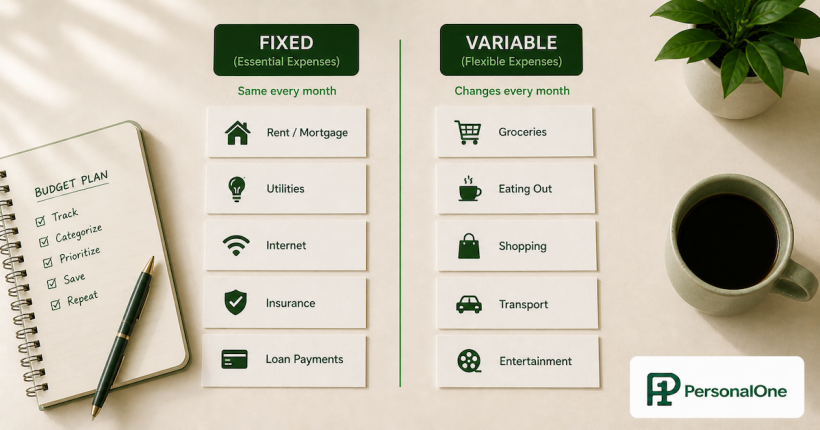
Step two is fixed expense mapping. Rent, insurance, subscriptions, loan minimums — these are costs that do not change month to month. List them. Total them. What remains is your operating budget for everything else.
Step three is variable expense tracking — just for 30 days, not forever. You need one honest month of data to know what your variable spending actually looks like: groceries, gas, dining, entertainment. You cannot set a realistic budget for categories you have never measured.
Step four is method selection. With real income data and real spending data in hand, you choose the budgeting framework that fits your life. Not the one that sounds best in theory. The one you will actually follow.
A Worked Example
Take-home pay: $3,800/month
Fixed expenses (rent, insurance, minimum debt payments, subscriptions): $2,050
30-day tracking reveals actual variable spending: $1,150 (groceries, gas, dining, entertainment)
That leaves $600 unaccounted for before tracking. Most people assume they're already close to breaking even. The tracking phase is what turns that assumption into a number you can actually plan around, whether it becomes savings, debt payoff, or a more honest spending category.
Common Budget Foundation Mistakes That Stall Progress
The most common mistake is building a budget around what you want to spend rather than what you actually spend. Optimistic budgets fail immediately because the gap between the plan and reality is too large to close with willpower alone.
The second mistake is skipping the tracking phase. One month of real data feels unnecessary when you think you already know where your money goes. Most people are wrong about this by hundreds of dollars per month. The tracking phase is not optional — it is the most important data collection you will ever do for your finances.
The third mistake is choosing a budgeting method based on popularity instead of fit. Zero-based budgeting requires a level of attention that works for some personalities and completely breaks down for others. Picking the wrong method and then concluding that you cannot budget is one of the most common financial setbacks for Millennials and Gen Z.
A fourth, quieter mistake is treating the foundation phase as a one-time event. Income changes, rent goes up, a subscription gets forgotten and quietly renews for a year. A foundation built once and never revisited slowly drifts out of sync with reality, which is often mistaken for the budget itself failing rather than the underlying data going stale.
Budget Foundations solves all of this by slowing down the setup phase. Spend two to four weeks getting the foundation right. Everything built on top of it becomes easier and more durable as a result.
What You Will Be Able to Do After This Cluster
After working through Budget Foundations, you will have a clear picture of your actual income, your fixed costs, and your real variable spending. You will have selected a budgeting method that fits your life. And you will have a working budget — not a perfect one, but one that is honest about where you currently stand.
From there, the rest of the Budgeting & Savings system builds naturally. Budget Structure & Cash Flow takes your foundation and gives it a structural system. Spending Control shows you how to manage the day-to-day execution. Reviews, Audits & Resets teaches you how to fix it when things drift. And Savings Strategy & Wealth Growth connects your budget to long-term financial growth.
The transition matters more than it might seem. Someone who jumps straight to account structure or automation without a real foundation ends up automating the wrong numbers — a bills account funded with a guess instead of an actual total, a savings transfer set at a round number instead of a figure grounded in real income and real spending. The structure runs exactly as designed either way. It just runs on bad data. That's why this cluster comes first, and why revisiting it periodically, not just once at the very beginning, keeps everything downstream accurate.
None of those clusters work without a solid foundation. This is where the system starts.
Ready to Build a Budget That Actually Holds?
Budget Foundations is one part of a complete system. See how budgeting connects to savings, spending control, and long-term wealth in the full framework.
Explore the Budgeting & Savings Clusters
You are here: Budget Foundations — Where every working budget starts
Budget Structure & Cash Flow — Organize money so it moves without chaos
Spending Control & Expense Management — Control where money goes day to day
Reviews, Audits & Resets — Fix what breaks and keep the system honest
Savings Strategy & Wealth Growth — Turn your budget surplus into long-term wealth
Money Psychology & Behavior — Understand the habits and beliefs behind your spending
Official Sources
More From This Hub
This cluster is part of the Budgeting & Savings system on PersonalOne — a complete framework for building a budget that grows into long-term wealth.
Go Deeper: Budget Foundations Guides
This cluster hub covers the framework. For specific situations and step-by-step execution, use these supporting guides:
How to Create Your First Budget: Millennials Guide
A deeper walkthrough with method comparisons and real-life examples.
Creating Your First Budget: A Simple Guide
A streamlined walkthrough for anyone starting from zero.
Beginner's Blueprint for Budgeting
The three-phase system for building a first budget on real data.
How to Budget When You're Broke
Budgeting strategies when every dollar is already spoken for.
Boost Your Savings With 10 Budgeting Tips
Practical moves that improve any budget immediately.
Money Management Paycheck to Paycheck
How to break the cycle when there is nothing left over.
Frequently Asked Questions
What is the best budgeting method for beginners?
There is no universal best method. Pay-yourself-first works well for people who struggle with tracking. The 50/30/20 framework works well for straightforward incomes. Zero-based budgeting works best for people who want maximum control and do not mind the time investment. The articles in this cluster help you match method to your actual situation.
How long does it take to build a working budget?
Building an honest foundation takes two to four weeks. The first two weeks are data collection — tracking what you actually spend. The second phase is building the framework around that data. Most people who skip the data phase end up rebuilding the budget within two months.
Do I need a budgeting app to follow this system?
No. The foundation can be built with a simple spreadsheet or even pen and paper. Technology can make the system more efficient once it is working, but the foundational steps are manual by design — because they require you to look at your real numbers, not approximations pulled by an algorithm.
What if my income is irregular or changes month to month?
Budget Foundations covers variable income scenarios. The key difference is baseline income calculation — using a conservative monthly estimate rather than an average — and building a buffer that absorbs the months where income falls short. The structure changes slightly but the foundational steps remain the same.
How does this cluster connect to the rest of the Budgeting & Savings system?
Budget Foundations is the first cluster for a reason. It provides the income clarity and spending data that every other cluster depends on. Once your foundation is stable, Budget Structure & Cash Flow shows you how to organize money systematically, and Spending Control & Expense Management gives you the tools to manage execution without tracking every dollar manually.
Do I need to rebuild my whole budget if my numbers were wrong the first time?
No. Getting the initial numbers slightly wrong is normal and expected, not a sign the process failed. Adjust the specific figures that were off, whether that's a fixed expense you forgot to include or a variable category that ran higher than tracked, and keep the rest of the foundation as-is. A budget foundation is meant to be calibrated over the first month or two, not built perfectly on the first attempt.
PersonalOne Money System
This content is researched, written, and owned by PersonalOne — a free financial education platform built to help Millennials and Gen Z build real financial systems.
This content is for educational purposes only and does not constitute financial advice. PersonalOne is not a licensed financial advisor, broker, or investment professional. Individual financial situations vary — consult a qualified financial professional for personalized guidance.