

February 25, 2026
Published: February 25, 2026
Home › Budgeting & Savings › Budgeting Apps & Financial Automation › How I Stopped Budgeting Manually
About the Author
Ally M. Scott is a personal finance advisor with more than 22 years of experience guiding everyday people through smarter money decisions. She specializes in breaking down complex financial topics into clear, actionable steps that help readers feel confident about their money.
TL;DR
- Manual budgeting isn’t a character flaw — it’s just an outdated system.
- The shift from stress to relief starts with a 3-step money automation framework: Capture → Allocate → Track.
- Once your system runs itself, you stop dreading your bank account and start actually trusting it.
- This article walks through one advisor’s personal journey — and how you can build the same system for yourself.
For years, I thought I was just bad at budgeting. Every Sunday evening I’d open a spreadsheet, stare at numbers I already knew were bad, and close the laptop without changing anything. The guilt would sit with me through Monday morning. By midweek, I’d forget to log a purchase. By Friday, I’d convince myself I’d “start fresh” next month.
Sound familiar? If you’ve ever avoided checking your bank account because you were afraid of what you’d find — you’re not broken. You just don’t have a system yet.
That distinction changed everything for me. And it can change everything for you too.
The Stress Was Real — And It Wasn’t About Willpower
The problem with manual budgeting isn’t discipline. It’s design. We ask ourselves to remember, track, calculate, and adjust — every single day — on top of everything else life demands. For most people, that’s not sustainable. It’s a system built for failure.
For me, the stress showed up in specific ways. I’d get paid and immediately feel behind — like rent, subscriptions, and “I forgot that was due” expenses were already eating away at something I hadn’t even touched yet. I avoided checking my balances because looking felt worse than not knowing. I’d spend money on something small, feel guilty, then emotionally spend even more.
The worst part? I knew what I should be doing. I’d read the articles, downloaded the budgeting apps, and even tried the cash envelope method for two weeks before abandoning it. The information was never the problem. The system was.
Here’s what no one tells you: budgeting anxiety isn’t about money. It’s about uncertainty. When you don’t have a clear picture of where your money goes, your brain fills the gap with worst-case scenarios. The goal isn’t to become more disciplined. The goal is to eliminate the uncertainty entirely — and that’s where automation comes in.
The System: From Manual to Autopilot
The shift happened when I stopped thinking about budgeting as a task and started treating it as a system — something I could build once and let run in the background. Think of it less like balancing a checkbook and more like setting up a thermostat: you configure it, and it does the work.
The framework I built (and that I now recommend to anyone who’ll listen) comes down to three stages:
The 3-Pillar Automation Framework
1
Capture — Your income has one entry point.
All income hits a single primary account. No splitting at the source, no confusion about which account has what. One door in.
2
Allocate — Automatic transfers do the work.
On payday, scheduled transfers move money to designated accounts: bills, savings, spending, investments. Your money gets sorted before you even log in.
3
Track — One dashboard shows you everything.
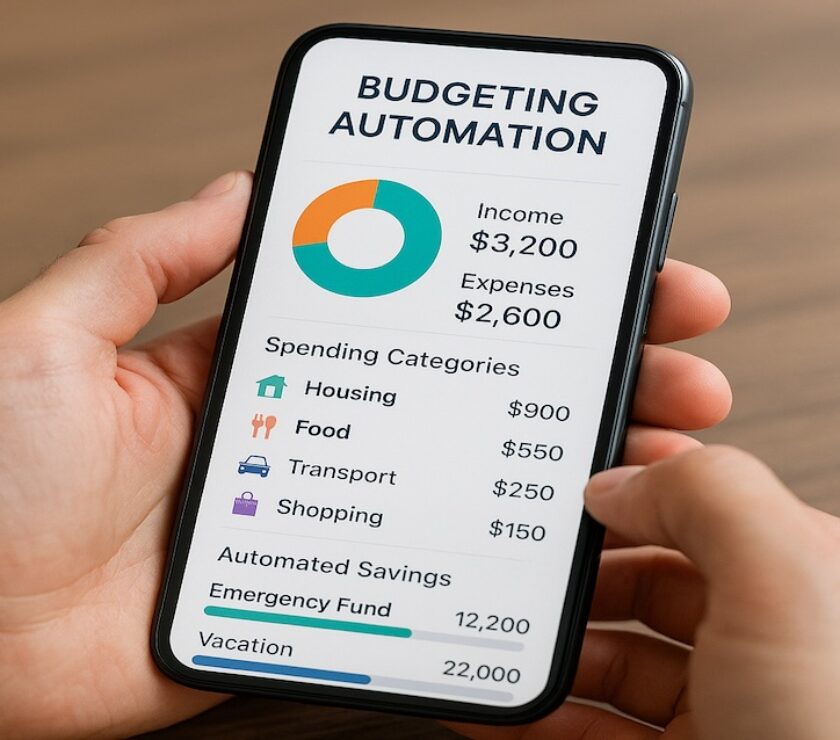
Rather than combing through multiple bank apps, a single tool aggregates your accounts and shows you exactly where things stand — in real time.
The Capture and Allocate steps can be set up directly through your bank — most allow you to create automatic transfers that trigger on a set date each month. But the Track step is where most people still fall apart, because logging into four different banking apps isn’t “tracking” — it’s just a harder version of the same problem.
That’s where Monarch Money (affiliate) comes in — a budgeting and financial tracking tool that connects all your accounts in one place, tracks spending automatically, and lets you see your full financial picture without the manual data entry. Once I had all three pillars in place, something shifted. I stopped dreading the numbers because I always knew what they were.
Ready to build your full money automation system?
Learn the complete framework — from setting up your accounts to running your finances on autopilot.
Start Here: Your Money on Autopilot →The Relief: What Life Looks Like When the System Runs
About two months into running this system, I noticed something strange: I stopped thinking about money as much. Not because I was ignoring it — but because I didn’t need to. The anxiety that used to follow me from Monday to Friday was gone, because the uncertainty was gone with it.
Payday stopped feeling like a countdown to broke. My savings account actually grew — not because I suddenly became more disciplined, but because the transfer happened automatically before I ever had the chance to spend it. Checking my bank app shifted from something I avoided to something almost satisfying.
The biggest change? I went from reactive to proactive with my money. Instead of looking backward at what I’d already spent, I was looking forward — planning, adjusting, and making decisions from a place of clarity instead of guilt.
That’s what a good system does. It doesn’t make you richer overnight. But it removes the mental load that was quietly draining your energy, and replaces it with something much more valuable: confidence.
Frequently Asked Questions
What if my income is irregular or I’m a freelancer?
Automation still works with variable income — it just requires a buffer account strategy. Route all income into a primary account and set your transfers to trigger only after a minimum balance threshold is met, or manually initiate them at the start of each month once you know what came in. The framework is the same; the timing adapts.
Do I need to be earning a certain amount for this to work?
No. The system works at any income level. In fact, it’s most impactful at lower income ranges — when every dollar matters, having a clear allocation system prevents the mental slip-ups that quietly erode your budget throughout the month.
How long does it take to set this up?
Most people can get the Capture and Allocate stages set up in an afternoon. Connecting your accounts to a tracking tool like Monarch Money takes about 15–20 minutes. The hardest part is deciding your allocation percentages — everything else is a one-time setup.
What if I set something up wrong and overdraft?
This is a valid concern, and the fix is simple: start with conservative transfer amounts, and keep a small buffer (even $50–$100) in your primary account for the first month while you calibrate. Adjust from there once you see your spending patterns clearly.
Is this the same as the “pay yourself first” method?
It’s closely related. Pay Yourself First is a savings principle — this framework is a full allocation system that applies that same logic to every dollar: savings, bills, and spending all get designated homes. It’s the full version of that idea.
Resources & Related Reading
- Budgeting Apps & Financial Automation: Cluster Hub
- Budgeting & Savings: Authority Hub
- Your Money on Autopilot — Full Automation System Guide
- Monarch Money Review (affiliate) — All-in-one financial tracking and budgeting dashboard
- Debt Relief & Credit Repair Hub
Disclaimer: The information provided on PersonalOne is for educational purposes only and does not constitute financial, legal, tax, or investment advice. PersonalOne and its content creators are not licensed financial advisors, attorneys, CPAs, or investment professionals. The frameworks, systems, and strategies presented here are general approaches to personal finance management and may not be suitable for every individual’s unique circumstances. Before making significant financial decisions, consult with qualified professionals such as a licensed financial advisor, CPA, or attorney who can assess your specific situation. Past performance and example scenarios do not guarantee future results. All financial strategies involve risk, and outcomes vary. PersonalOne receives no compensation for recommending specific financial products or services unless explicitly disclosed as sponsored content or affiliate relationships.