Updated: May 9, 2026
Home › Credit Building & Protection › Credit Monitoring & Protection System › Credit Checkup: How to Find and Fix Credit Report Errors
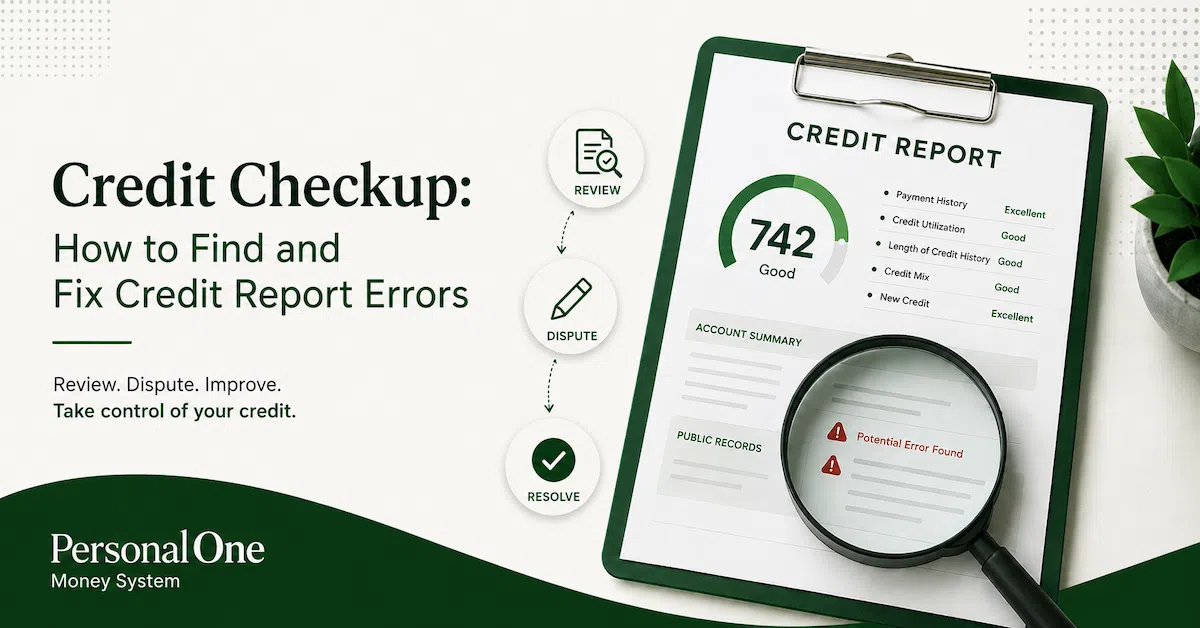
What You Need to Know — A year-end credit checkup is one of the highest-leverage financial moves you can make before January — lenders tighten approvals in Q4 and errors cost you money in higher interest rates
— Check all three bureaus: 1 in 5 credit reports contain errors, often appearing on only one or two reports
— Lower utilization fast: paying down cards below 30% (ideally 10%) can boost scores within weeks
— Dispute errors now: bureaus must respond within 30 days, giving you results before the new year
— A stronger credit profile means lower interest rates on everything from credit cards to mortgages
A credit checkup is one of the highest-leverage financial moves you can make — and one of the most consistently skipped. Errors on your credit report go unnoticed until they start costing real money in higher interest rates and declined applications, and most people never look closely enough to catch them. The complete framework for understanding what your credit file contains and how to protect it is in the Credit Monitoring & Protection System cluster.
This guide gives you the seven most effective steps to clean up your credit profile before December 31 and set yourself up for lower interest rates and stronger approvals in the year ahead. You do not need a credit repair service. You need the right moves at the right time. If you want the bigger-picture foundation first — how credit scores are built, what each factor weighs, and how scoring models work — the guide on how credit scores work covers every factor in detail.
For the broader authority hub that connects credit monitoring to score building, utilization strategy, and approval optimization, the Credit Building and Protection hub maps the complete system.
Why Year-End Is the Right Time for a Credit Checkup
End-of-year credit work creates momentum that compounds into January and beyond. Changes made in December often appear on January reports. Filing disputes in December means resolutions within 30 days — before Q1 applications begin. Many people apply for mortgages, auto loans, and credit cards in Q1, making December the optimal window to clean up the file before those decisions are made.
Every point of credit score improvement translates directly into money saved through lower interest rates over the life of loans. A December credit checkup is not maintenance — it is financial leverage.
Step 1: Pull All Three Credit Reports
Most people only check one bureau — usually Experian — but lenders check different bureaus depending on the loan type. An error on TransUnion will not show up if you only check Equifax. Pull all three: Equifax, Experian, and TransUnion. The only government-authorized source for free reports is AnnualCreditReport.com. Avoid impostor sites that charge fees or require credit card information.
Download and save PDF copies of all three reports. You will need them for comparison when disputing errors. The Consumer Financial Protection Bureau confirms that errors often appear on only one or two bureaus — a clean Experian report does not mean your TransUnion report is clean.
What to look for in each report:
✓ Personal information (name, addresses, Social Security number)
✓ All credit accounts and payment history
✓ Hard and soft inquiries
✓ Public records (bankruptcies, tax liens, judgments)
✓ Collections accounts
Step 2: Identify Errors, Inaccuracies, and Outdated Information
According to the Federal Trade Commission, one in five credit reports contain errors significant enough to impact credit scores and lending decisions. A single incorrect late payment can drop a score by 60-100 points depending on credit history. A wrong credit limit can make utilization appear dangerously high when it is actually fine.
Common errors to look for: accounts with incorrect balances, closed accounts listed as open, wrong personal information, duplicate accounts, incorrect late payments, accounts that are not yours, outdated negative items older than 7 years, and incorrect credit limits. Compare all three reports side-by-side — discrepancies between bureaus are red flags worth investigating immediately.
Document every error you find, including which bureau shows the mistake. You will need this information when filing disputes in Step 3.
Step 3: Dispute Errors Directly With the Credit Bureaus
Under the Fair Credit Reporting Act, you have the right to dispute any inaccurate information on your credit report. Bureaus must investigate and respond within 30 days — making December disputes particularly well-timed for Q1 applications. File disputes directly with each bureau that shows the error. Each bureau has an online dispute portal: Equifax at equifax.com, Experian at experian.com, and TransUnion at transunion.com.
When disputing a late payment you believe was on time, include documentation: bank statements showing the payment cleared, confirmation emails from the creditor, or screenshots of autopay confirmation. The stronger the evidence, the faster the resolution. A single successfully disputed late payment removal can move your score 15-40 points depending on how recent it was.
If a dispute is denied, request the method of verification, gather additional proof, and dispute again. You can also add a 100-word statement to your credit file explaining your position. For the full dispute process and what to do when errors persist, the guide on how to fix your credit in 90 days covers the complete recovery sequence.
Step 4: Lower Your Credit Utilization Before December 31
Credit utilization makes up 30% of your FICO score — the second-largest factor after payment history. The target is under 30% per card and in total, with under 10% being the range where scores in the excellent tier typically fall. Utilization has no memory in the FICO model: pay down a balance today and the improvement shows up within one billing cycle.
Strategic paydown priorities: address any card over 50% utilization first, then cards between 30-50%, then push every card below 10% if cash flow allows. Pay before the statement closes — not just before the due date — to ensure the lower balance is what gets reported to the bureaus. These are two different dates and the distinction matters significantly.
Calculate your current utilization:
Total credit card balances ÷ Total credit limits = Current utilization %
Target paydown: (Current Balance) − (Credit Limit × 0.10) = Amount to pay toward each card
Step 5: Handle Delinquent or Problem Accounts Strategically
If you have missed payments, accounts in collections, charge-offs, or settled accounts still showing balances, year-end is the time to address them before Q1 applications begin. Paying in full changes account status from "unpaid" to "paid" — which is significantly better with lenders even if the negative mark remains. For accounts with a generally clean history, a goodwill letter to the creditor requesting removal of a one-time late payment has a 30-40% success rate.
For collections accounts, pay-for-delete negotiation is worth attempting. The CFPB confirms consumers can negotiate removal in exchange for payment, though creditors are not legally required to agree. Get any agreement in writing before paying. Never give direct bank account access — use certified check or money order and keep all documentation.
Critical timing note: collection accounts older than 2-3 years may be approaching the statute of limitations in your state. Consult a qualified professional before making payments on very old debts, as payment can restart the clock. If complex credit issues are tied to broader debt problems, the best credit repair services guide covers professional options for situations that go beyond DIY.
Step 6: Avoid Opening New Credit Accounts in December
Opening new accounts in December harms three credit factors simultaneously: average account age (15% of score), hard inquiry count (10% of score), and the overall profile that lenders evaluate in Q1. New accounts lower average account age and signal active credit-seeking behavior — both of which can hurt approval odds for a mortgage or auto loan application submitted in January or February.
The better alternative: request credit limit increases on existing accounts. This improves utilization without the negative impacts of new accounts. Most issuers allow limit increase requests every 6-12 months online without a hard inquiry when the account is in good standing.
Step 7: Build a Credit Management System That Runs Automatically
A good credit plan is automated. Manual management requires ongoing decisions that eventually fail under the weight of a busy life. Automation makes excellent credit behavior the default rather than the exception.
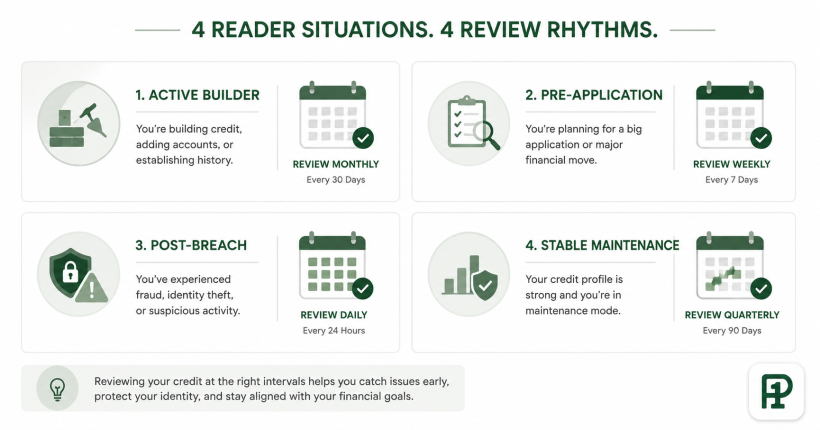
Set every credit account to autopay the minimum at minimum — this protects payment history from accidental misses caused by oversight. Enable balance alerts when you approach your personal utilization threshold on each card. Schedule one monthly review of statements for errors or unauthorized charges. Pull at least one full credit report per quarter, rotating through the three bureaus, so you always have a current picture without pulling all three at once.
The system that supports all of this — payment automation, utilization management, monitoring cadence, and score-building habits — is covered in the guide on how to build credit with better systems and habits.
Credit Score Ranges and What They Mean for Borrowing
Understanding where your score sits and what it unlocks is essential context for prioritizing this checkup work.
FICO Score Ranges and Real-World Impact
800-850 — Exceptional. Best available rates on all products. Lenders compete for borrowers in this range.
740-799 — Very Good. Excellent rates, easy approvals, access to rewards cards. Target range for major purchases.
670-739 — Good. Competitive rates, most approvals, standard card offers. Rate differences start to appear on mortgages and auto loans.
580-669 — Fair. Higher rates, conditional approvals, limited options. Mortgage rates 1-2% above average.
300-579 — Poor. Frequent denials, very high rates, secured products only. Mortgage rates 2-4% above average if approved.
On a $300,000 30-year mortgage, the difference between excellent and fair credit can exceed $150,000 in total interest paid over the life of the loan. That is the financial stake behind the credit checkup work in this guide.
Take Control of Your Credit Before the New Year
Your credit score is a financial lever that affects the cost of everything you borrow. The Credit Building and Protection hub maps the complete system — from monitoring and error disputes to utilization strategy, score building, and approval optimization.
Explore the Credit Building and Protection Hub →Frequently Asked Questions
How fast can my credit score improve from a year-end checkup?
Utilization improvements can show up within one billing cycle — sometimes within weeks of paying down a balance. Dispute resolutions take up to 30 days for bureaus to process. Payment history improvements take longer, requiring 3-6 months of consistent on-time payments before producing significant score movement. The fastest single action most people have access to is paying down high credit card balances before the statement closing date.
Does checking my own credit hurt my score?
No. Checking your own credit — through AnnualCreditReport.com, a free monitoring service, or a paid FICO product — generates a soft inquiry with zero impact on your score. Only hard inquiries from lender applications affect your score, and only temporarily. You can check your reports as often as you want without any negative consequences.
Should I use a credit repair service or handle this myself?
DIY credit repair works well for 1-3 simple errors with clear documentation. Consider professional services if you have multiple complex errors across all three bureaus, identity theft or mixed credit files, collections requiring skilled negotiation, or a time-sensitive situation where you need results quickly for a major purchase. Every action in this guide is something you can do yourself for free under the Fair Credit Reporting Act.
Will paying off collections improve my score immediately?
Not necessarily. Paying a collection changes its status from "unpaid" to "paid," which is better, but the collection itself may remain on your report for up to 7 years from the original delinquency date. Newer scoring models (FICO 9, VantageScore 3.0 and 4.0) ignore paid collections entirely — so impact depends on which model your lender uses. Negotiate pay-for-delete when possible to remove the entry completely.
How long do negative items stay on my credit report?
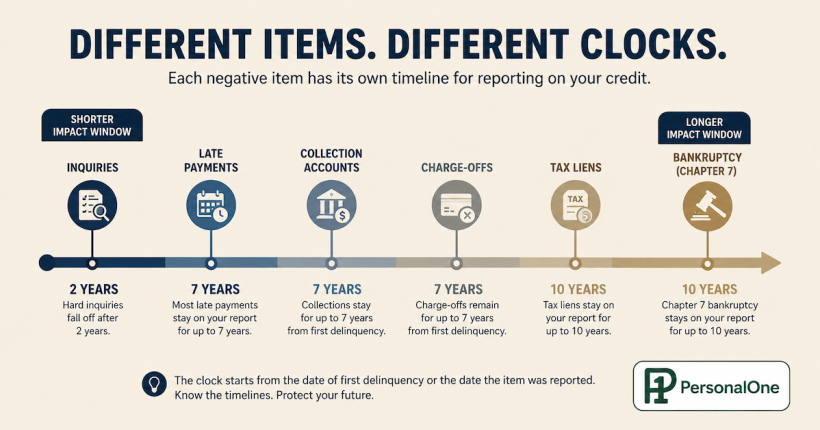
Most negative items remain for 7 years from the date of first delinquency: late payments, charge-offs, collections, and Chapter 13 bankruptcy. Chapter 7 bankruptcy remains for 10 years. Hard inquiries stay for 2 years but only impact your score for the first 12 months. The impact of negative items fades over time even before they fall off — a late payment from 5 years ago does far less damage than one from 6 months ago.
Official Sources
AnnualCreditReport.com — Free Official Credit Reports from All Three Bureaus
CFPB — Credit Reports and Scores
FTC — Fair Credit Reporting Act
MyFICO — Credit Education Center
Continue Learning About Credit
A year-end credit checkup is one layer of an ongoing monitoring system. The complete framework for protecting and building your credit year-round is in the Credit Building and Protection hub.
Disclaimer: This article is for educational purposes only and does not constitute financial, legal, or credit repair advice. Individual credit situations vary significantly. Credit score improvement timelines and results will differ based on your specific profile. Disputing accurate information on credit reports is illegal — always verify accuracy before disputing. PersonalOne is not a credit repair organization and does not offer credit repair services. Consult a qualified financial professional for personalized guidance.