Updated: May 15, 2026
Home › Credit Building & Protection › Credit Card Selection & Strategy › Why Your First Credit Card Matters More Than Your Score
Part of the Credit Card Selection & Strategy cluster.
About the Author
Don Briscoe is a financial systems strategist with 12+ years of experience helping Millennials and Gen Z build income and financial stability. He founded PersonalOne to provide the financial education he wished existed — structured, honest, and free.
What You Need to Know
— Your first credit card establishes your oldest account age — a factor that affects 15% of your credit score for decades.
— The right first card builds positive payment history (35% of score) from day one. A bad choice creates damage that takes years to repair.
— Credit score is a lagging indicator — your first card choice determines the trajectory before the score even matters.
— Starting with a predatory card (high fees, low limits, poor terms) makes it harder to qualify for better cards later.
— A solid starter card you keep open becomes your credit foundation — choose based on long-term value, not sign-up bonuses.
Your first credit card matters more than your credit score — and understanding why changes how you approach the entire decision. Most people starting out obsess over the three-digit number, checking it daily and treating it like it defines their financial identity. But the score is a report card. The card is the curriculum. What you choose first determines whether the report card was ever set up to be good.
Your first card is not just a piece of plastic. It is the foundation of your credit profile — and once you open it, that account becomes part of your financial history permanently. This guide covers why that first choice carries so much weight, what to look for, and what to do if you have already made a less-than-ideal start.
What Your Credit Score Actually Measures
A FICO credit score is calculated from five factors, each weighted differently. Payment history accounts for 35% — whether you pay on time, every time. Credit utilization accounts for 30% — the percentage of available credit being reported as used. Length of credit history accounts for 15%. New credit and credit mix account for 10% each. Together, payment history and utilization control 65% of the score. Both start with your first credit card, which is why selecting your first credit card is one of the highest-leverage financial decisions a person makes in their early adult life.
Your score is a report card showing how well you have managed that card. But the card itself — its limit, fees, terms, and how long you keep it open — determines whether you are even set up to succeed. The score follows the card, not the other way around.
Why Your First Card Sets Your Trajectory
It Establishes Your Oldest Account Age
Credit history length is calculated using your oldest account. Once you open that first card, the clock starts ticking. Keep it open for ten years and you have a decade of credit history backing every future application. Close it after two years because the fees were too high and you lose that anchor account — your average account age drops significantly.
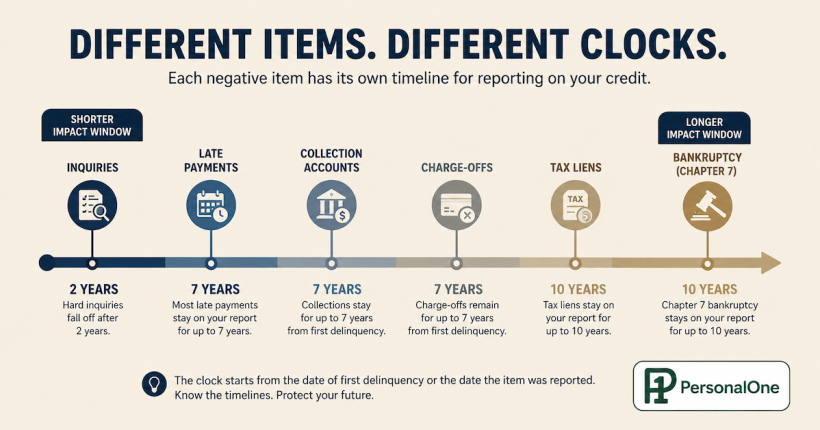
Even if you close the account, it stays on your credit report for up to ten years. But once it falls off, that history is gone permanently. If your first card is a predatory product you cannot afford to keep open, you are choosing between two bad outcomes: pay unnecessary fees for years to preserve the oldest account, or close it and restart your credit age from scratch.
A good first card eliminates this dilemma entirely. You keep it open indefinitely because there is no reason to close it.
It Determines Your Payment History Foundation
Payment history is the single largest factor in your credit score. Every on-time payment builds positive history. Every late payment creates damage that lingers for seven years. Your first card is where you learn credit habits — and the structure of the card shapes whether those habits are sustainable.
A card with high annual fees, confusing billing cycles, and predatory terms creates conditions where missing payments becomes more likely — not because the cardholder is irresponsible, but because the product is designed to generate fees. A no-fee card with clear terms sets up perfect payment history from day one. The card creates the behavior. The behavior creates the score.
It Shapes Your Utilization Patterns
Credit utilization is the percentage of available credit being reported as used. Your first card's credit limit determines how easy or hard this is to manage. A card with a $300 limit means $150 in grocery and gas spending reports as 50% utilization — a score penalty — even if the balance is paid in full. The same $150 on a card with a $1,500 limit reports as 10% utilization, which improves the score.
Low-limit predatory cards trap people in high utilization, which suppresses the score and makes it harder to qualify for better cards later. Understanding what credit utilization actually means and why the 30% rule is a myth is essential for managing this factor correctly from the start — the target is not 29%, it is closer to 10%.
What I've Seen
One of the most common patterns I have seen is people assuming their credit score is the problem when the real issue started with the first card they were approved for. A few years ago, I worked with a reader named Marcus, 24, who thought he had bad credit because his score stayed stuck in the low 600s despite paying on time consistently.
The real issue was the card itself. His first credit card came with a $300 limit, monthly maintenance fees, and multiple hidden charges buried in the agreement. Normal spending — gas, groceries, and a phone bill — pushed the reported balance above 60% utilization almost every month even when he paid most of it off quickly.
Because the limit was so low and the fees consumed part of the available credit automatically, the account kept signaling risk to the credit bureaus. Marcus thought he needed a higher score first before qualifying for something better, but the reality was the predatory card itself was suppressing the score and limiting future approvals.
Once he transitioned to a no-fee card with a higher limit and cleaner terms, utilization stabilized almost immediately and the score started recovering within a few reporting cycles. The lesson was simple but important: the first card often shapes the score long before the score shapes anything else.
The Compounding Effect of a Good First Card
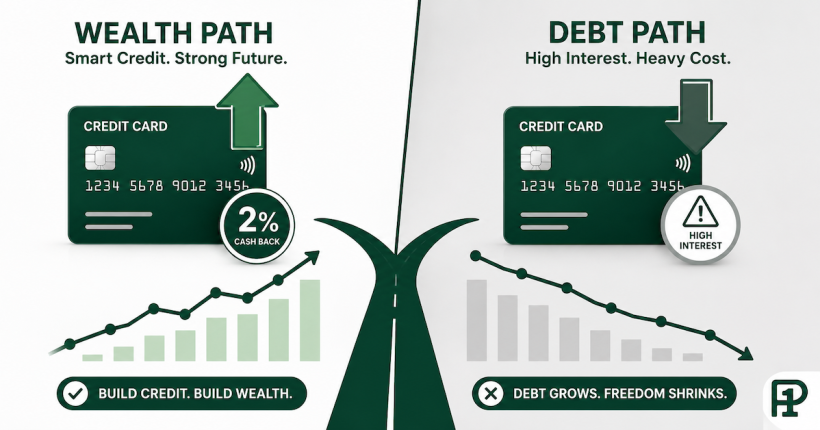
Your first card does not just affect your score. It affects your access to every future credit product. A strong foundation compounds forward: positive history leads to better card approvals, higher limits reduce utilization, better scores unlock premium products. A weak foundation compounds in the other direction: high fees lead to missed payments, damaged history leads to rejection for better cards, and the cycle of predatory products continues.
Most people assume they can fix a bad first card by opening a better one later. But credit approvals are based on existing history. If the first card damaged that history, every subsequent application starts from a disadvantaged position. The complete credit building and protection system covers how to build and protect this foundation across all five FICO factors — but it starts with the first card decision.
What Makes a Good First Credit Card
If the first card matters this much, the selection criteria need to be clear. There are four non-negotiables and a secondary list of nice-to-haves that matter less for starters.
Non-Negotiables
No annual fee — You need to keep this card open for years. Annual fees make that expensive and create a reason to close the account.
Reports to all three bureaus — Some cards do not report to Equifax, Experian, and TransUnion. If it does not report, it does not build your credit.
Reasonable credit limit — At least $500 to $1,000. Anything lower makes utilization management nearly impossible on normal everyday spending.
Clear terms — No hidden fees, confusing billing cycles, or predatory fine print. You need to understand what you are agreeing to.
Secondary features like rewards programs, mobile apps with payment reminders, and fraud protection are useful but not what you are optimizing for with a first card. The goal is credit infrastructure you can maintain indefinitely — not rewards you can maximize in year one. The guide on top credit cards for building credit covers which specific products meet these criteria in 2026 without requiring a hard pull to check eligibility.
For people who cannot qualify for an unsecured card, a secured card is a strong alternative. Many secured cards graduate to unsecured after six to twelve months of on-time payments and report to all three bureaus the same way. The full breakdown of how each type works and which builds credit faster is covered in the guide on secured vs. unsecured credit cards.
Common First Card Mistakes
Choosing Based on Sign-Up Bonuses
Sign-up bonuses are designed for people with established credit. For a first card they are a distraction. Cards with large bonuses typically carry high annual fees after the first year and spending requirements that encourage overspending. You are building a foundation, not gaming a system.
Applying for Multiple Cards at Once
Every credit card application creates a hard inquiry on your credit report. Multiple inquiries in a short period signal elevated risk to lenders. If denied for a first card, wait three to six months before applying again. Multiple rejections compound the difficulty of future approvals. Cards that offer pre-approval without a hard inquiry let you check your odds before formally applying — a smarter approach when you are starting out.
Carrying a Balance to Build Credit Faster
This is a persistent myth. Carrying a balance month-to-month does not build credit faster — it just costs interest. What builds credit is using the card regularly for normal purchases, paying the full balance each month, and keeping utilization below 10%. You do not need debt to build credit. You need consistent, responsible usage. How a credit card fits into a broader spending system — and why it outperforms a debit card for everyday purchases when used correctly — is covered in the guide on debit card vs. credit card.
Closing the Card After Getting a Better One
This is the most costly mistake. Closing your first card reduces your total available credit, which raises utilization on remaining cards. Once the closed account ages off your report, you permanently lose that history. If the first card has no annual fee, keep it open. Use it every few months for a small purchase, pay it off, and let it age. A dormant no-fee card is an asset, not a liability.
Build Credit That Works for Decades
Your first card is one piece of a complete credit-building strategy. How you manage utilization, payment timing, and account history determines whether credit becomes a long-term asset or a recurring problem. The PersonalOne build and protect your credit foundation guide covers all five FICO factors and how to use credit as a deliberate tool. Free, no signup required.
Framework-first. Less willpower. More infrastructure.
What to Do If You Already Have a Bad First Card
If this is not your starting point but a reflection point, there are three paths forward depending on the specifics of the card you have.
Option 1: Keep It Open
Even a bad card is better than no oldest account if it has no annual fee. Keep it open, pay it off, set up a small recurring charge on autopay, and let it age. The account's value to your credit profile comes from its age and payment history, not from how actively you use it.
Option 2: Request a Product Change
Some banks allow you to switch your card to a different product within their lineup without closing the account. This preserves the account age and credit limit while upgrading the terms. Call your issuer and ask directly — not all banks offer this, but it costs nothing to ask and the upside is significant.
Option 3: Accept the Loss and Build Forward
If the card carries a meaningful annual fee and no product change is available, closing it may be the right financial decision. You lose the account age benefit, but you stop paying unnecessary fees and can redirect that energy toward building positive history with a better card. Credit rebuilds. The timeline is longer than most people expect, but the path is straightforward.
The Long-Term View
Your credit score will fluctuate throughout your life. It drops when you apply for new credit. It rises when balances fall. It shifts with utilization and inquiries. None of those movements are permanent.
Your first credit card is different. That is a permanent foundation. Choose it based on what you can sustain for ten or more years — not what maximizes rewards in year one. A decade from now, applying for a mortgage with clean payment history on an account that has been open since you were twenty-two, the boring no-fee card will have done more for your financial life than any sign-up bonus ever could.
Resources
CFPB: What Is a Credit Card? — Consumer Financial Protection Bureau overview of credit card basics, terms, and consumer rights.
FTC: Credit Reports and Scores — Federal Trade Commission guidance on credit reporting, disputes, and protecting your credit profile.
myFICO: What's In Your Credit Score — Official FICO breakdown of all five score factors and their weights.
For the complete framework covering all five FICO factors, visit the Credit Building & Protection authority hub.
Frequently Asked Questions
Should I get a secured or unsecured card as my first card?
If you can qualify for an unsecured card with no annual fee, that is the better option. If you are denied, a secured card — where you deposit cash as collateral — is a solid alternative. Many secured cards graduate to unsecured after six to twelve months of on-time payments and report to the bureaus identically. The complete comparison is in the guide on secured vs. unsecured credit cards.
How long should I keep my first credit card open?
Ideally, indefinitely — especially if it carries no annual fee. Your first card becomes your oldest account, which directly benefits your credit score. Even after you have better cards, keeping the first one open with minimal usage preserves your credit history length and your total available credit.
Will closing my first credit card hurt my score?
Not immediately — the account stays on your credit report for up to ten years after closing, continuing to age. But once it falls off, that history is gone permanently. Closing also reduces your total available credit, which raises your utilization percentage on remaining accounts.
Can I upgrade my first credit card to a better one?
Some issuers allow product changes — switching to a different card within their lineup without closing the account. This preserves your account age and credit limit while upgrading the terms and features. Call your issuer and ask before closing and applying for a new card. Not all banks offer this option, but many do.
What credit score do I need for my first credit card?
Many starter cards approve applicants with no credit history or scores in the 580 to 620 range. Student cards and secured cards often have even more flexible requirements. Focus on cards designed for credit building rather than premium rewards cards that typically require scores above 700.
This content is for educational purposes only and does not constitute financial advice. PersonalOne is not a licensed financial advisor, broker, or investment professional. Individual financial situations vary — consult a qualified financial professional for personalized guidance. Credit card choices should be based on individual financial circumstances and creditworthiness. Always review terms and conditions before applying for credit products.