Updated: August 18, 2026
Home › Banking Systems › Where Your Paycheck Should Go First
Part of Banking Systems — the complete framework for structuring accounts, routing income, and automating your money.
What You Need to Know
— Where your paycheck lands first determines whether your money disappears within days or builds toward something, on autopilot.
— Money should reach its final destination within 48 hours of landing, automatically, not through manual transfers you have to remember to make.
— Direct deposit splitting, letting your employer route pieces of your paycheck to separate accounts, is the cleanest way to remove the decision entirely.
— Base your routing amounts on take-home pay, not gross income, and add a 10 to 15% buffer for bills that aren't monthly.
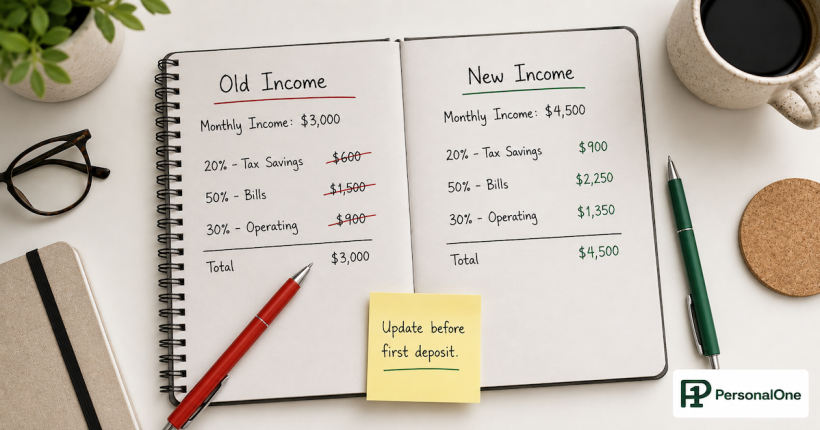
— Review your routing every few months, and immediately after any change in income, rent, or debt payments.
Most people treat payday as a decision point: money lands, then you figure out what to do with it. By the time you're deciding, you've already lost control. Paycheck money flow design flips that order. It's the practice of routing income to its destinations automatically, before you ever have the chance to spend first and save later.
This cluster hub covers the complete strategy: why the first 48 hours after payday matter most, the three routing strategies available to you, the mistakes that quietly break good routing setups, and how it all connects to the rest of your Banking Systems account structure.
Why the First 48 Hours After Payday Matter Most
Here's the pattern that plays out when income has no routing plan: the paycheck lands, the balance looks healthy, and you think "I'll transfer some to savings later." Rent and the car payment autopay a day or two later. By day four you're not sure how much is safe to move. By day seven, it's spent. Two weeks later, the cycle repeats.
That's not a discipline problem. It's a structural one. When income lands in the same account you spend from, three forces work against you: money that's visible feels spendable, willpower depletes the longer you delay a decision, and bills and spending always feel more urgent than savings, which can supposedly "wait."
The fix is to remove the decision entirely. When routing happens automatically within 48 hours, you never face the "should I transfer this?" question. The system executes before you have time to second-guess it.
Three Paycheck Routing Strategies
There are three ways to route income, each suited to a different situation. Most people do best with direct deposit splitting, but the right choice depends on income predictability and how complex your account structure already is.
Strategy 1: Single Landing Point With Automated Transfers
Your full paycheck deposits into one account, then automated transfers move money out 1 to 2 days later, splitting it across bills, savings, and spending.
Best for: consistent biweekly or monthly paychecks and simple account structures. Trade-off: there's a short window where the full amount sits in one account, which can tempt early spending.
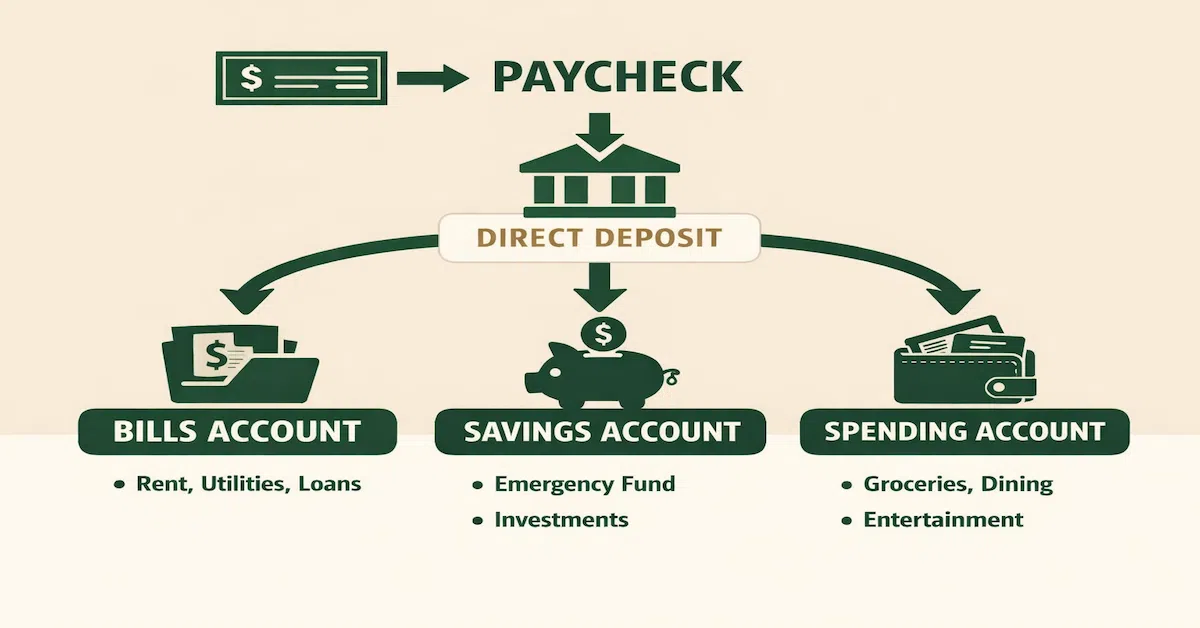
Strategy 2: Direct Deposit Splitting
Your employer splits the paycheck at the source, depositing set amounts directly into your bills, savings, and spending accounts. No secondary transfers, no window where money sits in the wrong place.
Example split for a $2,000 biweekly paycheck: $900 to bills (covering $1,800 in monthly bills), $200 to savings, $900 to spending.
Best for: W-2 employees with predictable pay who want zero manual intervention. Trade-off: requires employer support and is harder to adjust on the fly.
Strategy 3: Staging Account With Manual Review
Income lands in a dedicated staging account used only for receiving and distributing money, never for spending. You review and distribute within 48 hours on a set schedule.
Best for: freelancers, contractors, or anyone with multiple or irregular income sources. Trade-off: requires discipline to actually execute the transfer within the window; it isn't truly automated.
Start with direct deposit splitting if your employer supports it. If not, single landing point with scheduled transfers gets you most of the same benefit. Reserve the staging account approach for genuinely irregular income.
Common Income Routing Mistakes
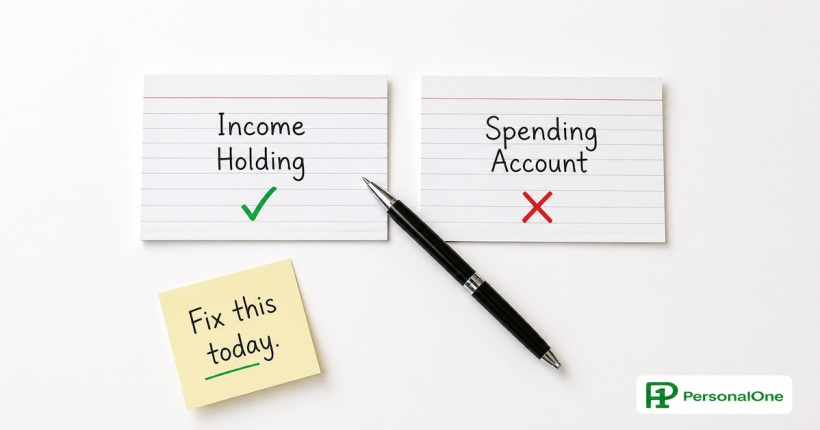
Routing Everything to One Spending Account
When all income lands in your spending account, the separation between bills, savings, and spending disappears, and every dollar competes for the same pool. Move money out within 48 hours using a split or scheduled transfer.
Setting Distribution Amounts Too Aggressively
Routing $600 to savings per paycheck sounds disciplined until you're pulling money back out by day 10 because spending needs were underestimated. Start conservative, track actual spending for two or three months, then adjust.
Ignoring Irregular Bills
Routine bills might total $1,800 a month, but car insurance hitting once every six months can drain the bills account without warning. Add a 10 to 15% buffer, or route an extra $50 to $100 per paycheck to cover irregular expenses.
Skipping Tax Reserves for Freelance Income
If you're self-employed, route 25 to 30% of gross income to a dedicated tax account before distributing the rest. Leave it untouched until quarterly payments are due.
Routing Based on Gross Instead of Take-Home Pay
Trying to route a percentage of gross income ignores taxes and pre-tax deductions already removed before the money hits your account. Always calculate routing amounts from your actual deposited paycheck.
Advanced Routing for Multiple or Irregular Income
Routing by income source: if you have a W-2 job plus a side hustle, consider routing them differently. Let your primary job cover bills and baseline savings for stability. Route side hustle income toward taxes, extra savings, and discretionary spending or debt payoff, since that's growth money rather than survival money.
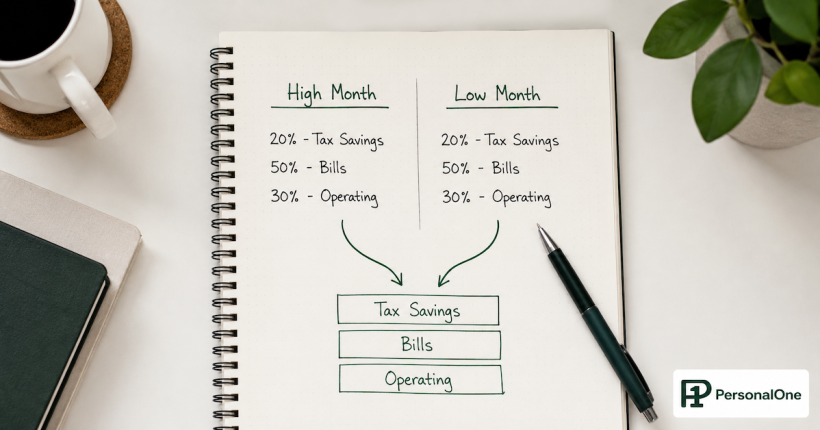
Seasonal income adjustment: if income varies by season, route extra from high-income months into an income-smoothing savings account, then draw from it during low-income months. This turns lumpy annual income into a consistent monthly cash flow.
Routing windfalls: set a standing rule for bonuses and tax refunds before they arrive, for example 50% to emergency fund or debt payoff, 30% to a savings goal, and 20% to guilt-free spending. Deciding in advance prevents "I'll decide later," which usually means spending all of it.
How Direct Deposit Splitting Connects to Your Bigger System
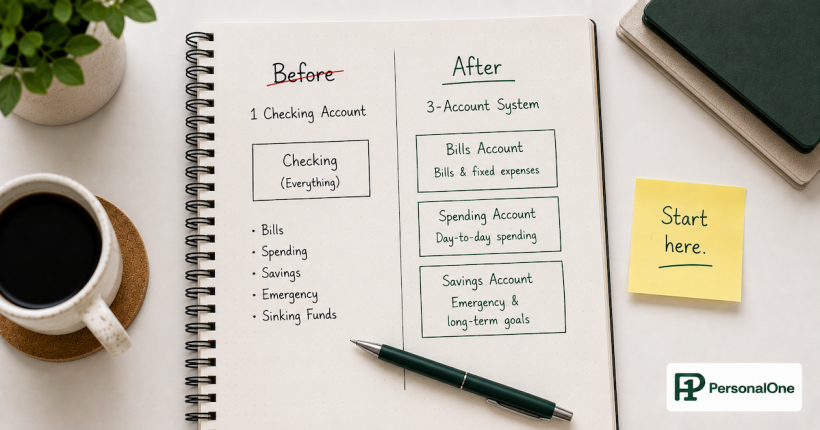
Paycheck routing isn't a standalone tactic. It's the input mechanism that feeds your entire account structure. Income routing gets money to land in the right places. Account structure keeps it separated into bills, spending, and savings zones once it's there. Financial automation makes the whole system run without ongoing manual effort.
Get the first step right and everything downstream gets easier. Get it wrong, and no amount of budgeting discipline fully compensates for money starting in the wrong place.
Build Your Complete Banking System
Paycheck routing is one piece of a working account structure. The Banking Systems hub covers how to separate accounts for control, protect against overdrafts, and automate the whole flow of your money.
More From This Hub
Return to Banking Systems for the complete framework — account structure, automation, and control.
Go Deeper: Paycheck Routing Guides
This hub covers the framework. For specific scenarios and step-by-step guidance, these guides go deeper:
Direct Deposit Splitting: The Smart Way to Control Cash Flow
A full walkthrough of setting up direct deposit splitting with your employer, step by step.
How to Route Income for Stability and Growth
Why obligations, then savings, then spending is the order that works, and how routing should shift as income grows.
What Happens When Income Hits the Wrong Account
The chain reaction that follows when a paycheck lands somewhere it shouldn't, and how to unwind it.
How to Adjust Your Paycheck Routing When Your Income Changes
What to update, and in what order, after a raise, a new bill, or a job change.
How to Route Income When Your Paycheck Isn't Predictable
Routing strategies built for commission, tips, or freelance income that changes month to month.
How to Set Up Income Routing When You're Starting From Zero
The first-time setup guide for readers with no accounts, no system, and no idea where to begin.
How to Route Income When You Have a Side Hustle
Keeping side income separate from your main job's routing so taxes and growth goals don't get lost.
How to Route Income When the Math Doesn't Work Yet
What to do when bills exceed income even before savings enters the picture.
Frequently Asked Questions
Can I change my income routing setup if it's not working?
Yes, and you should review it every 3 to 6 months, especially after a job change, raise, or rent increase. If you're constantly pulling money back from savings or your bills account keeps running dry, that's a signal to adjust the amounts, not a sign you've failed at the system.
What if my employer doesn't support direct deposit splitting?
Use single landing point routing instead. Set up automatic transfers through your bank that fire 1 to 2 days after payday. It's not quite as clean as splitting at the source, but scheduled transfers get you most of the same result.
Should I route a percentage of income or a fixed dollar amount?
Fixed dollar amounts are easier to predict and don't swing with overtime or bonuses. Route a specific number per paycheck rather than a percentage, and update it manually when your income changes in a lasting way.
How do I route income if I'm paid weekly instead of biweekly or monthly?
Divide your monthly bills total by 4 instead of 2, and do the same for your savings goal. Weekly paychecks actually make routing easier since the amounts are smaller and more frequent, which lowers the risk of one big miscalculation.
What happens when my paycheck varies due to overtime or commissions?
Base your routing on your minimum guaranteed income, not your best month. Route bills and savings against that floor, then let anything above it act as a buffer or go toward extra savings and debt payoff.
Should I route money to pay off debt or build savings first?
Build a starter emergency fund first, around $1,000 or one month of essential expenses, then prioritize debt above 7 to 8% interest. Once high-interest debt is cleared, split routing between savings and any remaining debt payoff.
PersonalOne Money System
This content is researched, written, and owned by PersonalOne — a free financial education platform built to help Millennials and Gen Z build real financial systems.
This content is for educational purposes only and does not constitute financial advice. PersonalOne is not a licensed financial advisor, broker, or investment professional. Individual financial situations vary — consult a qualified financial professional for personalized guidance.