November, 2026
Home › Banking Systems › Where Your Paycheck Should Go First › How to Route Income for Stability and Growth
What You Need to Know
— How your paycheck gets distributed in the first 24 hours after it arrives determines every financial outcome downstream — routing is the highest-leverage decision in personal finance.
— The sequence matters as much as the amounts — obligations first, then savings, then spending. Reversing the order means savings only happens if something is left over, and something is never left over.
— Stability routing and growth routing are two distinct modes — stability routing builds the financial floor, growth routing builds above it once the floor is solid.
— Direct deposit splitting allows your employer to send portions of each paycheck to separate accounts automatically — the cleanest implementation of routing with zero manual transfer required.
— Routing evolves as income grows — the allocation percentages that build stability at $3,500 per month are not the same ones that build wealth at $7,000 per month.
— The most common routing mistake is treating income as a single pool to allocate from after it arrives — by then the psychological pressure to spend it is already operating.
Most people manage money reactively. Income arrives, expenses present themselves, and whatever remains at the end of the month gets saved — if anything remains at all. This is not a discipline failure. It is a sequencing failure. When income lands in a single account with no routing instructions, the default spending pressure of daily life determines where it goes. Intentions compete against friction, and friction usually wins.
Deliberate income routing replaces reactive management with a system. Before any spending decision happens, money has already been distributed to its intended destination. Bills are funded. Savings are transferred. What remains in the spending account is genuinely available — not provisionally available pending mental math about upcoming obligations.
This article covers how routing works, how to design a routing sequence that builds stability first and growth second, and how to use direct deposit splitting to make the entire system run without a single manual transfer. The complete framework for paycheck distribution — including how to design the accounts that receive each routed portion — lives in the cluster on how to route income for stability and growth. This article covers the routing logic itself.
Why Income Routing Is the Highest-Leverage Financial Decision
Every financial outcome — emergency fund built, debt paid down, investments funded, spending controlled — traces back to what happened to money in the hours after it arrived. That window is when routing determines everything. Once money has sat in a checking account for two days, the psychological claim on it has shifted. It feels available. The urgency that would have prompted an immediate savings transfer has dissipated. The money gets spent.
This is not a character flaw. It is how human beings respond to the presence of money. The behavioral research is consistent: people spend what is visible and accessible, and they save what is not. Routing is the mechanism that moves money out of the visible and accessible category before spending pressure engages.
Most financial advice focuses on what to do with money over time — invest in index funds, pay down high-interest debt, build a six-month emergency fund. That advice is correct but incomplete. It skips the prerequisite: none of those outcomes happen consistently without a routing system that funds them automatically before the money becomes available to spend. Routing is not the interesting part of personal finance. It is the foundational part. Get it wrong and everything else is aspirational. Get it right and the outcomes follow with very little additional effort.
The Routing Sequence: Why Order Matters as Much as Amounts
A routing sequence is the order in which each portion of income gets claimed. The sequence determines which financial priorities are protected and which are left to compete for whatever remains. There is one sequence that works and several that do not.
The sequence that works: obligations first, savings second, spending last. This order is not arbitrary. It reflects the hierarchy of financial consequence. Missed obligations have immediate, compounding effects — late fees, credit damage, service interruption. Missed savings contributions delay financial security and compound quietly in the opposite direction. Spending is the only category that is genuinely adjustable in real time. It should receive whatever remains after the non-negotiables are funded, not the other way around.
The sequence most people actually use, by default: income arrives, spending happens throughout the pay period, whatever is left gets saved if the mood is right and the balance is sufficient. This inverted sequence is why savings accounts stay thin even at decent income levels. It is not that people do not want to save. It is that saving is structurally positioned as the last claim on income rather than the second.
The Routing Sequence in Practice
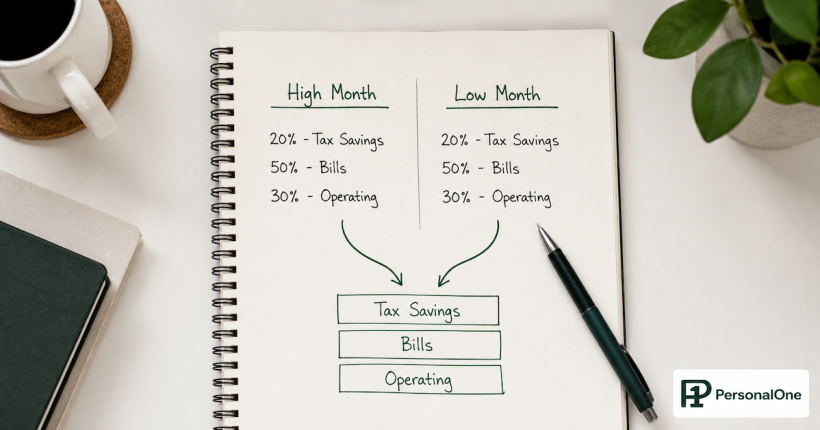
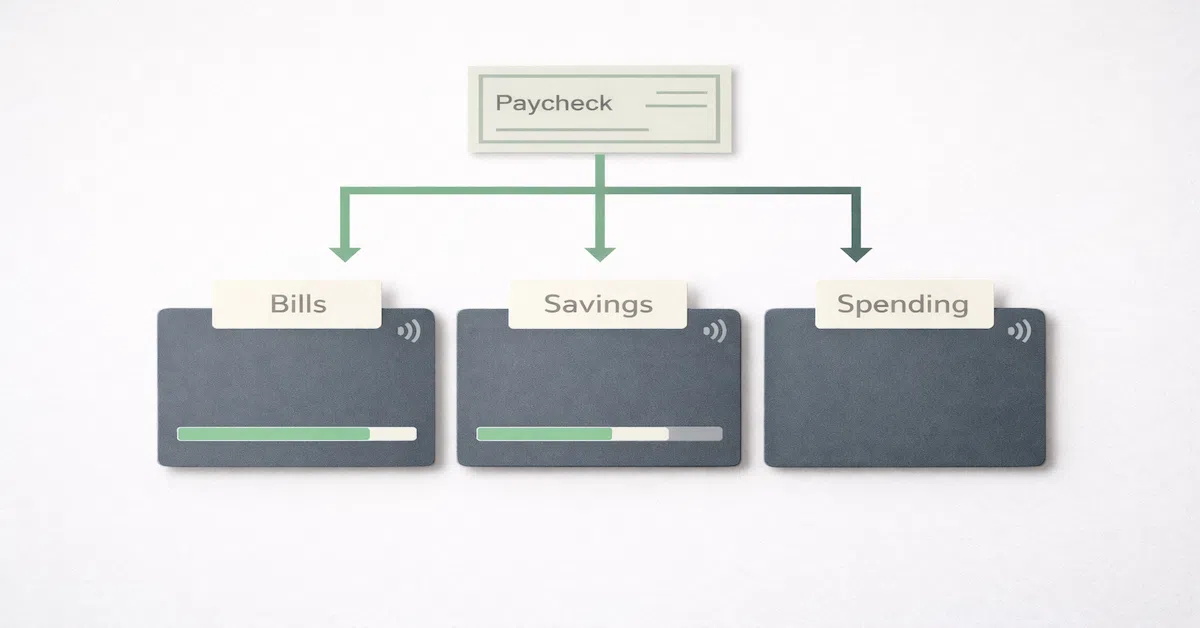
Step 1 — Income arrives in primary checking account (income landing account)
Step 2 — Obligations transfer automatically to bills account within 24 hours of deposit
Step 3 — Savings transfer automatically to savings account at the same time
Step 4 — Spending account receives remainder — this is the only balance you consult for day-to-day decisions
By the time you think about spending, obligations and savings are already funded. The decision space has been reduced to: is there money in the spending account? That is the only question that needs answering.
Stability Routing: Building the Financial Floor
Stability routing is the first mode. It applies when the financial floor — a funded emergency fund, zero high-interest debt, consistent bill payment, and predictable monthly cash flow — has not yet been fully built. The goal of stability routing is to get every dollar working toward that floor as efficiently as possible.
In stability routing, the savings allocation goes entirely to the emergency fund until it reaches its target. Typically three to six months of essential expenses, though one month is a meaningful first milestone that changes the financial risk profile significantly. No money goes to investment accounts, vacation funds, or discretionary goals until the emergency fund is funded. The emergency fund is the floor. Everything else is above the floor. You cannot build above a floor that does not exist.
Stability routing also means aggressively reducing high-interest debt before any discretionary savings above the emergency fund floor. High-interest debt — credit card balances at 20 to 29 percent APR — produces a guaranteed negative return that no investment consistently offsets. Routing additional income toward debt elimination in this phase is not sacrificing growth. It is removing the largest drag on it.
The spending allocation in stability routing is set at the minimum sustainable level — not the minimum possible level, but the minimum that prevents the system from breaking down due to unrealistic constraint. A spending allocation that is too low creates constant friction, encourages raids on the savings account, and typically results in the whole system being abandoned. The goal is a spending amount that is genuinely livable, not impressive on paper.
Growth Routing: Building Above the Floor
Growth routing begins when the financial floor is solid: emergency fund fully funded, high-interest debt cleared, bills consistently covered, cash flow predictable. At that point the routing allocation shifts. The emergency fund contribution stops or drops to a maintenance level. The freed-up allocation redirects to investment accounts, additional debt paydown on lower-interest debt, or specific wealth-building goals.
The transition from stability routing to growth routing is a milestone worth recognizing deliberately. Most people either never make the shift because they stay in survival mode by default, or they make it too early — routing money to investments before the emergency fund is in place, which means a single unexpected expense destroys the investment position via credit card debt. The transition should be a conscious decision made against specific criteria, not a gradual drift.
Criteria for Transitioning to Growth Routing
— Emergency fund at three months of essential expenses minimum
— No high-interest debt (above 8 to 10 percent APR) remaining
— Two consecutive months with no overdrafts or savings account raids
— Bills account consistently covering all fixed obligations without shortfall
— Spending account allocation genuinely covering variable needs without end-of-period stress
If all five criteria are met, the floor is real. Growth routing is appropriate. If any criterion is unmet, that criterion identifies the current routing priority.
In growth routing, the savings allocation splits across multiple destinations: continued emergency fund maintenance (a small monthly contribution that rebuilds after any use), retirement investment contributions, a mid-term goals account, and potentially debt paydown on lower-interest obligations. The exact split depends on individual priorities, but the routing logic is the same — automatic, sequenced, and resolved before spending begins.
How to Calculate the Right Allocation for Each Destination
Routing allocation starts with a fixed constraint: your total monthly take-home income is the ceiling. Everything allocated must fit within that number. The calculation works backward from obligations.
Step 1: Total your fixed monthly obligations. Every bill with a predictable amount and a due date — rent or mortgage, car payment, insurance premiums, loan minimums, fixed subscriptions. This number goes to the bills account. It is non-negotiable. Do not estimate; pull three months of statements and confirm the exact total including prorated annual charges divided by 12.
Step 2: Determine your savings allocation. In stability routing, this is the largest defensible contribution to the emergency fund without breaking the spending account. A useful starting point is 10 to 15 percent of take-home income. If your bills are unusually high, it may be 5 percent. The minimum worthwhile contribution is $50 per pay period — below that the habit value is preserved but the compounding effect is negligible.
Step 3: The spending account receives the remainder. Take-home income minus bills allocation minus savings allocation equals spending allocation. This is not a target — it is a result. If the result is insufficient to cover realistic variable expenses, the bills or savings allocations need to be audited. Do not set the spending allocation so low it cannot sustain daily life; an unsustainable spending constraint produces system abandonment, which is worse than a slightly lower savings rate.
Allocation Example — $4,800 Monthly Take-Home
Fixed obligations (bills account): $2,400 — 50%
Savings allocation (emergency fund): $480 — 10%
Spending account remainder: $1,920 — 40%
Biweekly transfers: $1,200 to bills, $240 to savings, $960 to spending per paycheck. By payday plus one day, every dollar has a destination. The spending account balance on day two is the actual spending limit for the period.
Direct Deposit Splitting: The Cleanest Routing Implementation
Direct deposit splitting is a feature offered by most employers that allows you to specify multiple bank accounts for paycheck distribution, with either fixed dollar amounts or percentages going to each account. It is the cleanest possible implementation of income routing because the distribution happens at the source — before the money ever touches your primary checking account.
With direct deposit splitting configured, your paycheck does not arrive as a single deposit to be manually divided. It arrives already divided: the savings portion goes directly to the savings institution, the bills portion goes directly to the bills account, and the spending portion arrives in the spending account as the only deposit you see in that account. The routing is complete before you have interacted with the money at all.
To set up direct deposit splitting, contact your employer's payroll department or access your employee self-service portal. You will typically need the routing number and account number for each destination account. Most payroll systems allow two to four destination accounts. Specify either a fixed dollar amount for savings and bills with the remainder going to spending, or specify percentages if your income varies.
If your employer does not offer direct deposit splitting — some smaller employers and contract payment platforms do not — automatic bank transfers scheduled for the day after deposit accomplish the same result. The key is that the transfers execute before you interact with the balance, not after you have decided to initiate them manually.
How Routing Evolves as Income Grows
Income growth does not automatically translate into wealth growth. Without a routing system that captures the additional income deliberately, lifestyle inflation absorbs it. Each income increase expands the spending account by default unless the routing allocation is updated to redirect the additional amount toward savings and investment.
The practical rule is to route at least 50 percent of every income increase above baseline. If take-home income rises by $400 per month, route at least $200 of that increase to savings or investment before updating the spending allocation. This preserves the lifestyle improvement while preventing the full increase from disappearing into higher discretionary spending.
As income grows, the routing destinations also expand. Stability routing has two savings destinations — emergency fund and debt paydown. Growth routing may have five or six: emergency fund maintenance, retirement accounts, a home down payment fund, a medium-term investment account, a goals fund, and a travel or experience allocation. Each destination requires its own routing line, either through direct deposit splitting or automatic transfers. The mechanism is the same regardless of the number of destinations; the complexity scales with the number of accounts, not with the difficulty of the routing logic itself.
Common Routing Mistakes That Keep People Stuck
Treating income as a single pool. When the full paycheck lands in one account with no routing instructions, every dollar is psychologically available to spend. The routing has to happen before spending pressure engages — which means it must be automatic, not intentional. Manual allocation after the fact consistently underperforms automatic allocation at the source.
Saving what is left rather than what is planned. End-of-month saving produces unpredictable, typically small savings contributions. Pay-yourself-first routing produces consistent contributions regardless of how the spending period went. The difference in outcomes over five years is not marginal. It is the difference between a funded emergency account and an empty one.
Setting the savings allocation too high for sustainability. A routing design that forces the spending account too low creates constant pressure to raid savings for normal expenses. Every savings raid trains the system to treat the savings account as a backup spending pool, which defeats the structural separation entirely. A lower, sustainable savings rate that never gets raided produces better outcomes than an ambitious rate that gets overridden monthly.
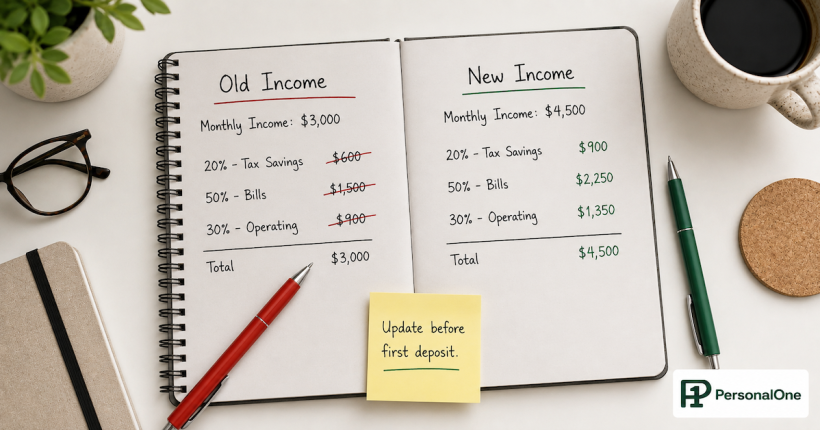
Never updating the routing allocation. A routing design set at $3,200 monthly take-home becomes incorrect at $4,500 monthly take-home. Bills change. Income changes. Savings goals complete and redirect. The routing allocation is not a set-and-forget configuration for life — it is a set-and-review-quarterly configuration that captures income growth and reflects current financial priorities.
Routing to savings and investments before eliminating high-interest debt. A 22 percent APR credit card balance is a guaranteed 22 percent negative return. No savings account and no investment portfolio consistently offsets that cost. Until high-interest debt is eliminated, routing additional income to savings above the emergency fund floor is almost always the wrong sequencing decision. Pay down the debt first. Then route toward growth.
Routing is the logic. The account structure is what makes it work.
Income routing without the right account architecture is money in motion with nowhere specific to land. The complete Banking Systems hub covers how to build the accounts, configure the automation, and design the structure that turns a routing plan into a system that runs itself.
Explore the Banking Systems Hub →More From Where Your Paycheck Should Go First
Direct Deposit Splitting: The Smart Way to Control Cash Flow — How to split your paycheck at the source so routing happens before spending pressure engages
You are here: How to Route Income for Stability and Growth
What Happens When Income Hits the Wrong Account — coming soon
How to Adjust Your Paycheck Routing When Your Income Changes — coming soon
Resources
CFPB — Bank Account Consumer Tools and Resources
FDIC — Consumer Protection and Deposit Insurance
CFPB — How to Set and Achieve Financial Goals
U.S. Department of Labor — Types of Retirement Plans
This article is part of the Banking Systems hub on PersonalOne — a complete framework for building the account structure and cash flow infrastructure that controls your financial outcomes automatically.
Frequently Asked Questions
What is the minimum savings contribution worth routing automatically?
The minimum contribution worth automating is $50 per pay period. Below that, the behavioral habit value is preserved — you establish the practice of routing savings before spending — but the compounding effect is negligible for years. More importantly, starting at $50 and increasing the amount over time produces better long-term outcomes than waiting until you can afford a more impressive number. Start where you are. Increase the amount with every income increase and every time a fixed bill decreases.
My employer does not offer direct deposit splitting. What is the next best option?
Automatic bank transfers scheduled for one business day after your expected deposit date accomplish the same result. Set them up through your primary checking account's bill pay or transfer scheduling feature. The one-day buffer prevents transfer failures if the deposit posts slightly late. The transfers should execute before you have logged in and seen the full balance — which means scheduling them for early morning the day after payday rather than end of day.
Should the bills account and spending account be at the same bank?
Yes, for operational efficiency. Same-bank transfers between the bills and spending accounts execute instantly or same-day, which matters if you ever need to move funds quickly. The savings account benefits from being at a separate institution specifically because the one to three day transfer window creates protective friction. Keep the operational accounts — bills and spending — at one institution. Keep the savings accounts at a different one.
How do I handle income from multiple sources with different timing?
Each income source routes through the same primary checking account and triggers the same transfer sequence. The simplest approach is to have all income land in the primary account first, then route outward to bills, savings, and spending via automatic transfers. If income sources arrive on predictable dates, schedule separate transfer batches for each income event. If timing is irregular, a buffer of one to two months of expenses in the primary account absorbs the variability and allows transfers to execute on a consistent schedule regardless of when each payment arrives.
When should I adjust my routing allocation?
Review routing allocations quarterly and whenever any of the following occur: income changes by more than 10 percent, a fixed bill increases or ends, a savings goal is completed and the contribution needs a new destination, or the spending account consistently runs out early or carries a large surplus at period end. The quarterly review takes 15 to 20 minutes and keeps the allocation aligned with your current financial situation rather than the situation that existed when you originally set it up.
Disclaimer: This content is for educational purposes only and does not constitute financial advice. Income routing strategies should be based on your individual financial situation, income stability, existing obligations, and financial goals. The allocation examples in this article are illustrative starting points, not prescriptions. Consult a qualified financial professional for personalized guidance on income allocation, debt payoff sequencing, and investment decisions.