Updated: April, 2026
Home › Investing & Wealth Growth › Retirement Account Strategy
Retirement Accounts Explained: 401(k), IRA, Roth & How to Use Them
TL;DR – Quick Takeaways
- Tax-advantaged accounts = most powerful wealth-building tool – Grow investments tax-free or tax-deferred. Massive long-term advantage.
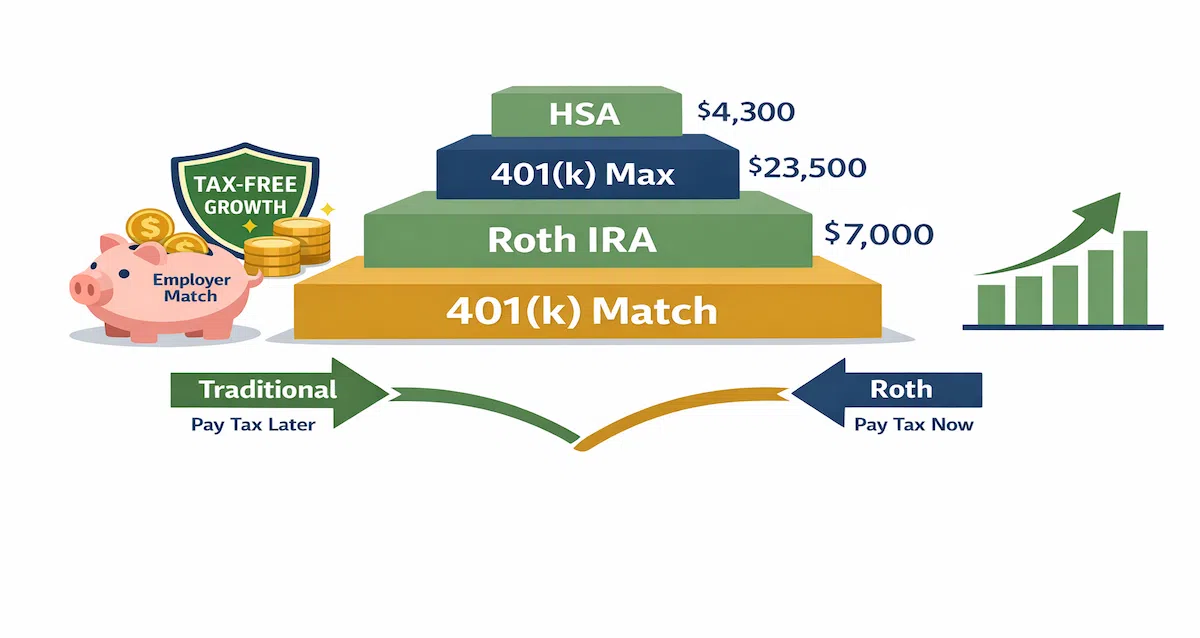
- Priority order: 401(k) match → Roth IRA → 401(k) max → HSA → Taxable – Optimize for free money first, tax advantages second.
- 401(k) employer match is 100% instant return – Contribute enough to get full match. Leaving this money on table is financial malpractice.
- Roth IRA = pay taxes now, grow tax-free forever – $7,000/year ($8,000 if 50+). Withdrawals in retirement completely tax-free.
- Traditional IRA = tax deduction now, pay taxes later – Lowers taxable income today. Pay taxes on withdrawals in retirement.
- 2026 contribution limits: $23,500 (401k), $7,000 (IRA), $4,300 (HSA) – $31,000, $8,000, $8,550 if age 50+.
- Roth vs Traditional decision: Current tax rate vs future tax rate – High earner expecting lower retirement income = Traditional. Young/lower earner = Roth.
- HSA = triple tax advantage (best account if eligible) – Tax-deductible contributions, tax-free growth, tax-free withdrawals for medical. Can be used as retirement account.
Why Tax-Advantaged Accounts Are Your Most Powerful Wealth Tool
The #1 wealth-building advantage most people underutilize: tax-advantaged retirement accounts.
Here's the math that changes everything:
Taxable Brokerage Account:
Invest $500/month for 30 years at 8% return = $745,179
Pay 15% capital gains tax on gains = $112,000 to IRS
You keep: $633,179
Roth IRA (tax-advantaged):
Invest $500/month for 30 years at 8% return = $745,179
Pay ZERO taxes on growth (it's a Roth)
You keep: $745,179
Difference: $112,000 more wealth by using the right account.
This is why tax-advantaged accounts—401(k), IRA, Roth IRA, HSA—are the foundation of retirement wealth. The government gives you massive tax breaks to incentivize saving for retirement. Use them.
The Account Priority Framework: Where to Invest First
Not all accounts are equal. You have limited dollars to invest. Here's the optimal order based on math, not emotion:
Priority 1: 401(k) Up to Employer Match
Why: Instant 100% return. If your employer matches 6%, contribute 6% minimum. That's $3,600/year in free money on a $60K salary. Never leave this on the table.
Amount: Whatever gets you full match (typically 3-6% of salary)
Priority 2: Roth IRA (if eligible)
Why: Tax-free growth forever. You'll pay 0% taxes on hundreds of thousands in gains. Best account for young people and low/moderate earners.
Amount: Max it out - $7,000/year ($8,000 if 50+)
Priority 3: 401(k) Beyond Match
Why: Tax-deferred growth. Lowers your taxable income now. Most people stop at the match—don't. Keep contributing.
Amount: Up to $23,500/year max ($31,000 if 50+)
Priority 4: HSA (if eligible)
Why: Triple tax advantage (deductible contribution, tax-free growth, tax-free withdrawals for medical). Can function as retirement account.
Amount: $4,300 individual, $8,550 family ($5,550/$9,850 if 55+)
Priority 5: Taxable Brokerage Account
Why: Once tax-advantaged accounts are maxed, this is where additional investments go. Still grows wealth, just less tax-efficient.
Amount: Unlimited
Example on a $75K salary:
- Contribute 6% to 401(k) = $4,500 (gets full employer match of $4,500)
- Max Roth IRA = $7,000
- Increase 401(k) to 10% = additional $3,000 (now $7,500 total)
- If still have money, max HSA = $4,300
- If still have money, open taxable brokerage
Total retirement contributions: $18,800/year = 25% of gross income. This is the path to retiring comfortably.
401(k): Employer-Sponsored Retirement Powerhouse
What is a 401(k)? An employer-sponsored retirement account that lets you invest pre-tax dollars. Your contributions reduce your taxable income, and investments grow tax-deferred until retirement.
2026 Contribution Limits:
- Under 50: $23,500/year
- Age 50+: $31,000/year (includes $7,500 catch-up contribution)
- Employer match: Does NOT count toward your limit (additional free money)
How employer matching works:
Example 1: 100% match up to 3%
You contribute 3% of salary ($60K × 3% = $1,800)
Employer matches 100% = $1,800
Total contribution: $3,600 ($1,800 yours + $1,800 theirs)
Example 2: 50% match up to 6%
You contribute 6% of salary ($60K × 6% = $3,600)
Employer matches 50% of that = $1,800
Total contribution: $5,400 ($3,600 yours + $1,800 theirs)
Example 3: Dollar-for-dollar up to 6%
You contribute 6% of salary ($60K × 6% = $3,600)
Employer matches dollar-for-dollar = $3,600
Total contribution: $7,200 ($3,600 yours + $3,600 theirs)
Key 401(k) rules:
- Vesting schedules: Your contributions are always 100% yours. Employer match may require 1-3 years before fully vested. Leaving early = forfeiting unvested match.
- Withdrawal penalties: Take money out before 59½ = 10% penalty + income taxes (with exceptions for hardship, first home, etc.)
- Required minimum distributions (RMDs): Must start taking distributions at age 73 (or face 50% penalty on required amount)
- Loan provisions: Some plans allow loans up to $50K or 50% of balance. You're borrowing from yourself but paying yourself back with interest.
Traditional 401(k) vs Roth 401(k): Many employers now offer both. Traditional = pre-tax contributions (lower taxable income now). Roth 401(k) = after-tax contributions (tax-free withdrawals later). Same decision framework as IRA vs Roth IRA (covered below).
Traditional IRA vs Roth IRA: The Tax Optimization Decision
The fundamental tradeoff: Pay taxes now or pay taxes later?
Traditional IRA:
- Contributions: Tax-deductible (reduces your taxable income this year)
- Growth: Tax-deferred (no taxes on dividends, capital gains while invested)
- Withdrawals: Taxed as ordinary income in retirement
- 2026 Limits: $7,000/year ($8,000 if 50+)
- Best for: High earners (22%+ tax bracket) who expect lower income in retirement
Roth IRA:
- Contributions: After-tax (no deduction, you've already paid taxes)
- Growth: Tax-free forever (no taxes on dividends, capital gains)
- Withdrawals: Completely tax-free in retirement (including all gains)
- 2026 Limits: $7,000/year ($8,000 if 50+)
- Best for: Young people, low-moderate earners (12-22% bracket), anyone expecting higher income in retirement
The decision framework:
Choose Traditional IRA if:
✓ You're in 22%+ tax bracket now
✓ You expect lower income in retirement
✓ You want to lower taxable income this year
✓ You're close to retirement (10-15 years)
Choose Roth IRA if:
✓ You're in 12% or 22% tax bracket now
✓ You're young (20s-40s) with decades to grow
✓ You expect higher income in retirement
✓ You want tax diversification
✓ You want flexibility (Roth contributions can be withdrawn anytime penalty-free)
Example scenario:
Age 28, single, $65K income, 22% tax bracket. Invest $7,000/year for 35 years at 8% return.
- Traditional IRA: Save $1,540 in taxes now ($7K × 22%). Total at 65: $1.2M. Pay taxes on withdrawals at ~22% = $264K to IRS. Net: $936K.
- Roth IRA: No tax savings now. Total at 65: $1.2M. Pay ZERO taxes on withdrawals. Net: $1.2M.
- Roth advantage: $264,000 more wealth.
Roth IRA income limits (2026):
- Single: Phase-out $146,000-$161,000 (can't contribute above $161K)
- Married filing jointly: Phase-out $230,000-$240,000
- Workaround: Backdoor Roth (contribute to Traditional IRA, immediately convert to Roth). Consult CPA.
HSA: The Triple Tax-Advantaged Secret Weapon
HSA (Health Savings Account) = the most tax-advantaged account that exists.
The triple tax advantage:
- Tax-deductible contributions: Like Traditional IRA, lowers your taxable income
- Tax-free growth: Like Roth IRA, investments grow without taxes
- Tax-free withdrawals for medical expenses: No other account has this (not 401k, not IRA, not Roth)
2026 Contribution Limits:
- Individual: $4,300/year ($5,550 if 55+)
- Family: $8,550/year ($9,850 if 55+)
Eligibility: Must have a High-Deductible Health Plan (HDHP). 2026 criteria: Deductible at least $1,650 individual / $3,300 family. Out-of-pocket max under $8,300 individual / $16,600 family.
How to use HSA as a stealth retirement account:
- Contribute the max every year ($4,300-8,550 depending on coverage)
- Invest it (don't leave cash) - most HSA providers let you invest in index funds once balance hits $1K-2K
- Pay medical expenses out-of-pocket (don't touch HSA funds)
- Save all receipts (no time limit on reimbursements)
- Let it grow for decades - 30 years at 8% turns $4,300/year into $540K+
- After 65: Can withdraw for ANY reason (taxed like Traditional IRA). Medical withdrawals still tax-free.
Why this works: You're essentially getting a Traditional IRA with bonus tax-free medical withdrawals. After 65, it functions like a Traditional IRA but with decades of medical receipts you can reimburse yourself for tax-free.
Ready to Build Your Complete Retirement Strategy?
Understanding retirement accounts is just the beginning. Learn the complete Stage 7 investing system including index fund selection, asset allocation, and long-term wealth building:
→ Master the complete Investing & Wealth Growth system
→ Investment fundamentals: Risk, diversification, asset allocation
→ What to invest in: Index funds and ETFs explained
Rollover Strategies: What to Do When You Change Jobs
Changing jobs? You have 4 options for your old 401(k):
Option 1: Leave it with old employer
Pros: Simple, no action required
Cons: Limited investment options, harder to manage multiple accounts, may have fees
Verdict: Only if old plan has exceptional low-cost funds
Option 2: Roll over to new employer's 401(k)
Pros: Consolidate accounts, maintain 401(k) benefits
Cons: New plan may have limited/expensive investment options
Verdict: Good if new plan has low fees and good fund selection
Option 3: Roll over to Traditional IRA
Pros: Total control, unlimited investment options, typically lower fees
Cons: Can complicate backdoor Roth conversions (pro-rata rule)
Verdict: Best option for most people
Option 4: Cash out
Pros: Immediate access to money
Cons: 10% early withdrawal penalty + income taxes + destroyed retirement wealth
Verdict: Almost never do this (exception: dire emergency and no other options)
How to execute a rollover:
- Open Traditional IRA at Vanguard, Fidelity, or Schwab
- Request "direct rollover" from old 401(k) provider
- Old provider sends check directly to new IRA custodian
- Funds transfer within 2-3 weeks
- Invest in low-cost index funds
Critical: Use "direct rollover" not "indirect rollover." Indirect = they send you a check, you deposit it. This triggers 20% withholding and you have 60 days to deposit or face taxes/penalties.
Common Retirement Account Mistakes (And How to Avoid Them)
Mistake #1: Not contributing enough to get full employer match
Employer matches 6%, you contribute 3%. You're leaving $1,800-3,000/year in free money on the table. Solution: Contribute AT LEAST enough for full match. This is non-negotiable.
Mistake #2: Cashing out 401(k) when changing jobs
$20K 401(k) cashed out at age 30. Penalties + taxes = $7K gone immediately. Lost compound growth over 35 years = $310K. Total cost: $317K. Solution: Always roll over to IRA or new 401(k).
Mistake #3: Not maxing Roth IRA when young
Age 25, eligible for Roth IRA, contribute $0 because "I'll do it later." At age 35, realize you missed 10 years of tax-free growth. Cost: $150K+ in lost wealth by age 65. Solution: Max Roth IRA every year in your 20s-30s. This is your biggest wealth lever.
Mistake #4: Paying high fees in 401(k)
Your 401(k) offers an S&P 500 fund with 1.2% expense ratio when Vanguard's is 0.03%. Over 30 years, that 1.17% difference costs you $140K on a $500K balance. Solution: Choose lowest-cost index funds in your plan. If all options are expensive, contribute to match only, then prioritize IRA.
Mistake #5: Taking 401(k) loans
Borrow $10K from 401(k) to pay off credit cards. Lose compound growth on that $10K. If you leave your job, loan becomes due immediately or counts as distribution (10% penalty + taxes). Solution: 401(k) loans are last resort. Build emergency fund to avoid this.
Mistake #6: Not diversifying within retirement accounts
100% in company stock in 401(k). Company fails (Enron, Lehman Brothers), retirement gone. Solution: Never hold more than 10% in single stock. Use diversified index funds.
Mistake #7: Ignoring Roth conversion opportunities
Low-income year (job loss, sabbatical, business startup). Could convert Traditional IRA to Roth at low tax rate. Don't do it. Miss massive tax optimization. Solution: Consult CPA about Roth conversions during low-income years.
Frequently Asked Questions
Can I contribute to both a 401(k) and an IRA?
Yes. 401(k) and IRA have separate contribution limits. You can contribute $23,500 to 401(k) AND $7,000 to IRA in the same year. However, if you're covered by a 401(k) at work, your Traditional IRA deduction may be reduced or eliminated at higher incomes ($77K-$87K single, $123K-$143K married in 2026). Roth IRA has separate income limits.
What if my employer doesn't offer a 401(k)?
Max out your Roth IRA ($7,000/year) first. Then open a taxable brokerage account and invest in low-cost index funds. Self-employed? Open a Solo 401(k) or SEP IRA with much higher contribution limits ($69,000 for 2026). Consult a CPA to optimize.
Should I do Roth or Traditional 401(k)?
Same decision framework as Roth vs Traditional IRA. If you're young (20s-30s) or in 12-22% tax bracket, choose Roth 401(k). If you're high earner (24%+ bracket) close to retirement, choose Traditional 401(k). Many people split 50/50 for tax diversification.
Can I withdraw from retirement accounts before 59½ without penalty?
Limited exceptions exist: Roth IRA contributions (not earnings) can be withdrawn anytime tax/penalty-free. First-time home purchase ($10K lifetime max from IRA). Qualified education expenses. Substantially equal periodic payments (SEPP). But generally, touching retirement money early destroys wealth. Build emergency fund to avoid this.
What should I invest in within my retirement accounts?
Keep it simple: Target-date funds (single fund, auto-adjusts as you age) or total market index funds (VTI, FSKAX, SWTSX). Avoid: Individual stocks, actively managed funds with high fees, sector funds, anything you don't understand. Boring index funds beat 80% of professional investors long-term.
How much should I have saved for retirement by age?
General guideline: 1x salary by 30, 3x by 40, 6x by 50, 8x by 60, 10x by 67. Example: Age 40 making $80K should have $240K saved. This assumes retiring at 67 and maintaining current lifestyle. Behind? Increase contributions now—every year of delay costs exponentially in compound growth.
Continue Learning
401(k), IRA, Roth Optimization
Why Your 401(k) Is Losing Money
Build the Foundation First:
- Stage 1: Financial Stability (Emergency Fund Required)
- Stage 4: Eliminate High-Interest Debt First
- Stage 6: Automate Your Contributions
Official Retirement Account Resources:
PersonalOne Money System
Built to help Millennials and Gen Z create structured financial systems that grow into long-term wealth.
Disclaimer: The information provided in this article is for educational purposes only and does not constitute financial, investment, tax, or legal advice. PersonalOne and its content creators are not licensed financial advisors, CPAs, or tax professionals. Retirement account rules, contribution limits, income limits, and tax implications are complex and change annually. The 2026 limits mentioned here are based on projected IRS adjustments and should be verified with official IRS publications before making decisions. Tax strategies like Roth conversions, backdoor Roth IRAs, and HSA optimization have specific rules and potential tax consequences that vary by individual situation. Before making retirement account decisions, consult with qualified professionals including a CPA for tax implications, a licensed financial advisor for investment strategies, and an attorney for estate planning considerations. Never make investment or tax decisions based solely on general educational content—your specific situation may require different strategies than those discussed here.