Updated: April, 2026
Home › Investing & Wealth Growth › Retirement Account Strategy › Retirement Savings Future
Retirement Savings Future: How to Build Income That Lasts 30+ Years
What You Need to Know
— Retirement is an income system, not a savings milestone.
— Inflation and healthcare are the biggest hidden risks over decades.
— Account strategy (tax-aware withdrawal sequencing, asset location) matters more than picking “hot” investments.
— Withdrawal timing and layered income sources (ladder) create resilience.
— Start structure early: automation, low fees, and tax-aware routing beat heroic one-off moves later.
Most people think retirement is about hitting a number. One million. Two million. Whatever sounds safe. The problem is that number doesn’t tell you how long your money lasts, how your expenses change, or how your income continues. It’s a static goal for a dynamic problem.
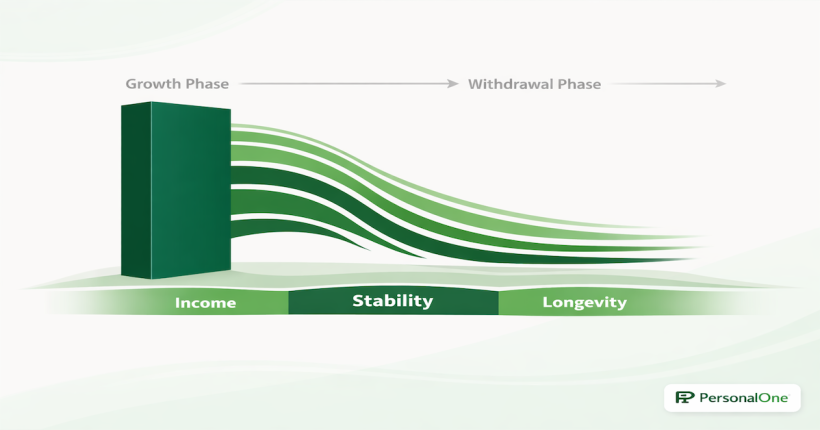
Your retirement savings future is not about reaching a finish line. It’s about building a system that continues to produce income long after you stop working. That system must survive inflation, market changes, healthcare costs, and a timeline that could easily stretch 30 years or more. Learn the practical steps in our retirement account strategy and how it fits inside the broader investing and wealth growth system. If you’re just getting started, see how small, consistent actions to start investing early accelerate everything that follows.
If you don’t build the system correctly, the number doesn’t matter. If you do build it correctly, the number becomes manageable. This article gives the practical tools: modeling inflation, planning for healthcare, withdrawal sequencing (Roth vs Traditional), income ladders, behavioral rules, concrete examples, and a step-by-step implementation plan you can use this year.
Inflation Modeling Over 20–30 Years
Inflation is the most underestimated force in retirement planning. It does not feel dramatic year to year, but over decades it compounds into something massive. A 3% inflation rate may seem harmless, but over 20 years it increases costs by roughly 81%, and over 30 years by nearly 142%.
That means a $50,000 lifestyle today could cost close to $90,000 in 20 years and over $120,000 in 30 years. Many retirement plans fail not because people didn’t save enough, but because they planned using today’s numbers instead of future reality.
Inflation affects everything: housing, food, transportation, utilities, and perhaps most importantly, healthcare. Nominal returns must beat inflation plus the taxes and fees you pay. When modeling, use conservative inflation assumptions (2.5–3.5%) and run stress scenarios at 4%+ to see downside impacts. That helps ensure your income system is robust.
Practical step: model your expected retirement spending in three buckets — essential (housing, food, healthcare), discretionary (travel, hobbies), and shock buffer (home repair, family support). Apply inflation assumptions separately where appropriate (healthcare inflation often runs higher than CPI).
Healthcare Cost Breakdown
Healthcare is the single biggest wildcard in retirement. Unlike other expenses, it tends to increase with age and is partly unpredictable. Medicare covers many basics but leaves significant out-of-pocket costs — premiums, deductibles, co-pays, dental, vision, and long-term care.
Fidelity’s annual healthcare cost estimates (widely used in planning) suggest a retired couple may need well over $300,000 over retirement for healthcare alone, depending on longevity and medical needs. Long-term care is separate and can add hundreds of thousands in outlays for assisted living or in-home care.
Practical actions:
- Build a dedicated healthcare buffer within retirement savings (separate from emergency or general savings).
- Maximize HSA contributions when eligible — HSAs are uniquely tax-efficient for medical costs and can be used strategically as part of retirement funding.
- Consider long-term care insurance in your 50s/60s if premiums are affordable and family risk is high.
- Plan for Medicare surtaxes and IRMAA impacts when modeling withdrawals and conversions.
Roth vs Traditional Withdrawal Scenarios
Most planners focus on accumulation; withdrawal strategy gets less attention. The tax treatment at withdrawal can change how long your money lasts and what you can spend.
Traditional accounts (401(k), Traditional IRA) give tax relief today; withdrawals are taxed as ordinary income in retirement. Roth accounts (Roth IRA, Roth 401(k)) are funded with after-tax dollars and grow tax-free — qualified withdrawals are tax-free. The choice affects required minimum distributions (RMDs), Medicare premiums, and estate planning.
Withdrawal sequencing matters. Example approaches:
- Conservative sequencing: draw first from taxable accounts, then tax-deferred, and preserve Roth as a tax-free buffer for later years or shock events.
- Tax-optimized sequencing: model marginal tax brackets year-by-year and withdraw from accounts to minimize lifetime taxes — this often includes small, strategic Roth conversions in low-income years to manage future brackets.
- Flexibility-first: maintain both Roth and Traditional balances to allow adaptive withdrawals depending on tax law and personal needs.
Specific example: drawing $40,000/year from a Traditional account could push you into higher income brackets, increasing taxes on Social Security and Medicare premiums. With a mixed bucket approach, you might pull $20,000 from a taxable account, $10,000 from Roth, and $10,000 from Traditional to stay in a lower marginal bracket.
Retirement Income Ladder Strategy
A retirement income ladder staggers income sources to smooth cash flow and reduce portfolio stress. Think of it as building complementary layers:
- Layer 1 — Guaranteed income: Social Security, pensions, annuities (if used) — predictable base.
- Layer 2 — Tax-efficient accounts: Roth withdrawals and HSA reimbursements — flexible and tax-free sources.
- Layer 3 — Tax-deferred accounts: Systematic withdrawals from 401(k)/IRA sized to remain within tax targets.
- Layer 4 — Taxable investments: Brokerage accounts used opportunistically to manage taxes and rebalancing.
- Layer 5 — Active income/side work: Part-time income early in retirement reduces portfolio withdrawal pressure.
Example ladder: delay Social Security until full retirement age or beyond to increase guaranteed income; use taxable and Roth accounts to fund early retirement years; begin tax-deferred withdrawals strategically near needed ages after optimizing conversions.
Real Case Comparison: Moderate vs Aggressive Saver
Two hypothetical savers illustrate system effects:
Moderate Saver: Starts saving in mid-20s, contributes 10% of salary, increases contributions with raises, uses low-cost index funds, and automates contributions. Over 40 years, compounding and steady contributions yield a large, diversified portfolio with lower stress.
Aggressive Saver: Starts in mid-40s, contributes 25% of income, uses aggressive asset allocation and high-fee active managers to catch up. While possible to accumulate a sizable balance, this approach carries higher sequence-of-return risk, tax planning complexity, and often more stress.
Why the moderate saver often wins: time for compounding, lower fees, and consistent contributions reduce sequence and behavioral risk. Catching up late requires higher savings, careful tax planning (catch-up contributions, Roth conversions), and often tighter spending trade-offs.
Building the PersonalOne Retirement System
A dependable retirement system has five components:
- Control: predictable cash flow, emergency buffer, and simple budgeting so retirement contributions are sustainable.
- Structure: account architecture (separate accounts, automated routing) that enforces savings behavior.
- Automation: recurring contributions, auto-escalation, and automated rebalancing to remove friction.
- Protection: insurance, conservative allocations for essential income, and buffers for healthcare or market downturns.
- Growth: tax-aware investing, diversification, and low fees to maximize after-tax compounding.
Implementation sequence: control → structure → automation → protection → growth. Many people try growth first (picking investments) without the infrastructure; that’s a recipe for underperformance. Build the foundation first.
Build a Retirement System That Actually Works
Structure beats guessing. Start building your system today.
Explore Retirement Strategy →Actionable Steps: What to Do This Year
A focused yearly action plan keeps the system moving forward. Here are practical steps you can take over the next 12 months:
- Q1: Capture employer match, set initial automation, open an IRA if you don’t have one.
- Q2: Audit plan fees and fund lineups; move new contributions to low-cost options.
- Q3: Increase deferral by 1% and assess HSA eligibility; establish a healthcare buffer.
- Q4: Review tax planning opportunities—harvest losses if appropriate and plan small Roth conversions for low-income years.
These quarterly actions break a large problem into manageable pieces and create a review ritual that keeps your plan adaptive.
Examples & Simple Calculations
Example — Inflation impact: $60,000 essential spending today at 3% inflation becomes about $121,000 in 25 years. Simple math shows why targeting a static nest-egg number without inflation adjustment is dangerous.
Example — Fee difference: $200,000 invested at a 7% gross return with 0.1% fees vs 0.8% fees over 30 years results in a difference of roughly $150k+ in final balance. Fees compound like an invisible tax.
Behavior and Longevity Risk
Behavioral risk—selling at the worst time, panic withdrawals, or abandoning plans—can sink retirement plans faster than market performance. Longevity risk (outliving savings) is also real: modern retirees commonly face 25–35 years of retirement. Build conservatism into your spending rules and plan for longevity by testing withdrawal rates under stress scenarios.
Practical guardrails:
- Use a sustainable withdrawal rule (e.g., dynamic withdrawal rules rather than fixed 4% when markets are depressed).
- Maintain a short-term cash buffer (2–5 years) to avoid forced selling during market downturns.
- Review plan annually and adjust withdrawals based on portfolio health and income ladder activation.
Frequently Asked Questions
How much should I save for retirement?
Aim to save 10–15% of income as a long-term baseline. Increase with age and income—use employer match as the first priority and scale from there.
Is a 401(k) enough?
A 401(k) is a core component but rarely enough by itself. Combine it with IRAs, HSAs, and taxable accounts to build flexibility and tax-managed withdrawals.
What if I start late?
Focus on increasing contributions, automating savings, reducing fees, and considering catch-up contributions (available after age 50). Time matters, but disciplined catch-up strategies work.
When should I worry about long-term care?
Consider the risk in your 50s and evaluate insurance options if family history or health increases exposure. Plan a healthcare buffer regardless—it's the most common unexpected retirement drain.
Resources
IRS — Retirement Plans and Contribution Limits
U.S. Department of Labor — Employee Benefits Security Administration
Fidelity — Retirement Healthcare Cost Guide
Disclaimer: This content is for informational and educational purposes only and does not constitute financial, tax, or legal advice. PersonalOne does not provide individualized financial recommendations. Always consult a qualified professional before making financial decisions based on your personal situation. Investing involves risk, including the potential loss of principal.