March, 2026
Home › Credit Building & Protection › Credit Monitoring & Protection System › Credit Karma Review
What You Need to Know
— Credit Karma is genuinely free — it makes money by showing you product recommendations, not by charging you
— You get free credit scores from TransUnion and Equifax using VantageScore 3.0 — not the FICO score most lenders use
— Free credit monitoring with real-time alerts is the most useful feature for the majority of users
— The score you see on Credit Karma will often differ from what your lender pulls — sometimes by 20–50 points
— Best for: people starting their credit journey who need free monitoring and basic score tracking
— Not for: people optimizing for a mortgage or major loan who need their actual FICO score
Credit Karma is the most recognized name in free credit score monitoring — with over 130 million members, it has become the default starting point for millions of people checking their credit for the first time. But free always has a structure behind it, and understanding exactly what Credit Karma is and what it is not matters before you treat it as your primary credit tool. Where Credit Karma fits within a layered monitoring setup — including when to add Experian coverage and when to upgrade to paid tools — is covered in the Credit Monitoring & Protection System guide.
This review covers what Credit Karma actually provides, how it makes money, where it falls short, and who it genuinely serves well. No vague endorsements. No glossing over the VantageScore gap that trips people up right before they apply for a mortgage or auto loan. The complete framework for building credit, protecting it, and monitoring it across all three bureaus is in the Credit Building & Protection hub.
If you are deciding whether to use Credit Karma as part of your credit monitoring system, this gives you what you need to make that call clearly.
What Credit Karma Actually Is
Credit Karma is a free financial platform that provides credit score monitoring, credit report access, and personalized product recommendations. It was founded in 2007, acquired by Intuit in 2020, and now operates as a standalone brand within the Intuit ecosystem alongside TurboTax and QuickBooks.
The platform pulls your credit data from TransUnion and Equifax — two of the three major credit bureaus. Experian data is not included. Scores are calculated using VantageScore 3.0, a scoring model developed jointly by the three bureaus as an alternative to FICO. This distinction matters significantly, which is covered in detail below.
Credit Karma also offers free tax filing through Cash App Taxes (formerly Credit Karma Tax), a high-yield savings account, and an identity monitoring feature. For most users, the credit monitoring and score tracking remain the core reason to use it.
What You Get for Free
Credit Karma provides a meaningful set of features at no cost. Understanding what is included — and what the limitations of each feature are — helps you use the platform correctly rather than over-relying on it.
Credit Karma Free Features Breakdown
Free credit scores: VantageScore 3.0 from TransUnion and Equifax, updated weekly. You can check as often as you want with no impact to your scores — these are soft pulls only.
Free credit reports: Full TransUnion and Equifax reports available directly in the platform, updated weekly. You can see open accounts, payment history, hard inquiries, and derogatory marks without going to AnnualCreditReport.com.
Credit monitoring alerts: Real-time notifications when something changes on your TransUnion or Equifax report — new accounts, hard inquiries, address changes, or derogatory marks. This is the most genuinely useful feature for identity theft protection.
Score simulator: A tool that estimates how specific actions — paying down a balance, opening a new card, missing a payment — would affect your score. Useful for rough planning, not for precise predictions.
Approval odds: Before you apply for a credit card or loan, Credit Karma shows an estimated approval likelihood based on your credit profile. This helps reduce unnecessary hard inquiries on applications likely to be declined.
Identity monitoring: Scans for your personal information in data breaches and on dark web marketplaces. Basic coverage is included free; more comprehensive monitoring requires their paid tier.
For someone building credit from scratch or establishing their first monitoring system, this feature set covers the basics well. The real-time alerts alone make Credit Karma worth installing even if you use a different tool for your primary score tracking.
How Credit Karma Makes Money
Credit Karma does not charge users. It generates revenue by showing you personalized offers for credit cards, personal loans, auto loans, mortgages, and insurance products. When you click an offer and are approved, Credit Karma earns a referral commission from the financial institution.
This model is important to understand for two reasons. First, the product recommendations you see are not neutral — they are influenced by which companies have affiliate agreements with Credit Karma and what those agreements pay. A card with a $200 signup bonus may appear prominently not because it is the best card for your profile, but because it carries a strong referral fee.
Second, your financial data — spending patterns, credit profile, debt levels — is used to target you with relevant offers. Credit Karma is transparent about this in their terms of service, but most users do not read those terms. You are the product in the attention economy sense: your data generates the targeting precision that makes their offers valuable to advertisers. That is not a disqualifying fact, but it is one worth knowing going in.
The VantageScore Problem You Need to Know About
This is the most important limitation in this review and the one most users discover at the worst possible time.
Credit Karma shows you VantageScore 3.0. The majority of lenders — including most mortgage lenders, auto lenders, and credit card issuers — use FICO scores. These are different scoring models with different calculations, different weights assigned to the same factors, and different outcomes from the same underlying credit data.
According to the Consumer Financial Protection Bureau, FICO scores are used in over 90% of lending decisions in the United States. VantageScore has been gaining ground but remains the minority model in actual underwriting decisions.
Real-World Score Gap Example
A borrower with a 720 VantageScore on Credit Karma may find their FICO 8 score is 695 when the mortgage lender pulls it. That 25-point gap moves them from one rate tier to another, potentially adding thousands of dollars in interest over the life of the loan. This is not a hypothetical — it is a common experience that catches people off guard when they have been monitoring only their VantageScore.
The practical rule: use Credit Karma for ongoing monitoring and trend tracking. Before any major credit application — mortgage, auto loan, personal loan above $10,000 — pull your actual FICO score. Many credit cards provide free FICO scores as a cardholder benefit, which is worth checking before paying for access separately.
Credit Karma vs. Checking All Three Bureaus
Credit Karma monitors TransUnion and Equifax. Experian — the third major bureau — is not included. This matters because not all creditors report to all three bureaus. A collection account, hard inquiry, or new account that appears on your Experian report will not trigger a Credit Karma alert.
For complete credit protection, you need monitoring that covers all three bureaus. Experian offers free basic monitoring of your Experian report directly through their platform. Layering Credit Karma for TransUnion and Equifax coverage with Experian directly gives you full bureau coverage at no cost.
Alternatively, paid services like Experian IdentityWorks provide consolidated three-bureau monitoring with identity theft insurance. Whether that upgrade is worth paying for depends on your risk profile and how actively you are managing your credit.
Who Credit Karma Is Actually Best For
Credit Karma Works Well For
People starting their credit journey: If you are under 25 and building credit for the first time, Credit Karma gives you free score access, report visibility, and monitoring without any cost barrier. The approval odds feature helps you avoid hard inquiries on cards you are unlikely to get.
People recovering from credit problems: Monthly score tracking makes progress visible during a recovery period. Seeing your score move from 580 to 620 to 650 over 18 months is motivating in a way that abstract advice is not.
People who want identity theft alerts: Real-time notifications when new accounts or inquiries appear on your report provide a meaningful layer of protection, especially if you are not checking your credit report manually every month.
People who are not actively applying for major credit: If you are not planning a mortgage or major loan in the next 6–12 months, VantageScore tracking is sufficient for general awareness and trend monitoring.
Credit Karma Is Not the Right Primary Tool For
People preparing for a mortgage: Your lender will pull FICO scores. Use a credit card FICO benefit or a paid FICO access service to know your actual lender-facing score before you apply. The VantageScore gap can cost you a better rate tier.
People who need Experian monitoring: If a creditor or collection agency reports primarily to Experian, Credit Karma will not catch it. Add Experian direct monitoring alongside Credit Karma for complete coverage.
People who do not want targeted financial offers: The platform is built around recommendations. If that model bothers you, the free features come with that trade-off baked in — it cannot be separated from the product.
How to Get Started With Credit Karma
Signing up takes under five minutes. You provide your name, address, date of birth, and the last four digits of your Social Security number for identity verification. Credit Karma performs a soft pull to access your credit data — this does not affect your scores.
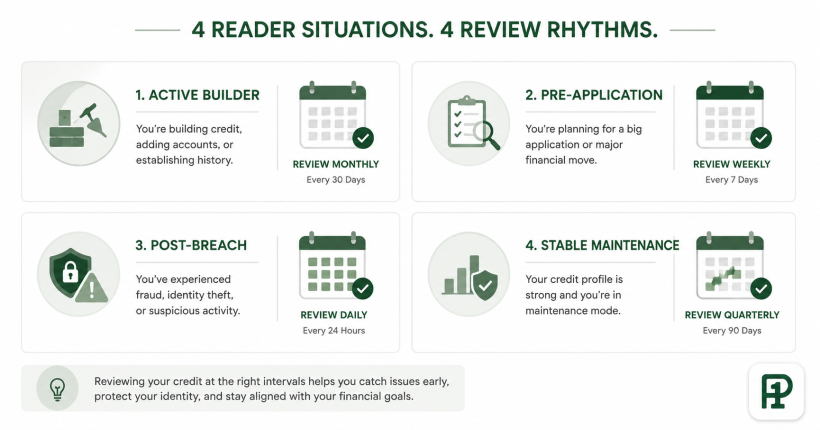
Once your account is set up, enable credit monitoring alerts immediately. This is the setting that delivers the most value and requires the least ongoing attention — you will be notified automatically if something changes on your TransUnion or Equifax report rather than needing to remember to check manually.
The two-step setup that gets the most out of Credit Karma: enable real-time monitoring alerts on day one, then immediately add Experian direct monitoring to fill the bureau gap. Together these two free tools provide coverage across all three bureaus at zero cost.
Create Your Free Credit Karma Account
Free VantageScore from two bureaus, real-time credit monitoring alerts, approval odds before you apply, and identity monitoring — all at no cost.
Get Started With Credit Karma (affiliate) →Affiliate link — PersonalOne may earn a commission at no cost to you. See disclosure below.
Credit Karma is one layer. A complete credit system covers all three bureaus.
How to structure credit monitoring across TransUnion, Equifax, and Experian — when to upgrade to paid tools and how to respond when something goes wrong — is in the Credit Building & Protection hub.
Explore Credit Building & Protection →Resources
Official Sources
CFPB — Credit Reports and Scores — Consumer Financial Protection Bureau guidance on how credit scores work, your rights to free credit reports, and how to dispute errors on your credit file.
AnnualCreditReport.com — The official federally mandated source for free credit reports from all three bureaus. You are entitled to free weekly reports from Equifax, Experian, and TransUnion.
FTC — Free Credit Reports — Federal Trade Commission guidance on your rights to free credit reports, how to access them, and what to do if you find errors.
Continue Building Your Credit System
Credit monitoring is the protection layer. The full framework for building, protecting, and optimizing your credit profile lives in the Credit Building & Protection hub. How to structure monitoring specifically — layering free and paid tools across all three bureaus — is in the Credit Monitoring & Protection System guide.
Frequently Asked Questions
Is Credit Karma actually free or is there a catch?
It is genuinely free to use. The business model is built on referral commissions when users click and apply for financial products through the platform. You are not paying with money — you are exchanging your financial data for targeting precision that makes those recommendations valuable to advertisers. That is the trade-off, and it is worth knowing upfront.
Why is my Credit Karma score different from what my lender sees?
Credit Karma uses VantageScore 3.0. Most lenders use FICO scores — a different scoring model. Both use the same underlying credit data but weight factors differently, which produces different scores from the same credit file. The gap is typically 10–40 points but can be larger depending on your credit profile. Before any major credit application, verify your FICO score through a credit card benefit that provides it or a paid FICO access service.
Does checking Credit Karma hurt my credit score?
No. Credit Karma uses soft inquiries to access your credit data. Soft pulls do not appear on your credit report and have no impact on your scores. You can check your scores and reports on Credit Karma daily without any effect on your credit.
Does Credit Karma show all three credit bureaus?
No. Credit Karma provides scores and reports from TransUnion and Equifax only. Experian data is not included. For complete three-bureau monitoring, supplement Credit Karma with Experian direct monitoring (free for your own Experian report) or a paid three-bureau monitoring service.
Is Credit Karma safe to use?
Credit Karma uses bank-level encryption and multi-factor authentication. As an Intuit company, it operates within the same security infrastructure as TurboTax and QuickBooks. The primary risk is not security — it is data usage for targeted advertising, which is disclosed in their terms of service. The platform is as secure as any major financial app for the data it accesses.
Should I use Credit Karma if I already get a free score from my credit card?
Yes, for a different reason. Many credit cards provide a FICO score from a single bureau. Credit Karma adds TransUnion and Equifax monitoring with real-time alerts that most credit card score features do not provide. Using both tools together gives you better coverage than either alone — FICO accuracy from your card, plus multi-bureau monitoring and alerts from Credit Karma.
Affiliate Disclosure & Disclaimer: This article contains an affiliate link to Credit Karma. If you create an account through that link, PersonalOne may earn a commission at no additional cost to you. This relationship does not influence our editorial assessment — we only recommend Credit Karma because it is genuinely useful for the use cases described, not because of the affiliate relationship. For all other products and services mentioned in this article, PersonalOne has no affiliate relationship and receives no compensation. This article is for informational and educational purposes only and does not constitute financial or legal advice. Credit monitoring features, bureau coverage, and platform terms change — verify current details directly with Credit Karma before relying on any specific feature.