Updated: June 3, 2026
Home › Credit Building & Protection › Credit Monitoring & Protection System
What You Need to Know
— Free monitoring from Credit Karma (TransUnion + Equifax) combined with Experian direct gives you all three bureaus at no cost.
— Real-time alerts are the most valuable feature — they catch unauthorized accounts and inquiries before damage compounds.
— A credit freeze is the strongest protection against new account fraud: free, reversible, and does not affect your existing accounts or credit score.
— Check your full credit reports at least twice per year — scores alone do not show errors, fraudulent accounts, or inaccurate derogatory marks.
— Identity theft response requires a specific sequence: fraud alert → freeze → dispute. Doing them out of order slows resolution.
Building a strong credit score takes months of consistent effort. Losing it to identity theft, a fraudulent account, or an undetected reporting error can happen in days. Credit monitoring is not optional infrastructure — it is the system that protects everything you are building.
This cluster hub covers the full credit protection system: what to monitor, how often, which tools to use at each budget level, how to freeze your credit, what to do when something goes wrong on your report, and how to respond to identity theft correctly.
Monitoring protects your score — building it is covered in the Credit Building and Protection hub, which maps the complete six-cluster credit authority framework.
Why Credit Monitoring Is Non-Negotiable
The FTC estimates that identity theft affects millions of Americans every year, with credit-related fraud accounting for a significant share of reported cases. In most situations, the victim has no idea their credit has been compromised until they apply for something — a mortgage, a car loan, an apartment — and the problem surfaces at the worst possible moment.
Monitoring does not prevent fraud. It reduces the window between when fraud happens and when you know about it. A monitoring system with real-time alerts can surface a fraudulent new account the same day it is opened. Without monitoring, that account may sit on your report for months before you discover it — long enough to damage your score significantly and complicate the dispute process.
Beyond fraud, monitoring catches legitimate errors — incorrect account statuses, payments reported late that were made on time, accounts belonging to someone with a similar name or Social Security number. The CFPB has found that a meaningful percentage of credit reports contain errors significant enough to affect lending decisions. Checking regularly is the only way to catch and dispute them before they cost you a loan approval or a favorable rate.
Free vs. Paid Monitoring: What You Actually Need
Most people do not need to pay for credit monitoring. A layered free system covers the same essential bases as most paid tiers for the majority of users.
Building a Free Three-Bureau Monitoring System
Credit Karma (free) — TransUnion and Equifax: Weekly score updates, full report access, and real-time alerts for both bureaus. Enable alerts immediately after setup. Score shown is VantageScore 3.0, not FICO.
Experian direct (free) — Experian bureau: Free monitoring of your Experian report with alerts for new accounts and inquiries. Completes the three-bureau coverage that Credit Karma does not provide.
AnnualCreditReport.com (free) — all three bureaus: Official free access to your full credit reports from all three bureaus, now available weekly. Use this to review full account histories, payment records, and hard inquiries that monitoring dashboards summarize but do not always show completely.
Credit card FICO benefit (free with qualifying cards): Many credit cards provide your actual FICO score as a cardholder benefit — Discover, Chase, Citi, and others offer this. Check your card benefits before paying for FICO access separately.
When Paid Monitoring Is Worth It
After an identity theft incident: Enhanced three-bureau monitoring with identity theft insurance and resolution support is worth the monthly cost during the recovery period.
3–6 months from a major loan application: Consolidated three-bureau reports and FICO score access in one dashboard reduces errors during the window when your score matters most.
After a data breach involving your SSN or financial accounts: Dark web monitoring and fraud insurance in paid tiers provides meaningful additional protection when sensitive data has been exposed.
How to Freeze Your Credit — and When
A credit freeze prevents new lenders from accessing your credit report. Since most credit issuers will not approve a new account without pulling your report, a freeze effectively stops new account fraud cold. Freezes are free, reversible, and do not affect your existing accounts, your current score, or any accounts already open.
How to Freeze All Three Bureaus
You must freeze each bureau separately — a freeze at one does not apply to the others.
Equifax: equifax.com/personal/credit-report-services/credit-freeze
TransUnion: transunion.com/credit-freeze
Experian: experian.com/freeze/center.html
Each bureau will provide a PIN or online account for managing your freeze. Store these securely — you need them to lift the freeze temporarily when applying for new credit.
Credit freeze vs. credit lock: A credit lock is faster to toggle via app but may carry a fee and is governed by the bureau's terms of service rather than federal law. A credit freeze is governed by the Economic Growth, Regulatory Relief, and Consumer Protection Act, which provides stronger legal protections. For most people, the freeze is the right choice.
If you are not actively applying for new credit, there is no downside to having all three bureaus frozen at all times.
How Often to Check Your Credit Reports
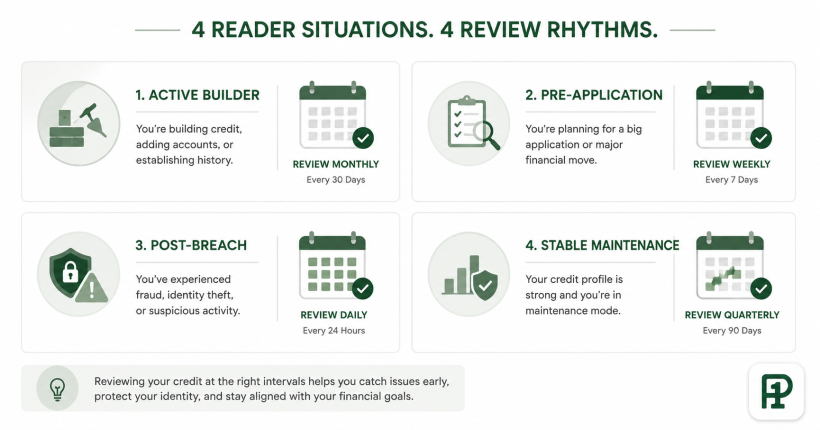
The minimum responsible schedule is twice per year — reviewing each bureau once every six months on a rotating basis. A more proactive schedule reviews one bureau every four months, cycling through all three over the year.
When reviewing, look specifically for accounts you did not open, hard inquiries you did not authorize, incorrect personal information, and payment statuses that do not match your records. Monitoring alerts handle the between-review period — the full manual review catches what alerts miss.
What to Do If Your Identity Is Stolen
Identity theft response requires a specific sequence. Doing steps out of order — for example, disputing accounts before placing a fraud alert — slows the resolution process and can complicate your legal standing.
Identity Theft Response Sequence
Step 1 — Place a fraud alert: Contact one bureau — it is required to notify the other two. A fraud alert requires lenders to take extra steps to verify your identity before extending credit. Initial alerts last one year; extended alerts for confirmed identity theft victims last seven years.
Step 2 — Freeze all three bureaus: Place a security freeze at Equifax, TransUnion, and Experian immediately to stop any new accounts from being opened.
Step 3 — Pull your full reports: Review all three bureau reports completely. Document every account, inquiry, or address you do not recognize.
Step 4 — File an identity theft report at IdentityTheft.gov: The FTC's official reporting site generates a personalized recovery plan and a report you can use with creditors and bureaus during the dispute process.
Step 5 — Dispute fraudulent accounts: Submit disputes to each bureau for accounts you did not open, using your FTC identity theft report as documentation. Bureaus are required to investigate and respond within 30 days.
Build the Full Credit Protection System
Monitoring is one layer of your credit authority framework. The Credit Building and Protection hub covers all six clusters — score building strategies, utilization and payment tactics, authorized user strategy, and optimization for major loan approvals.
Explore the Credit Building & Protection HubGo Deeper: Credit Monitoring & Protection Guides
This cluster hub covers the framework. For step-by-step execution and specific scenarios, use these supporting guides:
Credit Checkup: How to Find and Fix Credit Report Errors
A structured line-by-line review process for all three bureau reports — what each section should show, what red flags look like, and how to document anything that needs to be disputed.
Credit Karma Review: Is It Actually Worth Using?
What Credit Karma actually shows, where its two-bureau VantageScore data is reliable for tracking, where it falls short, and how to use it correctly alongside your actual FICO score.
How to Use Banking Tools to Rebuild Credit Faster
Secured cards, credit builder loans, autopay structure, and Experian Boost — how to connect your banking infrastructure to your credit rebuilding strategy and monitor the results in real time.
Free vs. Paid Credit Monitoring: What You Actually Need
Full comparison of monitoring tools by budget and risk profile — when free is enough, when paid coverage earns its cost, and how to build a complete monitoring stack at zero cost.
Coming Soon
How to Freeze Your Credit and Protect Yourself From Identity Theft
Step-by-step freeze process at all three bureaus, how to lift a freeze for new applications, what a freeze doesn't protect against, and how it fits into the complete identity protection system.
Coming Soon
How Often Should You Check Your Credit Report?
Situation-based review schedules for active builders, pre-application windows, post-breach periods, and stable maintenance — with specific timing triggers for each profile.
Coming Soon
How to Dispute a Credit Report Error Step by Step
The furnisher-and-bureau simultaneous dispute strategy that resolves errors more reliably than bureau-only submissions — with documentation requirements, timelines, and escalation steps.
Coming Soon
What Is a Fraud Alert and How Does It Protect You?
All three alert types explained as a decision framework — initial, extended, and active duty — with the honest "asks vs. requires" limitation and when a freeze is the stronger choice.
Coming Soon
Frequently Asked Questions
Does a credit freeze hurt my credit score?
No. A credit freeze has zero impact on your score. It does not affect your existing accounts, payment history, or utilization. The only thing a freeze does is prevent new lenders from pulling your report to approve new accounts. Your score continues to update normally while frozen.
Can I monitor all three bureaus for free?
Yes. Credit Karma covers TransUnion and Equifax with free real-time alerts and weekly score updates. Experian offers free direct monitoring of your Experian report. AnnualCreditReport.com provides free weekly access to full reports from all three bureaus. Layering these three tools gives you complete three-bureau coverage at no cost.
How do I dispute an error on my credit report?
The most effective approach is to dispute simultaneously with both the bureau reporting the error and the data furnisher — the bank or lender that sent the wrong information. Bureau-only disputes frequently close as "verified" because the bureau re-confirms what the furnisher already reported. Disputing the furnisher directly forces the source to correct the record, which then flows to the bureaus automatically. Each bureau also has an online dispute portal for direct submissions. Bureaus are required by the Fair Credit Reporting Act to investigate and respond within 30 days.
What is the difference between a fraud alert and a credit freeze?
A fraud alert notifies lenders to take extra verification steps before extending credit in your name — but it does not block access to your report entirely, and lenders are not legally required to comply. A credit freeze blocks all access for new credit decisions under federal law. A freeze is the stronger protection. Place a fraud alert if you suspect fraud but are still actively applying for credit; place a freeze if you want legally enforced maximum protection and are not applying for anything new.
Is Credit Karma safe to use?
Credit Karma uses industry-standard encryption and multi-factor authentication. As an Intuit company, it operates under the same security infrastructure as TurboTax. The primary trade-off is not security — it is data usage. Your financial profile is used to generate targeted product recommendations, which is how the platform earns revenue. That trade-off is disclosed in their terms. For credit monitoring purposes, the tool is reliable for what it covers — two bureaus with daily VantageScore updates and real-time alerts.
Government Resources
IdentityTheft.gov — FTC Official Identity Theft Recovery — Report identity theft and generate a personalized recovery plan.
AnnualCreditReport.com — Free weekly reports from all three bureaus, federally authorized.
CFPB — Credit Reports and Scores — Official guidance on monitoring, disputes, and consumer rights.
FTC — Fair Credit Reporting Act — Your legal rights regarding credit reporting, disputes, and freeze protections.
PersonalOne Money System
This content is researched, written, and owned by PersonalOne — a free financial education platform built to help Millennials and Gen Z build real financial systems.
This content is for educational purposes only and does not constitute financial, legal, or credit advice. Credit monitoring outcomes and identity theft recovery timelines vary based on individual circumstances and bureau response times. Always verify current processes directly with credit bureaus.