Home › Financial Automation › Investment Automation
Financial Automation › Cluster Hub
Automate Investing and Build Wealth Hub
Remove the timing anxiety and decision fatigue from investing — build systems that contribute to your wealth automatically, every period, without waiting for the perfect moment.
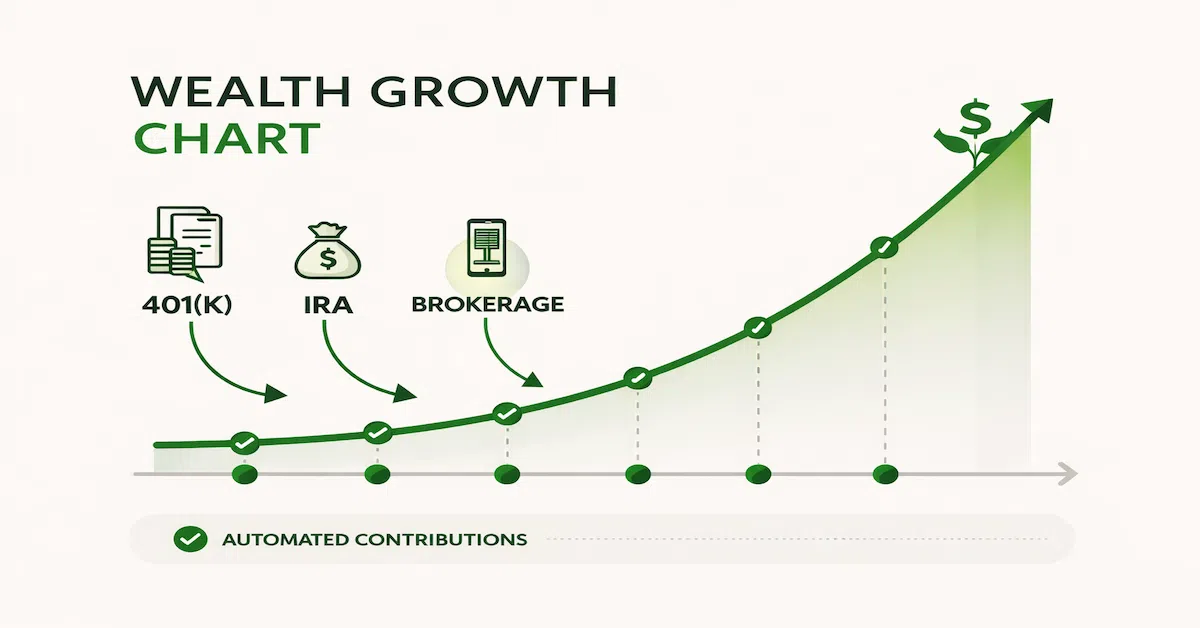
“I’ll invest when I have more money” is one of the most expensive sentences in personal finance. It delays the compounding that makes investing powerful — and the delay itself is the biggest cost. An automated investing strategy solves this by removing the decision entirely: contributions happen automatically on a schedule, invested in a pre-selected allocation, regardless of market conditions or monthly cash flow fluctuations. The system invests. You benefit from the compounding.
This is Cluster Hub 5 under the Financial Automation authority hub. It covers contribution mechanics — how to set up, schedule, and increase automated investments across 401(k), IRA, and taxable brokerage accounts — not investment strategy or asset allocation, which belong in the Investing & Wealth Growth hub.
What This Cluster Covers
This Cluster Covers
- 401(k) contribution automation and auto-increase
- Roth IRA automated contribution setup
- Recurring brokerage contributions
- Dollar-cost averaging mechanics
- Set-and-forget index fund investing
Covered Elsewhere
- What to invest in (Investing & Wealth Growth hub)
- Portfolio allocation strategy (Investing hub)
- Risk management frameworks (Investing hub)
- Investment account types explained (Investing hub)
The Investment Automation Framework
Investment automation follows a simple priority sequence: maximize free money first, then tax-advantaged accounts, then taxable accounts. Within each account, automation removes the timing decision that causes most investors to underperform their own investments.
Priority 1 — Capture the Employer Match
Every 401(k) with an employer match should be automated to at least the match threshold. A 50% match on contributions up to 6% of salary is a guaranteed 50% return on those dollars — no investment strategy replicates that return reliably. This is non-negotiable as a first automation priority. Set it at enrollment and revisit annually to confirm the contribution percentage still captures the full match as salary changes.
Priority 2 — Automate IRA Contributions
A Roth IRA funded through automatic monthly contributions of $50–$100 started in your mid-20s grows to a substantially larger amount than the same contributions started in your 30s, because the early years carry the most compounding time. Most brokerage platforms allow automatic monthly contributions from a linked checking account. The contribution goes in automatically, gets invested into a pre-selected fund automatically, and compounds without any ongoing action required.
Dollar-Cost Averaging as Built-In Strategy
Automated fixed-amount investing at regular intervals is dollar-cost averaging — buying more shares when prices are low and fewer when prices are high, without trying to time the market. The automation itself implements the strategy. Most people who try to time the market manually underperform those who invest the same amount on a fixed schedule. Automation removes the psychological temptation to wait for better conditions that rarely arrive at the right moment.
Annual Auto-Increase
Many 401(k) plans offer an auto-escalation feature that increases your contribution rate by 1% annually. Enabling this at enrollment means your contribution rate rises each year without requiring an active decision. Starting at 6% (to capture the match) and escalating by 1% annually reaches 15% in nine years — a strong retirement savings rate — through a series of increments too small to feel in each paycheck.
Articles in This Cluster
Coming Soon
How to Automatically Invest $50 Per Month
The step-by-step setup for a recurring brokerage contribution: which platform to use, how to connect your bank account, which fund to select for a set-and-forget approach, and what the long-run compounding looks like on a small consistent contribution.
Coming Soon
401(k) Auto-Increase Strategy Explained
How to set up automatic contribution escalation, what percentage to start at, how much to increase annually, and the long-run difference between escalating and staying flat.
Coming Soon
Dollar-Cost Averaging on Autopilot
Why automated fixed-amount investing outperforms market timing for most investors, how the math works across market cycles, and how to configure it so it runs without adjustment.
Coming Soon
Set-and-Forget Index Fund Investing
Why a single broad-market index fund on a recurring contribution schedule is a complete automated investment strategy for most people — and how to set it up in under 30 minutes.
Coming Soon
Automating Roth IRA Contributions Step-by-Step
Opening a Roth IRA, linking your bank account, setting a recurring monthly contribution, selecting a target-date or index fund, and enabling automatic investment — the complete setup walkthrough.
Explore the Full Financial Automation System
Investment automation is the final layer. The PersonalOne Financial Automation hub covers the complete system — banking infrastructure, budget automation, savings automation, and debt payment automation.
Return to Financial Automation Hub →Other Financial Automation Clusters
Banking Infrastructure Automation
Build the foundation that all other automations depend on.
Explore Banking Infrastructure →Budget Automation
Make your budget run without tracking every dollar manually.
Explore Budget Automation →Savings Automation
Save consistently without relying on willpower or memory.
Explore Savings Automation →Debt & Payment Automation
Automate debt payoff without risking your credit score.
Explore Debt Automation →