April 10, 2026
Home › Investing & Wealth Growth › Investment Fundamentals › Investing for Beginners
Investing for Beginners: What to Buy and How to Start Without Overthinking It
What You Need to Know
— Most beginners do not fail at investing because they pick the wrong asset — they fail because they never start
— The first priority is not picking stocks but building a stable financial system that supports consistent investing
— Index funds and ETFs provide the simplest and most reliable entry point for long-term investing
— Consistency matters more than timing — small amounts invested regularly outperform delayed “perfect entry” attempts
— The biggest risks early on are complexity, overconfidence, and reacting emotionally to short-term market movement
Investing for beginners is often presented as a decision about what to buy. In reality, it is a decision about how to build a system that allows money to grow without constant intervention. Most new investors approach the market as a series of isolated choices — which stock, which app, which trend. That approach creates hesitation and inconsistency because each decision feels high stakes.
A better approach is to treat investing as part of a structured system. The Investing & Wealth Growth system exists to remove guesswork and replace it with repeatable actions. This article focuses on the first layer of that system: how to start without overcomplicating the process.
Investing Starts With Your Financial Foundation
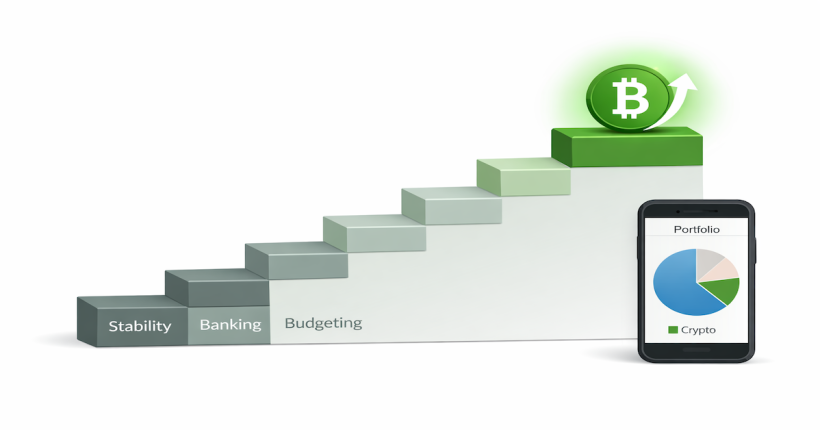
Before choosing investments, your financial structure determines whether investing will feel stable or stressful. If your income barely covers expenses, every market fluctuation will feel like a threat rather than a long-term opportunity. That leads to panic selling, inconsistent contributions, and abandoning the strategy altogether.
A stable foundation means your system can absorb normal life events without forcing you to interrupt your investing plan. This includes having basic cash reserves, manageable debt, and predictable cash flow. Without that structure, investing becomes reactive instead of strategic.
Start With Simple, Diversified Investments
Once your system is stable, the next decision is what to invest in. The most effective starting point is not complexity. It is diversification.
Index funds and exchange-traded funds (ETFs) allow you to invest in large groups of companies at once. Instead of relying on a single company to perform well, your investment tracks the overall market or a segment of it. This reduces risk and removes the need to constantly monitor individual positions.
Most long-term investors build their portfolios around these types of funds because they provide broad exposure, low costs, and consistent performance over time relative to active strategies.
The Beginner Decision Framework
Every investment decision should pass a simple framework. This prevents impulsive choices and keeps your strategy consistent.
A useful baseline:
- Is this investment diversified?
- Can I hold it for an extended period without needing the money?
- Do I understand what drives its value?
If any of these answers are unclear, the decision is incomplete. Waiting is not a missed opportunity. It is risk control.
Consistency Outperforms Timing
One of the most common mistakes beginners make is waiting for the “right time” to invest. This usually results in doing nothing. Markets move unpredictably in the short term, and trying to time entry points introduces unnecessary complexity.
A consistent contribution strategy removes this problem. Investing fixed amounts on a regular schedule allows you to participate in long-term growth without relying on short-term predictions.
Over time, this approach benefits from compounding — the process where returns generate additional returns. Compounding only works if you stay invested long enough for it to take effect.
Common Beginner Mistakes
Several patterns consistently disrupt beginner progress:
- Chasing high-risk or trending assets without understanding them
- Attempting to time market highs and lows
- Investing inconsistently based on emotions or news cycles
- Overcomplicating the portfolio too early
These behaviors shift investing from a structured system to a reactive activity. Long-term results come from stability, not constant adjustment.
Internet Red Flags Around Investing
Online investing advice often emphasizes speed and shortcuts:
- “Find the next winning stock”
- “Wait for the perfect entry point”
- “This asset will outperform everything else”
These ideas ignore the structural reality of investing. Most wealth is built through consistency, diversification, and time. Short-term wins are unpredictable and rarely repeatable.
Build the system first. Then let it run.
Start with the fundamentals cluster to build your investing foundation the right way.
Investment Fundamentals →Resources
Official Sources
Investor.gov — U.S. government resource for understanding investing basics and risk.
SEC Investor Education — Securities and Exchange Commission guidance on investing and market structure.
Continue Building Your Investing System
This article is one part of the complete investing system. To continue building your structure, move through the Investment Fundamentals cluster and the Investing & Wealth Growth authority hub.
Frequently Asked Questions
How much money do you need to start investing?
You can start with small amounts. The key factor is consistency, not the initial investment size.
Should beginners invest in stocks or funds?
Funds are generally more stable for beginners because they provide diversification immediately.
Is it better to wait for the market to drop?
Waiting often leads to inaction. A consistent investing approach typically produces better long-term results.
Disclaimer: This article is for educational purposes only and does not constitute financial advice.