May 17, 2026
What You Need to Know
- A freelance slow month is a system event, not a crisis — if your structure is in place before it arrives.
- This article shows how to stabilize your finances fast using your existing account structure
- Draw from your buffer account to cover the fixed expense gap — that is exactly what it is there for.
- You’ll avoid common mistakes like pausing tax routing, skipping minimum payments, or draining savings
- Document the slow month so you can identify patterns and adjust your buffer target accordingly.
Freelancer slow month survival is not about white-knuckling through a bad stretch. It is about executing a pre-built response protocol so that income drops do not become financial damage. The difference between a slow month that passes quietly and one that derails your finances entirely comes down to whether your system was ready before it arrived. That is the whole logic behind banking for irregular income — you build the structure in good months so the bad months run automatically.
A slow month inside a well-designed banking system for money management is a cash flow event with a defined response. A slow month without that structure is a personal finance emergency. This guide covers the response protocol step by step so you know exactly what to do when income drops — and what not to do.
Step 1: Confirm It Is Actually a Slow Month
Before executing any response, confirm that income is genuinely low for the month — not just delayed. Freelance payments frequently arrive late. A client who normally pays on the 10th might not clear until the 22nd. Before treating a cash gap as a slow month, wait until all expected invoices for that month have either cleared or formally gone past due.
If you are still waiting on payment at mid-month, do not draw from the buffer yet. Send a payment follow-up, check your invoice status, and wait until the month's full income picture is clear. Slow month protocol activates when total income for the month is confirmed to be below your fixed expense threshold — not when a single payment is late.
Step 2: Run an Immediate Expense Triage
Once a genuine income shortfall is confirmed, divide your expenses into two categories: fixed obligations and discretionary spending. Fixed obligations are non-negotiable: rent, loan minimums, insurance, utilities, and essential subscriptions. Discretionary spending is everything else: dining out, streaming services above essentials, clothing, entertainment, and any non-critical purchases.
Pause all discretionary spending immediately. This is not a permanent lifestyle change — it is a temporary cash conservation measure that reduces how much you need to draw from the buffer. Every dollar of discretionary spending you cut during a slow month is a dollar of buffer you preserve for the next one. Approach this as a system decision, not a self-punishment. The constraint has a clear end date: when income recovers.
Step 3: Calculate the Exact Gap
Add up your total fixed monthly obligations. Subtract total confirmed income for the month. The difference is your gap — the specific dollar amount you need to cover from the buffer. Do not draw more than the gap from the buffer. Do not round up to a comfortable number. Transfer the exact amount needed, nothing more.
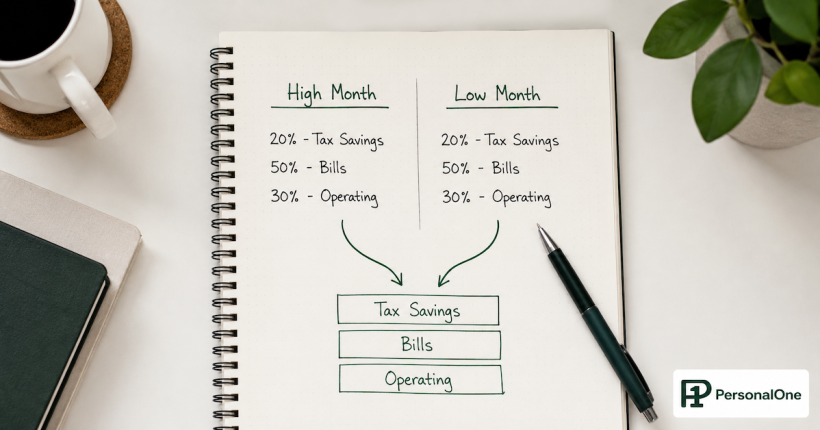
This precision matters for two reasons. First, it keeps your buffer as full as possible, which preserves your protection for subsequent slow months. Second, it forces you to make the calculation explicitly, which means you have a record of exactly how often and how much you draw. That data is what how to split freelance income across accounts becomes more accurate over time — your routing percentages and buffer targets are calibrated to real historical gaps, not guesses.
Step 4: Draw From the Buffer — Not From Other Sources
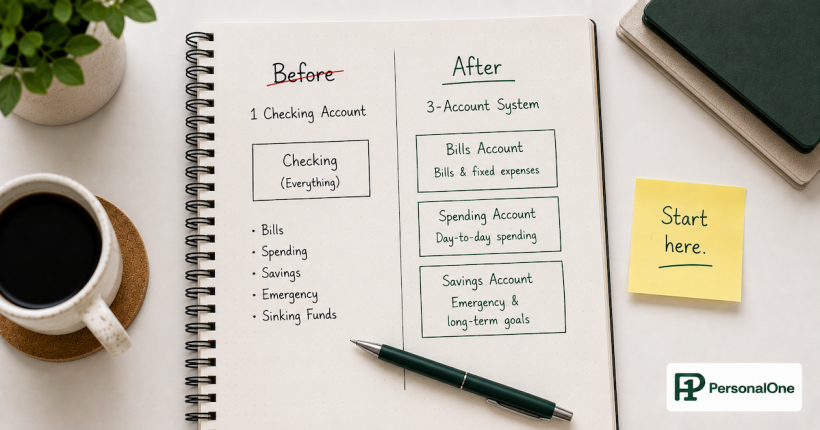
The buffer account is your designated first responder for income shortfalls. Use it. Do not reach for a credit card, do not touch your emergency fund, and do not pause tax savings and redirect that money to operating expenses. Each of those alternatives creates a secondary problem that outlasts the slow month itself.
Credit card debt at 20%+ APR compounds a temporary income dip into a long-term interest burden. Raiding your emergency fund for a predictable income fluctuation leaves you unprotected for actual emergencies. Skipping tax savings means the IRS will charge penalties and interest on top of the tax liability when the bill comes due. The freelancer buffer account system exists specifically so none of these alternatives become necessary. Trust the system you built.
Build the System Before the Slow Month
The Banking Systems hub covers every account structure and routing strategy you need to make slow months a non-event — not a crisis.
Explore the Banking Systems HubStep 5: Manage the Income Side During the Slow Month
While the buffer covers your fixed expenses, the income side of a slow month still deserves attention. Do not panic-market or accept low-quality work at rates that undermine your standard pricing. That approach trains clients to expect discounts and attracts projects that consume time without producing proportional revenue.
Instead, use the slower period strategically. Follow up on outstanding proposals. Reach out to past clients about upcoming projects. Review your service offerings and pricing to identify whether your rates reflect your current market value. The goal is to accelerate the return to normal income — not to fill the gap with work that creates new problems.
If the slow month extends beyond 45 days and the buffer is approaching 50% of its target, implement a temporary salary reduction as a secondary conservation measure. A 15–20% reduction in your personal salary transfer, combined with strict discretionary spending cuts, can significantly extend how long the buffer lasts without depleting it entirely. This is the point where managing low income periods transitions from short-term triage to medium-term cash preservation mode.
Step 6: Document Everything
Before the slow month ends, record the specifics: which month it was, total income received, total fixed expenses, exact buffer draw amount, and the apparent cause of the income drop (seasonal, client loss, invoice delay, market shift). Over time, this log becomes one of your most valuable financial assets — it reveals your actual income seasonality with precision.
Freelancers who track slow months accurately almost always discover patterns they did not consciously recognize: the same two months every year are consistently lower, certain client types pay slower in Q4, project-based income has a specific lag from proposal to payment. These patterns let you pre-position the buffer before your next predictable slow period rather than reacting to it after it arrives.
Step 7: Replenish Immediately When Income Recovers
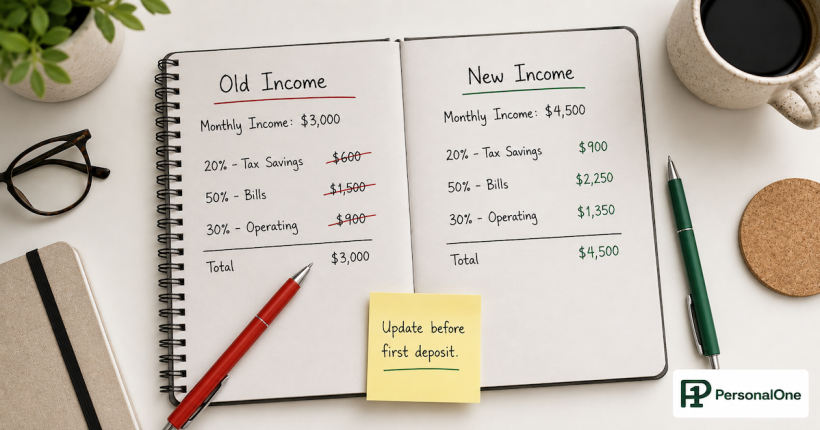
The moment income returns to normal levels, buffer replenishment becomes your first financial priority. Resume the full routing percentage to the buffer account and keep it elevated — temporarily increasing from 10% to 15% — until the buffer is back to its full target. Only then does allocation return to the standard routing percentages.
A depleted buffer going into the next slow month is not a manageable situation — it is the setup for a genuine financial crisis. Replenishment is not optional. It is the close of the slow month protocol and the reset that makes the next one survivable.
Resources
Official sources used to inform this guide:
- CFPB: Start Small, Save Up — Emergency Savings Resources
- IRS: Estimated Taxes for Self-Employed Individuals
- SBA: Managing Business Finances and Accounting
- FDIC: Money Smart Financial Education Program
For the complete banking framework, return to the banking systems and account structure guide.
Frequently Asked Questions
What counts as a slow month versus just a late payment month?
A slow month is confirmed when total income received by month-end is below your fixed expense threshold and all outstanding invoices for that month have either cleared or been formally flagged as past due. A delayed payment is not a slow month — it is a timing issue. Do not activate slow month protocol until the full month's income picture is clear.
Should I tell my clients I'm having a slow month?
No. Client relationships are professional relationships. Your cash flow situation is not relevant to them and sharing it can undermine confidence in your business. Follow up on outstanding invoices professionally and market proactively — but keep the financial pressure invisible to clients.
What if I don't have a buffer account yet and a slow month hits?
Without a buffer, your options are limited to cutting discretionary spending, negotiating payment timelines with vendors where possible, drawing on a low-interest line of credit if available, and accelerating income through rush projects or payment plans with existing clients. Building the buffer before the next slow month is the immediate priority once income recovers.
How do I know when to be worried versus when to trust the system?
Trust the system when the buffer is above 50% and income shows signs of recovering within 30–45 days. Escalate to active concern when the buffer drops below 50%, income has been consistently low for 45+ days with no clear reversal, and there are no outstanding proposals or pipeline opportunities to draw from. That combination signals a structural income problem, not a temporary fluctuation.
Can I use a slow month as a reason to lower my rates and attract faster work?
In most cases, no. Discounting rates to fill a slow month trains clients to wait for discounts and positions you as a commodity rather than a professional. The exception is a one-time project-specific discount offered to a trusted existing client for a defined scope — not a blanket rate reduction to the market. Protect your rate integrity. The buffer exists so you do not have to compromise your pricing under pressure.
Disclaimer: This content is for educational purposes only and does not constitute financial, legal, or tax advice. PersonalOne is a free financial education platform. Individual financial situations vary. Consult a qualified financial professional for advice specific to your circumstances.