June, 2026
Home › Banking Systems › Account Separation for Different Life Stages › How to Set Up Your First Bank Account Structure as a Student
Part of Account Separation for Different Life Stages — how to structure your banking as your income, responsibilities, and financial goals evolve.
What You Need to Know
— Most guides tell you which student bank account to open. This one tells you how to structure two or three accounts so your money does not disappear before the month is over.
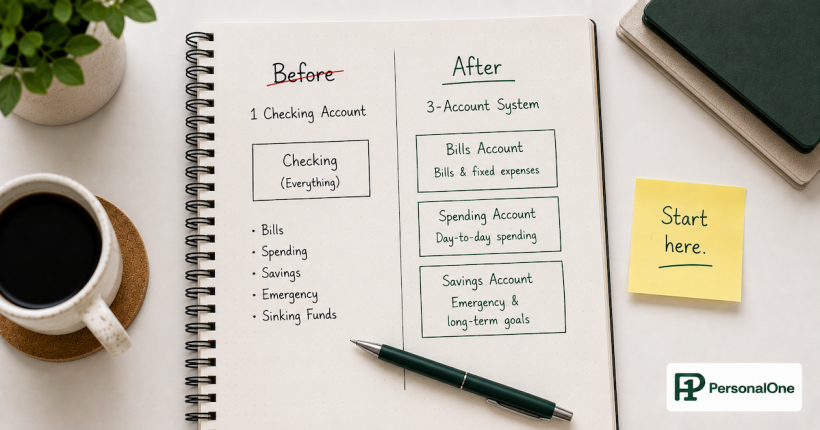
— A single checking account is the wrong setup for a student budget — it puts rent money, food money, and spending money in the same place and makes every purchase a mental calculation.
— The student bank account structure that works is simple: one account for fixed bills, one for everyday spending, one for savings. Three accounts. Zero guesswork about what is safe to spend.
— You do not need a student-specific bank account to do this. Any no-fee checking account and a high-yield savings account will work better than most products marketed specifically at students.
— The habits you build now determine how your money works for the next decade. Setting up the right structure as a student is the highest-leverage financial decision you will make before your first real job.
Every article about student banking asks the same question: which bank account should you open? Chase College Checking or SoFi? Ally or Capital One? That is not the wrong question — but it is a secondary one. The question that actually determines whether your money survives the semester is: how should you structure your accounts so that rent money, food money, and spending money are not all competing in the same place?
Most students open one checking account, put everything in it, and then mentally track what is available to spend versus what is earmarked for bills. That mental accounting works fine for about two weeks — until a rent payment clears on the same day as a night out, or until the electric bill hits three days before the next financial aid deposit. The problem is not the bank. The problem is the structure.
This guide covers the bank account structure for students that actually prevents those moments — not through more discipline or more tracking, but through separating money by purpose so that the collision cannot happen. The broader framework for how account structure evolves from student stage through early career and beyond is in the account structure for different life stages guide. This article builds the student version specifically.
The setup takes about an hour. The financial habits it installs last a career.
Why One Checking Account Fails Student Budgets
The single checking account problem is not unique to students — but it hits hardest at this stage because student income is irregular, the amounts are smaller, and the timing of expenses is less predictable than at any other point in adult financial life.
Here is what actually happens with a single-account setup. A financial aid deposit arrives. The balance looks healthy. You spend on groceries, social events, and supplies. At some point during the month, rent clears — or a phone payment — or a subscription you forgot about. Suddenly the balance that felt comfortable is dangerously low, and there are still two weeks until the next deposit. None of those individual spending decisions was wrong. The account structure made it impossible to know which decisions were safe.
The fix is not tracking every transaction more carefully. It is building an account structure that makes the safe spending amount visible without any calculation. When bill money lives in a separate account and only discretionary money lives in your spending account, every purchase decision becomes simple: if the spending account has it, you can spend it.
The Three-Account Student Structure
The right bank account structure for students is not complex. Three accounts, each with a defined purpose, each funded in the right order when income arrives. You do not need to be sophisticated to use this structure — you just need to open the right accounts and route money correctly from day one.
Account 1: The Bills Account
What it holds: Every fixed recurring expense — rent or dorm fees, phone bill, subscriptions, renter's insurance, any loan payment minimums. Money that is already spoken for before the month begins.
How it works: When income arrives, the total of all monthly fixed bills transfers here first. Autopay pulls from this account only. You never spend from it directly.
Why it matters: Your bills are funded and untouchable. They cannot be accidentally spent on a weekend. Rent clearing no longer creates a crisis — that money was already set aside and protected.
What to use: A no-fee checking account. No debit card in your wallet for this account. It exists to send money to billers, nothing else.
Account 2: The Spending Account
What it holds: Groceries, transportation, dining, social activities, clothing, personal care — everything discretionary. This is the only account your debit card is attached to.
How it works: After the bills allocation transfers out, the remaining income lands here. This is your actual available money. When it is gone, it is gone — no borrowing from bills, no raiding savings.
Why it matters: The balance in this account is always the true answer to "what can I spend?" No mental math. No wondering whether rent is still coming out. This is discretionary money and nothing else.
What to use: A no-fee checking account at the same or a different institution. This is your primary daily account — pick one with a good app, zero fees, and a strong ATM network.
Account 3: The Savings Account
What it holds: Emergency fund, irregular expenses (textbooks, travel home, car repairs), and any longer-term saving goal. Money that needs to be accessible but should not be touched for daily spending.
How it works: A small fixed amount transfers here automatically when income arrives — even $25 or $50 per month. The point is not the amount. The point is that saving happens automatically before spending begins, and the habit becomes permanent.
Why it matters: The students who graduate with any financial cushion are almost always the ones who had a separate savings account that was not easily accessible for daily spending. Physical separation from the spending account creates the friction that protects savings from impulse.
What to use: A high-yield savings account at an online bank. Even on a small student balance, earning 4%+ APY versus near-zero at a traditional bank creates a real difference over four years. The best savings accounts for 2026 covers the top options with no minimum balance requirements — many are accessible from day one with a $0 deposit.
How to Fund the Structure When Income Is Irregular
The biggest structural challenge for students is that income does not arrive on a consistent schedule. Financial aid comes in one or two large deposits per semester. Part-time job income arrives biweekly or weekly in variable amounts. Family support may come monthly or irregularly. The three-account structure works regardless of income timing — but the funding approach needs to account for irregular deposits.
The Financial Aid Deposit Approach
When a large financial aid deposit arrives, treat it as a semester's worth of income rather than a one-time windfall. The first step before spending a dollar is calculating your total fixed bills for the semester and moving that full amount to the bills account immediately.
Step 1: Add up every fixed expense for the next three to four months — rent, phone, any loan minimums, recurring subscriptions. Move that total to the bills account the day the deposit arrives. It is now protected.
Step 2: Move a set amount to savings — whatever your target is for the semester. Even $200–$300 set aside immediately is more than most students accumulate.
Step 3: The remainder is your spending money for the semester. Divide it by the number of weeks remaining and deposit only one week's allocation to the spending account at a time, keeping the rest in the bills account until it is needed. This prevents the "full account, feel rich, overspend early" pattern that leaves students short at the end of semester.
The Part-Time Job Paycheck Approach
With a consistent part-time income, set up automatic transfers that fire on every payday:
— A fixed amount to the bills account covering the proportional share of monthly fixed bills
— A small fixed amount to savings — start with $25 or $50 and increase when possible
— The remainder stays in the spending account as available discretionary money
What Accounts to Actually Open (And What to Skip)
Most banks market "student accounts" with features specifically designed for students. Some of these are genuinely useful. Most of them are designed to create brand loyalty that outlasts student status. Here is an honest breakdown of what matters.
What Actually Matters in a Student Checking Account
— Zero monthly fees with no minimum balance. A student account that charges $12/month when you dip below $1,500 is a trap. Dozens of no-fee options exist with no conditions attached.
— Zero overdraft fees. Ally, Discover, Capital One 360, SoFi, and Axos have eliminated overdraft fees entirely. If your bank charges $35 when a payment clears your account by $5, that bank does not belong in a student budget.
— A large ATM network or reimbursements. Out-of-network ATM fees ($3–$5 per withdrawal) accumulate fast. Prioritize a bank with 40,000+ fee-free ATMs or one that reimburses out-of-network fees monthly.
— A good mobile app. You will manage this account entirely from your phone. App Store and Google Play ratings matter — check them before opening.
— Early direct deposit. If you have a part-time job, access to your paycheck up to two days early (offered by SoFi, Ally, and others) can prevent cash flow gaps mid-month.
What to Be Skeptical Of
— "Student" accounts with automatic conversions. Some convert to standard fee-charging accounts when you turn 24 or graduate. Read the fine print before opening any account that markets itself primarily to students.
— Overdraft coverage presented as a feature. Overdraft protection that lets you spend past zero and then charges you $25–$35 for the privilege is not protection — it is a fee product. The three-account structure makes overdraft coverage unnecessary. Opt out of it.
— Banks that tie perks to minimum deposits. A $300 sign-up bonus that requires $5,000 in direct deposits within 90 days is not a student product. If the conditions are unrealistic for a student income, ignore the bonus.
The Savings Account Decision: Why This One Matters More Than the Checking Account
Most students spend a lot of time deciding which checking account to open and almost no time on the savings account. That is the wrong allocation of attention. Your checking account is where money passes through. Your savings account is where money works.
The national average savings rate at traditional banks is 0.38% APY as of May 2026. A $2,000 emergency fund at that rate earns $7.60 per year. The same $2,000 at a top online high-yield savings account paying 4.50% APY earns $90 per year. That $82 difference is not life-changing on its own — but it compounds, it builds the habit of keeping savings separate, and it teaches you that money can earn more money without any additional effort on your part. That lesson is worth considerably more than the interest itself.
There is no minimum income required to open a high-yield savings account. Most online banks allow you to open one with $0 and no monthly fees. The only reason not to open one as a student is not knowing it exists — which is exactly the gap this article exists to close. The full comparison of which accounts are paying the most right now, which have no minimums, and which are best for someone building from zero is in the best savings accounts for 2026 guide.
The One Financial Habit This Structure Installs Permanently
The three-account structure does more than prevent overdrafts and protect bill money. It installs the most valuable financial habit available — the habit of separating money by purpose before spending it.
Every person who builds real financial stability — regardless of income level — is doing some version of this. Money that arrives gets divided before it is spent: some for obligations, some for savings, some for living. The specific amounts change at every income level and life stage. The underlying structure does not. Setting it up for the first time as a student means you enter your first real job with the system already in place. You just change the amounts.
Students who graduate with no financial structure often spend the next three to five years of their working lives building the habits they could have built for free during school on a smaller scale. The cost of not having a structure is not just financial — it is the time and stress of learning these lessons with real money at stake and real obligations on the line. When your income grows and your financial responsibilities stack up, the signs your account structure has fallen behind guide covers how to recognize when an upgrade is overdue and what that upgrade looks like in practice. The complete framework for what this structure looks like as it evolves — through first job, growing income, and major life changes — is in the banking systems account structure guide.
Build the Structure Once. Use It for the Rest of Your Financial Life.
The student version of the three-account structure is the same structure that works at every income level — just with different amounts. For the complete framework on how account structure evolves from student stage through career growth, see the PersonalOne account separation for different life stages guide.
Frequently Asked Questions
Do I need a student-specific bank account to make this work?
No. Any no-fee checking account and a high-yield savings account will serve this structure better than most accounts marketed specifically to students. Student accounts often come with conditions, automatic conversions at graduation, or overdraft coverage framed as a feature. The structure matters more than whether the account has "student" in its name.
What if I only have one source of income and it is small?
The structure works at any income level — the amounts just change. If your total monthly income is $800, your bills account might hold $400, your spending account $350, and $50 moves to savings. The discipline is in the separation, not the size. Starting with small amounts builds the habit that serves you for decades.
Do I need to open all three accounts at the same bank?
No, and in some cases spreading across two institutions is better. Many students use one bank for checking (both bills and spending accounts) and a separate online bank for high-yield savings. The friction of the transfer delay between the savings account and your checking account is actually useful — it prevents impulse withdrawals from savings for discretionary spending.
What if I have financial aid and a part-time job?
Treat them as two separate income streams feeding the same structure. Financial aid gets allocated at the start of the semester using the lump-sum approach: bills share goes to the bills account, savings share goes to the savings account, spending share gets distributed weekly. Part-time income gets the automatic transfer approach: a fixed amount to bills, a small amount to savings, and the rest stays in spending.
When should I update this structure as I move from student to early career?
The structure itself does not change — just the amounts and possibly the institutions. When you get your first real job, you will have a consistent income, larger fixed obligations, and savings goals with real timelines. The three-account structure scales directly into that. The main update is recalculating the bills account amount to reflect actual adult fixed expenses and moving savings to an institution paying competitive rates if you have not already.
Official Sources
FDIC — Deposit Insurance Coverage and Bank Verification
More From This Cluster
Return to Account Separation for Different Life Stages for the complete framework on how account structure evolves from student through early career, family stage, and beyond.
This content is for educational purposes only and does not constitute financial advice. PersonalOne is not a licensed financial advisor, broker, or investment professional. Account features, fees, and interest rates vary by institution and are subject to change. Always verify FDIC insurance status and review current account terms directly with the institution before opening an account.