Updated: May 24, 2026
Home › Banking Systems › Account Separation for Different Life Stages › When to Change Banks: Signs Your Account Structure Has Fallen Behind
Part of Account Separation for Different Life Stages — how to structure your banking as your income, responsibilities, and financial goals evolve.
What You Need to Know
— The bank you opened at 19 was designed for someone with no income, no bills, and no financial goals. It was not designed to grow with you.
— Knowing when to change banks is less about fees and more about whether your current account structure still fits how your money actually works.
— The signs you have outgrown your bank are structural — your account setup is creating friction, limiting your savings growth, or making money management harder than it needs to be.
— Upgrading is not about switching to a "premium" bank. It is about matching your account structure to the financial stage you are actually in.
— The transition takes less than a week of effort spread over 30 days — and the compounding financial benefit of getting it right is permanent.
Most people open their first bank account as teenagers or college students and keep it for the next decade out of inertia. The account still works. Nothing is technically broken. But somewhere between the first real job, the first apartment, and the first time a savings goal actually mattered, the account stopped fitting the life it was supposed to support.
Knowing when to change banks is not really about the bank. It is about whether your current account structure — the combination of accounts you have, where they live, and how money moves between them — still matches how your money actually works. The account structure for different life stages changes as income grows, as responsibilities stack up, and as financial goals shift from "survive the month" to "build something." This article is about recognizing when your banking has fallen behind your life and what to do about it.
The answer is not always switching banks entirely. Sometimes it is opening one additional account at a better institution while keeping what works. Sometimes it is restructuring the accounts you already have. And sometimes the bank you have been loyal to for ten years is genuinely costing you money — not in obvious fees, but in structural misalignment that shows up as friction, missed savings growth, and a setup that requires constant manual effort to maintain.
Why Your Starter Bank Stops Fitting as Income Grows
The bank account you opened at 19 was designed for a specific financial situation: minimal income, minimal complexity, minimal goals. Basic checking. Maybe a savings account you never funded. A debit card tied to whatever was deposited. That setup had no friction because it had no structure to maintain — there was nothing to misalign.
As income grows, the account that required no thought starts requiring a lot of it. You are mentally tracking which account has bill money versus spending money. You are checking your balance before every grocery run because everything lives in one place. You have savings goals but no structural separation to protect them. You know you should be earning more on your savings but the account pays almost nothing. These are not personal finance failures. They are signs of an account structure that was not designed for the financial stage you are now in.
Research shows that 35% of Gen Z and 32% of Millennials plan to switch their primary bank within six months — but most of them are thinking about it as a product swap rather than a structural redesign. They switch banks and end up with the same single-account setup at a slightly better institution. The problem was never which bank. It was the architecture.
The full framework for structuring accounts at every income stage — what accounts you need, how money flows between them, and what changes as income grows — is in the banking systems account structure guide. This article focuses specifically on how to recognize when a structural upgrade is overdue and what that upgrade looks like in practice.
The Real Signs You Have Outgrown Your Bank
The generic signs — high fees, low savings rates, bad app — are real but incomplete. The more important signals are structural. They show up in how hard your money is to manage, not just in what your bank is charging you.
Structural Signs Your Account Setup Has Fallen Behind
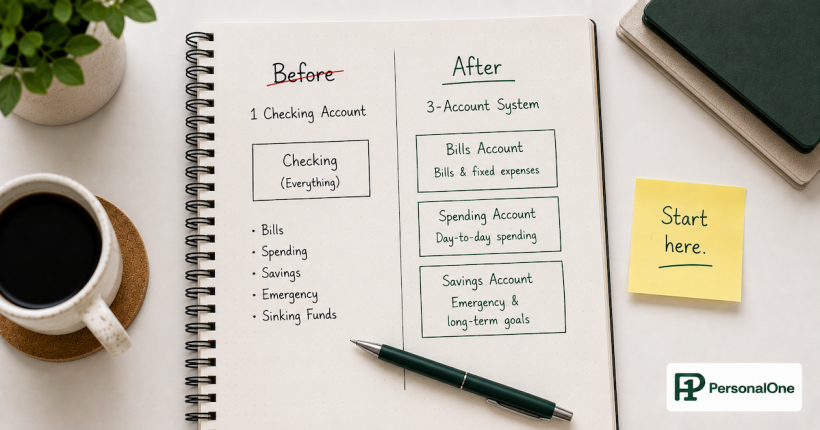
You are mentally tracking bill money vs spending money in the same account. If you check your balance and then do math before every purchase — "is this safe to spend or is some of this earmarked for rent?" — your account structure is doing no work for you. A proper setup makes that calculation unnecessary because the money is already separated.
Your savings account is at the same bank as your checking and earns almost nothing. The national average savings rate at traditional banks is 0.38% APY as of May 2026. Top online high-yield savings accounts are paying 4.00–5.00%. If your savings account is earning near zero, you have not outgrown your bank — you have been passively underpaid for years.
You have money goals but no structural separation protecting them. An emergency fund that lives in the same account as your spending will get spent. A vacation fund that sits in general savings will get raided when something urgent comes up. Goals need their own accounts or they are just intentions.
Your account structure requires manual effort to maintain. If you are manually moving money between accounts every payday, manually calculating what is available to spend, or manually reminding yourself not to touch certain balances — your infrastructure is not doing its job. A well-structured setup runs automatically.
You have taken on new financial responsibilities your current setup does not reflect. A first real job. A move out of a shared apartment. A side income stream. A relationship that combined finances. Each of these changes the account structure that is appropriate — and most people absorb each change without updating their banking.
You are paying fees that have no justification. Monthly maintenance fees, minimum balance penalties, out-of-network ATM charges — these made sense as a trade-off for your first bank's convenience when you were 19. They make no sense once better fee-free options exist that fit your current situation.
What the Right Account Structure Looks Like at Each Stage
Upgrading your bank is not about prestige or income thresholds. It is about matching your account architecture to the financial stage you are actually navigating. The structure that serves a 22-year-old with one income stream and no fixed bills is genuinely different from what serves a 30-year-old with a salary, rent, a car payment, and a savings goal with a timeline.
Early Career — First Real Income
The priority at this stage is separation: bills money in one place, spending money in another, savings in a high-yield account that earns real interest. A single checking account is not enough once fixed obligations exist. The account structure needs to reflect that some money is spoken for before it can be spent.
What to add: A dedicated bills account at a no-fee institution, a high-yield savings account separate from checking, automated transfers on payday so the structure runs without willpower.
Growing Income — Salary Increases and More Financial Complexity
As income grows, the account structure needs to reflect more goals, not just more money. An emergency fund with a real target. A savings account earning competitive interest. A structure where increased income actually flows somewhere useful rather than expanding lifestyle spending by default.
What to add: A high-yield savings account at an online bank paying 4%+ APY if you do not already have one, goal-based sub-accounts or separate savings accounts for distinct goals, an income routing plan that automatically sends money where it belongs on payday.
Major Life Changes — New Responsibilities, Combined Finances, Side Income
A new job, a move, a relationship that merges finances, or a side hustle that generates a second income stream all change the account structure that is appropriate. These are not incremental updates — they often require a full structural review of where money lands, how it is separated, and what accounts are serving which purpose.
What to review: Whether current account separation still reflects actual financial responsibilities, whether a second income stream needs its own routing and separation, whether combined finances require a shared account structure alongside individual accounts.
How to Actually Upgrade: The Right Sequence
The most common mistake people make when upgrading their banking is closing the old account first or trying to switch everything at once. Neither works. The correct approach is additive and sequential — open what you need, move what connects to it, verify everything is running, then close what no longer serves a purpose.
The Upgrade Sequence
Step 1 — Identify what is missing from your current structure. Not what your bank lacks in features — what your account setup is not doing. Are bills and spending money separated? Is your savings earning competitive interest? Is money routing automatically on payday or manually on effort?
Step 2 — Open the accounts that fill the gap. For most people at the early career stage this means a high-yield savings account at an online bank and a no-fee checking account for bills. Open these before closing or changing anything at your current bank.
Step 3 — Move direct deposit to the new checking account. Log into your employer's payroll portal and update direct deposit to the new account. This typically takes one to two pay cycles to take effect. Keep your old account funded during this window.
Step 4 — Migrate autopay to the appropriate accounts. Bills move to the bills account. Any remaining autopay tied to your old account gets updated. The full process for doing this without missing anything is in the how to switch from a traditional bank to an online bank guide.
Step 5 — Run one full pay cycle and verify. Confirm that direct deposit landed correctly, all autopay processed from the right account, and the structure is running as intended.
Step 6 — Close what no longer serves a purpose. Only after the new structure has run cleanly for at least one full cycle. Request written confirmation of any account closure.
The One Upgrade That Has the Most Impact for Most People
If you do nothing else, moving your savings out of a traditional bank savings account and into a high-yield savings account at an online bank is the single highest-return action available to most people reading this. It requires about 15 minutes of setup, carries zero risk (FDIC insurance is identical), and generates real interest on money that is currently earning almost nothing.
The math is not subtle. A $10,000 emergency fund at a traditional bank earning 0.38% APY generates $38 per year. The same $10,000 at an online bank paying 4.50% APY generates $450 per year. That is $412 of additional annual income that requires no additional work, no additional risk, and no financial expertise — only the account structure to put it in the right place. For a current comparison of which high-yield savings accounts are paying the most right now and which conditions apply, the best savings accounts for 2026 guide covers the top options with verified current rates.
This is not about chasing the highest possible rate or optimizing constantly. It is about not leaving significant money on the table year after year because your savings account is at the same bank you opened at 19 and that bank has no incentive to pay you more.
Build the Account Structure That Fits Where You Are Now
Upgrading your bank is one step. Building the account structure that makes your money work automatically — bills separated from spending, savings growing at a competitive rate, income routing correctly on every payday — is the complete system. The banking systems account structure guide covers the full framework.
Frequently Asked Questions
Does switching banks affect my credit score?
No. Opening or closing a checking or savings account does not affect your credit score. Credit scores are based on credit products — loans, credit cards, and lines of credit. Deposit accounts do not appear on credit reports. You can open, close, or change banks as many times as you need without any credit consequences.
How do I know if I need a new bank or just a new account at my current bank?
Start with the structural question: does your current bank offer a no-fee checking account, a high-yield savings account paying competitive rates, and the ability to separate accounts by purpose? If yes, you may only need to restructure within your current institution. If no — particularly on the savings rate question — adding an account at an online bank for savings is the most straightforward upgrade available.
Is it safe to keep savings at an online bank?
Yes, provided the institution is FDIC-insured. FDIC insurance covers up to $250,000 per depositor per institution regardless of whether the bank has physical branches. Every major online bank offering high-yield savings accounts is FDIC-insured. Verify any institution at FDIC.gov before opening an account. The safety of your deposits at an FDIC-insured online bank is identical to that of an FDIC-insured traditional bank.
How many bank accounts should I actually have?
For most people at the early career stage, three accounts cover the structure: a checking account for daily spending, a dedicated bills account for fixed recurring expenses, and a high-yield savings account for emergency funds and goals. These three accounts can live at two or three different institutions — the structure matters more than the number of institutions. Adding accounts beyond three should be driven by a specific purpose, not by accumulation.
What if I am not sure my current bank is the problem?
Audit your last three months of bank statements. Add up every fee you paid — maintenance fees, ATM fees, overdraft fees, minimum balance penalties. Check the APY your savings account earned versus what a top online HYSA would have paid on the same balance. If the total gap — fees paid plus interest foregone — exceeds $200 per year, your current institution is costing you real money. That is the number to look at, not whether your bank's app is good or bad.
Official Sources
FDIC — Deposit Insurance Coverage and Bank Verification
More From This Cluster
Return to Account Separation for Different Life Stages for the complete framework on structuring your banking at every stage of your financial life.
This content is for educational purposes only and does not constitute financial advice. PersonalOne is not a licensed financial advisor, broker, or investment professional. Account features, fees, and interest rates vary by institution and are subject to change. Always verify FDIC insurance status and review current account terms directly with the institution before opening an account.